

The assistance with the biggest headline benefit may not be the best fit for your home purchase. Michigan down payment assistance programs 2026 can differ in how funds are provided, who may qualify, and whether repayment is required. Start with your full purchase plan, not just an advertised amount.
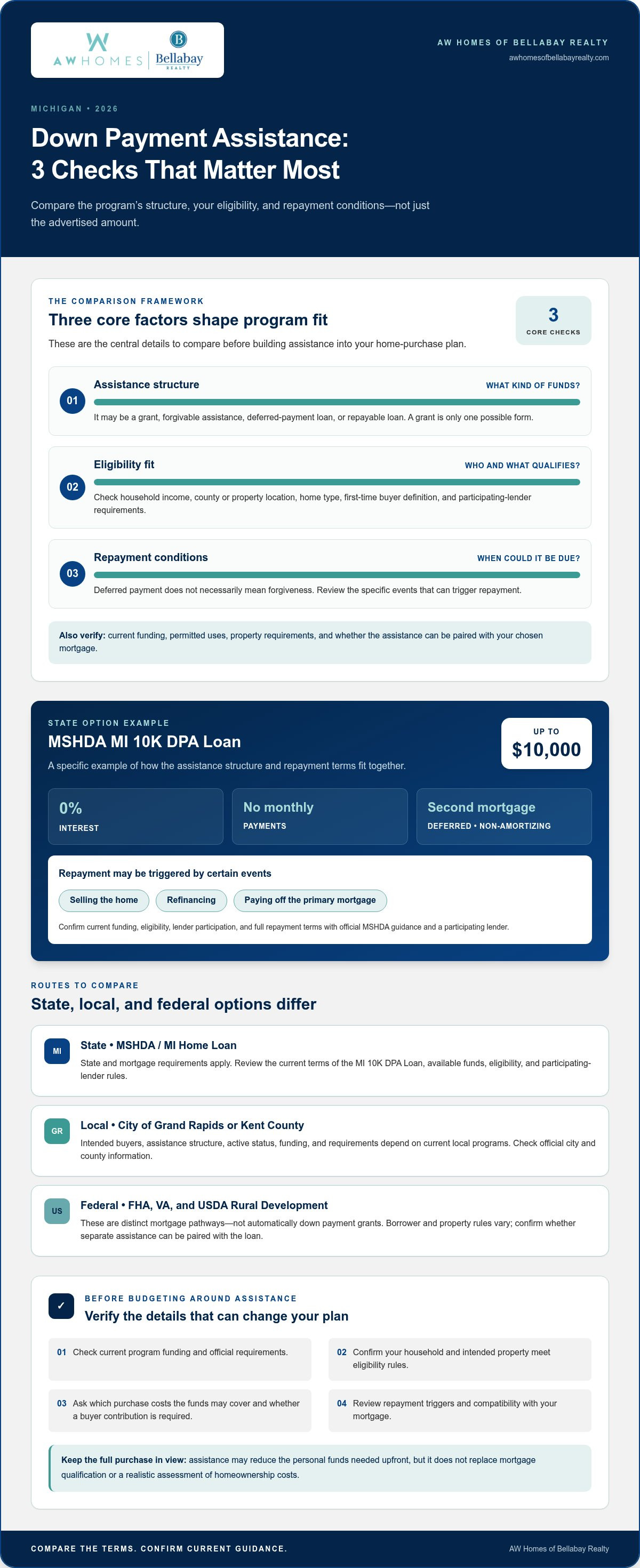
It’s understandable to feel uncertain. Household income, county, property choice, and program funding can all affect which options are worth exploring. Some programs offer grants or forgivable assistance, while others use repayable loans. For example, MSHDA’s MI 10K DPA Loan offers up to $10,000 as a deferred, 0% interest second mortgage. Repayment is triggered by certain events, such as selling or refinancing the home.
This guide compares Michigan’s key assistance options and explains the eligibility and repayment details to review before applying. You’ll learn how to distinguish program types, identify details to verify with the administering agency, and connect financing readiness to a realistic home search. With local buyer guidance across Greater Grand Rapids, you can approach the next step with a clearer plan.
Key Takeaways
- Compare assistance by its structure, eligibility rules, and repayment conditions, not just the advertised benefit.
- Use this guide to sort through Michigan down payment assistance programs 2026 and identify which program routes may fit your purchase.
- Review program details such as funding, property requirements, lender participation, and household eligibility.
- Prepare for an application by organizing your goals and financial information, then reviewing program terms with a participating lender.
- Connect financing readiness to your home search so your budget and neighborhood priorities work together.
Michigan Down Payment Assistance 2026: Pros and Cons
Down payment assistance can help eligible buyers manage some of the upfront funds needed to purchase a home. It isn’t the mortgage itself: the mortgage is the primary loan used to buy the property, while assistance is a separate benefit or loan that may work alongside it. A grant is one possible form of assistance, not a synonym for every program. Other options may use a forgivable, deferred-payment, or repayable loan, each with its own conditions.
A down payment is the buyer’s upfront contribution toward a home’s purchase price. Assistance may reduce the amount you need to bring from personal funds, but it doesn’t remove the need to qualify for the mortgage or meet program requirements. Michigan down payment assistance programs 2026 may have separate rules for household income, property location and type, participating lenders, and repayment. Funding and terms can change, so use current 2026 guidance from the administering agency and lender before building your budget around a benefit.
The potential advantage is added flexibility at a costly moment in the purchase. The tradeoff is that assistance can come with limits, required steps, or future repayment obligations. A deferred payment, for instance, may still be a loan that becomes due under specified conditions. Treat assistance as one part of your purchase plan, not as a guarantee of mortgage approval or a substitute for assessing the full monthly cost of ownership.
Which upfront homebuying costs might assistance address?
Down payment support is intended to help with the buyer’s contribution toward the purchase price. Closing-cost assistance is different: it may be designated for eligible transaction expenses. A program might cover one category, both categories, or only specific approved uses. The mortgage product and program rules determine how funds can be applied, so don’t assume assistance covers every expense due at closing. Review permitted uses and any required buyer contribution before estimating the cash you’ll need.
Who should explore Michigan assistance programs?
First-time buyers are a natural group to investigate, but some programs may also serve buyers who meet particular requirements. “First-time” can be defined differently across programs. Repeat buyers may face additional restrictions or may not meet a program’s definition. Eligibility can also depend on household income, the home’s location and type, and lender participation. Compare your circumstances with the official requirements rather than ruling yourself in or out based on a program’s name.
For a grounded next step, separate two questions: does a program appear to fit your household and intended property, and can the primary lender approve the mortgage? The lender can address financing readiness, while local buyer representation can help connect that budget to a practical home search in Greater Grand Rapids.
Michigan 2026 Assistance Options: Compare State, Local, and Federal Routes
Start by identifying the administrator and financing structure, then check whether the option fits your intended home and mortgage. This comparison of Michigan down payment assistance programs 2026 distinguishes direct assistance from loan pathways that may support a purchase but aren’t automatically grants.
State: MSHDA and MI Home Loan. For buyers who meet current state and mortgage requirements, MSHDA’s MI 10K DPA Loan offers up to $10,000 as a 0% interest, non-amortizing second mortgage with no monthly payments. Repayment is triggered by events such as selling, refinancing, or paying off the primary mortgage. Review current funding, eligibility, lender participation, and full repayment terms.
Local: City of Grand Rapids or Kent County. Intended buyers, assistance structure, and active status depend on any current local program. Review official city and county information for 2026 funding and requirements before including local assistance in a purchase budget.
Federal: FHA, VA, and USDA Rural Development. These are distinct mortgage pathways, not automatically down payment grants. Eligibility and property rules vary by loan type. Confirm whether separate assistance can be paired with the loan.
What should buyers verify about MSHDA and MI Home Loan?
MSHDA’s MSHDA MI 10K DPA Loan page is the authoritative place to review the state option’s current terms. Confirm the program name, available funds, eligibility rules, and participating-lender requirements using current official guidance. Review how the assistance is structured, when repayment is due, and whether it can be paired with your chosen mortgage. Don’t rely on old limits or benefits as current 2026 terms.
Are there local or federal routes to consider?
For Grand Rapids or Kent County assistance, review current program notices on official government websites. Don’t assume a previously offered program remains active or funded. Federal mortgage routes differ, too. FHA, VA, and USDA Rural Development loans each have their own borrower and property rules. USDA eligibility is tied to location and program requirements, while VA eligibility depends on service-related criteria. A participating lender can clarify loan compatibility and current requirements.
Once financing routes are clearer, local buyer representation can help connect a lender-informed budget with neighborhood priorities in Greater Grand Rapids, including Ada, Caledonia, Forest Hills, and East Grand Rapids. Explore Greater Grand Rapids home search guidance as you shape your plan.
How to Compare Michigan Down Payment Assistance Without Misreading the Fine Print
The advertised benefit is only one part of the comparison. A grant, forgivable loan, deferred-payment loan, and repayable loan can each carry different conditions. Review the written terms to understand what you receive, what you must do to retain the assistance, and when repayment could be required. For Michigan down payment assistance programs 2026, the details matter as much as the amount.
Grant or loan: what repayment questions matter?
Find out whether assistance must be repaid, may be forgiven, or is deferred until a later event. Check the agreement for terms related to selling, refinancing, transferring ownership, paying off the primary mortgage, or changing how you occupy the home. Deferred repayment isn’t necessarily forgiveness. Review the signed program documents alongside lender disclosures so you understand the conditions and when an obligation may come due.
A forgivable loan may have conditions that must be met before the balance is forgiven, while a grant has its own written requirements. Terms vary by program, including any local assistance offered in the Grand Rapids area. Don’t assume that rules for one city or county apply elsewhere. The program agreement explains permitted uses, occupancy requirements, and repayment obligations.
How can assistance affect the mortgage and home search?
Some programs require a participating lender, a particular mortgage product, or homebuyer education. Confirm that the assistance and loan can be used together before treating funds as part of your purchase budget. First-time buyer status alone doesn’t guarantee eligibility. Household income, purchase price, location, property type, and occupancy may also matter, and requirements differ by program.
Build your home search around the full budget, including the mortgage payment, other ownership costs, and any buyer contribution required by the program. If assistance limits eligible properties or locations, account for that before focusing on particular homes. A lender can clarify financing and program compatibility; local buyer representation can help translate your budget and neighborhood priorities into a practical search.
For a clearer look at the steps after an offer is accepted, read the Michigan home closing process guide. Understanding the transaction timeline alongside assistance terms can help you prepare for the next stage.
How to Prepare for a Michigan Down Payment Assistance Application
A clear sequence can make assistance research easier to manage. Treat mortgage preapproval and program approval as related but separate decisions: a lender may assess your mortgage application, while the assistance program has its own eligibility and funding requirements. For Michigan down payment assistance programs 2026, use these steps to build a plan before making an offer:
- Set your purchase goals. Outline your preferred location, property needs, timing, and comfortable budget.
- Speak with a participating lender. Discuss mortgage options, preapproval, and which assistance programs the lender can work with.
- Compare programs. Review eligibility, available funding, deadlines, permitted uses, repayment, and property restrictions using current official guidance.
- Prepare possible documents. Gather the information the lender or program may request, then confirm which items apply to your application.
- Confirm the terms in writing. Keep written details on eligibility, funding status, deadlines, repayment obligations, and property requirements for reference.
For West Michigan buyers, location deserves early attention. A home’s municipality or county may affect whether local assistance applies, while statewide programs can also set property rules. Verify location-specific eligibility before narrowing your search or counting assistance as part of your available funds.
What information may a buyer need to gather?
Requirements vary by program and lender, but possible requests include identification, income records, information about household members, asset statements, and details about the planned purchase. Keep documents current as your application and home search progress, especially if your household or financial circumstances change. A participating lender can identify the records needed for the loan and explain what additional information the assistance program may require.
When should you compare assistance with your home search?
Start lender conversations early, before making an offer. That gives you time to understand how your budget, loan product, program rules, and intended property fit together. Buyer representation can help align search criteria with your budget and neighborhood priorities, while the lender and program administrator determine eligibility and financing. For more on local buyer guidance, read the Grand Rapids buyer’s agent guide.
Ready to connect financing readiness with a focused Greater Grand Rapids home search? Explore buyer representation and home-search guidance.
Plan Your Michigan Home Purchase With Financing Clarity
Turn assistance research into a workable purchase plan: verify current program terms, assess what you can comfortably afford, align an eligible mortgage with any assistance, and then refine your home search. This keeps a potential benefit in perspective. It’s one piece of the financing picture, not a substitute for lender approval or a complete affordability review.
For buyers exploring Michigan down payment assistance programs 2026, the lender and program administrator determine financing and eligibility. AW Homes of Bellabay Realty's role is buyer representation and local real estate guidance. We help you consider how your lender-informed budget may relate to property options and neighborhood priorities across Greater Grand Rapids, including Ada, Caledonia, Forest Hills, and East Grand Rapids.
What can local buyer representation help you navigate?
A buyer’s agent can help organize a property search, provide local market context, and guide offer negotiations. The search can also reflect what this move means for you. Relocating, moving to a larger home, or downsizing may each bring different location, space, and timing priorities. Your agent can help shape search criteria around the budget you’ve discussed with your lender, while the lender and program administrator assess mortgage and assistance eligibility.
What are the next steps for Grand Rapids-area buyers?
Review current availability, eligibility, deadlines, property restrictions, and repayment terms with official program administrators and participating lenders. Then clarify your timing, preferred locations, comfortable budget, and home requirements. A focused conversation about these priorities helps keep financing research and your home search aligned.
If you’re moving to the area, the Grand Rapids relocation guide offers additional context for planning a move to West Michigan. With current financing details and informed local guidance, you can approach your home search with a clearer plan for this next chapter.
Move Forward With a Clearer Homebuying Plan
The right assistance option is the one whose current rules fit your household, financing, and intended property, not simply the one with the largest advertised benefit. As you compare Michigan down payment assistance programs 2026, review eligibility and repayment terms with official administrators and participating lenders, then shape your search around a budget you understand.
For Greater Grand Rapids buyers, local neighborhood knowledge can help connect that lender-informed budget with priorities across communities such as Ada, Caledonia, Forest Hills, and East Grand Rapids. AW Homes of Bellabay Realty provides buyer representation and market guidance through major home transitions, while lenders and program administrators make financing and eligibility decisions.
Whether you’re relocating, moving into a home that better suits your next chapter, or adjusting to a new lifestyle, a thoughtful plan can make each step more manageable. Plan your next home purchase with AW Homes of Bellabay Realty, and move toward your Grand Rapids-area home search with greater clarity.
Frequently Asked Questions
What down payment assistance programs are available in Michigan in 2026?
Michigan buyers can explore state options such as MSHDA’s MI Home Loan paired with the MI 10K DPA Loan, as well as local programs where offered. The MI 10K DPA Loan provides up to $10,000 as a deferred, 0% interest second mortgage, subject to program rules. Availability, funding, and terms can change, so review current MSHDA guidance and official local government information before relying on assistance.
Who qualifies for Michigan down payment assistance?
Eligibility depends on the specific program and may consider household income, purchase location and price, property type, occupancy, lender participation, and credit requirements. MSHDA generally defines a first-time homebuyer as someone who hasn’t owned a home in the previous three years, but other program rules may differ. A participating lender and the program administrator assess mortgage and assistance requirements separately. Meeting one criterion alone doesn’t guarantee approval.
Is Michigan down payment assistance a grant or a loan?
It can be a grant, a forgivable loan, a deferred-payment loan, or a repayable loan, depending on the program. For example, the MI 10K DPA Loan is a 0% interest second mortgage with no monthly payments, but repayment is triggered by events such as selling, refinancing, or paying off the primary mortgage. Read the program agreement carefully to understand whether repayment applies and what conditions govern it.
Can I use down payment assistance with an FHA, VA, or USDA loan?
Possibly, but compatibility depends on the assistance program, mortgage product, lender, and property. FHA, VA, and USDA Rural Development are mortgage pathways, not automatically grants, and each has distinct requirements. Before choosing a home or counting assistance toward your funds, have a participating lender explain which combinations are permitted and how each program affects your financing. Confirm the rules in current program guidance and loan disclosures.
Do I have to be a first-time homebuyer to get Michigan assistance?
Not always. Some programs are designed for first-time buyers, while others may define that term differently or use different eligibility rules. MSHDA generally considers a buyer first-time if they haven’t owned a home in the previous three years. Repeat buyers shouldn’t assume they’re automatically excluded, but should review each program’s current criteria, including income, property, location, occupancy, and lender requirements.
How do I apply for down payment assistance in Michigan?
Start by setting your purchase goals and speaking with a lender who participates in the program you’re considering. Compare current options, then identify which documents may be needed, such as identification, income, asset, household, and purchase information. Confirm eligibility, funding, deadlines, property restrictions, and repayment terms with the administrator and lender. Mortgage preapproval and assistance approval are related, but they’re separate decisions.
Are there down payment assistance programs in Grand Rapids or Kent County?
Local assistance may depend on active city or county programs, available funding, and the home’s location. Review current City of Grand Rapids and Kent County government information for program status, eligibility, application steps, and property rules. Don’t assume a program previously offered is still active. Buyers searching across Greater Grand Rapids, including Ada, Caledonia, and East Grand Rapids, should confirm whether a particular home’s location fits the program requirements.


