

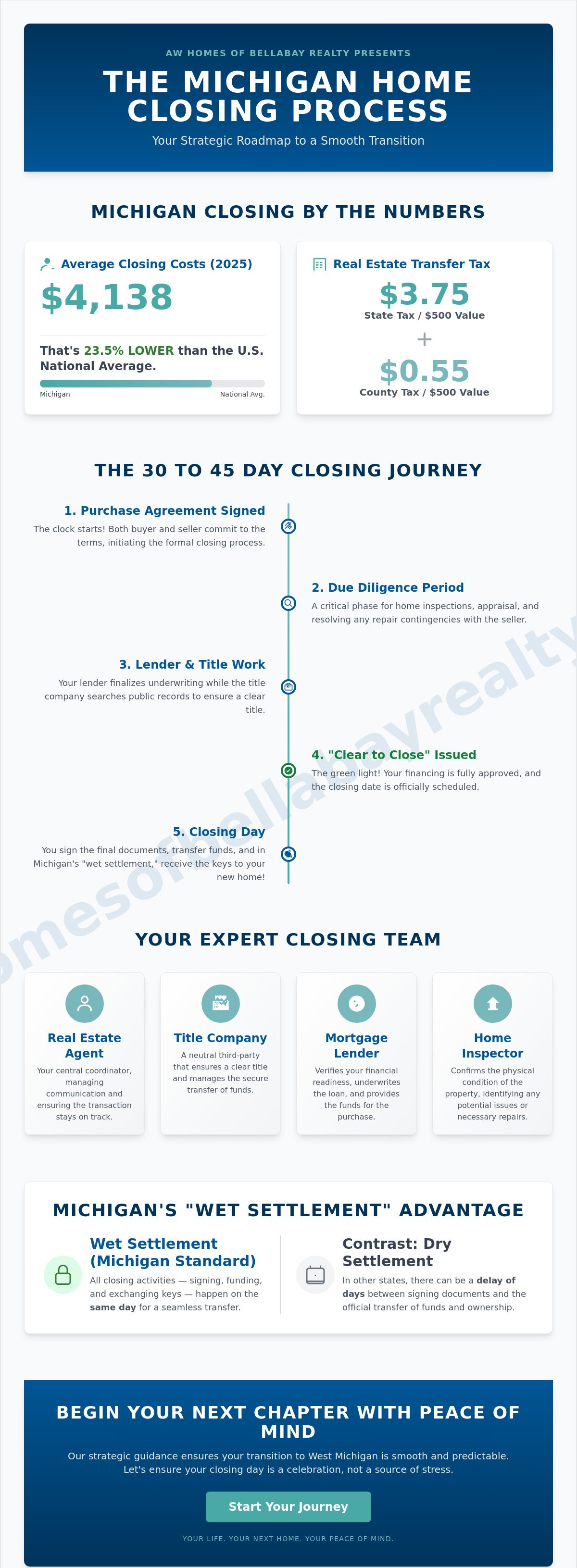
Did you know that in 2025, the average closing cost in Michigan was $4,138, which is 23.5% lower than the national average? While that data is encouraging, the actual home closing process in Michigan involves a complex web of state transfer taxes, county fees, and legislative shifts that can feel overwhelming. You've worked hard to reach this milestone, and you deserve to approach the closing table with absolute confidence. We understand the weight of this transition, whether you're moving up to a larger home in Ada or relocating to Grand Rapids.
It's common to feel a sense of apprehension about last minute delays or the 6.31% mortgage rates currently impacting the May 2026 market. We're here to replace that anxiety with a strategic, unhurried roadmap designed for your peace of mind. This guide provides a clear checklist of what to sign, a breakdown of the $3.75 state transfer tax per $500 of value, and insights into the 2.7% property tax inflation cap. Your Life. Your Next Home. Your Peace of Mind. Let's ensure your next chapter begins with a smooth, predictable transition.
Key Takeaways
- Understand the typical 30 to 45 day timeline from purchase agreement to settlement to ensure a predictable transition.
- Navigate the home closing process in Michigan with confidence by mastering inspection contingencies and securing your final lender approval.
- Create your "Peace of Mind" kit for closing day to ensure you have every required document and certified fund ready for a seamless signing.
- Identify and resolve common closing delays, such as appraisal gaps or credit shifts, before they impact your scheduled move-in date.
- Learn how the final recording of your deed officially marks the beginning of your next chapter in West Michigan.
Understanding the Home Closing Process in Michigan
The home closing process in Michigan is the definitive final step where property ownership officially transfers from the seller to the buyer. Often referred to as settlement, this stage is far more than a simple meeting to sign documents. It's the culmination of weeks of preparation, due diligence, and financial coordination. Understanding the Home Closing Process requires looking at it as a strategic orchestration of legal and financial milestones that ensure your transition is secure. In Michigan, this process is governed by specific disclosure laws designed to provide buyers with absolute peace of mind before they commit to their next chapter.
Most residential transactions in West Michigan follow a typical timeline of 30 to 45 days from the initial purchase agreement to the closing table. This window isn't just a waiting period; it's a functional necessity. It allows for the completion of mortgage underwriting, comprehensive home inspections, and detailed title searches. We act as your Strategic Guide during these weeks, managing the flow of information so you don't feel overwhelmed by the moving parts. This methodical approach ensures that no detail is left to chance, whether you're moving into a quiet neighborhood in Ada or a vibrant community in Grand Rapids.
Key Players in a West Michigan Closing
A successful closing relies on a team of professionals working in harmony. Each player has a specific role in protecting your interests and ensuring a smooth transition.
- The Title Company: This neutral third party acts as the guardian of the transaction. They perform the title search to ensure no liens exist and manage the escrow account where funds are held.
- Real Estate Agents: Your agent serves as the central coordinator. They facilitate communication between the lender, the title company, and the other party's representative to keep the timeline on track.
- Lenders and Inspectors: Mortgage lenders verify your financial readiness, while inspectors confirm the physical condition of the home. Occasionally, real estate attorneys are involved to review complex land contracts or unique estate stipulations.
Michigan-Specific Closing Customs
Michigan is generally considered a "wet settlement" state. This means that in a standard home closing process in Michigan, the mortgage funds are disbursed, the seller is paid, and the keys are often exchanged the very same day the documents are signed. This differs from "dry closing" states where there is a delay between signing and the actual transfer of funds.
Local customs can vary slightly within the state. In Kent County and the greater Grand Rapids area, it's common for closings to take place at the title company's office, though remote options have become increasingly accessible. For those looking at specialized properties in Forest Hills or Cascade, local expertise is vital. These areas often have specific property tax considerations or association disclosures that require a steady, knowledgeable hand to navigate. Your peace of mind comes from knowing your guide understands these local nuances intimately.
Essential Pre-Closing Steps for a Smooth Transition
The period following an accepted offer is a season of meticulous verification. During the home closing process in Michigan, this is when your strategic plan moves from theory into action. You'll work closely with your agent to resolve any repair contingencies identified during the home inspection. It's about ensuring the property aligns with your expectations before you commit to the final signature. At the same time, your lender is finalizing the underwriting. Receiving your "Clear to Close" is the definitive signal that your financing is secure and your move-in date is firm.
While your lender reviews your final credit profile, the title company is examining the property’s history. They look for unpaid property taxes or historic liens that could cloud your ownership. This is also when you'll see the calculation for Michigan real estate transfer taxes. As of May 2026, the state tax remains $3.75 for each $500 of value, while the standard county rate is $0.55 per $500. Understanding these costs early ensures no financial surprises at the table. If you're feeling uncertain about these figures, our Buyer Agency Services provide the personalized guidance needed to navigate these complexities with total peace of mind.
The Role of Title Search and Insurance
Title companies act as investigators. They scour public records to ensure the seller has the legal right to transfer the home. This investigation uncovers potential encumbrances like easements or contractor liens that could affect your future use of the property. Title insurance is the shield against future ownership disputes. It protects your financial interest for as long as you own the home, ensuring your next chapter isn't interrupted by claims from the past.
The Final Walkthrough Checklist
Usually scheduled 24 to 48 hours before the actual closing, the final walkthrough is your last opportunity to verify the home's condition. This isn't a second inspection. It's a confirmation of good faith. We recommend checking the following items:
- Confirm all agreed-upon repairs from the initial inspection have been completed.
- Verify all fixtures, such as light fixtures or built-in appliances, remain in place as specified in the contract.
- Check for any new damage that might have occurred during the seller's move-out process.
- Test the HVAC system and major appliances to ensure they remain in working order.
- Ensure the seller has removed all trash and personal belongings from the property.
What to Expect on Closing Day in Michigan
Closing day is the precise moment your vision becomes a reality. In the home closing process in Michigan, this meeting is the pivot point between your current life and your next chapter. Most closings take place at a title company office in Grand Rapids, Ada, or Cascade, though remote options have become increasingly common for busy professionals. You'll enter a room prepared with a stack of documents, but with a strategic guide by your side, this high stakes meeting becomes a calm, orderly transition. Your Vision. Your Signature. Your Next Chapter.
To maintain your peace of mind, we recommend arriving with your "Peace of Mind" kit. This ensures no last minute hurdles interrupt the momentum. You'll need to bring two forms of government issued identification, such as a driver's license or passport. You must also bring proof of your wire transfer or a cashier's check for the exact amount specified in your final Closing Disclosure. We'll have already compared this document to your initial Loan Estimate to ensure the 6.31% mortgage rate and other fees align with our expectations. This unhurried review is your final safeguard before the physical act of signing begins.
Key Documents You Will Sign
The volume of paperwork can feel significant, but each document serves a specific purpose in protecting your investment. You'll sign the Promissory Note, which is your legal promise to repay the lender under the agreed terms. You'll also execute the Mortgage, sometimes called a Deed of Trust; this document provides the lender with security for the loan. Finally, you'll sign the Warranty Deed. This is the most vital piece of paper in the room, as it's the instrument that actually transfers the title and ownership of the property into your name.
Financial Logistics: Wiring Funds and Escrow
Managing the movement of large sums of money requires absolute precision and safety. We always advise verifying wiring instructions directly with the title company via a known phone number to prevent fraud. Once the funds reach the escrow account, the title company acts as the neutral distributor. In Kent County, they'll handle the proration of property taxes. Since Michigan taxes are billed in July and December, the title company calculates exactly what the seller owes for their time in the home and what you'll prepay for the upcoming months. This ensures a fair, mathematically certain split that leaves no loose ends for your first months of ownership.
Navigating Common Closing Delays and Pitfalls
Even with the most meticulous planning, the home closing process in Michigan can encounter unexpected hurdles. These moments test the resolve of any buyer or seller, but they don't have to derail your next chapter. A strategic approach involves anticipating these friction points before they manifest. Whether it's a title discrepancy or a shift in the local market, having a steady, knowledgeable partner ensures these obstacles are handled with professional composure rather than panic. Your Life. Your Next Home. Your Peace of Mind.
The logistical "domino effect" of selling and buying simultaneously is a frequent challenge for move-up buyers in Grand Rapids. If one closing is delayed by even 24 hours, it can stall the entire chain. We manage this by strategically aligning contract dates and maintaining open lines of communication with all parties involved. This high level coordination ensures your transition remains as unhurried and smooth as possible, regardless of the moving parts.
Financing and Appraisal Issues
The appraisal coming in lower than the purchase price is a primary source of stress for homeowners in Forest Hills and Cascade. In a competitive landscape, an appraisal gap can threaten the transaction. We manage this by preparing for "gap coverage" in the initial offer or exploring bridge loans to maintain your timeline. It's equally vital to keep your financial profile static during this window. Even a small purchase on credit can trigger a re-underwrite of your mortgage. Keeping your finances "frozen" until the keys are in your hand is the surest way to protect your interest.
Resolving Title Defects and Liens
Title "clouds" are another common cause for a temporary pause in the home closing process in Michigan. These are often administrative relics, such as an old utility lien from 2019 or an unrecorded easement on a property in Ada. Our role as your consultant is to coordinate with the title company to clear these defects. Title insurance provides a robust defense of title, shielding you from the financial burden of these historic disputes. We negotiate these hurdles directly with the seller's representative, often resolving the issue before you even realize a problem existed.
Managing these complexities requires a partner who understands the nuances of the West Michigan market. If you're ready to secure a guide who prioritizes your long term well being over a quick closing, explore our Buyer Agency Services to start your journey with absolute confidence.
Beyond the Signature: Your Next Chapter in West Michigan
The moment you receive the keys is the symbolic start of your next chapter. While the heavy lifting of the home closing process in Michigan is complete, the days following your settlement are about anchoring your life in your new community. Whether you're settling into a quiet street in Ada or a historic home in East Grand Rapids, the transition from "buyer" to "homeowner" involves a few final, strategic steps to protect your investment. Your Life. Your Next Home. Your Peace of Mind.
After the meeting, the title company sends your documents to the Kent County Register of Deeds. In Kent County, a flat recording fee of $30 per document is standard, along with a $5.00 tax certification fee for warranty deeds. This official recording is what notifies the public of your ownership. We recommend storing your original closing packet, including the Closing Disclosure and Warranty Deed, in a secure fireproof safe. These documents are essential for future tax filings or when you eventually decide to move up to your next residence.
Post-Closing Responsibilities
Your first priority should be filing for the Principal Residence Exemption (PRE). This allows you to exempt your home from the 18-mill school operating tax, which significantly reduces your annual property tax bill. For the 2026 tax year, the deadlines to file are June 1 for the summer levy and November 1 for the winter levy. Missing these dates can result in unnecessary expenses during your first year of ownership. We also suggest the following tasks:
- Transfer utility accounts, including water, electricity, and gas, into your name effective on the closing date.
- Review your first mortgage payment date, which typically occurs on the first of the month following a full month of ownership.
- Establish a seasonal maintenance schedule to protect your property value, especially with the 2.7% property tax inflation cap in place for 2026.
- Update your address with the USPS and your financial institutions to ensure no sensitive documents are lost.
Why a Strategic Guide is Essential
Navigating the complexities of West Michigan real estate requires more than just a license. It demands a partner who views your move as a life milestone rather than a transaction. Angela Worth and the team at AW Homes provide the localized reliability and unhurried expertise needed to ensure no detail is overlooked. From the initial search in Cascade to the final signature at the title office, we act as your transition expert. We don't just help you find a house; we help you find your way home. If you're ready for a stress-free experience, start your next chapter with a smooth transition today.
Secure Your Smooth Transition Today
Mastering the home closing process in Michigan is about more than just signing papers. It's about ensuring your 6.31% mortgage rate is locked, your title is clear of historic liens, and your Principal Residence Exemption is filed by the June 1 deadline. These strategic details form the vital foundation of a successful move. You've worked hard to reach this milestone; you deserve a partner who values your journey as much as the destination.
Angela Worth and the team at Bellabay Realty have provided trusted local expertise since 2007. As a West Michigan relocation and transition expert, Angela offers concierge-style service to families in Grand Rapids, Ada, and Forest Hills. We prioritize your long-term well-being through unhurried navigation and methodical planning. Our goal is to replace the inherent stress of real estate with the calm confidence you need to enjoy your new space.
Download Our West Michigan Home Seller Strategy Guide to ensure your next chapter begins with absolute clarity. Your Life. Your Next Home. Your Peace of Mind. We're ready to guide you home with the care and precision you deserve.
Frequently Asked Questions
How long does the home closing process take in Michigan?
The home closing process in Michigan typically takes between 30 and 45 days from the moment the purchase agreement is signed. This window provides the necessary time for the lender to complete underwriting and for the title company to perform a thorough search. While some cash transactions can close in as little as 14 days, most buyers in Grand Rapids and Ada should plan for a six week timeline to ensure every detail is handled with precision.
What are the typical closing costs for a buyer in Michigan?
Buyers should expect to pay between 2% and 5% of the home's purchase price in closing costs. On a median priced home of $382,211, this ranges from approximately $7,600 to $19,100. These costs include loan origination fees, appraisal costs, and the $30 recording fee per document. Budgeting for these expenses early in your search ensures your next chapter begins on a firm financial foundation without last minute surprises.
Do I need an attorney for a real estate closing in Michigan?
Michigan law doesn't require an attorney to be present at a real estate closing. Most residential transactions are successfully managed by licensed real estate agents and title company professionals who act as neutral third party administrators. However, you might choose to hire an attorney if you're navigating a complex land contract or unique estate requirements. For the majority of move up buyers, the strategic guidance of an experienced agent provides the peace of mind needed for a smooth transition.
What happens if my appraisal comes in low right before closing?
If an appraisal comes in lower than the purchase price, you must negotiate a price reduction, cover the appraisal gap with additional cash, or exit the deal using your appraisal contingency. Lenders will only finance a percentage of the appraised value, not the contract price. In a competitive Forest Hills market, we often prepare for this by including appraisal gap language in the initial offer. This proactive approach prevents the transaction from stalling at the final hour.
Can I close on my Michigan home remotely?
You can close on your home remotely using Remote Online Notarization (RON) or a mobile notary service. Many title companies in West Michigan now offer digital signing platforms for non-notarized documents to streamline the experience. While some lenders still require a physical "wet signature" on the final mortgage note, we can often coordinate a hybrid closing. This flexibility is ideal for relocation clients or busy professionals who can't attend a traditional office meeting.
What is the difference between a Warranty Deed and a Quitclaim Deed in MI?
A Warranty Deed guarantees that the seller holds a clear title and has the legal right to sell the property, while a Quitclaim Deed offers no such protections. Warranty Deeds are the standard instrument for the home closing process in Michigan because they protect the buyer against future ownership claims. Quitclaim deeds are generally reserved for transfers between family members or clearing minor title "clouds" where no money is changing hands.
Who pays for title insurance in a Michigan home sale?
Customary practice in West Michigan dictates that the seller pays for the owner's title insurance policy, while the buyer pays for the lender's policy. This split ensures the buyer receives a clear title and the lender's financial interest is protected. While everything in a real estate contract is technically negotiable, following these local customs in Kent County helps maintain a smooth, professional negotiation. It's one more way we ensure your transition is predictable and stress free.
What should I do if I find a problem during the final walkthrough?
If you discover a new problem during the final walkthrough, you should immediately notify your agent to negotiate a repair or a financial credit before signing any documents. You shouldn't proceed with the closing until the issue is addressed through a formal addendum. Common solutions include the seller placing funds in an escrow holdback or providing a closing cost credit. Taking a firm stand at this stage protects your investment and ensures the home matches the promised condition.


