

What if the latest mortgage-rate headline tells you less about your next move than the homes available in your neighborhood? The impact of interest rates on Grand Rapids housing market activity is real: rates shape monthly payments and buying power, while local inventory influences how those pressures affect buyers and sellers. As of October 3, 2026, Zillow Home Loans reported a 30-year fixed mortgage rate of 7.875% in Michigan. Zillow reported 600 homes for sale and 1.2 months of supply in Grand Rapids as of August 31.
If you’re unsure whether to buy now, wait for a lower rate, or sell while demand remains active, that uncertainty makes sense. A rate change can shift what fits your budget, but waiting means weighing your timeline against local market conditions. National headlines alone can’t show how a particular neighborhood or price range is moving.
This article explains how mortgage rates affect affordability and real estate decisions, and what 2025 Grand Rapids data can, and can’t, suggest about 2026. You’ll also find practical ways for buyers, sellers, and homeowners to assess next steps using local trends, personal goals, and a clear plan.
Key Takeaways
- See how the impact of interest rates on Grand Rapids housing market affordability depends on more than the rate alone, including your loan amount, down payment, and term.
- Learn how to interpret 2025 regional housing data from GVSU’s Seidman Business Review, including the four counties in its Grand Rapids metro definition and the limits of its findings.
- Compare what changing borrowing costs may mean for buyers, sellers, and current homeowners, and how local competition can shift the equation.
- Build a decision framework around your timeline and financial comfort, then compare scenarios using current lender-provided terms rather than guessed future rates.
- Know which local indicators to watch in 2026, and why past data offers context rather than a forecast or guarantee.
How interest rates affect affordability in the Grand Rapids housing market
A mortgage interest rate is the cost of borrowing money to buy a home, expressed as a percentage of the loan. It’s separate from the purchase price: the price is what the home sells for, while the rate helps determine how much interest you pay over time. In short, the rate changes the cost of financing a home, but it doesn’t set the home’s value on its own.
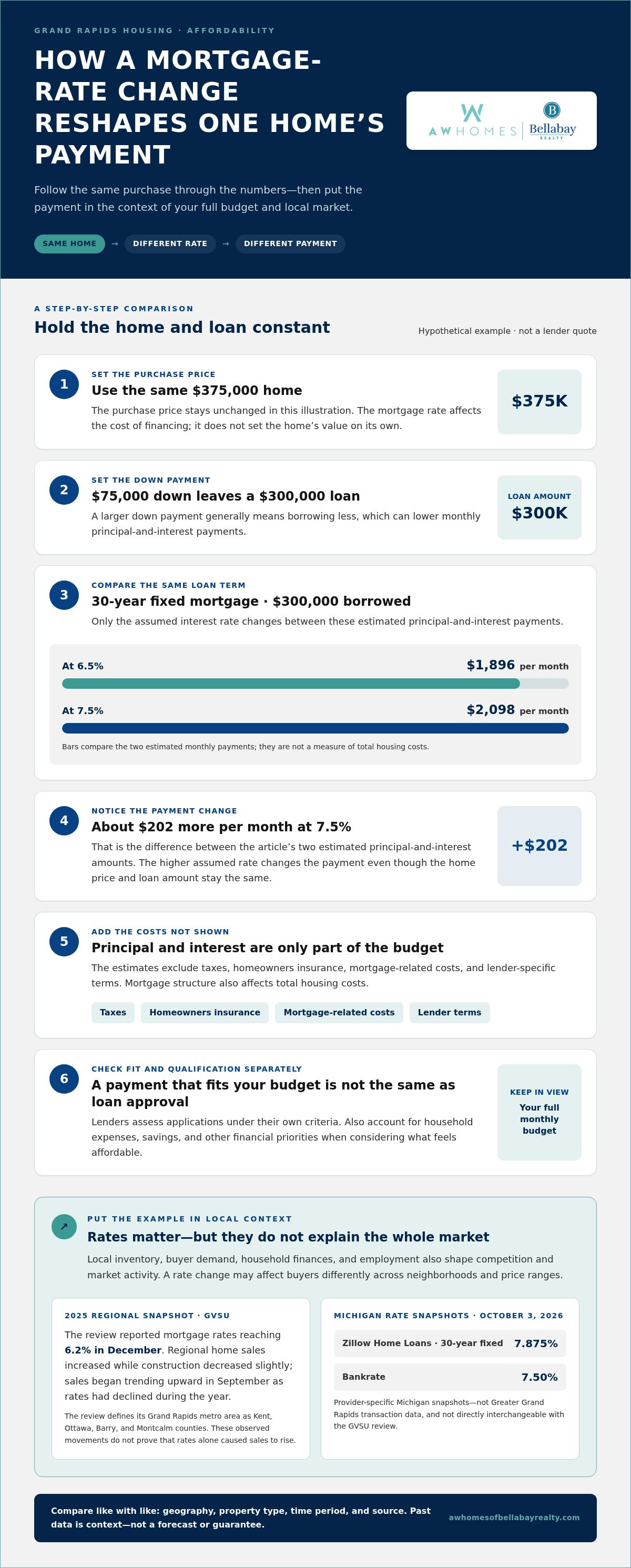
For a typical fixed-rate mortgage, monthly principal-and-interest payments depend on the interest rate, amount borrowed, and loan term. A larger down payment generally means a smaller loan and lower principal-and-interest payments. A longer term can lower the monthly payment while extending the time you pay interest. Taxes, homeowners insurance, mortgage structure, and lender terms also affect total housing costs, so principal and interest are only part of the budget.
Why a mortgage-rate change can alter buying power
Hypothetical example, not a lender quote: Imagine buying the same $375,000 home with a $75,000 down payment, leaving a $300,000 loan. On a 30-year fixed-rate mortgage at 6.5%, estimated monthly principal and interest would be about $1,896. At 7.5%, it would be about $2,098. The purchase price and loan amount stay the same, but the payment changes because the assumed rate is higher. These estimates exclude taxes, insurance, mortgage-related costs, and lender-specific terms.
That difference can change the price range a buyer feels comfortable exploring. But a payment that fits your budget isn’t the same as qualifying for a loan. Lenders assess applications under their own criteria, and households also need to account for expenses, savings, and other financial priorities. In Greater Grand Rapids, a useful affordability plan considers both lender terms and the full monthly budget.
Why rates do not determine home prices by themselves
Interest rates are one influence among several. Inventory, buyer demand, household finances, and local employment all help shape how many people can and want to compete for homes. These connected forces are part of real estate economics. If borrowing costs rise, some buyers may reduce their budgets or pause their search, but the effect in a particular Grand Rapids neighborhood depends on what else is happening there.
Market responses can take time. Buyers and sellers may need to adjust plans, and available homes or completed sales may not reflect a rate change immediately. Lower rates can improve borrowing affordability, but they don’t guarantee higher prices or a particular market direction. The impact of interest rates on Grand Rapids housing market conditions is best understood alongside local supply, demand, and household circumstances.
What 2025 data says about interest rates and Greater Grand Rapids housing
The GVSU Seidman Business Review offers a useful regional snapshot, but its figures need to be read within the boundaries of its analysis. The review defines the Grand Rapids metro area as Kent, Ottawa, Barry, and Montcalm counties. That’s not the same geography as Greater Regional Alliance of Realtors (GRAR) reporting, which covers Kent, Ionia, and parts of other counties. Different boundaries can produce different figures, even when both sources use a Grand Rapids label.
What the 2025 Grand Rapids review shows
GVSU’s review reports that mortgage rates declined during 2025, reaching 6.2% in December. It also reports that regional home sales increased while construction decreased slightly. Sales began trending upward in September as rates had declined during the year. These are observed movements, not proof that falling rates alone caused sales to rise. Inventory, household finances, employment, and other market conditions can also influence activity.
The review’s home-price indexes use repeat sales, tracking properties that sold more than once, and exclude typical distressed sales. This method provides a particular view of price movement. It isn’t a tally of every home sale or a direct measure of every property’s value. Treat the findings as regional context, not a guarantee about a specific neighborhood or home.
How to read local housing data responsibly
For a 2026 rate reference, Zillow Home Loans reported a Michigan 30-year fixed rate of 7.875% on October 3, 2026, while Bankrate reported 7.50% on the same date. These are provider-specific Michigan snapshots, not Greater Grand Rapids transaction data, and they aren’t directly interchangeable with GVSU’s review.
Before drawing conclusions about the impact of interest rates on Grand Rapids housing market conditions, compare like with like: geography, property type, time period, and source. Keep reported figures separate from explanations for them. A rise in sales alongside lower rates may be consistent with rates influencing activity, but it doesn’t establish a single cause or predict what comes next. The 2025 review is retrospective, so it can’t stand in for a complete 2026 update or forecast.
For a decision tied to your own move, combine regional reporting with neighborhood-level context and your timeline. Explore local buyer and seller guidance to put Greater Grand Rapids market trends in perspective.
How interest rates affect Grand Rapids buyers, sellers, and homeowners differently
The same rate environment can lead to different decisions depending on whether you’re entering the market, selling a home, or considering a move. Higher borrowing costs may narrow some buyers’ budgets, but the effect on competition depends on how many buyers remain active and how much local inventory is available. Rates matter, along with timing, property fit, and your next housing step.
| Role | How rates may matter | Decision to weigh |
|---|---|---|
| Buyer | A higher rate may mean a larger principal-and-interest payment or a lower comfortable price range. | Compare searching within today’s budget with waiting, without assuming future rates or competition. |
| Seller | Borrowing costs may influence which financed buyers can comfortably pursue the home. | Assess demand and available inventory alongside your timing and next-home plans. |
| Current homeowner | A move may replace an existing mortgage with financing at different terms. | Consider the total cost and benefits of moving, not just the rate on a new loan. |
What changing rates may mean for Grand Rapids homebuyers
For buyers, a manageable payment is only one part of the decision. Local inventory and competing offers can affect which homes are available and how much flexibility you have during negotiations. A lower rate could improve affordability, but it doesn’t guarantee more suitable listings or less competition. Waiting may suit a household that needs time to strengthen its finances; searching now may suit someone whose timeline and budget already align.
Rather than trying to predict the perfect moment, define a comfortable payment range and explore homes that fit it. A comparative market analysis and neighborhood-level perspective can help you evaluate options without assuming the market will move in one direction.
What changing rates may mean for sellers and homeowners
Sellers may consider how financing costs influence the pool of buyers able to pursue their home, but rates alone don’t determine list price, time on market, or sale proceeds. Property condition, pricing, location, competing listings, and buyer demand all matter. A homeowner planning to buy again should also weigh financing and availability for the next home before setting a sale timeline. Coordinating both moves can be as important as choosing when to list.
Waiting for lower rates isn’t automatically better for every household. Future rates are uncertain, and a rate change can coincide with shifts in inventory and buyer activity. Broad mortgage industry forecasts may offer context, but they aren’t a prediction for a specific Grand Rapids neighborhood or household. The impact of interest rates on Grand Rapids housing market decisions depends on the local options and personal priorities in front of you.
A practical decision framework for a changing Grand Rapids mortgage market
A sound plan starts with your life, not a rate prediction. A move tied to a new job, a growing household, downsizing, or a change in routine may have a different timeline from a move you can comfortably postpone. Use these steps to compare choices without relying on guessed future rates.
- Set your timeline and comfort level. Decide when you’d ideally move and what monthly housing cost feels sustainable, including expenses beyond principal and interest.
- Define the home and location you need. List the features, neighborhoods, and commute or lifestyle needs that matter most, then separate essentials from preferences.
- Build a move-now scenario. Use current lender-provided terms, including the estimated rate, loan structure, down payment, and other costs. Keep your target home type and household budget clear.
- Build a wait-and-reassess scenario. Use the same home needs and budget assumptions, but account for the real cost of waiting, such as continued housing expenses or a delayed life transition. Don’t assume rates or home prices will move in a particular direction.
- Choose a review point. If you wait, decide when you’ll revisit the plan and what would change your decision, such as updated financing terms, a shift in household needs, or different local inventory.
A buyer’s checklist for evaluating timing
Set a sustainable monthly housing budget before choosing a purchase-price ceiling. Then compare current financing scenarios using lender-verified terms and costs. Keep the assumptions consistent so the comparison is meaningful. Include location, home requirements, and how long you expect to own the property. A home that fits your timeline and budget may serve you better than waiting in hopes of a rate that may or may not arrive.
A seller’s checklist for planning a move
Assess your current home, desired next home, and the order of those transactions together. A local comparative market analysis can help frame pricing and competition more clearly than national rate headlines alone. If you’re considering a Forest Hills sale, use neighborhood-specific insight to shape the plan around your property and next move.
The impact of interest rates on Grand Rapids housing market decisions is personal as well as financial. Local guidance can help connect your timeline, financing scenarios, and neighborhood options. Plan your Grand Rapids home move with those details in view.
What to watch next: interest rates and the 2026 Grand Rapids housing outlook
One rate headline can’t describe the full market. To understand the impact of interest rates on Grand Rapids housing market conditions, track financing alongside local supply, completed transactions, prices, and construction. Compare the same geography and time periods, and treat each measure as one part of the picture.
Which local indicators matter more than a single rate headline
- Mortgage rates: Zillow Home Loans reported a Michigan 30-year fixed rate of 7.875% on October 3, 2026. This is a dated statewide snapshot, not a quote for every borrower.
- Inventory and pending activity: Zillow reported 600 homes for sale and a median of 7 days to pending in Grand Rapids as of August 31, 2026. These figures describe a specific place and date, not every Greater Grand Rapids community.
- Prices: Zillow reported a Grand Rapids median home value of $307,094 as of August 31, 2026, up 3.2% over the prior year. A home-value estimate is not the same measure as a closed-sale price.
- Closed sales and new construction: Review dated local reports for these measures, checking their coverage area and comparison period. The figures provided here don’t establish a complete 2026 trend for either indicator.
Geography matters. The GVSU Seidman Business Review’s 2025 metro area includes Kent, Ottawa, Barry, and Montcalm counties. GRAR reporting covers Kent, Ionia, and parts of other counties. Grand Rapids, Ada, Caledonia, and East Grand Rapids can also show different listing choices and buyer activity. Don’t combine figures from these areas as if they describe one identical market.
Likewise, 2025 findings are context, not a forecast or guarantee for 2026. A shift in mortgage rates may influence buyers’ budgets, but inventory, demand, employment, and new construction also shape local outcomes. Observing two trends at once doesn’t prove that one caused the other.
Turn market context into a next step
Before making a rate-driven decision, revisit your timing, budget, and housing needs. Then look at comparable local inventory, closed sales, and prices for the places and property types you’re considering. A neighborhood-level view can help you interpret broad market signals without assuming that Grand Rapids, Ada, Caledonia, and East Grand Rapids will move in lockstep.
If you’re considering buying, selling, downsizing, or relocating, AW Homes of Bellabay Realty can help you connect local conditions to your plans. Start with your priorities, current options, and the transition you want to make.
Make your next move with a local plan
The impact of interest rates on Grand Rapids housing market decisions goes beyond a monthly payment. Rates shape borrowing costs, but local inventory, buyer demand, and your timeline also matter. While 2025 data offers helpful context, it can’t promise what 2026 will bring. A thoughtful plan weighs your budget, the home or sale you’re considering, and the next chapter you want to take.
Angela Worth leads a residential real estate team serving Greater Grand Rapids. Buyer guidance can include property sourcing, comparative market analysis, and contract negotiation. Seller support includes market positioning, marketing, negotiation, and transaction management. Local insight can help you assess your options, whether you’re buying, selling, downsizing, or relocating.
Plan your next move with local Grand Rapids real estate guidance. With a clear view of your priorities and the market around you, you can move forward with confidence.
Frequently Asked Questions
Is the Grand Rapids housing market affected by mortgage interest rates?
Yes. Mortgage rates can affect buyers’ monthly payments and purchasing power, which may influence demand and competition. The impact of interest rates on Grand Rapids housing market activity also depends on local inventory, prices, household finances, and new construction. Effects can vary by neighborhood and property type, so national trends may not describe conditions in Grand Rapids, Ada, Caledonia, and East Grand Rapids equally.
How do interest rates affect home prices in Grand Rapids?
Mortgage rates can influence what financed buyers can afford, which may affect demand and pricing pressure. They don’t set home prices on their own. Available homes, buyer activity, property condition, location, and broader economic factors also matter. To understand pricing in a particular area, review comparable local sales and current inventory. A relationship between rate changes and prices provides context, but doesn’t prove one caused the other.
Should I wait for mortgage rates to fall before buying a home in Grand Rapids?
There’s no single answer that fits every buyer. Future rates and home prices are uncertain, and a suitable home may or may not be available later. Start with your timeline and a monthly budget that feels comfortable, then compare current lender-provided financing scenarios with the trade-offs of waiting. Local inventory and the homes that meet your needs matter too. A rate prediction alone isn’t a complete buying plan.
Can lower interest rates make the Grand Rapids housing market more competitive?
They can improve borrowing power for some buyers and may encourage additional demand, but increased competition isn’t guaranteed. The local effect also depends on available homes, buyer finances, and other market conditions. Watch dated inventory and sales figures for your target area alongside mortgage rates to see whether activity is changing. A lower rate by itself doesn’t establish that bidding will increase or prices will rise.
How do higher interest rates affect home sellers in Grand Rapids?
Higher borrowing costs may reduce what some buyers feel comfortable spending, potentially affecting the pool of interested financed buyers. The effect on a specific sale depends on the property, pricing, local inventory, and buyer activity. Sellers should also consider their next move and its timing. A current local market analysis can help frame the decision, but rates alone don’t determine a home’s sale price or time on market.
What should I watch in the Grand Rapids housing market in 2026?
Track mortgage rates alongside local inventory, closed sales, prices, and new construction. Compare figures from the same area and time period because regional reports may define Greater Grand Rapids differently. The GVSU Seidman Business Review’s 2025 findings offer background, not a forecast or guarantee for 2026. Use current, dated information, and distinguish reported market changes from forecasts or explanations about what caused them.
Do interest rates affect Ada, Caledonia, and East Grand Rapids the same way?
Mortgage rates affect financing across these communities, but local market conditions can differ. Inventory, home types, price ranges, buyer demand, and individual property features all shape how rate changes may play out. One community’s sales or prices shouldn’t be assumed to represent another’s. If you’re planning a move, compare recent data for the specific location and property type that fit your needs, alongside your budget and timeline.


