

Does accepting a contingent offer mean your home sale is effectively "stuck" until someone else's deal closes? Many sellers in Grand Rapids and Forest Hills fear that saying yes to these terms is an invitation for uncertainty, financial strain, and the dreaded double mortgage. Understanding exactly what is a contingent offer when selling a house is the first step toward turning a complex contract into a calculated advantage. In a market where inventory has reached a 4.6 month supply, these offers are becoming a standard part of the local landscape. You deserve a process that prioritizes your equity, your timeline, and your peace of mind.
We understand that a home sale is more than a transaction. It's a significant life transition that requires expert navigation and strategic planning. This guide will empower you to manage these offers with professional authority and total confidence. You'll discover how to leverage "kick-out" clauses, protect your financial security, and move toward your next chapter without the weight of unnecessary risk. We'll walk through the specific legal nuances of Michigan contracts and the 2026 regulations that keep your transition seamless, secure, and successful.
Key Takeaways
- Understand how a contingent offer functions as a strategic bridge, allowing you to move forward while maintaining essential safeguards for your financial security.
- Learn exactly what is a contingent offer when selling a house so you can navigate 2026 market conditions with professional authority and confidence.
- Discover the power of the "kick-out" clause, a vital tool that gives you the right to accept a stronger offer while under a conditional contract.
- Master the art of evaluating buyer risk by assessing the status of their current home in local West Michigan neighborhoods like Caledonia or Ada.
- Benefit from a concierge-style strategy that orchestrates every logistical and emotional milestone for a seamless transition to your new chapter.
Defining the Contingent Offer from a Seller’s Perspective
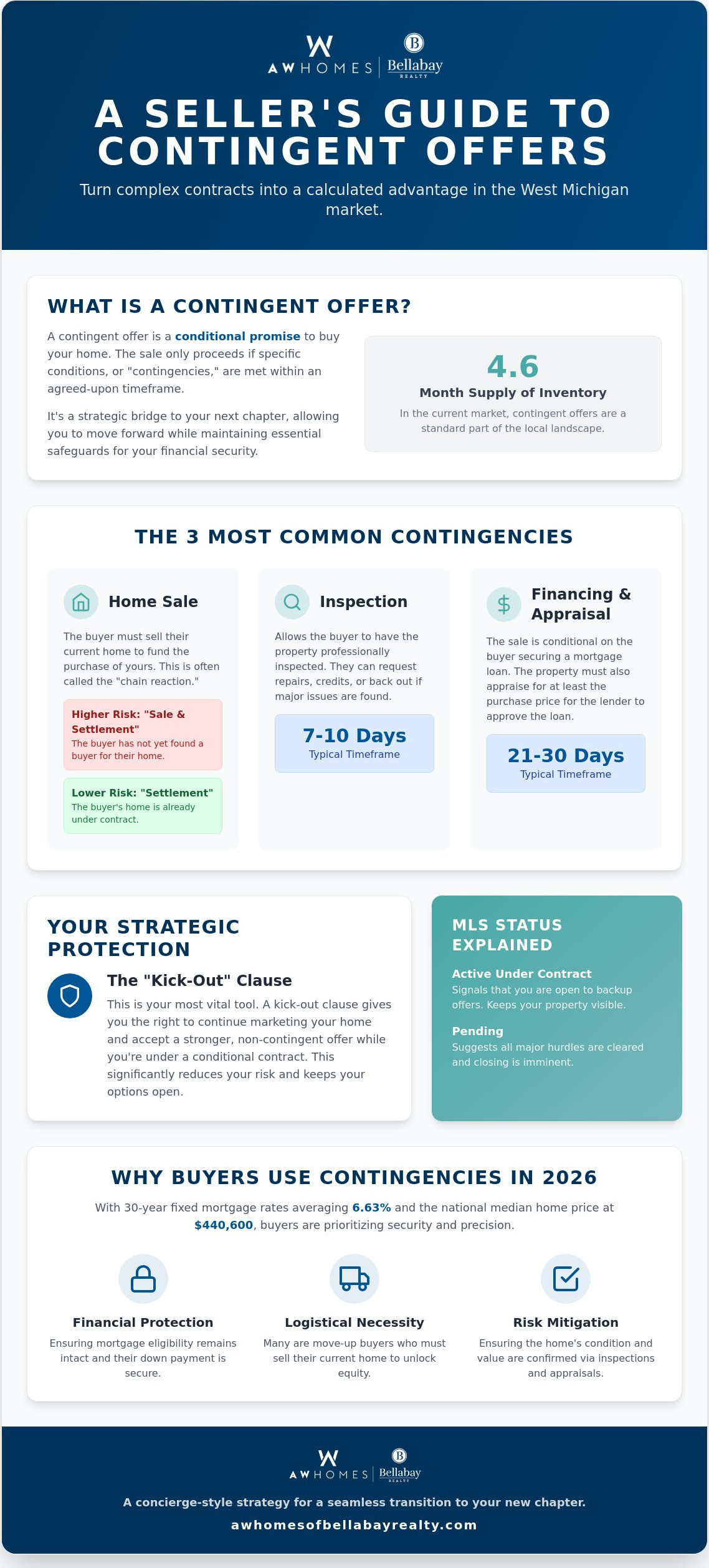
A contingent offer is essentially a conditional promise. It represents a bridge between your current property and your next chapter, but it's a bridge that only holds if certain pillars are firmly in place. For a seller, understanding what is a contingent offer when selling a house means recognizing that while your property is technically "off the market," the transaction remains in a state of strategic waiting. It's a period defined by three essential elements: intentionality, protection, and patience.
When you accept these terms in West Michigan, your listing status typically shifts in the MLS. It moves from "Active" to "Active Under Contract" rather than "Pending." This distinction is vital for your peace of mind. A "Pending" status suggests that all major hurdles are cleared. "Active Under Contract" signals to agents in Forest Hills, Ada, and Caledonia that while you've chosen a buyer, you may still be open to backup offers. This keeps your options viable and ensures you aren't left behind if the primary deal falters.
The Anatomy of a Contingency Clause
Every Real estate contract relies on specific clauses to define the boundaries of the agreement. These clauses outline exactly what must happen for the sale to proceed. In 2026, the typical timeline for an inspection contingency is 7 to 10 days, while financing and appraisal windows generally span 21 to 30 days. If the buyer cannot satisfy these conditions within the agreed timeframe, the contract provides an "escape hatch." Usually, this allows the buyer to exit the deal and recoup their earnest money, leaving the seller to relist the property and begin the search for a new partner.
Why Buyers Propose Contingencies in 2026
The return of contingencies in 2026 reflects a more balanced and thoughtful market. With 30 year fixed mortgage rates averaging 6.63%, buyers are prioritizing financial security and logistical precision. They aren't just being difficult; they're managing their own life transitions. Most buyers propose contingencies for three specific reasons:
- Financial Protection: They need to ensure their mortgage eligibility remains intact and their down payment is secure.
- Logistical Necessity: Many are move-up buyers who must sell their current home to unlock the equity required for your property.
- Risk Mitigation: With the national median home price reaching $440,600, buyers want to ensure the home's condition truly reflects its value through professional appraisals and inspections.
By viewing these requests through the lens of a strategic advisor, you can move past the initial anxiety. You aren't just waiting; you're participating in a methodical process designed to ensure a successful closing for everyone involved.
The Three Most Common Contingencies West Michigan Sellers Encounter
While every contract is unique, most sellers in Grand Rapids encounter three specific hurdles that define the timeline of their sale. These safeguards provide clarity, mitigate risk, and protect your equity. Understanding what is a contingent offer when selling a house requires a close look at these pillars, as they directly influence the home closing process in Michigan. By identifying these conditions early, you can move from a place of uncertainty to one of professional authority.
The Home Sale Contingency: The 'Chain Reaction'
In sought-after communities like Ada and Forest Hills, move-up buyers often rely on the equity from their current residence to fund their next purchase. This creates a "Chain Reaction" where your closing depends on the successful sale of the buyer's home. It's vital to distinguish between a "Sale and Settlement" contingency and a "Settlement" contingency. A "Sale and Settlement" means the buyer hasn't found a buyer for their own home yet, which carries higher risk. A "Settlement" contingency means their home is already under contract and simply needs to reach the finish line. For sellers, the latter is far more desirable as it indicates a shorter, more predictable path to the closing table.
Appraisal and Inspection: The Technical Hurdles
The technical aspects of a Contingent in Real Estate agreement focus on the home's value and physical integrity. In the current 2026 market, a professional home appraisal typically costs between $314 and $424. If the appraisal comes in lower than the offer price, an "Appraisal Gap" occurs. You must be prepared to negotiate whether the buyer covers the difference, you lower the price, or you meet in the middle.
Similarly, the inspection contingency remains a standard protection. With the average cost for a home inspection in 2026 sitting around $343, buyers are looking for peace of mind. To avoid the "inspection trap," many proactive sellers in Caledonia and Grand Rapids are opting for pre-inspections or using "as-is" clauses. These strategies limit repair demands and keep the transaction moving forward without last-minute friction. Strategic preparation ensures that these technical milestones become stepping stones rather than stumbling blocks. If you are looking for a partner to help manage these complex timelines, our residential listing services are designed to provide the emotional security you need during this transition.
Strategic Protection: Understanding the 'Kick-Out' Clause
Accepting a conditional proposal shouldn't feel like you're surrendering control of your timeline. When sellers ask what is a contingent offer when selling a house, they're often looking for a way to mitigate the risk of their property sitting idle. The "kick-out" clause is the professional solution to this concern. It's a strategic provision that allows you to keep your home on the market and continue seeking better terms, even after you've signed a contract. It transforms a passive waiting period into an active pursuit of the best possible outcome.
This clause serves as a vital safeguard against market staleness. In a landscape where inventory is shifting, keeping your listing visible to new buyers is essential. By maintaining an "Active Under Contract" status, you signal to the market that your home is still a viable opportunity. This creates a sense of urgency for other buyers and ensures you aren't left starting from scratch if the initial buyer's plans fall through. It provides leverage, visibility, and control.
How the Kick-Out Clause Works in Practice
Implementing this strategy requires a methodical approach to contract negotiation. The process typically unfolds in three distinct stages, designed to protect your interests while respecting the buyer's needs. First, you accept the contingent offer with a specific kick-out provision included in the agreement. This sets the legal foundation for your continued marketing efforts.
Second, you continue the work of selling your home in Forest Hills MI by hosting tours and engaging with prospective buyers in the Greater Grand Rapids area. You aren't just waiting; you're actively building a pipeline of interest. Finally, if you receive a non-contingent backup offer that meets your goals, you trigger the clause. This begins a formal countdown that requires the original buyer to either remove their contingencies or step aside for the new offer.
The Seller’s Advantage: Right of First Refusal
The core of this protection is the Right of First Refusal. This mechanism typically gives the primary buyer a window of 24 to 72 hours to decide their next move. It forces their hand. They must either commit fully to the purchase by removing their contingencies or allow you to move forward with a more secure buyer. This window is not a time for high-pressure tactics; it's a period for unhurried negotiation and clear communication.
For sellers in Ada and Caledonia, this provides the emotional security needed during a major life transition. You aren't "stuck" in a deal that might fail. Instead, you're in a position of strength, knowing that you have a clear path forward regardless of the buyer's situation. This methodical approach ensures no detail is left to chance, providing a stress-free path to your next home.
Evaluating the Risk: When to Accept (or Decline) a Contingent Offer
Deciding to accept a conditional contract requires a shift from emotional attachment to objective analysis. It's about weighing the certainty of your transition against the potential for delay. In the current landscape, where the Grand Rapids real estate market outlook shows a 4.6-month supply of inventory, sellers have more room to be selective. Understanding what is a contingent offer when selling a house that actually closes depends on how well you vet the "chain" behind the buyer. You aren't just selling a property; you're evaluating a secondary transaction that you cannot control but must rely upon.
A strategic audit of the buyer's situation is essential. Start by assessing the location and status of the home they need to sell. A property in a high-demand area like East Grand Rapids or Forest Hills is far more likely to move quickly than one in a stagnant market. You should also look for a "Price Premium." Buyers with contingencies often offer a higher purchase price to compensate the seller for the added risk and potential holding costs. If the price doesn't reflect this trade-off, the risk might not be worth the reward.
Red Flags in a Contingent Offer
Some conditions signal a high probability of the deal falling through. These red flags should prompt immediate caution or a request for better terms. Watch for these indicators of a weak offer:
- The buyer's home isn't on the market yet: This adds weeks of uncertainty to your timeline before the "chain" even begins.
- Excessive contingency periods: Any window stretching beyond 45 days creates a significant risk of your home becoming "stale" on the MLS.
- Low earnest money: A small deposit suggests the buyer has little "skin in the game" and may walk away easily if their own sale hits a minor snag.
Green Lights: When the Risk Is Worth It
Conversely, some contingent offers are exceptionally strong and provide a clear path to a successful closing. These "green lights" suggest a buyer who is organized and committed to the transition. You're in a strong position when the buyer’s home is already past the inspection and appraisal phase, as the most volatile hurdles are cleared. Additionally, look for buyers working with a reputable, local buyers agent in Grand Rapids who can verify the strength of the secondary contract. If you need a professional to audit your current offers and identify the most secure path forward, our residential listing services provide the expert insight you deserve.
Navigating the Transition: The AW Homes of Bellabay Realty Concierge Approach
Selling a home in West Michigan involves more than just signing documents and transferring keys. It's a profound transition that marks the end of one chapter and the deliberate beginning of another. While you might initially focus on what is a contingent offer when selling a house, the true value of professional guidance lies in the orchestration of the move itself. At AW Homes of Bellabay Realty, we view our role as strategic consultants who prioritize your long-term well-being. Our approach is defined by intentionality, personalization, and expert insight. By anchoring our identity as a neighborhood authority in Forest Hills, Ada, and Caledonia, we ensure your property is positioned with professional authority and localized reliability.
Our deep roots in these communities allow us to move beyond simple salesmanship. We understand the specific situational needs of families in different life stages, whether you're seeking more space or simplifying your lifestyle. This regional dominance means we don't just list your home; we curate a journey that reflects your unique goals. We provide a steady, logical, and supportive flow that begins with a broad vision and narrows down into specialized expertise. This progression ensures that the actual process of your transaction mirrors the promise of a stress-free experience, providing the emotional security you deserve during a high-stakes milestone.
Expert Navigation of Simultaneous Sales
Managing the "contingent dance" requires a steady hand and a logical process. We specialize in coordinating the complex timelines of move-up buyers and downsizers, ensuring you only have to pack your boxes once. This seamless transition is supported by high-end professional photography and intentional staging that makes your property stand out in a competitive 2026 market. Our concierge philosophy is a sophisticated blend of strategic focus, empathetic reassurance, and meticulous logistical management. We don't leave your future to chance. Instead, we create a rhythmic, supportive flow that mirrors the unhurried life you're moving toward.
Your Next Chapter Starts Here
We believe that a successful transaction is measured by your personal evolution rather than just a closing price. High-pressure sales tactics have no place in a significant life milestone. We replace urgency with organization and anxiety with a methodical plan. This approach ensures that no detail is overlooked, from the initial market positioning to the final walkthrough at the closing table. Your emotional security is our ultimate anchor, providing a core pillar of trust throughout the entire process. Whether you're moving within Greater Grand Rapids or relocating across the state, we're here to be your highly competent partner.
Connect with AW Homes of Bellabay Realty for a strategic consultation on your home sale.
Embracing Your Next Chapter with Confidence
Accepting a conditional proposal shouldn't mean surrendering your peace of mind. By reframing what is a contingent offer when selling a house as a strategic bridge rather than a barrier, you can navigate the 2026 market with professional authority. You've learned how to leverage the kick-out clause, vet buyer readiness, and protect your equity through every logistical milestone. This methodical approach ensures that your transition remains a positive evolution in your personal story, free from the anxiety of the unknown.
At AW Homes of Bellabay Realty, we remain deeply invested in the Greater Grand Rapids community. We provide concierge-style real estate expertise tailored for move-up buyers and downsizers in Forest Hills, Ada, and Caledonia. Our specialized guidance ensures that no detail is left to chance, offering you the emotional security needed during this significant life milestone. We don't just facilitate transactions; we orchestrate seamless evolutions for our clients.
Secure your seamless transition with a strategic home sale consultation from Angela Worth.
Your evolution as a homeowner is a journey worth celebrating. We look forward to guiding you into your next chapter with professional authority and unhurried care.
Frequently Asked Questions
Can I still accept other offers if I take a contingent one?
You can absolutely accept backup offers if your contract includes a strategic kick-out clause. This provision allows you to keep the property active on the West Michigan MLS and continue hosting tours for prospective buyers. If a non-contingent backup offer arrives, you give the original buyer a set window to remove their contingencies or step aside. It ensures you maintain leverage, visibility, and control throughout the transaction.
What happens if the buyer's house doesn't sell on time?
The contract typically terminates if the buyer's home sale stalls beyond the agreed timeframe. This allows the buyer to exit the deal without losing their earnest money while you regain the right to sell to someone else. In some cases, you may choose to grant an extension if they are close to closing. This decision requires a careful audit of their current progress, local market demand, and your own moving timeline.
Is a contingent offer the same as a pending sale?
A contingent offer is not the same as a pending sale. When you are asked what is a contingent offer when selling a house, think of it as a conditional agreement where specific hurdles must still be cleared. "Pending" usually indicates that all major contingencies, such as the inspection and appraisal, have been satisfied. In our local market, contingent homes are often listed as "Active Under Contract" to invite continued backup interest.
How much earnest money should I ask for in a contingent deal?
Sellers should generally request an earnest money deposit between 1% and 3% of the home's purchase price to ensure the buyer is fully committed. In a contingent deal, this deposit acts as a show of good faith and financial stability. While the buyer often recoups this money if a contingency isn't met, a substantial deposit indicates they are serious, prepared, and invested in making the transition successful.
Should I accept a contingent offer in a seller's market?
You should only accept a contingent offer in a seller's market if it includes a price premium or a very short kick-out window. In high-demand areas like Forest Hills, non-contingent offers are often more attractive because they offer a faster path to closing. However, if a contingent buyer is willing to pay significantly above market value and their own home is already under contract, the risk may be strategically sound.
What is the 'kick-out' clause in Michigan real estate?
The kick-out clause is a strategic provision that allows a seller to keep their home on the market while under a contingent contract. It gives you the right to accept a better, non-contingent offer if one becomes available. Once triggered, the original buyer typically has 24 to 72 hours to remove their sale contingency or forfeit the deal. It provides the emotional security, logistical flexibility, and professional protection sellers need.
Can I back out of a contingent offer as a seller?
A seller cannot simply back out of a contingent offer without a legal reason once the contract is signed. Your exit strategy depends entirely on the buyer failing to satisfy their specific conditions or missing a contract deadline. If they meet all requirements on time, you are legally bound to complete the sale. This is why professional contract review is essential to ensure your rights, equity, and timeline remain protected.
How long do contingencies usually last in West Michigan?
Contingency timelines in West Michigan are precisely defined by the type of condition. Inspection periods typically last 7 to 10 days, while financing and appraisal windows generally span 21 to 30 days. A home sale contingency often requires 30 to 60 days, depending on the current market trends in neighborhoods like Ada or Caledonia. Clear timelines prevent the transaction from drifting and ensure a methodical, stress-free path to your next home.


