

A low offer is a negotiation opening, not a reason to cut your price immediately. Knowing how to handle lowball offers on your home means responding calmly, comparing the offer with nearby sales and your home’s condition, then countering at a price that reflects its value. An offer arriving within the first 48 hours may be a buyer testing the waters, so a thoughtful counter can keep the conversation open.
It’s understandable to feel disappointed when an offer falls short of what you expected. But price is only one part of the proposal: the buyer’s financing, contingencies, closing timeline, and flexibility can all affect how appealing the deal is.
This guide explains how to assess whether an offer is truly low, use comparable sales to support your position, and weigh all the terms before responding. You’ll also learn when to counter, when to reconsider your asking price, and how to protect your priorities without pushing a serious buyer away.
Key Takeaways
- Respond to a low offer calmly and use a considered counteroffer to keep a productive negotiation open.
- Compare the property with similar neighborhood sales, accounting for condition and meaningful upgrades.
- Judge the full offer, including financing strength, contingencies, closing timing, and the amount you may net at closing.
- Use flexibility on terms to explore a better overall outcome without conceding more on price than you intend.
- If multiple offers point to a pricing mismatch, reassess the asking price against current market conditions before deciding your next move.
1. How can I effectively handle a lowball offer from a buyer without scaring them away?
In most cases, counter rather than reject a low offer outright. A calm response can keep negotiations open, while comparable sales and your home’s upgrades help support your price. Keep the tone factual, address the buyer’s terms, and leave room for a productive conversation.
For U.S. home offers and counteroffers, the written offer, its deadlines, and applicable state contract rules shape the process. Follow the stated timelines, and put any proposed price or term changes clearly in writing.
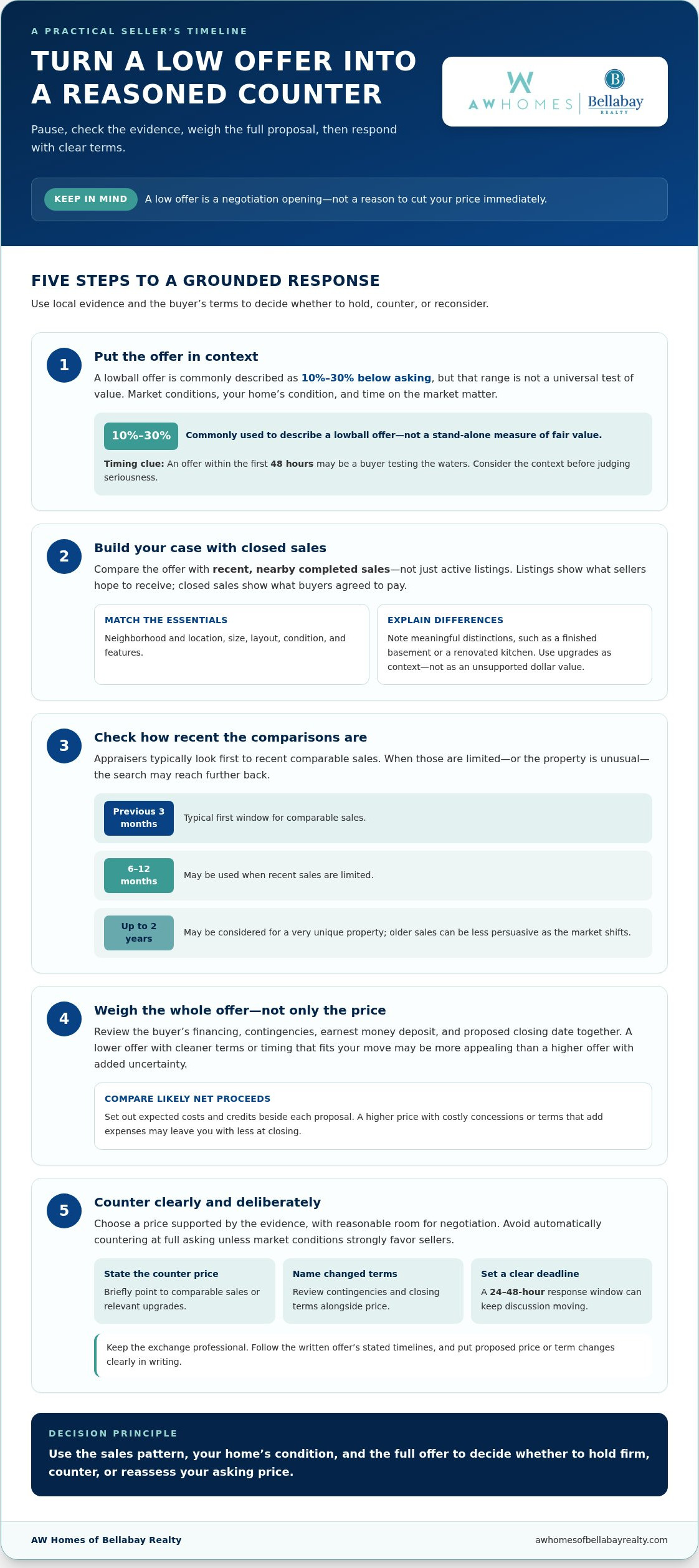
A lowball offer is commonly described as 10% to 30% below the asking price, but that range is not a universal test of value. Market conditions, the home’s condition, and time on the market matter. An offer that looks low against your list price may be closer to fair market value if comparable homes have sold for less.
Respond to every offer, including one that feels significantly below expectations. A buyer may be testing your flexibility rather than walking away. If the offer arrives within the first 48 hours of listing, consider that context before judging the buyer’s seriousness. Your response can be a firm counteroffer, rather than an immediate rejection.
Build your counter around nearby sales of homes similar to yours in location, size, condition, and features. Then explain how relevant differences support your position. For example, if a comparable home lacked a renovated kitchen, point to your kitchen upgrade as a distinction, not as an unsupported dollar value. Buyers are more likely to understand a price backed by local evidence than one based only on your attachment to the property.
Before sending a counteroffer, take these steps:
- Compare the offer with recent neighborhood sales and your home’s condition.
- Choose a price that reflects value while leaving reasonable room for negotiation.
- Review contingencies and closing terms, then set a clear response deadline; a 24-to-48-hour window can keep discussions moving.
Avoid automatically countering at full asking price unless market conditions strongly favor sellers. Your first concession can shape how buyers approach later negotiations, so make each adjustment deliberately. If the offer falls well below your evidence-based range, counter closer to your target and briefly explain the comparable sales or upgrades behind it.
Keep the exchange professional: acknowledge the offer, state your counter price, and identify any terms you’re changing. A counter gives the buyer a clear path to continue without suggesting you accept the original price. If the buyer responds with different contingencies or timing, assess those terms alongside price before deciding whether to negotiate further.
2. Using neighborhood comparable sales to support price
A comparable sale is a recently sold home with a location and features similar to yours. To judge an offer against your asking price, compare it with actual nearby sales, not just active listings. Active listings show what sellers hope to receive; completed sales show what buyers agreed to pay. That distinction helps you decide whether to hold firm, adjust, or stay flexible.
Start with sales in the same neighborhood, then compare the homes’ size, layout, condition, and features. A house with a finished basement may not match one without it, even if both are on the same street. Note meaningful differences rather than treating every sale as equal. If a comparable home had fewer updates, explain how your property’s condition supports its asking price.
Timing matters. Appraisers typically look for comparable sales from the previous three months. If recent sales are limited, they may use sales from six to twelve months earlier; for a very unique property, they may look as far back as two years. Older sales may be less persuasive as local demand and prices shift. Check whether the market has changed since each sale closed.
Use a simple comparison process before sending a counteroffer:
- Choose nearby closed sales with similar features and condition.
- Note how each comparable differs from your home, such as its layout or renovations.
- Compare the offer with the pattern of sales, not one unusually high or low result.
- Use the strongest examples to explain your asking price calmly and specifically.
Then assess market conditions around your listing. If similar homes are selling quickly near asking price, a lower offer may not reflect the competition a buyer faces. If comparable properties have sold for less or remain available, the offer may signal that buyers see a gap between your price and the market. Multiple offers below your target can also be useful feedback. Treat that pattern as a reason to reassess, not as a personal judgment about your home.
Finally, compare expected net proceeds, not just the offer price. A higher offer with costly concessions or terms that add expenses may leave you with less at closing than a lower offer with cleaner terms. Set out the likely costs and credits beside each offer, then compare the amount you expect to keep. That gives you a clearer basis for deciding whether a counteroffer is reasonable.
For a West Michigan home, a local listing analysis can help put neighborhood sales and current market conditions in context before you respond.
3. Evaluating offer price, contingencies, and buyer qualifications
A sound negotiation weighs the full offer, not just the price. Review the buyer’s financing, contingencies, earnest money deposit, and proposed closing date together. A lower offer with fewer contingencies or a closing date that fits your move may suit you better than a higher offer with terms that create uncertainty.
Ask whether the buyer has a lender pre-approval letter and whether the offer includes an earnest money deposit. These details help you assess readiness, but they don’t prove the buyer will close. A cash offer may simplify parts of a sale, yet it doesn’t automatically justify accepting a lower price. Consider evidence of funds and the contract terms alongside the amount offered.
Can a real estate agent negotiate a lowball offer, and what should sellers ask their agent? Yes. An agent or brokerage such as Mountain View Realty LLC can help compare the offer with market conditions, assess the buyer’s qualifications and contingencies, and shape a counteroffer. Ask how similar homes are performing, which terms create risk, and whether waiting or adjusting your price better serves your priorities.
Local conditions change the negotiating balance. In a hot seller’s market, lowball offers are rarely accepted; after a home has been listed for more than three months, buyers may expect sellers to consider serious offers. Seasonal timing can also affect buyer activity and competing listings, so compare your offer with current neighborhood demand rather than relying on a general rule.
How do local market conditions and state-specific customs affect lowball offer negotiations? Local supply, buyer demand, and customary offer terms influence each side’s leverage. State practices can shape how agents present and negotiate terms, so focus on the written offer, its deadlines, and your local market context.
Understand motivation without assuming it. A buyer may be testing your flexibility, responding to repair concerns, or prioritizing a particular move date. Ask what matters most to them during negotiations, then see whether a different term can bridge the gap. Respectful, focused communication keeps the discussion on workable terms rather than personal reactions.
Timing can be part of the solution. A buyer able to close in 15-30 days may offer a faster timeline than the 45-60 days described as standard in the market. If you need time, ask whether the buyer can allow 30 days to move out or accommodate a delayed closing. A motivated buyer may be willing to adjust the schedule, while you preserve the terms that matter most.
Before deciding, compare three paths with your agent: accept, counter, or move on. Discuss net proceeds, buyer readiness, and the consequences of each contingency. If the terms don’t meet your needs, declining remains an option; if the buyer is serious, a precise counter can keep the conversation open.
4. Considering contingencies and seller costs
A low offer’s contingencies can change its real value to you as the seller. Review inspection, financing, and appraisal conditions alongside the proposed price. For example, a buyer requesting an inspection may later seek repairs or credits. A buyer choosing an information-only inspection still gets information, but the request’s terms matter. Read each contingency in the contract before deciding whether to accept, counter, or reject.
Separate repair concerns from the purchase price. If the home needs work, a buyer can request a seller credit toward closing costs or a credit instead of repairs. Compare that request with the cost and logistics of doing the work yourself. A clear credit may be easier to assess than an open-ended repair request, but its effect on your proceeds still deserves careful review.
List expected seller costs before comparing offers. Include proposed credits and any costs the buyer might agree to cover, such as title insurance or HOA transfer fees. Ask your real estate agent to show how each term changes your estimated amount at closing. A higher offer can leave you with less if its concessions outweigh the price difference.
- Review inspection terms and any requested repair or credit language.
- Compare financing and appraisal contingencies for possible delays or renegotiation.
- Identify title insurance, HOA transfer fees, and other negotiable costs.
- Calculate the likely net proceeds after agreed credits and seller expenses.
Your move-out needs have value, too. If you need extra time after closing, consider whether a temporary leaseback could work. If the buyer can accommodate your preferred move-out date, you may avoid temporary housing or storage costs. Put the proposed timing and occupancy terms clearly into the contract rather than relying on a verbal understanding.
Non-price terms can make a low offer more workable. You might discuss a different closing date, a partial closing-cost credit, or leaving appliances or furnishings. Each concession has a practical cost, so decide what matters most before responding. For example, keeping an appliance may be less valuable to you than a closing date that supports your next move.
Don’t assume a low offer is meant to insult you. A buyer may be accounting for visible repairs or trying to manage buying costs. Ask your agent to identify which contingency or expense seems to be driving the request. A focused response can address that concern without agreeing to every term.
Reject the offer if its price, contingencies, or timing don’t fit your priorities. Otherwise, counter with specific contract changes, such as limiting a credit to an agreed amount or adjusting the move-out date. This keeps the discussion practical and lets the buyer respond to terms they can evaluate.
5. Evaluating whether an offer is genuinely low
Judge an offer against evidence, not the asking price alone. A discount can look dramatic when the home was priced above comparable sales, while a smaller reduction can still miss current market value. Review recent closed sales, your property’s condition, and how long the listing has been active before deciding whether the buyer’s number is genuinely low.
Time on market changes the context. Once a home has been listed for three months or more, a buyer may offer 10% to 15% below asking, expecting the seller to consider serious terms. That does not make every discounted offer reasonable. Compare it with similar sales and local demand, then ask whether the offer accounts for a specific condition or simply tests your flexibility.
The same dollar reduction means different things at different price points. For a $200,000 listing, an offer $50,000 to $75,000 below asking is generally an unusually large gap. That reduction may be more feasible on a $500,000 home, depending on the property and market. The lesson is to evaluate the discount proportionally, then check whether comparable homes support the proposed price.
Use this sequence to assess the offer:
- Calculate how far the offer sits below your asking price.
- Compare it with recent neighborhood sales and your home’s condition.
- Review time on market, competing listings, and buyer demand.
- Weigh contingencies, closing terms, and expected proceeds alongside price.
If several buyers make similarly low offers, treat the pattern as market feedback. Revisit your pricing against recent sales and active competition. Your choices include countering with evidence, waiting for a stronger offer, or making a strategic price adjustment. Experienced real estate professionals such as The Kombrink Team can help distinguish a buyer’s negotiating position from a mismatch between your asking price and market conditions.
Your own situation matters, too. If you need to sell on a defined timeline, a lower offer with workable terms may be more useful than waiting. If the buyer’s price or contingencies fall short of your priorities, you can walk away. Set your minimum acceptable net proceeds and preferred timing before responding, so the decision reflects your plans rather than frustration with the discount.
Before rejecting an offer, consider whether a counter could address the gap without giving up your priorities. If you have no reason to move quickly and comparable homes support your price, holding firm can make sense. If your home has remained listed for months, use the response as a chance to reassess both the offer and your selling strategy.
For a market-based review of your pricing and next steps, request guidance on your home sale.
AW Homes of Bellabay Realty: Residential Listing Services
AW Homes of Bellabay Realty provides Residential Listing Services for homeowners weighing offers against comparable sales, property condition, and their next move. If a buyer’s price feels far below expectations, personalized guidance can help you assess the terms, consider a counter, and decide whether the proposed proceeds fit your priorities. Local insight into Grand Rapids, Ada, Caledonia, East Grand Rapids, and surrounding West Michigan communities can also put pricing and buyer interest in context.
Turn to AW Homes of Bellabay Realty when you want support positioning your home and evaluating offers as part of a larger transition. A clear plan can help you weigh price, timing, and terms without letting one disappointing number drive the decision.
Visit awhomesofbellabayrealty.com to discuss your home sale.
Set the terms for your next move
A low offer can become a useful point of decision, even if it doesn’t lead to a sale. Decide what matters most for your next chapter: the proceeds you need, the timing you can manage, and the terms you’re comfortable accepting. Knowing how to handle lowball offers on your home also means defining those priorities before another negotiation begins.
With that framework in place, you can respond intentionally instead of letting one buyer’s number set the direction. If your plans involve selling, buying, or relocating, AW Homes of Bellabay Realty offers Residential Listing Services, Buyer Agency Services, and Relocation Assistance to support those transitions.
When you’re ready to discuss your next step, contact AW Homes of Bellabay Realty. A clear plan can help you move forward with confidence.
Frequently Asked Questions
How can I effectively handle a lowball offer from a buyer without scaring them away?
Reply with a calm, clear counter and keep the conversation focused on a workable deal. For sellers learning how to handle lowball offers on your home, a useful response thanks the buyer, states your counter price, and briefly explains its basis. For example: “Thank you for your offer. We’re countering at this price based on the home’s condition and recent nearby sales.” You can also invite discussion of a closing date that works for both parties.
Low Ball Offers: Are They Ever a Good Idea?
Yes. A low opening offer can make sense for buyers if it reflects the home’s condition, comparable sales, or terms that benefit the seller. In U.S. home sales, lowball offers are often described as 10% to 30% below asking, though context matters. Buyers should explain the reasoning behind their proposed price rather than treating a steep discount as a strategy by itself.
How do you determine whether a home offer is truly a lowball offer?
Compare the offer with recent sales of similar homes, then account for your property’s condition and time on the market. A large gap from asking price alone doesn’t establish that an offer is unreasonable. For example, an offer below list price may align with nearby sales if your home needs updates. Review the buyer’s contingencies and your likely net proceeds before deciding whether to counter.
How should sellers evaluate a low offer against comparable home sales and current market conditions?
Look for closed sales that match the home’s neighborhood, size, layout, and condition, then compare them with current listings. Closed sales show completed transactions; active listings show buyers’ other options. Appraisers typically seek comparable sales from the previous three months, using older sales when recent matches are scarce. If the offer aligns with nearby sales but not your asking price, that difference can guide your response.
How much should you counter above a low offer, and how do you calculate the counteroffer?
There’s no fixed amount to add to a low offer. Set your counter by weighing comparable sales, the proceeds you need, and how much room you want for negotiation. If the offer falls below your evidence-based target, counter closer to that target rather than adding an arbitrary premium. Keep the proposed price connected to the home’s value and clearly identify any terms you’re changing.
What terms besides price can make a low home offer more attractive or risky?
Closing timing, financing, inspection terms, and requested credits can change an offer’s practical value. A quicker closing may suit a seller with an urgent move, while a delayed date or temporary leaseback may help someone coordinating another home. Repair or closing-cost credits reduce proceeds. Review the whole contract: a lower price with workable terms may compare favorably with a higher offer that includes costly concessions.
How can sellers respond professionally to a lowball offer without losing the buyer?
Stay courteous and focus on terms the buyer can respond to. A practical reply states your counter price, offers a concise reason, and identifies any flexibility on timing or other conditions. If you’re deciding how to handle lowball offers on your home, avoid calling the offer insulting or assuming the buyer’s motives. Address a specific concern, such as a requested repair, with a clear alternative when it suits your priorities.
When should a seller accept a low offer instead of waiting for a better one?
Consider accepting when the offer fits your financial and moving priorities better than waiting. Compare the expected proceeds, contract terms, and timeline with the costs or disruption of keeping the home on the market. Similar low offers may suggest buyers see a gap between your price and current demand. If the terms don’t meet your needs, counter or decline; if the overall proposal works, accepting can support your next move.


