

One heir generally can’t sell an inherited Michigan home on everyone’s behalf. When several heirs own it together, selling an inherited property in Michigan typically requires their agreement, unless a court authorizes another route, such as a partition action. That makes the family decision only the first part of the process.
It’s understandable to focus on who wants to sell and how the proceeds will be divided. But ownership, probate status, and property-tax treatment can also affect the timing and financial outcome.
This guide explains how heir agreement and probate affect a sale, how capital gains on an inherited home are generally calculated, and why Michigan’s property-tax uncapping rules deserve attention. You’ll also learn what to consider before listing, so the next steps reflect both the family’s decisions and the property’s circumstances.
Key Takeaways
- Confirm who legally owns the home and whether all co-owners agree before planning a sale.
- Understand how probate status and court authority can affect when the property may be transferred or sold.
- Learn why an inherited home’s tax basis is generally tied to its value at the owner’s death, and what that can mean for capital gains.
- Review Michigan’s property-tax uncapping rules and family-transfer exemptions before deciding what to do with the home.
- Once the sale path is clear, use residential listing guidance to plan pricing, preparation, and marketing around the property and family’s goals.
Do all heirs have to agree to sell inherited property in Michigan?
- First, identify who owns the property and who has authority to authorize a sale. When several heirs inherit as co-owners, they typically must agree to sell the entire home. One co-owner cannot sell everyone else’s interest without their cooperation or legal authority. If the heirs cannot agree, a co-owner can file a partition action in the appropriate Michigan trial court. The court may divide the property or order a sale and distribute the proceeds according to ownership shares.
- Next, separate Michigan inheritance and estate taxes from federal estate tax. Michigan inheritance tax applies only to inheritances from people who died on or before September 30, 1993. Michigan estate tax has not applied to deaths since 2004. For a person who died in 2026, the federal estate tax exemption is $15 million per person. These taxes concern an estate’s taxable assets, not simply whether heirs decide to sell a house.
- For a qualifying small estate, consider whether a Petition and Order for Assignment can help transfer assets, including real estate. Michigan Public Act 1 expanded this process to include real property, effective February 21, 2024. The estate must meet the applicable small-estate requirements for the procedure. Gather ownership records and estate information, then determine which transfer process applies before signing a sale agreement. A probate court may need to authorize the transfer or sale.
- If inheritance-tax review is needed for a discovered estate asset, assemble a local community statement showing the real estate’s state equalized value (SEV) as close to the date of death as possible. That valuation is relevant to the Michigan Department of Treasury’s inheritance-tax determination. For a sale today, remember that Michigan’s old inheritance tax applies only to deaths on or before September 30, 1993. Keep the death date, asset records, and valuation together when organizing the estate file.
- Account for property and transfer taxes separately. Michigan property taxes continue to affect ownership, and a transfer can raise Proposal A uncapping questions. A sale may also involve Michigan real estate transfer tax. Before selling an inherited property in Michigan, clarify who will pay sale-related costs and how proceeds will be divided among the owners.
Should heirs sell, rent, or keep an inherited Michigan home? Compare its condition and carrying costs with the family’s plans and potential rental income. Selling can resolve shared ownership; keeping or renting preserves the property but requires agreement on responsibilities.
What are typical Michigan real estate agent commissions and closing costs? Commission terms vary by transaction and are negotiated. Closing costs may include transfer tax, title charges, mortgage payoffs, and property-tax adjustments. Review the expected net proceeds, not just the offer price.
Do I Have to Pay Capital Gains on the Sale of an Inherited Home?
Selling an inherited home may result in capital gains tax, but the calculation starts with its inherited basis, not simply the original purchase price. Take these steps to understand the potential gain and the federal and Michigan tax rules.
-
Determine the Inherited Property’s Cost Basis
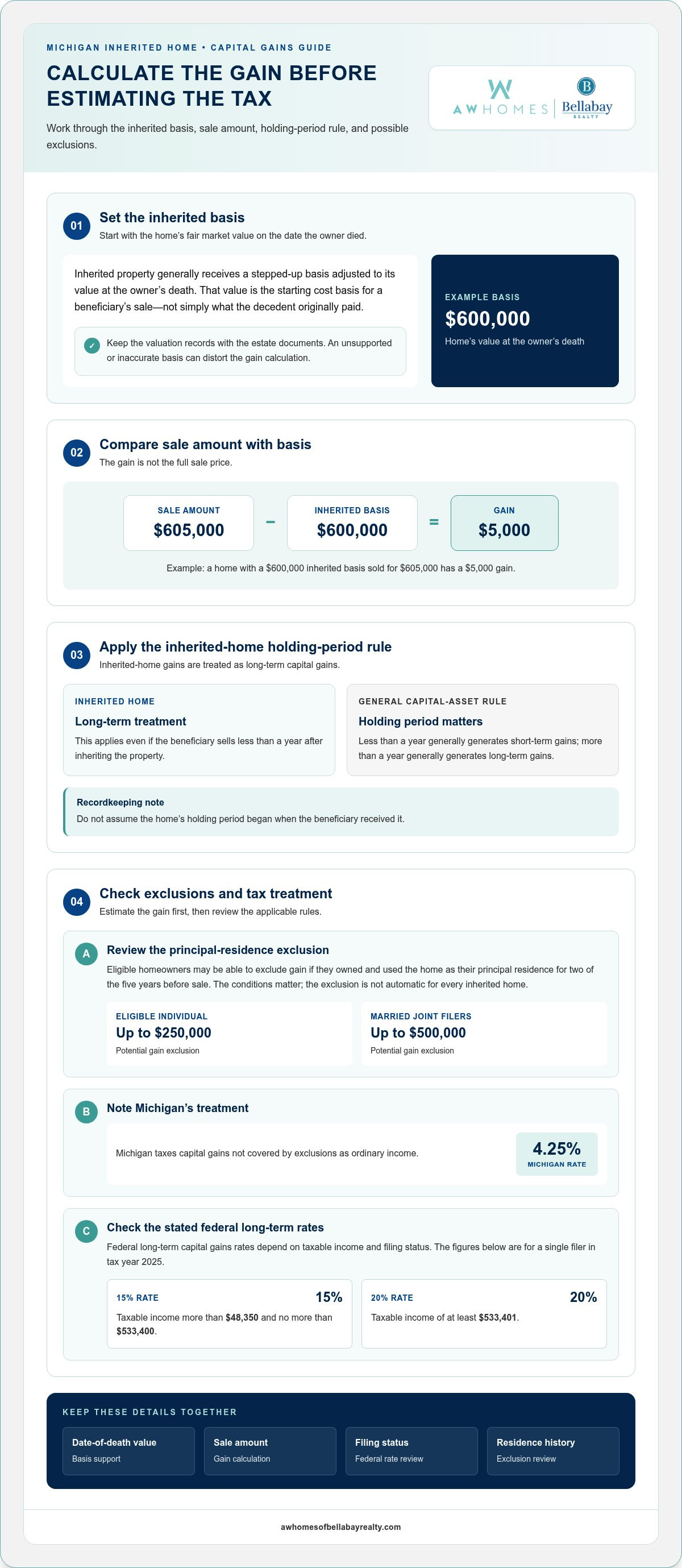
Find the home’s fair market value on the date the owner died. Inherited property generally receives a stepped-up basis adjusted to that value, which becomes the starting cost basis for a beneficiary’s sale. For example, if a home was worth $600,000 at death, the inherited basis is generally $600,000, even if the decedent bought it decades earlier for much less.
How is the cost basis of inherited property determined in Michigan? It’s generally the property’s fair market value at the owner’s death. Keep the valuation records with the estate documents, since an unsupported or inaccurate basis can distort the gain calculation.
-
Calculate Capital Gains on the Sale
Compare the sale amount with the inherited basis to estimate the gain. A home with a $600,000 basis sold for $605,000 has a $5,000 gain. The gain is not the full sale price. How is capital gains tax calculated when selling inherited real estate? Calculate the gain first, then consider the applicable federal and Michigan tax treatment.
Michigan taxes capital gains not covered by exclusions as ordinary income at 4.25%. Federal long-term capital gains rates depend on taxable income and filing status. For tax year 2025, a single filer’s rate is 15% when taxable income is more than $48,350 and no more than $533,400. It is 20% at taxable income of at least $533,401.
-
Distinguish Short-Term and Long-Term Gains
Classify the gain before estimating federal tax. Inherited-home gains are treated as long-term capital gains even if the beneficiary sells less than a year after inheriting the property. That differs from the general rule: capital assets held less than a year generate short-term gains, while assets held more than a year generate long-term gains.
Use the long-term treatment when organizing the sale records. Don’t assume the home’s holding period began when the beneficiary received it.
- Review whether a principal-residence exclusion may apply. The IRS says a home-sale exclusion may allow eligible homeowners to exclude up to $250,000 of gain, or $500,000 for married joint filers, if they owned and used the home as their principal residence for two of the five years before sale. The conditions matter, so don’t treat the exclusion as automatic for every inherited home.
Separate the basis, sale amount, filing status, and residence history in your records. For a broader view of whether the property fits your financial plans, explore inherited-home investment considerations.
Probate timelines, creditor claims, and inventory fees
Start by confirming how the decedent’s Michigan real estate passed to others and who has authority to transfer it. Probate status, creditor claims, and required filings can affect the route to closing.
-
Review Probate Requirements and Timelines
Check whether the home passed through a trust or joint ownership with rights of survivorship; those transfers might avoid probate. Otherwise, probate is usually needed to transfer the home to an heir before a sale. Simple, uncontested informal probate often closes in 5 to 9 months, while formal cases commonly take 9 to 12 months. An estate generally can’t close earlier than five months after appointment of the personal representative.
Can an executor or heir sell inherited property in Michigan before probate is complete? If probate is required, the transfer to heirs generally must be completed before a sale. A personal representative whose Letters of Authority include the power to sell real estate can petition the court to approve a sale in the estate’s best interests.
-
Address Creditor Claims and Inventory Fees
Track the creditor-notice period and inventory deadline as soon as a personal representative is appointed. Creditors generally have four months from published notice to present claims. The representative generally has 91 days after appointment to prepare the estate inventory, unless the court sets another deadline. Michigan probate courts charge a graduated inventory fee based on inventoried estate value under MCL 600.871.
If paying that fee would cause genuine hardship, the representative may petition for a reduction or waiver under MCL 600.880b. Don’t treat the home’s sale proceeds as immediately distributable: estate debts, expenses, and court requirements affect what remains for beneficiaries.
- Prepare the title-transfer documents before setting a closing date. After probate, the deed transferring an inherited Michigan home is usually filed with the county register of deeds. A sale may require a certified copy of the death certificate and court-issued documents establishing the heir’s legal right to the property.
What steps are required to transfer title and close on an inherited Michigan property? Confirm who is authorized to sell, gather the death certificate and court documents, complete the transfer deed, and file it with the local register of deeds. Keep the probate order and deed details aligned so the title records clearly show the transfer.
- Coordinate early if heirs live in different states. Distance can make collecting signatures and estate records more involved, so identify who needs to sign and how documents will reach the closing. If the decedent’s main estate is being handled elsewhere, include the possibility of ancillary probate in the title-transfer review. The property’s location and existing estate proceedings shape that question. For heirs managing affairs from afar or navigating real estate decisions across different markets, consulting professional resources like resouthsound.com can offer valuable guidance on regional transactions.
Informal probate Letters of Authority can typically arrive within a few days to two weeks after filing. Formal probate typically adds four to eight weeks before those letters issue. These milestones can help heirs plan paperwork and sale preparation without assuming the home can transfer automatically.
How Does Proposal A Uncapping Affect an Inherited Michigan Home?
Before deciding what to do with an inherited home, identify whether the transfer changes its taxable value. Check the family-transfer exemption and file the required affidavit on time.
- Review the property’s taxable-value history and the transfer details. Michigan Proposal A limits annual taxable-value increases while the same owner holds the property, subject to the applicable rules. A transfer of ownership can trigger uncapping, resetting taxable value to the state equalized value for the calendar year following the transfer. The Michigan Legislature describes this reset in the General Property Tax Act.
For an inherited home, compare the deceased owner’s relationship to the recipient with the exemption criteria. A transfer may qualify for an exemption, so don’t assume that inheritance automatically uncaps the property. The transfer’s purpose and how the home will be used afterward matter.
-
Check Family-Transfer Exemptions
Determine whether the recipient qualifies as a close family member under Michigan’s exemption rules. The close-family exemption has applied since December 31, 2014, to qualifying transfers of residential real property. A transfer to a decedent’s spouse is excluded from the definition of transfer of ownership under MCL 211.27a(6).
For other qualified-relative transfers, the exemption under MCL 211.27a(6)(f) and (7)(u) applies only if the property isn’t used commercially after conveyance. A family agreement to keep the home residential doesn’t replace the statutory conditions. Record the relationship and intended use when preparing transfer documents.
-
File the Property Transfer Affidavit
Submit Property Transfer Affidavit Form 2766 to the city or township assessor within 45 days of the transfer. Filing is required even when the new owner believes a family exemption applies. Use the transfer date to calculate the deadline, and retain a copy with the deed and inheritance records.
The affidavit reports the ownership change and helps the assessor determine whether uncapping applies. If the assessor or Michigan Department of Treasury requests proof of a qualifying family relationship, provide it within 30 days of the request. Keep the relationship records consistent with the names and transfer details on the deed.
- Address late filing promptly. Michigan charges $5 per day for a late residential Property Transfer Affidavit, capped at $200. Missing Form 2766 can also delay the assessor’s review of the transfer and exemption. A false exemption claim carries a $200 fine, so describe the relationship and property use accurately.
If an attorney is helping with the estate transfer, coordinate the affidavit deadline with the deed preparation. The typical sequence is to document the conveyance, submit Form 2766, and preserve evidence supporting any exemption. That creates a clear record for the assessor and helps the family understand the home’s property-tax treatment before a sale or change in use.
Michigan property tax uncapping after inheritance
After an inheritance or sale, Michigan taxable value may remain capped or reset, depending on the transfer and any exemption. Track the ownership change and the home’s use, because those details shape the property-tax impact.
-
Review Property Tax Uncapping After Inheritance
Compare the inherited home’s taxable value with its state equalized value (SEV), then identify the transfer year. Michigan generally limits annual taxable-value increases to the lesser of inflation or 5 percent while the same owner holds the property. After a transfer of ownership, the taxable value generally resets to SEV for the calendar year following the transfer, according to the Michigan Legislature.
For example, a qualifying child inherits land with a $45,000 taxable value and $140,000 SEV. The taxable value remains $45,000 while the child owns it, under the stated example. The key is whether the transfer qualifies for an exemption, not simply whether the estate transferred ownership.
-
Track Taxable Value Changes After Inheritance or Sale
Keep the deed, Property Transfer Affidavit, assessment notices, and any exemption documents together. Compare each notice’s taxable value and SEV, then note the year the ownership transfer occurred. Michigan’s General Property Tax Act, MCL 211.27a, governs uncapping after a transfer, including inheritance. A sale to a new owner can trigger a reset for the calendar year following that sale.
How do Michigan property taxes and taxable value change after inheritance or sale? A qualifying family transfer may preserve the prior taxable value, while a nonexempt ownership transfer generally resets taxable value to the following year’s SEV. After a later sale, the buyer’s taxable value may reset under the transfer rules.
- Confirm whether the inherited property meets Michigan’s close-family exemption conditions. Qualifying residential transfers can avoid uncapping, but the property must not be used for commercial purposes after conveyance. Record how the home will be used and retain documents showing the recipient’s relationship to the decedent. A later change in use can affect whether the exemption remains applicable.
Also distinguish a property-tax transfer from estate tax. The taxable-value reset concerns local property assessment; it is separate from federal estate tax and Michigan’s former inheritance tax. A death certificate and deed can help establish the ownership timeline, while the assessor’s records show the property’s taxable value and SEV.
- Use the likely tax treatment when weighing whether to sell, keep, or invest in the home. A family transfer that preserves taxable value may affect carrying costs, while a later nonexempt sale can change the next owner’s assessment. For guidance on how the property fits your investment plans, discuss inherited-home investment strategy with AW Homes of Bellabay Realty.
AW Homes of Bellabay Realty: Residential Listing Services
AW Homes of Bellabay Realty can help heirs move from estate decisions to a thoughtful sale plan through Residential Listing Services. Once ownership and authority to sell are clear, listing guidance can help you assess the home’s presentation, consider its position in the West Michigan market, and plan next steps with the other heirs.
If your family is still weighing whether to sell or hold the property as an investment, Real Estate Investment Consulting can help frame the decision around your goals. For heirs preparing to sell, the focus shifts to a clear listing strategy and a coordinated transition, while keeping the property’s role in the family’s next chapter in view.
Contact AW Homes of Bellabay Realty to discuss your inherited home, or visit awhomesofbellabayrealty.com.
Choose a Next Step That Fits Your Plans
An inherited home can represent a fresh decision for the family, not just another transaction. Once the heirs agree on what comes next, turn that decision into a practical plan: prepare the property for sale, explore a new home, or coordinate a move connected to a life change. A clear direction can help everyone focus on the same outcome.
For families selling an inherited property in Michigan, AW Homes of Bellabay Realty offers Residential Listing Services to support the sale. If your plans also involve a purchase or a move, Buyer Agency Services and Relocation Assistance can support that next chapter. The right support depends on the direction you choose.
Contact AW Homes of Bellabay Realty to discuss your next step. You can move forward with a thoughtful plan, one decision at a time.
Frequently Asked Questions
How long does probate take in Michigan?
Michigan probate generally takes seven to 12 months. Simple, uncontested informal estates often close in roughly 5 to 9 months, while formal cases commonly take 9 to 12 months. Contested matters can extend to 12 to 24 months or longer. Informal Letters of Authority may arrive within a few days to two weeks, but that is only an early milestone, not the full estate timeline.
Is there a time limit on selling inherited property?
There isn’t a single sale deadline tied to inheriting a home. The key timing issue is whether the seller has legal authority to transfer it: when probate is required, the probate step generally must be completed before the sale. Meanwhile, the estate must keep track of property taxes, insurance, maintenance, and any mortgage obligations. Those ongoing responsibilities can make the family’s decision about timing financially important.
When do capital gains taxes kick in?
Capital gains tax may apply when the sale produces a gain above the inherited property’s tax basis. Inherited homes receive long-term capital-gain treatment even if sold less than a year after inheritance. For tax year 2025, the federal long-term rate for a single filer is 15% when taxable income exceeds $48,350 and is no more than $533,400. Michigan taxes gains not covered by exclusions as ordinary income at 4.25%.
If I move into the inherited house, do I get the Principal Residence Exemption automatically?
No. Moving in doesn’t automatically apply Michigan’s Principal Residence Exemption (PRE); file the PRE affidavit with the local assessor. The filing deadline is June 1 for the summer levy or November 1 for the winter levy. An eligible owner-occupied home may be exempt from up to 18 mills of local school operating tax. If you later rent the inherited home, remove the PRE using Form 2602.
How does inheriting real estate in Michigan work through probate or a trust?
A home held in a trust or jointly with rights of survivorship might pass without probate. The trust’s terms or recorded ownership determine who receives the property and who can act for it. If neither applies, probate is usually needed to transfer the home to heirs. After probate, the deed transferring the property is usually filed with the county register of deeds, creating a public record of ownership.
What Michigan taxes apply when selling an inherited property?
Potential taxes include capital gains tax, property tax, and real estate transfer tax. Michigan’s inheritance tax applies only to inheritances from people who died on or before September 30, 1993; Michigan estate tax hasn’t applied to deaths since 2004. Michigan’s real estate transfer tax is $3.75 for each $500 of sale price. Capital gains tax depends on the gain and applicable exclusions, not simply the home’s full sale price.
What documents are needed to sell inherited property in Michigan?
Gather a certified copy of the death certificate and court-issued documents showing the seller’s legal right to the home, when probate applies. The deed and ownership records help establish who can convey title. The recipient must also file Property Transfer Affidavit Form 2766 with the city or township assessor within 45 days of transfer. Keep estate and transfer records together, and disclose known property defects when required.
How do multiple heirs agree to sell inherited property in Michigan?
Start by identifying every co-owner and agreeing on the sale terms, including the asking strategy, accepted offer, and distribution of net proceeds. One co-owner generally cannot sell the entire jointly owned home without the others’ cooperation or legal authority. If agreement fails, a co-owner can bring a partition action in the appropriate Michigan trial court. The court may divide the property or order a sale and distribute proceeds according to ownership shares.


