

Yes, eligible veterans may be able to build a home with VA financing, but construction financing follows a different path from buying a completed home. This VA home loan guide for veterans in Grand Rapids explains what to know about building, loan benefits, and closing costs before choosing your next step.
It’s reasonable to seek clarity before committing to a home design, lot, or financing plan. Building can involve extra coordination, so it’s important to understand how VA financing fits the process from the start.
You’ll learn how VA construction financing works in broad terms, how the program’s benefits and funding fee may affect your purchase, and which costs can arise at closing. The guide also explains how an experienced real estate agent can help you assess properties, coordinate your home search, and make informed decisions in the Grand Rapids area.
Key Takeaways
- VA financing may support a home build, but the construction process differs from purchasing a completed home.
- Eligible borrowers may benefit from no down payment and no private mortgage insurance, subject to loan terms.
- Understand how the VA funding fee and other closing costs can affect your budget before choosing a financing path.
- A real estate agent familiar with VA purchases can help you assess property options and navigate the Grand Rapids home search.
Can You Build a Home with a VA Loan?
Building may be possible with VA construction financing, though the loan structure and participating lender shape the process. Start by understanding your eligibility, construction plan, and intended use of the property.
Eligibility and Certificate of Eligibility
VA home loan eligibility is the service-based qualification that determines whether you can use the benefit. Active-duty service members generally need at least 90 continuous days of service to meet the stated VA home loan eligibility requirement, according to the U.S. Department of Veterans Affairs. Other routes include 181 consecutive days during peacetime, six years in the National Guard or Reserve, or qualifying Title 32 service. Certain surviving spouses may also qualify.
A Certificate of Eligibility (COE) verifies eligibility for VA-backed financing. Request it online through the VA, through a lender, or by mail using VA Form 26-1880. Getting the COE helps clarify access to the benefit before you plan financing or make an offer.
Appraisals and Property Requirements
A VA appraisal estimates a property’s value and checks whether it meets minimum property requirements for safety, sanitation, and soundness. It doesn’t replace a home inspection, which provides a separate, closer assessment of the property’s condition. For a proposed build, the appraisal and property review relate to the completed home, so the plans and construction details matter.
VA purchase loans can cover a property with up to four units if you occupy it as your primary residence. This can make a qualifying multi-unit property an option alongside a single-family home.
In Grand Rapids, property taxes are approximately 1.3%-1.6% in the metro area; homeowners insurance depends on the home and selected coverage. Include both in your ownership budget, since they affect monthly costs beyond principal and interest.
Veterans in Grand Rapids can request a Certificate of Eligibility (COE) online through the VA or work with a lender that handles VA-backed loans. Private lenders provide VA loans, which are guaranteed by the U.S. Department of Veterans Affairs, so lender participation is part of arranging financing. Ask about the construction-loan structure early, before settling on a lot or build plan.
VA loan benefits, including no down payment and no PMI
For eligible borrowers, VA financing can reduce upfront cash needs and eliminate the need for private mortgage insurance. The details affect your payment and purchase budget.
Zero-Down-Payment Benefit
A VA-backed purchase loan may require no down payment if the sales price doesn’t exceed the home’s appraised value. This can help eligible buyers preserve savings for moving, repairs, or other homeownership expenses. Although the VA doesn’t require a down payment, a lender may. The appraisal and lender’s terms therefore matter when estimating how much cash to bring to closing.
Zero down doesn’t mean zero costs: closing expenses and the VA funding fee may still affect your total borrowing. Your Certificate of Eligibility helps establish access to the benefit, while credit and lender requirements also shape the financing decision.
VA-Guaranteed Loan Benefits
The U.S. Department of Veterans Affairs guarantees a portion of VA home loans made by private lenders, usually about 25%. That backing supports the program, while borrowers still apply through a lender and repay the mortgage under its terms. VA-guaranteed loans don’t require private mortgage insurance, which conventional mortgages often require when the down payment is below 20%.
Eligible borrowers can use the benefit more than once. A prior VA loan doesn’t automatically rule out another purchase, though available entitlement and the new loan’s terms affect the transaction. Qualifying spouses may also access VA home loans. For a Grand Rapids buyer weighing a purchase against an investment strategy, the property’s intended use and occupancy should guide the financing plan.
VA loans have no loan limit for borrowers with full entitlement. That doesn’t remove the lender’s assessment of credit, income, the property, or its appraised value. These factors still inform approval and affordability. VA loans typically have more flexible credit requirements than conventional mortgages, but lender standards influence the final decision.
Compare the full monthly payment, not just the down payment: principal, interest, taxes, and homeowners insurance all shape affordability. If you’re focused on long-term returns, Real Estate Investment Consulting can help you consider the property alongside the financing benefits.
Closing costs
VA closing costs include lender charges and other transaction expenses, separate from your down payment. The funding fee, any exemptions, seller concessions, and interest rate all affect the amount you finance and your monthly payment.
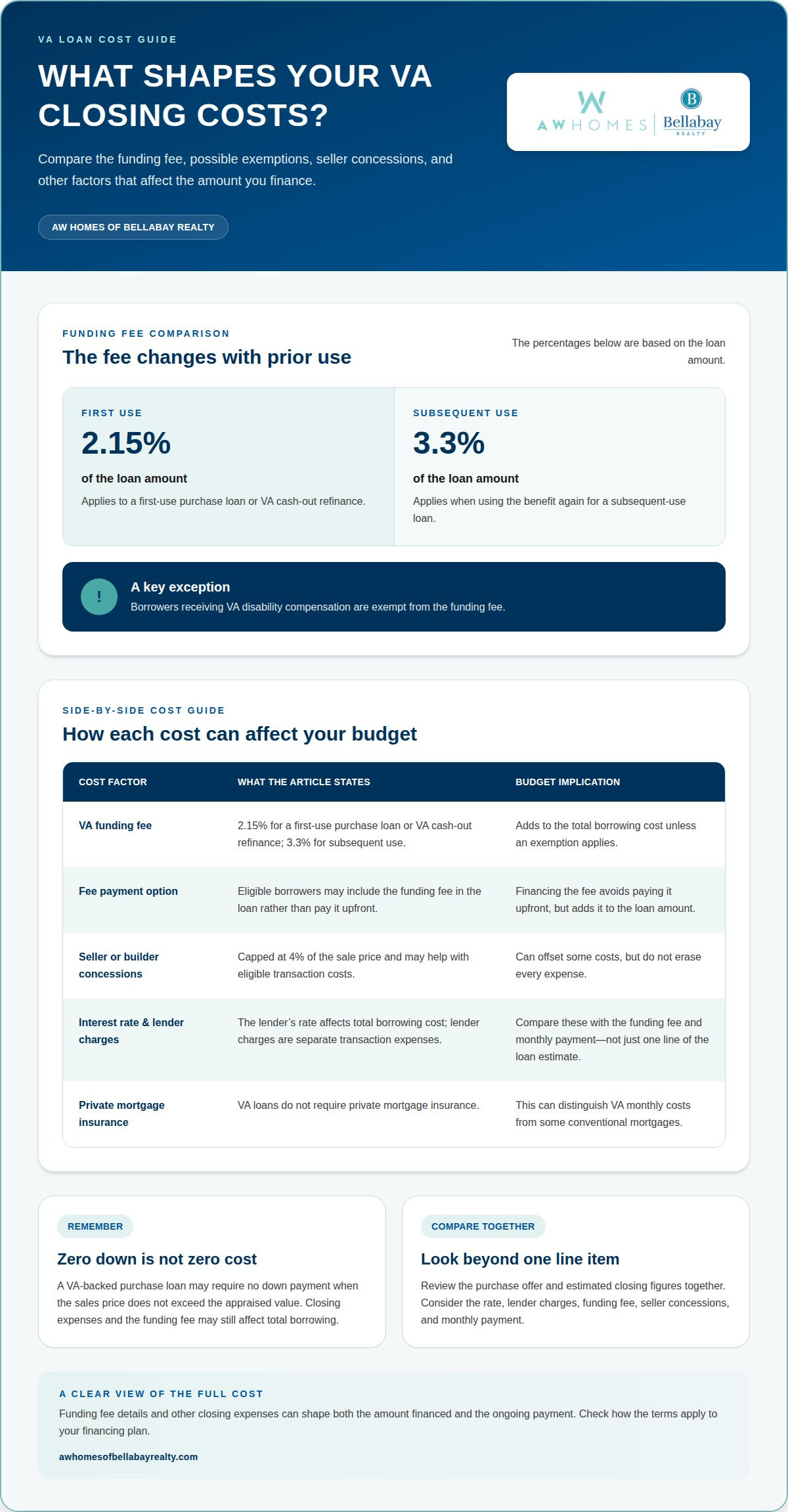
According to the U.S. Department of Veterans Affairs, the funding fee for a first-use purchase loan or VA cash-out refinance is 2.15% of the loan amount. For a subsequent use of the benefit, the fee is 3.3% of the loan amount, according to the U.S. Department of Veterans Affairs. Borrowers receiving VA disability compensation are exempt from the funding fee. Eligible borrowers may include the fee in the loan rather than paying it upfront.
Seller concessions, including builder concessions, are capped at 4% of the sale price, according to the U.S. Department of Veterans Affairs. These concessions can help with eligible transaction costs, but they don’t erase every expense. Review the purchase offer and estimated closing figures together so you understand which costs the seller may cover and which remain yours.
The lender’s interest rate affects the total borrowing cost. Compare the rate, lender charges, funding fee, and monthly payment, rather than focusing on just one line of a loan estimate. VA loans don’t require private mortgage insurance, which can distinguish their monthly costs from those of some conventional mortgages.
For a VA purchase, borrowers typically begin with lender preapproval, submit an offer, and provide documents for underwriting. The lender orders an appraisal, completes its review, and prepares final figures for closing. VA purchases commonly take 50-55 days to close, while ideal conditions may allow about 30 days. Timing depends on appraisal, underwriting, title work, and how quickly requested documents are completed.
Before signing, compare the closing disclosure with the agreed offer and lender estimate. Confirm the funding fee or exemption, seller concessions, prepaid homeowners insurance, property taxes, and cash due at closing. Reviewing these details helps you understand the full cost of the purchase before ownership transfers.
Finding a VA-experienced real estate agent
A real estate agent familiar with VA purchases understands how financing considerations intersect with the property search, offer, appraisal, and closing. In Grand Rapids, Ada, Caledonia, and East Grand Rapids, that practical coordination can help veterans focus on homes that fit their plans, not just their loan preapproval.
Look for support that connects your home search to the VA purchase process. An agent can help identify suitable homes, shape an offer around the property and your priorities, and coordinate timing with your lender. The lender handles financing decisions, while the agent supports the real estate transaction. Neither role replaces the other.
Useful experience shows in the details. An agent familiar with VA purchases can help you consider how the appraisal fits your offer timeline, communicate property concerns, and keep transaction milestones organized. If a home’s condition raises questions, for example, the appraisal and a separate inspection serve different purposes. Clear communication helps you understand each step without confusing one review for another.
Military moves can involve changing schedules, unfamiliar neighborhoods, and decisions made from a distance. An agent familiar with relocation needs can organize virtual or in-person showings around your circumstances and help compare areas by commute, housing type, and daily priorities. The same thoughtful approach can support eligible surviving spouses considering a home purchase.
Experience also means communicating plainly about the offer, lender coordination, and how factors such as the interest rate affect your overall budget. A no-down-payment option can preserve available cash, but it doesn’t determine which home suits your needs. Strong guidance connects financing choices with the property, location, and your long-term plans.
For a VA home loan guide for veterans in Grand Rapids, the practical takeaway is to seek coordinated real estate support that understands VA purchase steps and local housing choices. If the property is also part of an investment plan, discuss its investment role as you assess its fit and future use.
AW Homes of Bellabay Realty
AW Homes of Bellabay Realty supports your next move through Buyer Agency Services, Residential Listing Services, Relocation Assistance, and Real Estate Investment Consulting. If you’re preparing to buy in Grand Rapids, Ada, Caledonia, or East Grand Rapids, Buyer Agency Services can support your property search and offer decisions while you coordinate financing with your lender.
For a military relocation, Relocation Assistance can help organize your real estate transition around your housing goals. If you’re selling a home or weighing a property as an investment, Residential Listing Services and Real Estate Investment Consulting can support those distinct decisions.
Turn to AW Homes of Bellabay Realty when you’re ready to plan a purchase, relocation, sale, or investment decision. Contact AW Homes of Bellabay Realty to discuss your real estate goals.
Shape Your Next Move with Confidence
A VA home loan guide for veterans in Grand Rapids can clarify your options, but your next step is personal: define the kind of home and community that fit your plans. A thoughtful property search starts with priorities such as location, daily routines, and whether this move marks a new beginning or a transition for your household.
AW Homes of Bellabay Realty can support your next stage through Buyer Agency Services, Residential Listing Services, and Relocation Assistance. Whether you’re preparing to purchase, sell, or move to Grand Rapids, Ada, Caledonia, or East Grand Rapids, real estate guidance can help bring your plans into focus alongside your lender’s financing process.
Take the next step at your own pace. Contact AW Homes of Bellabay Realty to discuss your real estate plans and explore a path that fits your next chapter.
Frequently Asked Questions
Am I Eligible for a VA Loan?
Eligibility depends on your service history or qualifying connection to a veteran. Active-duty members generally need at least 90 continuous days of service, according to the U.S. Department of Veterans Affairs. National Guard and Reserve members may qualify through other service routes, and some surviving spouses may be eligible. A Certificate of Eligibility establishes your program eligibility; a lender separately reviews your finances and application.
Are VA Loans Risky?
A VA loan isn’t inherently risky, but taking on a mortgage requires a realistic plan for monthly expenses and long-term repayment. Consider how taxes, insurance, maintenance, and changes in household income could affect your budget. For example, a payment that fits now may become harder to manage after a relocation or change in family needs. Assess the full cost of ownership, not just the loan’s upfront requirements.
How Long Does the VA Loan Process Take?
A VA purchase commonly takes about 50-55 days to close. The timeline runs from lender application and document review through property appraisal, underwriting, and final closing preparations. A purchase in Grand Rapids may take longer if an appraisal, title work, or required paperwork takes extra time. Build flexibility into your move plans, especially if you’re coordinating a military relocation or a home sale with the purchase.
If I've Previously Used a VA Loan, Can I Use It Again?
Yes, eligible borrowers can use VA loan benefits more than once. Your remaining entitlement and existing VA loan obligations help determine how a later purchase can be structured. For example, selling a home financed with a VA loan may change your available entitlement for another purchase. A lender can assess your existing loan, entitlement, and the intended use of the new home together.
Is the VA Loan a Good Option?
A VA loan may suit an eligible buyer whose plans align with its occupancy and financing requirements, but the right fit depends on the property and household budget. Compare the full loan terms with your priorities, including how long you expect to live in the home and your other monthly obligations. In the Grand Rapids area, buyers considering Ada, Caledonia, or East Grand Rapids can weigh neighborhood needs alongside affordability.
What Are the Income Requirements?
There isn’t one income figure that fits every VA borrower; lenders assess whether documented income supports the proposed housing payment and other debts. They may consider income stability, recurring obligations, and the loan’s full monthly cost. For service members, some lenders can gross up non-taxable Basic Allowance for Housing by 25% for qualification. The amount considered depends on the lender’s review of your application and income documents.


