
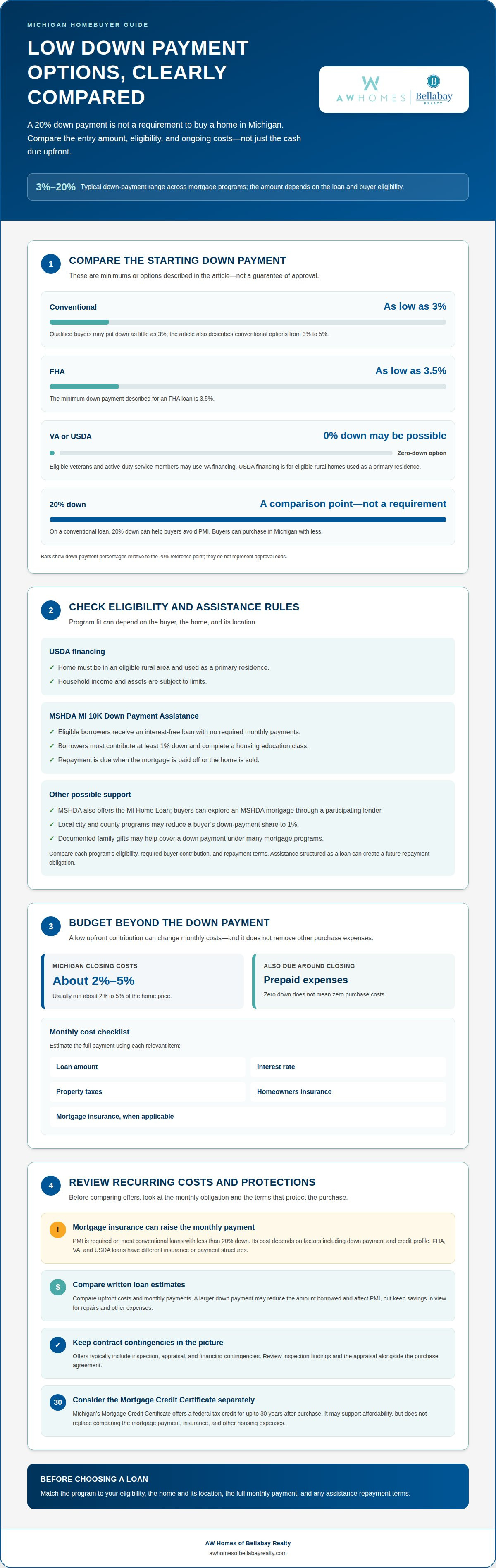
A 20% down payment isn’t a requirement for buying a home in Michigan. Learning how to buy a house with a low down payment in Michigan starts with comparing loan options: qualified buyers may put down as little as 3% with some conventional loans or 3.5% with an FHA loan, while eligible VA and USDA borrowers may qualify for zero-down financing.
It’s understandable to focus on the down payment, but the amount due upfront is only part of the picture. With less than 20% down, most loans require private mortgage insurance, which can add to monthly costs. You’ll also see why matching a loan program to the home, your finances, and your plans matters as much as finding a lower starting amount.
Key Takeaways
- Compare loan programs and assistance options to understand which may fit your finances and the home you’re considering.
- Factor mortgage insurance into your monthly budget, not just the amount you’ll bring to closing.
- Learn how a real estate agent can help connect your financing plan with property choices, offer terms, and local market context.
How Much Down Payment Is Required to Buy a Home in Michigan?
Michigan buyers generally don’t need a 20% down payment. The amount depends on the mortgage program, and down payments typically range from 3% to 20% of the purchase price. FHA loans can require as little as 3.5% down, while eligible USDA Rural Development loans may allow 0% down. Eligibility, property location, and whether the home will be your primary residence all affect which options fit.
USDA financing is limited to eligible rural homes used as a primary residence, and household income and assets are subject to limits. According to the Electronic Code of Federal Regulations, Michigan USDA Section 502 Direct Home Loans are governed by the Housing Act of 1949, as amended, and 7 CFR, Part 3550.
Michigan’s State Housing Development Authority offers the MI Home Loan and MI 10K Down Payment Assistance. The MI 10K program provides eligible borrowers an interest-free loan with no required monthly payments, but borrowers must contribute at least 1% down. A housing education class is required. The assistance loan is repaid when the borrower pays off the mortgage or sells the home.
What Michigan down payment assistance programs are available, and who qualifies? Eligible buyers may access MSHDA’s MI 10K assistance or local programs, with eligibility shaped by program rules, household circumstances, and property location.
What are the risks and repayment rules for down payment assistance loans in Michigan? Assistance structured as a loan can create a future repayment obligation, even when monthly payments aren’t required. For MI 10K, repayment is due when the mortgage is paid off or the home is sold; review that timing alongside the main home loan before deciding.
MSHDA housing education helps prepare buyers for homeownership and supports them throughout the mortgage. To explore an MSHDA mortgage, buyers can apply through a participating MSHDA lender. Local city and county programs may also reduce a buyer’s down payment share to 1%, while documented family gifts may help cover a down payment under many mortgage programs. Compare each program’s eligibility, required buyer contribution, and repayment terms before making an offer on a home.
Mortgage insurance and monthly payment considerations
A low down payment can make buying a house in Michigan more accessible, but it can also affect your monthly costs. Compare loan types, mortgage insurance requirements, and any potential tax benefits to understand what fits your budget.
Low-Down-Payment Mortgage Options
A low-down-payment mortgage lets buyers purchase with less cash upfront, while the loan program shapes eligibility and ongoing costs. Michigan buyers may find conventional options with down payments from 3% to 5%, FHA loans requiring as little as 3.5%, and zero-down options through VA or USDA programs. Eligible veterans and active-duty service members may use VA financing. USDA financing serves eligible rural homes used as primary residences.
Zero down doesn’t mean zero purchase costs. You’ll still need to plan for closing costs and prepaid expenses, and your lender will review your credit, income, debts, and the property. Before choosing a loan, compare the full monthly payment, not just the cash needed upfront.
Mortgage Type Minimums and Insurance
Conventional loans may allow qualified buyers to put down as little as 3%. Private mortgage insurance, or PMI, is required on most loans with less than 20% down. That insurance adds to the monthly payment, so a smaller initial contribution can mean higher recurring costs.
A 20% down payment can help buyers avoid PMI on a conventional loan, but it isn’t a general requirement to buy in Michigan. FHA, VA, and USDA loans have different eligibility rules and insurance or payment structures. Compare each loan’s minimum down payment and monthly obligations before choosing.
Michigan’s Mortgage Credit Certificate offers homebuyers a federal tax credit for up to 30 years after purchase. It may support the broader affordability picture, but it doesn’t replace comparing the mortgage payment, insurance, and other housing expenses. Buyers should consider how a tax credit fits their finances alongside the lender’s approval terms.
Estimate your monthly costs using the loan amount, interest rate, property taxes, homeowners insurance, and any mortgage insurance. PMI costs depend on factors such as your down payment and credit profile. A larger down payment may reduce the amount you borrow and affect PMI, but you’ll also want savings for repairs and other expenses. Compare written loan estimates to see your upfront costs and monthly payment clearly before making an offer.
These examples show the upfront contribution before closing costs, prepaid expenses, and any assistance are applied:
Michigan closing costs usually run about 2% to 5% of the home price. Buyers should also budget for prepaid costs, which may include items collected around closing. The monthly mortgage payment depends on the loan amount, interest rate, property taxes, homeowners insurance, and mortgage insurance when applicable.
What upfront and monthly costs should Michigan buyers budget for besides the down payment? Plan for closing costs and prepaid expenses upfront, then account for your mortgage payment and ongoing housing costs. Your income, loan terms, interest rate, and the home’s property taxes and insurance all affect the monthly budget.
Section 8 homeownership assistance may help eligible households buy rather than rent. The household’s contribution toward a homeownership voucher mortgage can vary with its circumstances and income. Assistance can generally continue for 10 to 15 years if household circumstances and income remain similar. The voucher’s amount is tied to what it would pay toward rent, so household income and program eligibility matter to the financial plan.
Protect your purchase with clear contract terms. An offer typically includes contingencies for inspection, appraisal, and financing. An inspection helps identify the property’s condition, while an appraisal helps the lender assess its value after acceptance. Review the inspection findings and appraisal alongside the purchase agreement before moving toward closing. Contract contingencies can provide a path to address issues, while financing protections relate to obtaining your home loan. Together, these steps help you weigh the property and its costs, not just the initial down payment.
Working with a real estate agent
A real estate agent can help connect your financing limits with practical home choices. Share your preapproval range, planned down payment, and monthly budget before touring homes. This helps focus your search on properties that fit your loan amount and leave room for taxes, insurance, and closing costs. In Grand Rapids, Ada, Caledonia, and East Grand Rapids, neighborhood context can also help you compare homes beyond their asking prices.
Prepare for the lender’s application as you begin your home search. Mortgage preapproval may require proof of income, tax returns, bank statements, and debt information. An agent can organize your property search around your financing details while the lender evaluates your credit and ability to qualify. If you’re considering an MSHDA loan program, keep its eligibility requirements in mind as you look at homes.
Market conditions can shape offer strategy. In October 2025, Michigan homes averaged 34 days on the market; 27.9% of sold homes closed above list price. Those figures provide context, not a prediction for a particular neighborhood or listing. An agent can help you assess comparable properties and consider an offer that fits your budget, rather than stretching simply to compete.
After your offer is accepted, the lender may order an appraisal to assess the home’s value. The purchase offer typically includes contingencies for inspection, appraisal, and financing. An agent can help you track contract milestones and understand how inspection findings or the appraisal may affect your next decisions. Before closing, the final walkthrough lets you check that the property remains in its expected condition.
Keep the plan grounded in three numbers: your available cash, your approved loan amount, and the monthly payment you can manage. For guidance that brings Michigan property choices and your budget together, plan your home search with local real estate guidance.
AW Homes of Bellabay Realty: Residential Listing Services
AW Homes of Bellabay Realty helps buyers in Grand Rapids, Ada, Caledonia, East Grand Rapids, and surrounding West Michigan communities connect their financing plan with a practical home search through Buyer Agency Services. If you’re comparing homes with a set down payment and monthly budget, Angela Worth can help you consider property options, neighborhood context, and offer terms together. This keeps your decision grounded in both your financial plan and the life you’re building.
Relocation Assistance helps buyers coordinate a move while considering a new home, while Real Estate Investment Consulting supports buyers evaluating a property as an investment. If selling your current home is part of your transition, Residential Listing Services can help with that step too.
For guidance on your next home search, contact AW Homes of Bellabay Realty.
Shape Your Next Move With Confidence
The right home is more than a financing decision. It’s a place for the routines, relationships, and plans that shape your next chapter. Consider how a property fits your daily life and the flexibility you want to keep. That perspective can help you make your next decision intentionally.
Understanding how to buy a house with a low down payment in Michigan also means defining what matters beyond financing. As you consider how to buy a house with a low down payment in Michigan, think about your preferred communities, the features you need, and how the move fits your longer-term plans. Those priorities can guide a home search that feels personal, not rushed.
When you’re ready to explore your next move, connect with AW Homes of Bellabay Realty and begin planning a home search around your goals. Your next chapter can start with a thoughtful first step.
Frequently Asked Questions
Which Programs Can I Buy a Home with No Money Down?
Eligible veterans and active-duty service members can use VA loans with no down payment. USDA Rural Development financing may also offer zero-down options to qualifying buyers purchasing an eligible rural home as their primary residence. Eligibility may depend on a buyer’s financial circumstances. For either option, the borrower and property must meet program requirements, so compare the criteria with your intended home and household finances.
Can You Use Gift Funds or Down Payment Assistance?
Yes. Many mortgage programs allow documented gifts from family members toward a down payment, and eligible buyers may use assistance programs to reduce upfront cash needs. Assistance may be a grant or a loan, so review the terms. A repayable assistance loan can affect your finances later, even if it doesn’t require monthly payments during homeownership.
Do You Really Need 20% Down?
No, Michigan buyers aren’t generally required to put 20% down. A smaller contribution can make buying possible sooner, though it may increase the amount borrowed and add mortgage insurance to monthly costs. Consider how much cash you would retain after closing, too. Keeping savings available for moving expenses, repairs, and other household needs can be part of a sound purchase decision.
How much may I borrow?
Your borrowing limit depends on your income, existing debt, credit profile, loan terms, and your lender’s approval criteria. Property expenses also affect affordability, so a home in Grand Rapids may create a different budget picture from one in Ada, Caledonia, or East Grand Rapids. A lender reviews your financial application and estimated housing costs to determine the loan amount you can pursue.
I would like to put down as little as possible; what program is best for that?
There isn’t one best program for every buyer. Eligible VA and USDA borrowers may have zero-down options, while qualified conventional borrowers may have low-down-payment choices. Start by matching your eligibility and intended property to the loan rules. Then compare the monthly payment, mortgage insurance, and any assistance repayment terms. The smallest initial contribution may not lead to the most manageable overall housing budget.
How much down payment assistance does the Michigan State Housing Development Authority offer?
The assistance is an interest-free loan with no required monthly payments, and the program requires a housing education class and a minimum buyer contribution. Repayment is due when the mortgage is paid off or the home is sold, so include this future obligation in your planning.


