

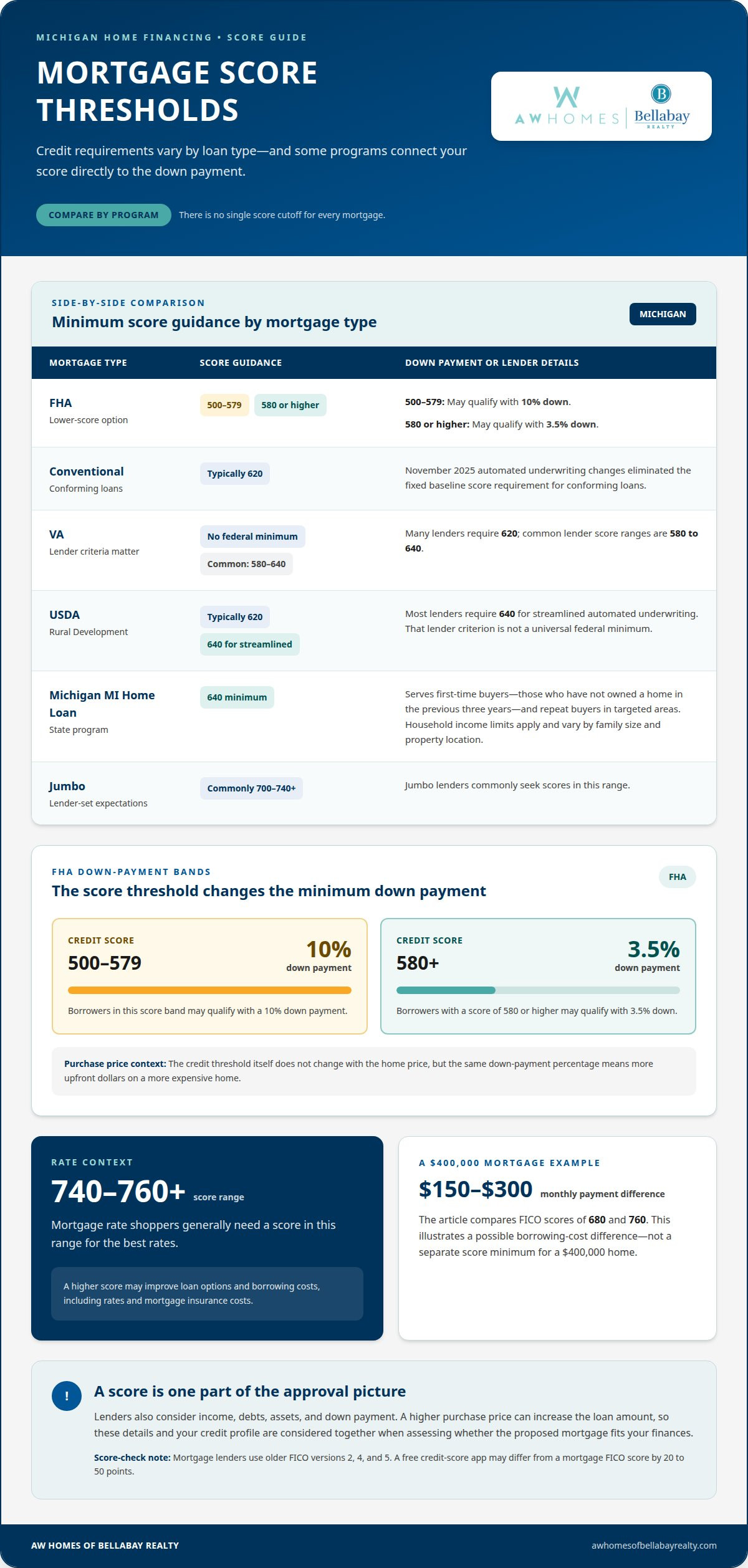
A lower credit score doesn't automatically close the door to buying a home in Michigan. The credit score needed to buy a house in Michigan depends partly on the mortgage type: FHA borrowers with scores from 500 to 579 may qualify with a 10% down payment, while those with scores of 580 or higher may qualify with 3.5% down. For the best mortgage rates, shoppers generally need a score of 740 to 760 or higher.
It’s understandable to focus on your credit score when planning a major purchase, but it’s only part of the picture. Lenders also consider income, debts, assets, and down payment. A higher score may improve your loan options and borrowing costs.
This guide explains how FHA credit-score thresholds relate to down-payment requirements, how purchase price can shape financing options, and how your score may affect mortgage rates. You’ll also learn what other financial details lenders weigh, so you can plan your next steps with greater clarity.
Key Takeaways
- Compare mortgage options by their credit requirements, not by a single universal score cutoff.
- See how purchase price, down payment, income, and debt work together to shape borrowing options.
- Learn which credit habits can strengthen your profile before you apply for a mortgage.
- Understand how FHA credit-score bands affect the down payment you may need to plan for.
What’s the minimum credit score to buy a house?
In Michigan, there is no single credit-score cutoff for every mortgage. The loan type determines the threshold, and your score can also affect your down payment, interest rate, and mortgage insurance costs.
Credit Scores and Mortgage Terms
A mortgage credit score helps lenders assess qualification and set loan terms. Its effect can extend beyond approval: a higher score can support better rates and lower mortgage insurance costs. Mortgage rate shoppers generally need 740 to 760 or higher for the best rates. Lenders use older FICO versions 2, 4, and 5, so a free credit-score app may differ from a mortgage FICO score by 20 to 50 points.
Minimum Scores by Mortgage Type
Minimums vary by loan type, so the right comparison is program-specific. Conventional mortgages typically require 620, although November 2025 automated underwriting changes eliminated the fixed baseline score requirement for conforming loans. VA loans have no federal minimum; many lenders require 620, and common lender ranges are 580 to 640. USDA loans typically start at 620; most lenders require 640 for streamlined automated underwriting. Michigan’s MI Home Loan requires 640, while jumbo lenders commonly seek 700 to 740+.
Options for Borrowers With Lower Scores
Yes, you can buy a house in Michigan with a score below 580 through some FHA financing. FHA guidelines allow scores from 500 to 579 with a 10% down payment; at 580 or higher, borrowers may qualify with 3.5% down. The score is only one part of approval. Lenders also consider income, debts, assets, the down payment, and other financial information. Those details help assess whether the proposed mortgage fits the borrower’s overall finances.
Credit Checks During Prequalification
A mortgage prequalification credit check gives a lender information to assess a possible loan. A hard check may temporarily lower a score by a few points for a short period. Credit bureaus bundle mortgage rate-shopping inquiries made within a 45-day window as one inquiry. This makes that window useful for comparing mortgage offers, while the lender still considers the wider application, including income, debts, and assets.
How purchase price relates to credit requirements
A higher purchase price does not automatically change a mortgage program’s credit-score threshold. It can increase the loan amount, making your income, debts, down payment, and credit profile important factors to consider together.
FHA Credit and Down-Payment Requirements
FHA’s credit bands connect the borrower’s score to the minimum down payment, helping buyers understand the upfront funds required. Scores from 500 to 579 may qualify with 10% down; scores of 580 or higher may qualify with 3.5% down. The same percentage means a larger down payment on a more expensive home, even though the credit threshold itself doesn’t change.
Michigan’s MI Home Loan program has a 640 minimum score. It serves first-time buyers, defined as people who haven’t owned a home in the previous three years, and repeat buyers in targeted areas. Household income limits also apply and vary by family size and property location.
Credit Requirements for a Higher-Priced Home
A $400,000 mortgage illustrates how credit can affect the cost of borrowing, not just access to a loan. The monthly payment may differ by about $150 to $300 between FICO scores of 680 and 760. That comparison doesn’t set a separate score minimum for a $400,000 home. Lenders also assess income, debts, assets, and down payment to determine whether the loan fits the borrower’s finances.
Purchase price also matters for Michigan MI Home Loan eligibility because the program has a statewide price limit. If you’re considering a home above that limit, you’ll need to assess a different financing path. A lower-priced home does not guarantee approval if other financial factors don’t support the proposed mortgage.
USDA Loans and Lender Requirements
USDA or Rural Development loans typically have a 620 minimum score, while most lenders require 640 for streamlined automated underwriting. This distinction matters because a program’s general threshold and a lender’s underwriting criteria may differ. Yes, Michigan lenders may apply requirements above federal loan minimums: VA loans have no federal minimum, yet many lenders require 620.
For a USDA application, the 640 score is relevant to streamlined automated underwriting, not a universal federal minimum. Loan approval also considers the borrower’s financial details, including income, debts, assets, and down payment. Comparing the loan type, credit threshold, and total borrowing needs helps connect a home’s price to a realistic financing option.
How Can You Improve Your Credit Score to Buy a Home?
Build credit before applying by focusing on payment history, balances, and avoidable credit inquiries. Payment history accounts for 35% of a score, while amounts owed and credit utilization account for 30%. These factors make consistent payments and manageable balances practical priorities as you prepare for a mortgage.
Use these focused actions to strengthen your credit profile:
- Pay every bill on time. Payment history carries 35% of a credit score, so avoid missed due dates while preparing to apply.
- Reduce revolving balances. Amounts owed account for 30% of a score. Keeping overall credit utilization below 30% is recommended for maintaining strong scores.
- Review reports for errors. Dispute possible credit-report errors so inaccurate information can be addressed before a lender reviews your application.
- Limit new applications. Avoid unnecessary credit applications or hard checks when possible. New credit accounts for 10% of a score, and applications can add inquiries to your record.
Credit history length also matters, accounting for 15% of a score. Avoid closing established accounts without considering how that choice could affect your history. A steady pattern of on-time payments and lower balances gives lenders a clearer view of your credit management over time.
For many borrowers, meaningful credit improvement takes three to six months of focused effort. Starting early is useful if you need to address balances or payment habits. Progress depends on which parts of your credit profile need attention, so paying down one balance may not resolve other issues.
A rapid rescore can update a mortgage applicant’s credit file in three to five business days. It may reflect a recent correction or balance reduction sooner during the mortgage process, but it does not replace lasting credit habits. Before seeking mortgage approval, practical steps include reducing debt, paying bills on time, disputing possible errors, and limiting new applications.
FHA down-payment and credit-score thresholds
FHA financing links credit-score bands to different minimum down payments, making this threshold especially important when planning upfront funds. The key distinction is between a score below 580 and one at or above 580. A one-point difference between 579 and 580 crosses the stated FHA threshold, although the lender still evaluates the full mortgage application.
Under federal FHA guidelines, borrowers with scores from 500 to 579 may qualify with a 10% down payment. Borrowers with scores of 580 or higher may qualify with 3.5% down. These are eligibility thresholds, not a promise of approval. Income, debts, assets, and other financial information remain part of the lender’s assessment.
The down payment is calculated as a share of the home’s purchase price. The same FHA percentage therefore requires more upfront money for a higher-priced property than for a lower-priced one. The credit-score threshold does not change with the purchase price, but the down-payment amount does. Consider both your credit band and available funds when evaluating a home.
A score of 580 doesn’t mean the borrower must choose a higher down payment: FHA borrowers at or above that threshold may qualify with 3.5% down. A score in the 500-to-579 band may still provide an FHA path, but requires 10% down under the stated guidelines. Improving a score across the 580 threshold can therefore change the minimum down-payment requirement, while improving it within the same band doesn’t alter that FHA threshold.
Use FHA credit-score bands as a planning guide, not as the sole measure of affordability. Compare the applicable down-payment percentage with your available funds, then weigh the mortgage payment against your other obligations. Credit scores can also affect mortgage insurance costs, so the down payment is only one part of the total borrowing picture. Considering your score, upfront cash, and ongoing costs together gives you a clearer basis for choosing a purchase range.
AW Homes of Bellabay Realty
AW Homes of Bellabay Realty helps buyers connect mortgage planning with practical home-search decisions. Buyer assistance can help you weigh price, location, and property fit alongside the financing criteria your lender has outlined. A real estate agent does not set your credit-score requirements or approve your mortgage, but local insight into Grand Rapids, Ada, Caledonia, and East Grand Rapids can help focus your search around your plans.
If you’re relocating, downsizing, selling a home, or considering a residential property investment, tailored real estate guidance can help bring those decisions into focus. AW Homes of Bellabay Realty provides relocation assistance, sellers assistance, and real-estate investment consulting. Contact AW Homes of Bellabay Realty to discuss your next move.
Move From Mortgage Planning to a Home Search
Your next step is to connect your financing plan with the kind of home and community that fit your life. The credit score needed to buy a house in Michigan is one part of the plan; your priorities for location, space, and timing help shape the search. A real estate professional can help turn those priorities into a focused home search in Grand Rapids, Ada, Caledonia, or East Grand Rapids, while your lender addresses mortgage qualification and loan terms.
AW Homes of Bellabay Realty can help you navigate this transition with local market insight and guidance tailored to your plans. Whether you’re preparing to buy, coordinating a move, or balancing a sale with a purchase, a conversation can help you identify a practical next step.
Contact AW Homes of Bellabay Realty to discuss your home plans. A thoughtful start can make the road ahead feel more considered and manageable.
Frequently Asked Questions
What credit score gets the best mortgage rates?
Mortgage shoppers generally need a score of 740 to 760 or higher to access the best rates and lowest loan fees. Treat that range as a pricing target, not a promise of one quoted rate. For a useful comparison, request offers for the same loan type, repayment term, down payment, and rate-lock timing. That makes it easier to compare similar financing options.
What credit score is needed to buy a house in Michigan with a conventional mortgage?
Conventional mortgages typically use a 620 score threshold, but conforming conventional underwriting changed in November 2025. Automated underwriting no longer uses a fixed baseline credit-score requirement for these loans. That means the score alone may not determine the result. A borrower’s full financial profile and the automated underwriting assessment matter, so the conventional loan category and lender’s criteria both shape qualification.
What credit score is required for an FHA loan in Michigan?
FHA borrowers with scores from 500 to 579 may qualify with a 10% down payment; borrowers with scores of 580 or higher may qualify with 3.5% down. For someone near the 580 threshold, the distinction can affect upfront funds. FHA eligibility also involves the lender’s review of the application, so the score and down-payment band are key starting points rather than the entire approval decision.
What credit score is required for VA and USDA home loans in Michigan?
VA loans have no federal minimum credit score, though many lenders require 620 and commonly look for scores from 580 to 640. USDA loans typically have a 620 minimum; most lenders require 640 for streamlined automated underwriting. A Michigan buyer comparing these programs should distinguish the federal VA rule from lender standards, and the USDA general threshold from the score often used for streamlined underwriting.
How do credit score and down payment affect mortgage approval in Michigan?
Your score can influence which loan options and terms are available, while your down payment affects how much you need to finance. For example, FHA’s lower-score band requires a larger down payment than its 580-or-higher band. Approval also considers income, debts, assets, and other financial information. A stronger down-payment plan cannot replace the lender’s review of those factors.
What mortgage rates might Michigan homebuyers get at different credit scores?
A higher credit score generally positions borrowers for more favorable mortgage pricing, while a lower score can mean higher rates or loan fees. There is no single rate for each score band: loan type, down payment, repayment term, and lender pricing also affect your quote. Compare offers with the same loan details and timing to understand how your credit may affect the rates available to you.


