

The asking price is only part of the story. An MLS listing sheet is a property record from the Multiple Listing Service. Learning how to read an MLS listing sheet means looking beyond price to market time, sale status, property details and disclosures. These fields help you understand a home’s status and identify questions to consider before moving forward.
It’s easy to focus on the most visible numbers, but a listing’s status, price history and fine print add important context. This guide explains what those fields show, what public listings may leave out and how to interpret the information as part of a considered home search. You’ll get a clearer view of the listing, the details that need professional interpretation and the next steps that can support a confident decision.
Key Takeaways
- Read current and cumulative market time together to see whether a listing’s history is longer than its latest active period suggests.
- Look beyond the asking price: listing fields can show property characteristics, tax details, sale terms and information about disclosures.
- Distinguish active, contingent and pending statuses to understand whether a home may still be available for showings or offers.
- Recognize that public listings can leave out useful context, including details that help explain a property’s costs, condition or availability.
What does "days on market" tell you about a listing?
A real estate agent reads the list price (LP), original list price (OLP), and price per square foot alongside recent comparable sales. LP/SF and SP/SF show list and sold price per square foot, while price history reveals reductions that may change how the asking price compares with homes sold in the last 90 days.
An agent reviews the property-tax field for the amount and year shown, usually the most recent tax year, and checks HOA fees for what they cover. Taxes and HOA fees affect the ongoing cost of a purchase. Days on market, by contrast, describes how long the property has been listed, not a tax assessment or monthly expense.
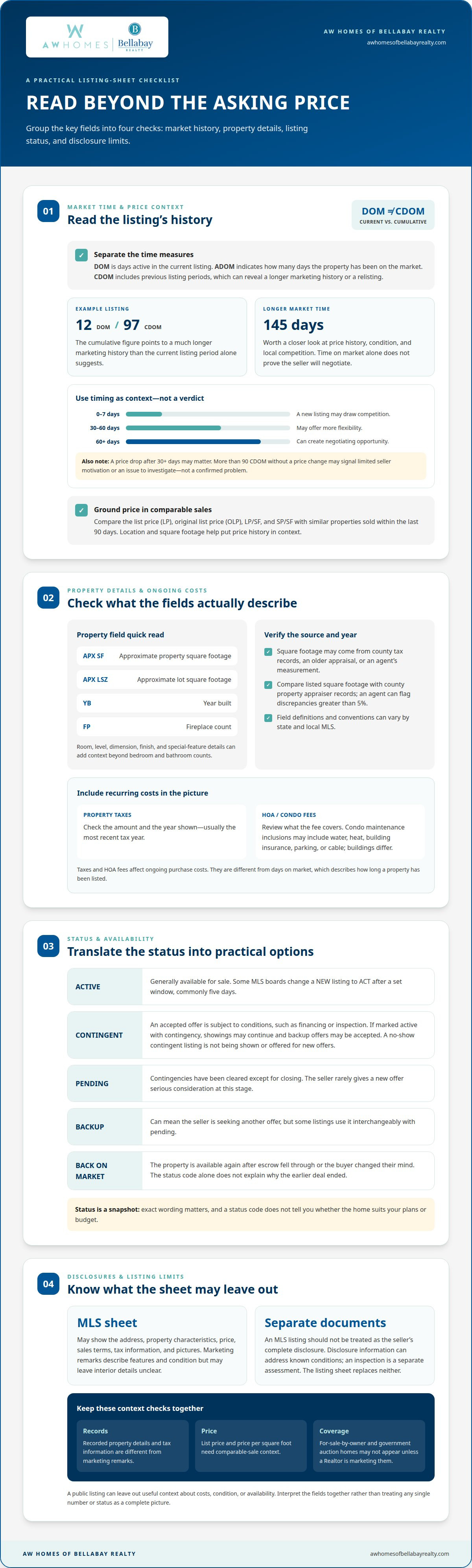
- Identify the current listing period. DOM refers to days a property has been active in its current listing. ADOM indicates how many days the property has been on the market; an example listing with 145 days deserves a closer look at its price history, condition and local competition. It isn’t proof by itself that the seller will negotiate.
- Compare DOM with CDOM. CDOM, or cumulative days on market, includes previous listing periods. A property showing 12 DOM and 97 CDOM has a much longer marketing history than its current figure suggests. That difference can reveal a relisting, including a change of agent.
- Read the timeline as context, not a verdict. A new listing at 0-7 days may draw competition; 30-60 days may offer more flexibility, while 60+ days can create negotiating opportunity. A price drop after 30+ days may matter. More than 90 CDOM without a price change may signal limited seller motivation or an issue to investigate, not a confirmed problem.
- Separate records from remarks. Tax information and recorded property details provide a different kind of context than marketing remarks, which describe the home’s features and condition. If the remarks focus on the neighborhood but omit interior details, ask what the description leaves unclear before arranging a showing.
- Ground price in comparable sales. An agent can compare similar properties sold within the last 90 days, considering location and square footage. This helps put price history and LP/SF into context rather than treating days on market as a standalone measure of value.
Does an MLS listing include the seller's property disclosure?
An agent considers bedroom and bathroom counts, square footage, lot size and year built as separate details. Square footage may come from county tax records, an older appraisal or an agent’s measurement, so figures can differ. Field definitions and conventions also vary by state and local MLS.
- Read property fields together. APX SF refers to property square footage, and APX LSZ to lot square footage. YB means year built; FP means fireplace count. The lower section may identify rooms, levels, dimensions, finishes and special features. Together, those details give more context than a bedroom count alone. For example, buyers evaluating a Colorado horse property for sale will often look beyond standard interior dimensions to examine pasture acreage, barn specs, and water rights listed in the MLS remarks.
- Compare listing details with public records. An MLS sheet may include the address, characteristics, price, sales terms, tax information and pictures. An agent can compare the listed square footage with county property appraiser records and flag discrepancies greater than 5%. This comparison can help identify figures that need clarification before a purchase.
- Review taxes and building amenities. The taxes field indicates the taxes paid and the year represented, usually the most recent tax year. Condo maintenance-fee fields may show whether water, heat, building insurance, parking or cable are included. Read each inclusion alongside the fee, since buildings can cover different costs.
- Treat disclosure as a separate document. An MLS listing may include selected property details, but it shouldn’t be treated as the seller’s complete disclosure. Disclosure information can address known property conditions, while an inspection provides a separate assessment. The listing sheet alone doesn’t replace those documents or explain every condition relevant to a contract.
- Account for homes outside the MLS. Homes for sale by owner and government auction properties may not appear unless a Realtor is marketing them. For help understanding listing details as part of a home sale, request a professional listing review.
What do "active," "contingent" and "pending" mean on a listing?
- Start with the status field. On a Multiple Listing Service record, active generally means the property is available for sale. Some MLS boards change a NEW listing to ACT after a set window, commonly five days. A status code describes the listing’s current position, not whether the property suits your plans or budget.
- Check the exact contingent wording. A contingent listing has an accepted offer subject to conditions, such as financing or inspection. If it’s marked active with contingency, showings may continue and the seller may accept backup offers. A no-show contingent listing isn’t being shown or offered for new offers, so the wording changes your practical options.
- Read pending as a later transaction stage. A pending listing has cleared its contingencies except for closing. The seller rarely gives a new offer serious consideration at this point. A pending status usually signals less opportunity for a buyer to enter the transaction than an active listing with contingency.
- Interpret backup and back-on-market labels carefully. A backup status can mean the seller is seeking another offer, but some listings use it interchangeably with pending. Back on market means the property is available again after escrow fell through or the buyer changed their mind. It can reopen the possibility of a showing or offer, but the code alone doesn’t explain why the earlier deal ended.
- Confirm availability against the current record. Consumer real estate sites may lag the actual MLS by 24-48 hours, so a displayed status can be out of date. A listing marked active online may already have an accepted offer. Treat the status square as a useful signal, then have an agent interpret the current MLS record before planning a showing or preparing an offer.
Fields and information omitted from public listings
- Separate the full MLS record from its public display. A listing sheet may include the property address, characteristics, asking price, sales terms, tax information and photographs. A public-facing page can present only selected details, while the full record may offer more fields. Treat marketing photos and remarks as useful context, not a complete description of every feature.
- Read room and area details with care. Listing fields may identify rooms, levels, dimensions, finishes and special features. A realtor can explain whether a finished room or unfinished area appears in the stated square footage, and how the listing describes its use. Compare that description with the floor plan and property details before relying on an area figure.
- Look for costs attached to shared amenities. Condo maintenance-fee fields may identify included services, but the public view can make those details difficult to spot. Parking may be described as owned or rented. If rented, or excluded from maintenance fees, the listing may specify its monthly cost. A locker or storage space may also need separate clarification in the listing details or contract.
- Identify information that needs fuller context. Photos can show a renovated kitchen without describing the age or condition of other systems. Remarks may emphasize location while giving little detail about interiors, repairs or unfinished spaces. Treat those gaps as questions for the property review, not as proof that a feature exists or is absent.
- Use the listing as a starting point. A public page can summarize a home, but it may not show every field available to an agent or every document relevant to a purchase. An agent can interpret the record alongside the property’s listed features and transaction details. For help reviewing a home’s listing information, request a professional listing review.
AW Homes of Bellabay Realty: Residential Listing Services
AW Homes of Bellabay Realty helps sellers interpret listing details as part of a broader home-sale strategy through its Residential Listing Services. This guidance is useful when pricing, property remarks, market time and status changes need to be considered together to position a home.
For buyers, Buyer Agency Services can bring professional guidance to evaluating listing information and considering a potential purchase. Relocation Assistance supports clients navigating a move, while Real Estate Investment Consulting is relevant when assessing a property as an investment. The right next step depends on your transaction and the decisions ahead.
If you’re preparing to sell or weighing a home purchase, contact AW Homes of Bellabay Realty to discuss your real estate goals.
Turn Listing Details Into a Confident Next Step
Knowing how to read an MLS listing sheet gives you a stronger starting point, but the record is only one part of a real estate decision. Connect what the listing says with your priorities, timing and plans for the property. A conversation with AW Homes of Bellabay Realty can help you bring those considerations into focus before deciding how to proceed.
Whether a home is part of a move, a sale or a new chapter, thoughtful guidance can make the process feel more manageable. Bring your questions and goals to the conversation, and take the next step at a pace that feels right for you. Contact AW Homes of Bellabay Realty to discuss your real estate plans.
Frequently Asked Questions
What is an MLS listing sheet?
An MLS listing sheet is a structured record of a home offered for sale through a Multiple Listing Service. It brings property details, transaction information and marketing content together. Think of it as a working snapshot, not a complete property file: it can orient your search, while documents such as inspection reports provide separate information about the home.
How can a real estate agent help you make sense of an MLS listing?
A real estate agent can show you how to read an MLS listing sheet by connecting its details to your priorities and explaining unfamiliar fields. For example, if you’re comparing homes in Grand Rapids, Ada, Caledonia or East Grand Rapids, local market knowledge can help put each property in context. AW Homes of Bellabay Realty’s Buyer Agency Services can support your review as you assess a potential purchase.
What is MLS?
MLS stands for Multiple Listing Service. It’s a system real estate professionals use to share information about properties for sale with other participating professionals. The term doesn’t refer to one nationwide listing database; MLS systems serve different markets. For a home search, the relevant MLS record can help agents access and interpret property information in the area where the home is listed.
What does the square footage on a listing actually measure?
Square footage is the area reported for a property, but its meaning depends on the measurement method and local listing conventions. Finished living area and unfinished space, such as a basement, may be described separately. If a listing gives only one figure, an agent can explain its context and how it relates to the home’s layout and usable spaces.
What is the MLS, and who enters the data on a listing?
The MLS is a professional real estate listing system, and participating real estate agents, Realtors and brokers enter listing information. The person submitting a listing supplies details such as property characteristics and marketing remarks. This information can then be shared with other professionals through the system, while a public display may show only selected fields from the record.
What information is included on an MLS listing sheet?
Knowing how to read an MLS listing sheet starts with recognizing common fields: address, asking price, property characteristics, sales terms, tax information and photographs. Depending on the record, it may also show room details, status, market time, fees or parking notes. These details help frame your search, though the fields shown can vary by property and local MLS practices.


