

What if a quiet stretch of showings is a reason to reassess, not a reason to slash your asking price? For sellers focused on selling a home in a slow market Grand Rapids, limited buyer activity can raise tough questions: Is the price misaligned with comparable homes? Does the listing need a clearer presentation? Or are buyers in this part of the market taking longer to act?
It’s understandable to worry that every extra day on the market weakens your negotiating position. But reacting too quickly can narrow your options just as much as waiting without a plan. Look at the evidence together: buyer feedback, comparable homes, listing engagement, showing activity, and how your property compares with current options in its neighborhood.
This guide explains which signals may call for a change and which may warrant patience. You’ll learn how local market insight, thoughtful presentation, and careful offer comparisons can help you reach qualified buyers without rushing a decision. From Ada and Cascade to East Grand Rapids and Caledonia, a focused plan can clarify your next step, whether that means refining the listing, negotiating an offer, or considering a lower price.
Key Takeaways
- A slower response doesn’t automatically mean your home can’t sell. Buyer activity varies by price range, condition, location, and competing listings.
- Review exposure, showings, feedback, competition, and offers in sequence to identify where buyer interest is dropping off.
- Compare price, presentation, access, offer terms, and timing before choosing an adjustment. Use current comparable evidence to guide price decisions.
- For selling a home in a slow market Grand Rapids, review the evidence, make a focused change, and reassess the response before making another adjustment.
- Local insight and coordinated listing support can shape a strategy for Grand Rapids, Ada, Caledonia, Cascade, and East Grand Rapids.
Selling a Home in a Slow Grand Rapids Market: What the Situation Really Means
A slow market describes a relative shift in buyer activity, not a verdict on your home. Buyers may take longer to schedule showings, compare more options, or negotiate more carefully than they did in a faster period. The effect varies by listing: price range, condition, location, and competing homes all shape how buyers respond.
It also helps to distinguish slower activity from a market-wide decline. A real estate bubble involves broader forces than one home receiving fewer showings; Wikipedia’s overview of a Real Estate Bubble offers general context. For your next decision, focus on current local evidence rather than assuming a slower response means the market is collapsing or your home cannot sell.
Which Grand Rapids market signals should sellers watch?
Compare three types of activity in the area and price range most relevant to your home. Active listings show what buyers can choose now. Pending listings offer clues about what is attracting offers. Recent closed sales show what buyers have actually purchased. Keep comparisons close in location, condition, and features. Broad Grand Rapids or Kent County figures provide context, but they don’t describe every neighborhood or property.
Days on market is another useful signal, not a forecast. It shows how long homes have taken to sell in a defined area and period; it can’t predict how long an individual listing will take. Few showings may mean the listing is reaching too few buyers or missing their expectations. Showings without offers may indicate concerns about price, condition, or terms. In either case, look for patterns in feedback and comparable listings before changing course.
Does a slow market mean you need to sell as-is?
No. A slower pace doesn’t automatically make an as-is or cash sale the best fit. A standard listing may suit sellers who can prepare the home and want to reach buyers through a conventional marketing process. An as-is approach may appeal when avoiding repairs or reducing preparation is a priority, particularly if the home needs work. The right path depends on the property and your plans for the transition.
There are trade-offs. Skipping repairs may limit buyer interest, affect the terms buyers offer, or change your eventual net proceeds. A cash offer may involve different contingencies and timing, but neither speed nor value is guaranteed. Compare the full offer, including conditions and closing expectations, with the likely costs and effort of preparing and listing the home. For selling a home in a slow market Grand Rapids, an informed comparison helps preserve options better than choosing a route out of fear.
Diagnose Your Grand Rapids Listing Before Changing the Strategy
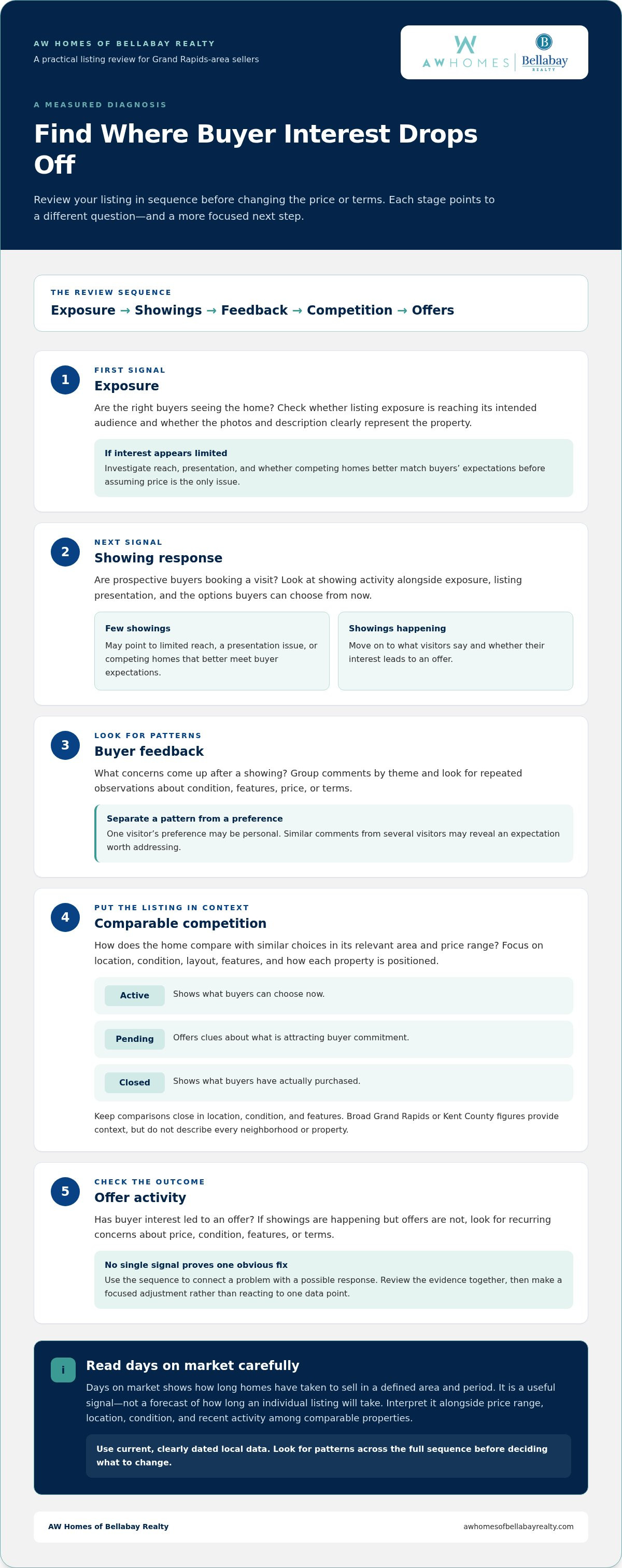
Before changing the price or terms, identify where buyer interest is dropping off. Review the listing in sequence: exposure, showing response, buyer feedback, comparable competition, then offer activity. At each stage, ask a specific question. Are the right buyers seeing the home? Are they booking a showing? What concerns come up afterward? How does the home compare with similar options available now? Has interest led to an offer?
This order helps connect a problem with a possible response. Few showings may point to limited reach, a presentation issue, or competing homes that better match buyers’ expectations. If showings are happening but offers aren’t, look for recurring concerns about condition, features, price, or terms. Neither pattern proves there’s one obvious fix, but each gives you a useful place to investigate.
What do showings and buyer feedback reveal?
Showing volume is a signal, not a verdict. Check whether listing exposure is reaching the intended audience, whether the photos and description accurately represent the home, and whether competing properties are attracting attention. Then group feedback by theme. One visitor’s preference may be personal; similar comments from several visitors may reveal an expectation worth addressing.
Days on market shows how long a listing has been active, but it can’t predict when an individual home will sell. Interpret it alongside the home’s price range, location, condition, and recent activity among comparable properties. Market indicators change, so use current, clearly dated local data rather than relying on an old regional average.
How do local competition and listing presentation affect interest?
Compare your home with active listings buyers could choose instead. Focus on location, condition, layout, features, and how each property is positioned. A nearby home with a different level of updating may not be a direct comparison, even if its asking price looks similar. Pending listings can offer clues about what is attracting buyer commitment, while closed sales record completed transactions.
Check the listing for accuracy and clarity. Do the photos show the spaces and features buyers need to understand? Is it practical for prospective buyers to schedule a visit? Does the description make the home’s strongest attributes easy to find? Professional photography can strengthen the first impression, while accurate details and workable access help carry that impression into a showing.
For a more tailored review, explore local listing guidance and compare buyer activity in your specific Grand Rapids-area segment with your home’s response. A focused diagnosis helps distinguish what needs attention from what simply takes time.
Price, Presentation, or Terms: Which Adjustment Makes Sense?
A useful adjustment addresses the point where buyers are hesitating. If interest is low, review how the home is positioned and how easily buyers can view it. If showings are happening but offers aren’t, look for repeated concerns about condition, price, or terms. For anyone selling a home in a slow market Grand Rapids, the goal is to respond to evidence rather than make several changes at once out of fear.
| Adjustment | When to consider it | What to weigh |
|---|---|---|
| Price positioning | Comparable sales and active competition suggest buyers see better value elsewhere. | Use relevant evidence, not a competitor’s asking price alone. A list price sets expectations, while negotiated terms and the final outcome can differ. |
| Presentation | Photos, listing details, or repeated showing feedback don’t make the home’s strengths clear. | Correct inaccuracies and address recurring concerns where practical. For staging specifics, see the dedicated home-staging article. |
| Access | Buyer interest exists, but scheduling a showing is difficult. | Consider whether more flexible showing arrangements could make it easier for interested buyers to visit. |
| Contingencies | An offer includes conditions that affect certainty or the seller’s next steps. | Review each contingency and its implications rather than judging an offer on price alone. |
| Timing flexibility | A buyer’s proposed closing schedule differs from the seller’s ideal plan. | Weigh the timeline against your move and other commitments. Flexibility may help, but only if it works for your transition. |
When is a price review more useful than another change?
Revisit price when recent comparable sales, current active competition, and buyer response point to a mismatch. A home may attract showings but no offers because buyers see stronger value elsewhere. Or the asking price may be reasonable while access or presentation creates friction. Compare the full picture before deciding. The guide How to Price My Home to Sell: West Michigan Market Tips covers pricing in greater detail.
Which non-price changes can improve a buyer’s decision?
Start with practical steps: clarify listing information, improve showing access where possible, and consider recurring buyer concerns. If an offer requests a concession, assess how it affects likely net proceeds and whether it addresses a buyer’s concern or supports a smoother transaction. Offer strength also depends on financing, contingencies, requested concessions, and the proposed closing timeline. Compare those terms together, then decide what fits your priorities. A thoughtful counteroffer or manageable adjustment may serve you better than an automatic price cut.
A Measured Action Plan for Selling in a Slow Grand Rapids Market
A deliberate plan gives each change a purpose. Rather than resetting the strategy after every quiet day, use a repeatable cycle: review the evidence, choose one adjustment, observe the response, then reassess. This makes it easier to see whether a change helped and reduces the risk of cutting price, changing terms, and reworking the presentation all at once.
What should sellers review at each decision point?
Review new competing listings, recent comparable sales, showing activity, and meaningful buyer feedback together. Then note what the evidence suggests, what adjustment you’re making, and what response would help evaluate it. For example, if buyers repeatedly say the listing makes the home’s layout hard to understand, clarifying the property information may be a more focused first step than changing the price.
Set review points with your agent around actual listing activity rather than an unsupported fixed number of days. Revisit the plan when new comparable homes appear, feedback forms a pattern, or showing interest changes. Include your own circumstances in the discussion: move plans, timing needs, and acceptable offer terms matter alongside market signals.
How can a seller prepare without over-improving?
Preparation should fit the home, its likely buyers, and your next move. Prioritize visible maintenance and straightforward presentation. Before taking on a major renovation, compare the home’s condition with similar local listings and consider whether the work addresses a clear buyer concern. No single repair or cosmetic update can promise a higher final sale price.
Keep the process manageable. A Forest Hills seller guide can offer related local listing guidance, while your home’s condition and competition should shape its preparation plan. For sellers selling a home in a slow market Grand Rapids, disciplined choices can protect time and resources while keeping the listing aligned with buyer expectations.
Ready to turn listing activity into a measured next step? Connect with AW Homes for personalized selling guidance and build a plan around your property, local competition, and transition priorities.
How AW Homes of Bellabay Realty Guides a Grand Rapids Home Sale
Selling is both a financial decision and a personal transition. AW Homes of Bellabay Realty, led by Angela Worth, provides local insight and coordinated residential listing support across Greater Grand Rapids, including Ada, Caledonia, Cascade, and East Grand Rapids. The plan is shaped around the home, current market evidence, and what the seller needs from the next move.
What does a coordinated listing strategy include?
Professional photography presents a home clearly, while thoughtful market positioning connects its features and condition with the buyers most likely to consider it. The team helps sellers interpret market response and assess offer terms, including contingencies, requested concessions, and proposed timing. Negotiation and transaction management carry the process forward once an offer is under consideration.
Each step supports the next: prepare the home for presentation, position it thoughtfully, then evaluate interest and negotiate with the seller’s priorities in view. For related local context, see Sell My Home in Forest Hills MI: The Strategic 2026 Seller’s Guide.
How can local guidance make the next move feel manageable?
A seller planning to relocate may have different timing priorities from someone downsizing or moving up to a larger home. Those plans can shape preparation decisions, showing arrangements, and the offer terms that matter most. For homeowners focused on selling a home in a slow market Grand Rapids, local guidance connects personal priorities with the conditions affecting their specific property.
The process moves through clear stages: align on goals and preparation, develop the listing’s market position, review buyer response, evaluate offers, and coordinate the transaction. Market conditions and individual circumstances can change, so this structure provides direction without promising a particular sale date or outcome. For broader context, the Grand Rapids market outlook can help frame regional conditions alongside property-specific guidance.
Angela Worth and the AW Homes team welcome a conversation about your selling goals, timing, and next steps. With a thoughtful plan and steady guidance, you can approach the transition with greater clarity.
Move Forward With a Clear Selling Strategy
A slower buyer response doesn’t automatically mean you need to accept a lower offer or abandon a traditional listing. Start with evidence from comparable homes and buyer activity, then choose a focused adjustment to price positioning, presentation, access, or terms. Review the response before making another change to keep decisions deliberate.
For selling a home in a slow market Grand Rapids, your next move matters too. Timing, relocation plans, and acceptable offer terms should shape the strategy alongside local market conditions. A plan that fits your home and your life can make the process feel more manageable, even when the pace is uncertain.
Angela Worth leads the locally focused AW Homes team serving Greater Grand Rapids. Listing support includes professional photography, market positioning, negotiation, and transaction management, coordinated around your goals and the property’s circumstances.
Talk through your Grand Rapids home-selling strategy with AW Homes. A thoughtful next step can help you move into your next chapter with greater clarity and confidence.
Frequently Asked Questions
Is Grand Rapids a slow housing market in 2026?
Grand Rapids isn’t uniformly slow in 2026; conditions are becoming more balanced, but the market still has relatively limited supply. The October 2026 market research summary for this guide reports 2,182 active listings, up 17% year over year, and 1.2 months of housing supply. Those regional figures don’t predict how an individual home will perform. Compare current pending listings and days on market in the relevant neighborhood, price range, and property type.
How long does it take to sell a home in a slow market?
There’s no reliable single timeline for every home. Time to sell depends on current competition, pricing, condition, buyer financing, and negotiated terms. Days on market provides context only when the geography, time period, and calculation are clear; an area average can’t guarantee an individual result. Review your listing’s showing activity and buyer feedback with your agent, alongside your move plans and timing priorities.
Should I lower my asking price if my Grand Rapids home is not getting offers?
Not automatically. First compare recent relevant sales with current competing listings, then review showing volume and recurring buyer feedback. Few showings may point to an exposure or positioning issue; showings without offers may call for a review of buyer concerns, terms, or price. Any adjustment should reflect evidence and your priorities, not pressure alone. For more detail, read How to Price My Home to Sell: West Michigan Market Tips.
Can I sell my house as-is in Grand Rapids if the market is slow?
Yes, an as-is sale may suit some sellers, particularly when reducing repair or preparation work is a priority. It doesn’t remove the need to understand disclosures, buyer expectations, and offer terms. Fewer repairs may be convenient, but could also affect buyer interest or negotiation. Compare the trade-offs with your goals, and don’t assume a cash offer, a particular closing timeline, or a specific net amount is assured.
What should I fix before listing a home in a slow market?
Start by assessing visible maintenance needs, safety concerns, and recurring buyer feedback before committing to larger projects. The right preparation depends on the home’s condition, competing listings, and your priorities. A repair or cosmetic update may improve presentation, but it can’t guarantee a higher sale price. For presentation ideas, see the site’s dedicated home-staging article and tailor preparation to the property rather than renovating by default.
How can I compare offers when selling a home in Grand Rapids?
Compare more than the headline price. Review financing, contingencies, requested concessions, closing timing, and the likelihood of completing the transaction. Then consider estimated proceeds and whether the proposed terms fit your next move. A lower offer with terms that better match your needs may be worth weighing against a higher offer with more conditions. Review the contract language with your real estate representative before deciding which offer best supports your plans.


