

What if the strongest mortgage offer isn’t the one with the lowest advertised rate? The right fit also depends on loan terms, fees, timing, and how clearly the lender answers your questions. If mortgage terminology makes offers hard to compare, you’re not alone. The questions to ask your mortgage lender can turn a complex conversation into a clearer set of choices.
This practical checklist will help you compare lenders, understand the costs and conditions behind each estimate, and leave conversations knowing what happens next. You’ll also learn what to ask about communication and timing, which can matter when you’re coordinating financing with a home search in West Michigan.
Ask each lender the same questions, and request important terms and estimates in writing so you can compare them consistently. Your lender is the source for loan terms, financing guidance, and underwriting decisions. A local buyer’s agent can help coordinate lender conversations with your purchase timeline as you explore Grand Rapids, Ada, Caledonia, East Grand Rapids, Forest Hills, and nearby communities.
Key Takeaways
- Use the same questions to ask your mortgage lender so you can compare loan options and estimates on consistent terms.
- Ask what a preapproval does and doesn’t confirm, and which assumptions or documents could change the lender’s initial answer.
- Request an itemized explanation of fees and payment estimates, including the assumptions behind each figure.
- Clarify how the rate lock works, when it expires, and what could affect your closing timeline.
- Compare lenders on loan fit, clarity, documented costs, timing, and communication, then resolve unclear answers before choosing.
Questions to Ask Your Mortgage Lender Before You Apply
Before applying, ask about loan fit, total costs, the expected timeline, and the service you can expect throughout the process. These questions to ask your mortgage lender help you look beyond a headline rate or preliminary estimate. Speaking with more than one lender can give you options to consider, but the value comes from comparing the details, not assuming that any one conversation guarantees better terms.
A lender comparison checklist is a shared set of questions and notes that helps you evaluate each lender’s loan options, costs, timeline, and communication on consistent terms. Keep your priorities in view: the maximum amount a lender may approve isn’t necessarily the monthly payment you’re comfortable carrying. If you want an introduction to basic concepts and terminology, see what is a mortgage loan.
What to prepare before speaking with a lender
Make a clear summary of your income, employment, savings, debts, and intended purchase. You don’t need to guess which paperwork a lender requires. Ask what documents are needed for an initial review, and whether any details you share are assumptions rather than verified information.
Prepare questions about both your budget and your comfort level. For example: “What purchase range might fit the monthly payment I’m comfortable with?” and “What costs should I consider beyond the loan payment?” The lender can explain financing and eligibility; you decide what fits your household plans. If you’re searching in Greater Grand Rapids, identifying your likely price range and preferred communities can make the conversation more specific.
How to make each lender conversation comparable
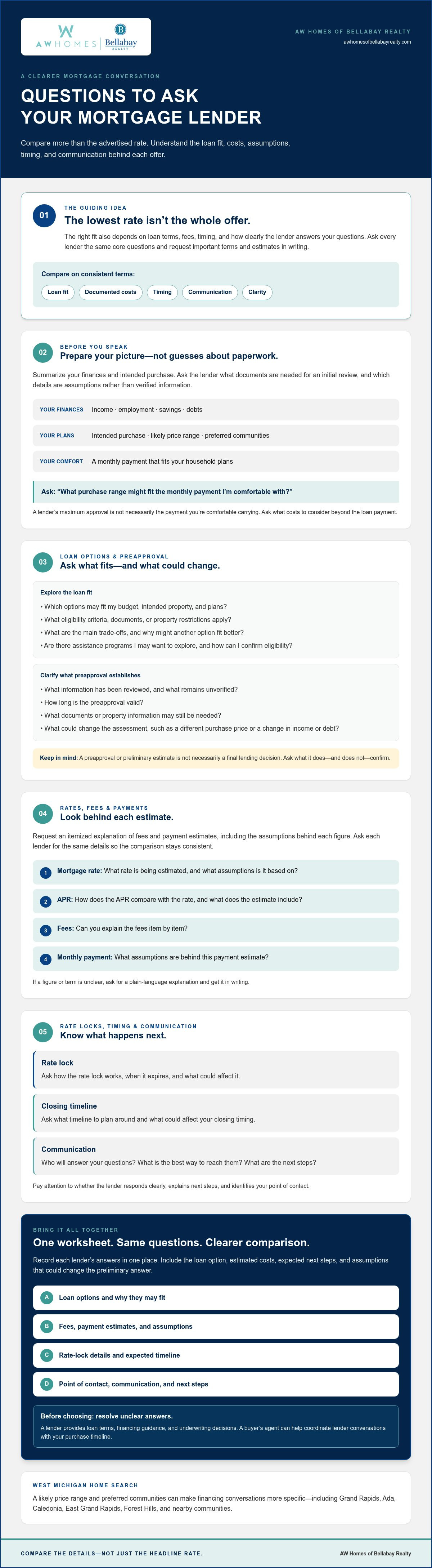
Ask each lender the same core questions, then record the answers in one worksheet. Include the loan option discussed, estimated costs, expected next steps, and assumptions that could change the preliminary answer. If a term or figure isn’t clear, ask the lender to explain it in plain language and provide the explanation in writing.
- Which loan options may fit my situation, and why?
- What information or documents could change this initial assessment?
- What costs and timeline should I plan around at this stage?
- Who will answer my questions, and what’s the best way to reach them?
Pay attention to the process as well as the answers. Note whether the lender responds clearly, explains next steps, and identifies your point of contact. That information can help you coordinate financing conversations with your home search and purchase timeline. A buyer’s agent can help with real estate coordination, while loan terms, underwriting decisions, and financing advice must come from the lender.
Questions About Loan Options, Preapproval, and Eligibility
A loan option is useful only if its requirements and trade-offs fit your finances, intended property, and plans. Ask the lender to explain why an option may suit you, what you’d need to qualify, and what might make another option worth considering. Loan suitability depends on your financial picture and goals, not simply on which option has the most appealing initial estimate.
Which loan options fit my situation?
Ask which loan types may fit the purchase you’re considering, then explore the conditions behind each possibility. Questions to ask your mortgage lender include:
- Which options may fit my budget, intended property, and plans?
- What eligibility criteria, documentation, or property restrictions apply?
- What are the main trade-offs, and what could make another option a better fit?
- Are there assistance programs I may want to explore, and how can I confirm eligibility?
Ask for the reasoning behind a recommendation, not just the name of the loan. A lender can explain financing requirements and whether it offers or can discuss relevant programs, but don’t treat a program as available to you until the lender confirms its current terms and your eligibility. The Consumer Financial Protection Bureau’s guide to preparing for your mortgage can help you organize questions and get ready for the application process.
What does preapproval confirm, and what can change?
Ask what information the lender reviewed, what remains unverified, and how long the preapproval is valid. Also ask what could change the assessment, such as a different purchase price, a change in income or debt, or details about the property. Request a clear explanation of what the preapproval does and doesn’t establish.
A preapproval or preliminary estimate is not necessarily a final lending decision. The lender can explain what additional review, documents, or property information may still be needed before underwriting reaches a decision. Ask which parts of the current assessment rely on assumptions and what steps would confirm them. If your circumstances or the home you pursue change, check with the lender before relying on an earlier answer.
Keep the lender’s answers with your comparison notes, especially validity dates and outstanding conditions. For buyers searching in Greater Grand Rapids, an agent can help coordinate home-search decisions with the financing timeline, while the lender remains the source for loan terms and eligibility guidance. If you’d like real estate guidance as you explore the area, learn about buyer representation in Greater Grand Rapids.
Questions About Mortgage Rates, APR, Fees, and Monthly Payments
A rate quote is only useful when you understand what it represents and the assumptions behind it. Ask each lender to explain the interest rate, annual percentage rate (APR), itemized charges, and estimated monthly payment. Then compare the answers using the same loan type, term, down payment, and rate-lock assumptions where possible.
How do I compare the interest rate and APR?
The interest rate is the rate used to calculate interest on the loan. APR is a broader comparison figure that generally reflects the interest rate plus certain loan costs over time. It can help show differences between offers, but it doesn’t capture every expense of buying or owning a home and isn’t a complete measure of which loan is right for you.
Ask the lender which charges and assumptions are included in its APR calculation and why it differs from the interest rate. If comparing written Loan Estimates, request them when available and confirm with each lender what stage of the process the estimate represents and when you can expect it. Don’t compare figures based on different loan terms, down payments, or rate-lock assumptions without first understanding those differences.
What should I ask about fees and the estimated payment?
Request an itemized explanation of lender charges and other estimated transaction costs. Ask which charges are lender fees, which relate to other parts of the purchase, and whether any amounts are estimates that may change as your application and property details develop.
Clarify what the monthly payment estimate includes. Ask whether it covers principal and interest, property taxes, homeowners insurance, mortgage insurance, or other applicable expenses, and which costs you may need to budget for separately. Then compare the estimates using a consistent worksheet:
| Comparison item | Lender A | Lender B |
|---|---|---|
| Loan type and term | Record details | Record details |
| Down payment assumption | Record amount or percentage | Record amount or percentage |
| Interest rate and lock assumptions | Record details | Record details |
| Estimated monthly payment and included expenses | Record components | Record components |
| Itemized fees and other estimated costs | Record details | Record details |
These questions to ask your mortgage lender can reveal why two offers that look similar at first may differ in payment assumptions or charges. If a figure is unclear, ask for the explanation in writing and note what could cause it to change. Compare the full picture, not just one appealing number.
Questions About Rate Locks, Closing Timelines, and Communication
The lowest quoted rate doesn’t automatically make a lender the strongest fit. Rate-lock terms, follow-through, and clear updates can also affect how well financing aligns with your purchase. As you ask questions to ask your mortgage lender, look for a process you understand and a point of contact who can explain changes before they disrupt your plans.
What should I ask about locking a mortgage rate?
Ask when a rate lock may be available, how long it lasts, and what conditions apply. Then clarify what happens if your closing timeline changes or the lock period expires. Ask whether an extension may be possible, what could affect its terms, and how you’ll be notified if anything changes. Details vary, so rely on the lender’s current explanation rather than assuming a lock works the same everywhere.
Request written confirmation of the applicable terms, including the lock’s start and expiration dates and any conditions the lender identifies. If the purchase schedule shifts, contact the lender promptly and ask how that affects your specific lock. A clear written answer helps you understand your options without relying on a verbal estimate.
How will the lender keep my purchase on track?
Ask the lender to walk you through expected milestones, who is responsible for each next step, and how you can check your application status. Confirm which channel to use for questions, how often you should expect updates, and who to contact if a deadline is approaching and you haven’t received an answer. Also ask how the team typically responds and how to raise an urgent concern.
- Who is my primary contact, and who can help if they’re unavailable?
- How will I receive updates, and how often should I expect them?
- How should I report a change in income, debt, employment, or purchase plans?
- What information do you need from my real estate professionals, and how will coordination happen?
- If a milestone is delayed, who will explain the impact and next steps?
A West Michigan home purchase involves coordinating financing decisions with the property search, offer, and agreed transaction dates. Ask the lender which milestones depend on your documents or decisions, and keep your real estate professional informed about timeline changes. A buyer’s agent can help coordinate the real estate side of the process, but the lender must clarify rate-lock terms, loan status, and financing decisions.
Planning a home search in Greater Grand Rapids? Explore buyer representation with AW Homes of Bellabay Realty for local guidance and purchase coordination.
How to Compare Lender Answers and Choose Your Next Step
After speaking with lenders, turn your notes into a side-by-side scorecard. Use identical questions and comparable assumptions, then distinguish confirmed written terms from verbal estimates or items still awaiting review. If answers don’t match, ask each lender to clarify the difference before deciding. Clear, consistent information gives you a sounder basis for comparing the full experience, not just one appealing number.
A practical lender comparison checklist
Rate each category using a simple label, such as “clear,” “needs follow-up,” or “unclear.” The goal isn’t to award a lender an arbitrary score. It’s to identify what fits, what’s documented, and what you still need to understand.
- Loan fit: Does the lender explain why the option may suit your finances, intended property, and plans?
- Clarity: Are terms and assumptions explained in language you understand?
- Documented costs: Are estimates itemized and available in writing, with uncertain amounts identified?
- Timing: Are milestones, dependencies, and rate-lock terms explained clearly?
- Communication: Do you know who to contact, how to check progress, and what to do if plans change?
Keep the lender’s written information beside your notes, and label estimates as preliminary when they haven’t been confirmed. If two lenders give different answers about a cost, condition, or timeline, ask what assumptions account for the difference. Resolve material inconsistencies before choosing. The questions to ask your mortgage lender are useful only when the answers help you make an informed comparison.
Who can help with the home purchase alongside your lender?
Your mortgage lender explains loan options, financing requirements, and underwriting decisions. Your buyer’s real estate agent supports the home search and helps coordinate real estate steps with the purchase timeline. An agent can’t select or approve your loan, so take financing questions and decisions back to the lender.
As you plan the purchase, keep a simple timeline of offer dates, lender milestones, document requests, and agreed transaction dates. This can help you spot a question or potential delay early and direct it to the right person. Your lender can explain financing steps; your agent can help coordinate the home search and real estate process.
If you’re exploring homes in Greater Grand Rapids, Ada, Caledonia, Forest Hills, or East Grand Rapids, AW Homes of Bellabay Realty offers buyer representation and local home-search guidance. Connect with the team to discuss support for your West Michigan purchase. Keep your lender as the source for loan terms and financing decisions.
Move Forward With a Clearer Homebuying Plan
The right lender conversation should leave you with more than a promising rate. Use the questions to ask your mortgage lender to compare loan fit, written costs, rate-lock terms, timing, and communication on consistent terms. If an answer is unclear or estimates don’t align, ask for clarification before choosing. Loan terms and approval decisions belong to the lender; your buyer’s agent can help coordinate the home search with your purchase timeline.
For buyers planning a move in Greater Grand Rapids, local insight can help bring the next steps into focus. AW Homes of Bellabay Realty offers buyer representation and relocation assistance across communities including Ada, Caledonia, Forest Hills, and East Grand Rapids. Explore buyer representation with AW Homes of Bellabay Realty and take your next step with a local partner.
Frequently Asked Questions
What questions should I ask a mortgage lender first?
Start by asking which loan options may fit, what eligibility requirements apply, and what a preapproval confirms. Then ask about the estimated monthly payment, interest rate, APR, itemized fees, rate locks, key milestones, and who will manage your application. Use the same core questions with each lender, and ask for unclear explanations in writing. This gives you a more useful comparison of the loan and service, not just one quoted figure.
Should I talk to more than one mortgage lender?
Speaking with multiple lenders can help you compare available options, explanations, estimated costs, and communication styles. Ask each lender the same questions and use comparable assumptions so the answers are easier to review side by side. Before authorizing a credit inquiry, ask how it will be handled and confirm current credit-scoring guidance with a qualified source. No single lender is the right choice for every buyer, so consider the full fit.
What is the difference between a mortgage interest rate and APR?
The interest rate is the rate used to calculate interest on your loan. APR generally reflects the interest rate plus certain loan costs, though the exact calculation and included costs depend on the offer and applicable rules. Ask the lender to explain both figures in writing. Compare offers with similar loan types, terms, down payments, and other assumptions. Neither the interest rate nor APR alone captures every cost or determines which loan best fits you.
What should I ask about mortgage preapproval?
Ask what financial information the lender reviewed, which documents are still needed, and how long the preapproval remains current. Find out what could change the preliminary assessment, such as updated income or debt information, a different purchase price, or the property you choose. A preapproval isn’t a guarantee of final financing. Ask the lender to explain its scope, conditions, and next steps so you know what has been reviewed and what remains subject to confirmation.
Can I negotiate mortgage rates or lender fees?
Ask whether the lender can review the rate or fees and what information it needs to consider your request. If you have another written offer, ask the lender to compare it using equivalent loan terms and assumptions. Don’t assume every charge is negotiable or that a lower rate means a lower overall cost. Request any revised terms in writing, and review the itemized costs and payment estimate before relying on the change.
When should I ask a lender to lock my mortgage rate?
Ask the lender when a rate lock may be available, how long it lasts, and what conditions apply. Find out what happens if the closing date changes or the lock expires, and whether an extension may be possible. Lock policies and market conditions can vary, so get current details directly from your lender. Keep written confirmation of the terms with your loan documents, including any conditions or changes the lender explains.
What should I do if a lender’s answers are unclear or differ from another lender’s?
Ask each lender to clarify the answer in writing and identify the assumptions behind it. Check whether you’re comparing the same loan type, term, down payment, fees, and timing before treating the answers as inconsistent. Note unresolved questions and ask for a clear next step before choosing. If you’re coordinating a home search in Grand Rapids, Ada, Caledonia, or East Grand Rapids, your buyer’s agent can help track real estate timing, while the lender explains financing.


