

What if the builder who sounds most reassuring is simply the one whose answers are hardest to compare? Choosing where to build in Michigan is a major decision, and it’s natural to want clear answers about what’s included, how the schedule works, and what happens when plans change. The right questions to ask a new home builder in Michigan can turn broad promises into details you can review side by side.
This checklist will help you prepare for builder meetings, compare scope and standard features, and understand the process from early decisions through inspections and future responsibilities. You’ll find questions about written agreements, construction timing, change procedures, communication, and local permitting, which can vary by city or township.
As you compare builders in Grand Rapids, Ada, Caledonia, Forest Hills, Cascade, or East Grand Rapids, keep notes and request important details in writing. A buyer’s representative can help organize conversations and compare options, while a qualified legal or inspection professional can help assess specialized concerns. With a clear process, you can make your next home decision with greater confidence and peace of mind.
Key Takeaways
- Use the questions to ask a new home builder in Michigan to understand how the builder’s experience, project approach, and lot considerations fit your plans.
- Compare builders using the same categories, including included features, selections, allowances, potential changes, and communication.
- Gather the agreement and related documents before committing, then note unanswered questions and unclear terms for review.
- Ask how the builder explains warranty coverage and handles concerns after completion.
- Organize your priorities and documented answers; buyer representation can help you compare options with local West Michigan context.
Why the Right Questions Matter When Choosing a Michigan Home Builder
Choosing a new-build home can feel exciting and uncertain at the same time. You’re making decisions about a future home while learning how a builder works, what the proposed scope covers, and how communication will happen. Questions to ask a new home builder in Michigan should help you understand those details, not just create a good first impression.
Builder conversations are most useful when they uncover four things: process, scope, communication, and fit. A model home can help you picture the possibilities, but your decision also depends on the details behind it. One builder may describe a feature as standard while another lists it as an upgrade. Record the exact explanation and compare the same topics with each builder. For background on a prominent company with Michigan operations, see PulteGroup, a major residential home construction company.
Start with your household’s priorities
Before a meeting, sort your needs into must-haves, flexible preferences, and features you may need later. Think beyond the number of bedrooms: consider daily routines, storage, accessibility, work or caregiving needs, and how your household might change. Then ask how the builder’s plans and process could accommodate those priorities. A clear list helps keep the conversation grounded in how you’ll live, rather than decisions made on the spot.
In the Grand Rapids area, location also shapes fit. A layout that works for your routine is only part of the decision; the lot and surrounding community matter too. Keep your location preferences alongside your home priorities so you can assess the whole picture as you explore options in Grand Rapids, Ada, Caledonia, East Grand Rapids, and nearby communities.
Use questions to clarify commitments
Ask for plain-language explanations of the proposed scope, the steps in the process, each party’s responsibilities, and the documents that record decisions. If an answer is verbal, note it and ask where the relevant detail will appear in writing. A useful meeting note includes the question, the response, any document or section mentioned, and who will follow up on unanswered points.
- What is included in the described scope, and where is it listed?
- How are decisions, updates, and changes documented?
- Who will respond to each open question?
Consistent notes make it easier to compare answers without relying on memory or a general sense of which meeting felt best. They can also reveal where an answer is incomplete or where two explanations use different terms.
Builder conversations can help you understand a proposal, but they aren’t a substitute for legal, financial, or technical advice. Have a qualified professional review matters within their expertise, such as agreement terms, financing decisions, or construction concerns. Buyer representation can help organize builder conversations and compare options, while local knowledge of Grand Rapids, Ada, Caledonia, Forest Hills, Cascade, and East Grand Rapids adds context to your location search. Clear roles, documented answers, and thoughtful comparisons make the next decision more manageable.
Questions About the Builder’s Experience, Home, and Michigan Lot
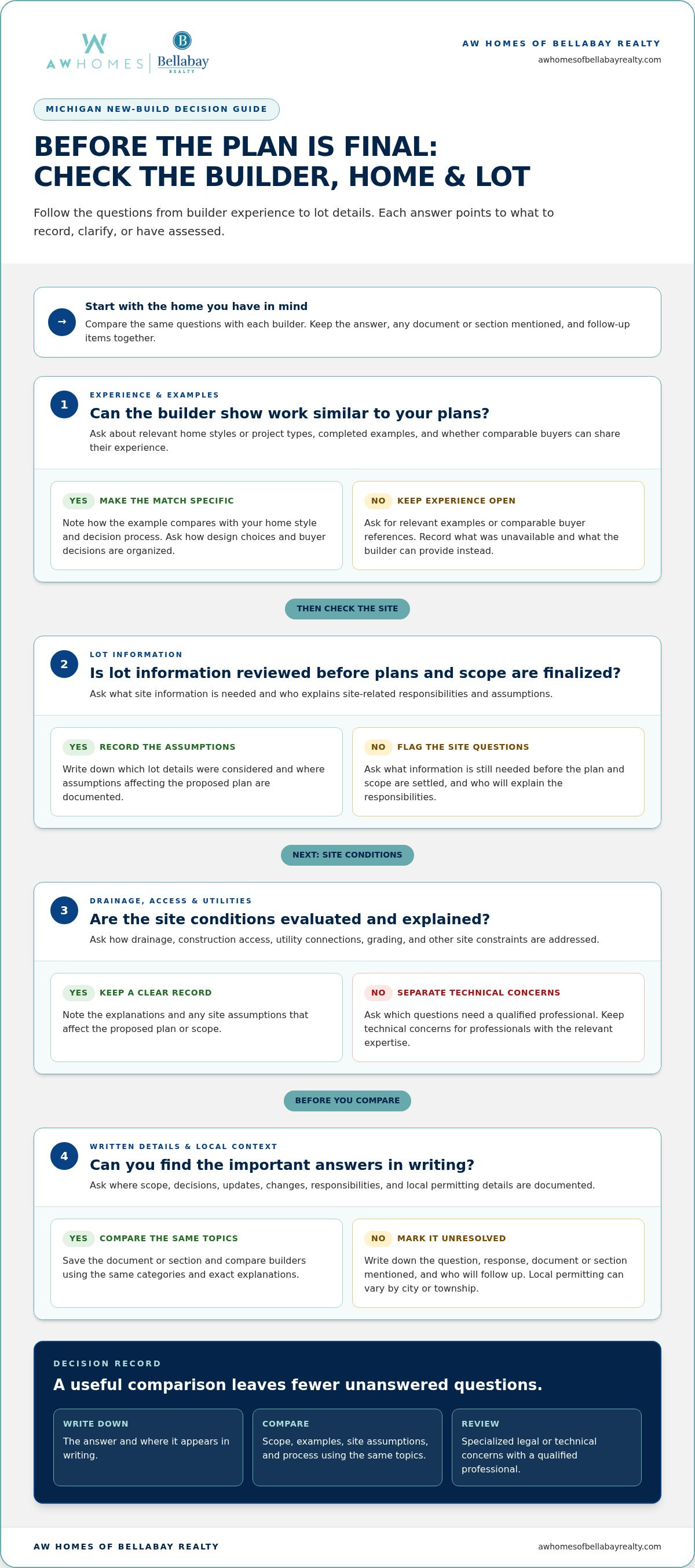
A builder’s track record matters most when it helps you understand how their experience relates to the home and property you’re considering. The useful question isn’t only how many projects a company has completed, but whether its work and process align with your needs and the specific lot. These questions can help connect those details, especially when comparing options around Grand Rapids, Ada, Caledonia, Forest Hills, Cascade, or East Grand Rapids.
Ask about experience and the homes they build
Ask which home styles and project types the builder handles regularly, and whether they can share examples that resemble your plans. You can also ask whether completed homes are available to view and whether buyers with a comparable project can share their experience. A tour can help you understand finishes and layout in context. Ask how design decisions are made, when selections happen, and how your priorities inform the plan.
- Which home types or project approaches best match your experience?
- Can I see completed examples similar to the home I have in mind?
- Can I speak with buyers whose projects are comparable?
- How are design choices and buyer decisions organized?
Look for specific, relevant answers rather than relying on a broad description of experience. If the builder shares a reference, ask how that project compares with yours, such as in home style or decision process. The goal isn’t to find an identical project. It’s to understand how the builder’s experience could translate to your plans.
Ask how the lot and location shape the plan
A home plan doesn’t exist separately from its site. Ask what information about the lot is reviewed before plans and scope are finalized, and who explains site-related responsibilities. Topics may include drainage, construction access, utility connections, grading, and other site constraints. Keep technical questions for qualified professionals, and request clear documentation of any site assumptions that affect the proposed plan.
- What site information is needed before the plan and scope are settled?
- How are drainage, access, and utilities evaluated and explained?
- Which site questions should be addressed by a qualified professional?
Local context matters, too. A property in East Grand Rapids may offer a different setting and daily routine than one in Cascade, Ada, or Caledonia. Consider your typical travel, access to places you visit often, and how the surrounding neighborhood fits your plans. For general code reference, Michigan’s official page provides the Michigan Residential Code and other building regulations; a qualified professional can help interpret technical requirements for a particular project.
Builder-specific research and local buyer guidance can work together as you assess a home and its location. Learn more about personalized buyer guidance for comparing West Michigan options.
How to Compare Michigan Builders’ Scope, Schedule, and Communication
Two builder proposals can look similar at first and still describe different homes, decision points, or responsibilities. A side-by-side comparison helps you spot those differences before they become assumptions. Use the same categories for every conversation, and keep the builder’s wording or written explanation alongside your notes. That makes your questions to ask a new home builder in Michigan more useful than a list you simply work through once.
A useful builder comparison means asking the same questions, documenting answers, and following up clearly. Create a simple grid with a column for each builder and rows for the topics below. Mark an answer “not yet provided” rather than filling gaps with guesses.
- Included scope and items described as optional
- Selections, allowances, and decision deadlines
- How changes are requested, reviewed, and recorded
- Schedule milestones and progress updates
- Who answers questions and how follow-up is handled
Industry resources, such as the National Association of Home Builders (NAHB), can offer broader context about home building. Your comparison should focus on each builder’s specific written proposal and communication process.
Compare scope, selections, and changes
Start with what each proposal says is included. Ask which features are part of the described scope, which are optional, and which require a buyer selection. If the builder uses allowances, ask what they cover and how selections are documented. Don’t treat two similar-sounding descriptions as equivalent until you understand what each means.
Clarify how selection deadlines are shared and how a requested change is reviewed and approved. Record where the decision will be documented and whether it changes other parts of the proposal. If an answer is still open, add it to a “needs follow-up” row in your grid. This keeps uncertainty visible instead of turning it into an assumption.
Compare schedule and communication practices
Ask who will provide updates, how you can raise a progress question, and how schedule changes will be explained. The goal isn’t to expect a fixed completion date from an early conversation. It’s to learn how the builder communicates about progress and what information you’ll receive as the project moves forward.
Record named milestones only when the builder provides them in writing. Note the milestone, where it appears, and how updates will be shared. If one builder describes regular check-ins and another gives updates only in response to questions, record that difference plainly. You can then consider which process suits your need for information instead of relying on vague impressions.
Before choosing, scan the grid for blank cells, terms you can’t compare, and answers that still need clarification. Ask for the missing explanation and attach it to the relevant proposal or notes. A careful comparison won’t make every builder’s process identical, but it can help you decide based on clear scope, realistic expectations, and communication that works for you.
Questions to Ask Before Signing a New-Home Agreement in Michigan
Before you commit, shift from conversation mode to careful review. Builder answers can help clarify expectations, but the agreement and related documents are where you’ll find the terms that shape the project. At this stage, questions to ask a new home builder in Michigan should help you identify what’s documented, what remains unclear, and which points need independent review.
Use a deliberate sequence. Gather the documents, compare them with your recorded answers, list the gaps, then review the terms with the appropriate professional. This keeps an unanswered question from getting lost in a long packet or an exciting meeting.
- Collect the documents. Gather the agreement and any materials that explain scope, selections, changes, schedule, responsibilities, and coverage.
- Compare answers with the paperwork. Check whether the written information reflects what you understood from builder conversations.
- List unresolved points. Write each open question clearly and note who is expected to respond.
- Arrange independent review. Ask a qualified legal professional about agreement language and a financial professional about financing questions.
Clarify documentation, coverage, and responsibilities
Ask which documents define the home’s scope, selected features, change process, schedule, and each party’s responsibilities. Then ask how warranty terms are provided, where coverage details appear, and how post-completion concerns are raised and answered. Clear references help you find the relevant information later, rather than relying on a verbal summary.
Also ask who coordinates questions about inspections and construction-stage access, and how those arrangements are communicated. These questions clarify the builder’s process; they don’t replace advice from an independent inspector, attorney, or other qualified professional.
Resolve open questions before making a commitment
Keep an open-issues list with three columns: the question, the response or document needed, and whether it’s resolved. For example, if a selection or responsibility is described differently in a meeting and in the paperwork, record the discrepancy and request a clear explanation. Don’t treat silence or an informal assurance as a settled answer.
Have an appropriate independent professional review agreement terms or financing questions within their expertise. For questions about local legal requirements or how they apply to your circumstances, consult a qualified professional familiar with the relevant jurisdiction. This is separate from preparing for closing; the Michigan home closing process guide provides an overview of that later stage.
A buyer’s representative can help keep builder conversations and options in perspective without representing the builder. Buyers comparing West Michigan choices can also explore buyer guidance for a new-home search.
Choose Your Next Step with Local Michigan Buyer Guidance
You’ve gathered answers, compared what each builder has put in writing, and identified the points that still need attention. Now bring those details back to your household’s priorities. Which option fits your must-haves, daily routines, location preferences, and comfort with the process? Keep unresolved items visible and address them before moving forward. Questions to ask a new home builder in Michigan are most valuable when they help you make a decision that fits both the home and the life you want to build there.
Buyer assistance can add structure to the search. A buyer’s representative can help organize conversations, keep track of options, and compare details from the buyer’s perspective. That role is separate from the builder’s role. It offers another point of view as you evaluate your choices, without representing the builder or replacing legal, financial, inspection, or construction professionals.
Connect builder choice to the right community
A home’s fit depends on more than its floor plan. Consider how the location supports your typical routines, preferred surroundings, and plans for the next stage of life. Angela Worth’s local knowledge spans Grand Rapids, Ada, Caledonia, Forest Hills, Cascade, and East Grand Rapids, providing context as you weigh community preferences alongside builder-specific research. If you’re moving into the region, the Grand Rapids relocation guide can help you consider the broader move as you compare areas.
For example, note the everyday needs that matter most to your household, then consider how each community and home option aligns with them. A comparison that includes lifestyle and location can help you see beyond a builder’s presentation and assess the decision as a whole.
Get support for your next home decision
Personalized buyer guidance can help you organize the home search and transaction, from clarifying your priorities to evaluating available options. Angela Worth brings 9+ years of real-estate experience, and AW Homes of Bellabay Realty has completed 250+ West Michigan transactions. The agency has a 5.0 ★ Zillow rating with 50+ client reviews. These details offer context about the experience behind the service, while the right next step remains the one that fits your circumstances.
Buyer representation in Grand Rapids can provide buyer-side support as you consider your options. Learn more about AW Homes of Bellabay Realty’s personalized buyer assistance. Your Life. Your Home. Your Peace of Mind.
Move Forward with a Clearer Sense of Fit
A new home decision doesn’t have to hinge on who makes the strongest first impression. Let your priorities guide the next conversation. If an answer feels incomplete, pause and seek clarity; if an option aligns with your plans and the written details support your understanding, you can move ahead with greater confidence.
Questions to ask a new home builder in Michigan are tools for making a considered choice, not a test you need to finish in one meeting. Keep your notes close, revisit what matters most to your household, and give yourself room to weigh the home, the process, and the community together.
Buyer-side guidance can offer a steady perspective as you compare options and plan your next steps. Connect with Angela Worth at AW Homes of Bellabay Realty for personalized buyer assistance as you consider what support would make your search feel more organized.
Your next home decision can begin with clarity, thoughtful questions, and confidence in the direction that feels right for you.
Frequently Asked Questions
What questions should I ask a new home builder in Michigan before signing?
Ask what the agreement commits each party to do, how decisions are recorded, and what steps remain before work begins. Questions to ask a new home builder in Michigan should also clarify who handles communication, how requested changes are documented, and where warranty information is provided. If a term is unclear, mark the exact language and have an appropriate independent professional explain its implications before you sign.
How do I compare new home builders in Michigan?
Compare proposals against the same priorities, not just the headline price or model-home appearance. Note whether the layout, storage, finish choices, and communication approach fit your household, then record where each builder’s written materials explain those points. Keep a separate list of unanswered questions. This helps you make a decision based on practical fit and available information, rather than which presentation felt most persuasive.
What should I ask a builder about standard features and upgrades?
Ask the builder to identify which specific features are included in the home you’re considering, which are optional, and how choices are recorded. For instance, if a display kitchen includes a particular appliance or finish, ask whether that exact item appears in the proposed scope or is only shown as an example. Request written descriptions of your selections so you can compare what each option means before making decisions.
Can I negotiate changes to a new construction home agreement?
You can raise a requested change with the builder, but don’t assume it’s accepted until the builder explains the process and the agreement or related documents reflect the decision. Ask who reviews the request, how any effect on scope or scheduling is described, and what written approval looks like. An independent legal professional can help you understand proposed changes to the agreement before you accept them.
How do I find out what a new home warranty covers?
Request the warranty documents and ask where they describe covered items, exclusions, time periods, and how to submit a concern. Ask whether different parts of the home are addressed separately and who receives a post-completion request. Rather than relying on a general verbal summary, read the actual coverage language and note anything you don’t understand. A qualified professional can help explain terms that affect your circumstances.
What should I ask about the construction timeline?
Ask what milestones the builder currently expects, how schedule updates are shared, and who explains a change. If you’re coordinating a move, ask which dates are estimates and which decisions or events could affect the schedule. Keep written updates together so you can track what has changed and when. Avoid treating an early projection as a guaranteed completion date unless the written agreement clearly establishes that commitment.
Do I need a buyer’s agent when purchasing a new construction home?
A buyer’s agent isn’t the builder’s representative; the agent can provide buyer-side guidance as you consider your options. That support can help organize questions, review available homes, and weigh location alongside your needs. Before working together, discuss the scope of representation and compensation in writing. For buyers comparing new construction around Grand Rapids, Ada, Caledonia, or East Grand Rapids, local context can complement builder-specific information.
What should I ask about the lot before building a home in Michigan?
Ask what information about the lot has been gathered and what assumptions are reflected in the proposed plan. You can ask how access, utilities, drainage, and other site-specific matters are addressed, and which questions should go to qualified technical professionals. For example, a preferred floor plan may need to be considered alongside the property’s shape and surroundings. Keep site questions distinct from general home-design preferences so each gets the right attention.


