

What if the most significant hurdle to your seamless home sale isn't the inspection or the appraisal, but a line item you didn't see coming? For many sellers in Grand Rapids, Ada, and Forest Hills, the Michigan property transfer tax often feels like a hidden obstacle that complicates an otherwise celebratory milestone. You've invested time, emotion, and resources into preparing your property for its next chapter. You deserve a closing process defined by precision, transparency, and peace of mind.
We understand that navigating the technicalities of real estate legalities can feel overwhelming during a period of significant transition. This guide will demystify the complexities of state and county tax requirements to ensure you have total clarity on your net proceeds. We'll explore the current 2026 rates, identify specific exemptions that protect your equity, and provide a methodical framework for a seamless experience. By the end of this article, you'll possess the expert insight needed to budget with confidence and move forward into your next life stage with ease.
Key Takeaways
- Distinguish between state and county obligations to build a precise and transparent closing budget.
- Calculate your Michigan property transfer tax using the 2026 standard state rate of $3.75 per $500 of the total sale price.
- Identify specific exemptions for family transfers or market value losses that can significantly reduce your financial burden.
- Utilize a meticulous closing checklist to verify the accuracy of your deed and Preliminary Closing Disclosure.
- Leverage the expertise of a local authority in Grand Rapids and Forest Hills to ensure a seamless, stress-free property transition.
What is the Michigan Property Transfer Tax?
The Michigan property transfer tax is a mandatory administrative fee triggered whenever ownership of real property changes hands. It represents a vital final step in your home-selling journey. This assessment is not a single charge but rather a combined total of two distinct components: the state transfer tax and the county transfer tax. Both are calculated based on the total purchase price of the property. This ensures that the contribution remains proportional to the value of the asset being transferred. Because this tax is collected at the moment the deed is recorded with the Register of Deeds, it serves as a definitive marker of a completed transaction.
Understanding these costs early allows for precise financial planning. Whether you're selling a family estate in Ada or a modern residence in Grand Rapids, these fees are a standard part of the Michigan real estate landscape. They are non-negotiable, predictable, and essential for the orderly transfer of land titles. By viewing this tax through the lens of a strategic transition, you can approach your closing with a sense of order and professional clarity.
The Purpose of the Transfer Tax
This tax serves three essential functions: it funds local initiatives, maintains public records, and validates the property transition. By contributing these funds, you support the regional infrastructure that makes our West Michigan communities such desirable places to live. The revenue generated often supports schools, parks, and essential municipal services that maintain the long-term value of local neighborhoods. Beyond the financial contribution, the payment of this tax acts as a formal certification. It ensures the legal validity of the deed as it's processed by the Register of Deeds. It's the final administrative milestone that confirms your property has been successfully passed to its new owner.
Who is Responsible for Payment?
In the state of Michigan, the responsibility for paying the transfer tax typically rests with the seller. The Grantor is the party relinquishing the property title. Because this fee is a standard closing cost, it's usually deducted directly from the sale proceeds during the settlement process. This methodical approach ensures that the payment is handled seamlessly without requiring additional out-of-pocket expenses at the closing table. Your title company or legal representative manages the calculation and distribution of funds as part of the total transaction. This provides a layer of emotional security, knowing that every detail is accounted for before you complete your personal evolution to your next home.
Calculating Your 2026 Michigan Transfer Tax Rates
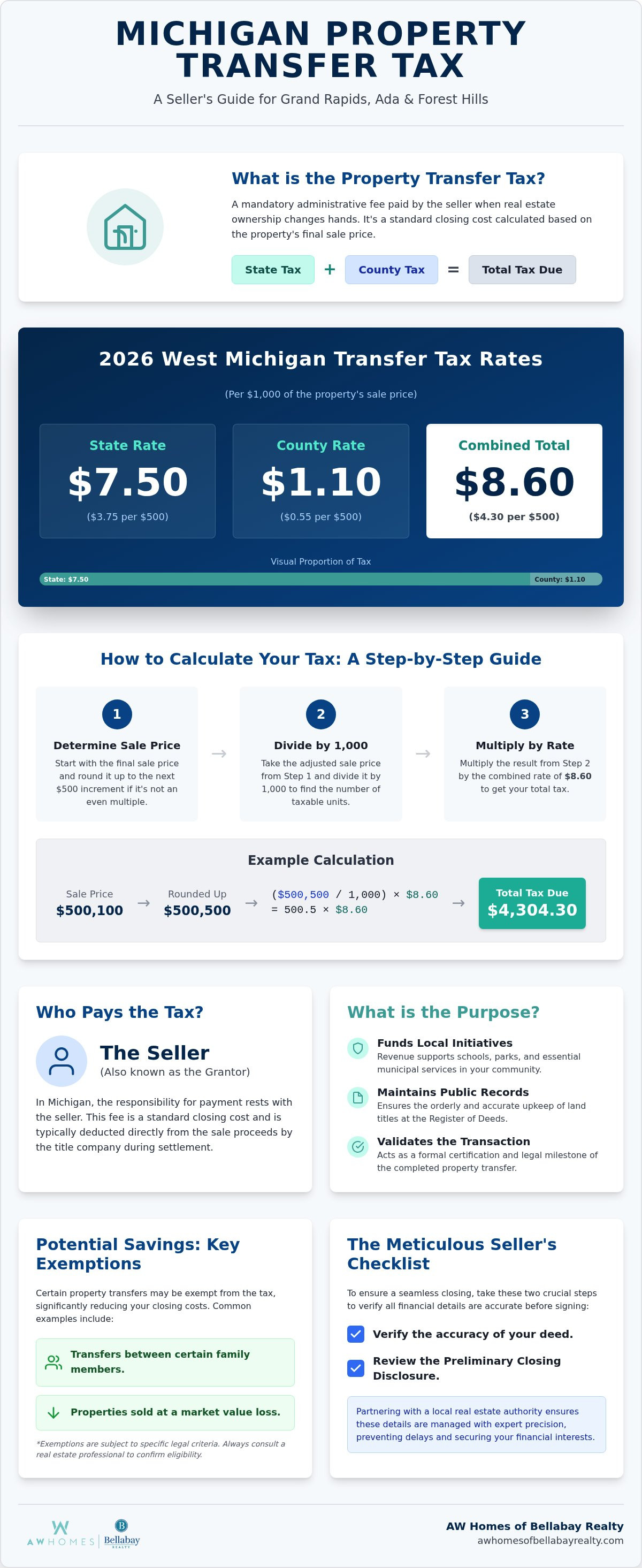
Precision defines every successful real estate transition. While some costs fluctuate with the market, the Michigan property transfer tax follows a rigid, state-mandated formula. It’s calculated in $500 increments of the total sale price. This means even a small increase in your final sale price could shift your tax bracket slightly. The state level assessment is set at $3.75 per $500 of value, which equals $7.50 for every $1,000. On the local level, most West Michigan counties, including Kent and Ottawa, apply a rate of $0.55 per $500, or $1.10 per $1,000.
This combined rate of $8.60 per $1,000 of value serves as a strategic benchmark for West Michigan sellers. It allows you to move beyond complex tax tables and focus on the broader vision of your life transition. By understanding the state’s $7.50 portion and the county’s $1.10 contribution, you gain a sophisticated perspective on where your proceeds are allocated. This transparency is the first step toward a stress-free closing experience.
Step-by-Step Calculation Guide
Start with your final sale price. If your property sells for $500,100, round up to $500,500 to satisfy state requirements. Divide this figure by 1,000 and multiply by 8.60 to reach your total estimate. This methodical formula provides a clear window into your closing costs, allowing you to plan your next transition with total confidence and professional clarity.
Local Variations in West Michigan
Geographic nuances play a vital role in your final net proceeds. In Kent County, the Register of Deeds acts as the final gatekeeper, verifying that every document is accurate before recording. While Ottawa County follows similar rate structures, the administrative flow can differ. Whether your home is in the quiet streets of Ada or the vibrant neighborhoods of Forest Hills, having a neighborhood authority who understands these local nuances is essential.
Partnering with a specialist for your residential listing services ensures these local details are managed with expert precision. This level of care prevents recording delays, secures your financial interests, and protects your emotional security throughout the sale. By leaving no detail to chance, you ensure your personal evolution to a new home is both seamless and rewarding.
Key Exemptions: Are You Overpaying Your Transfer Tax?
Strategic planning involves more than just calculating rates; it requires identifying opportunities to preserve your equity. While the Michigan property transfer tax is a standard closing cost, the law provides specific scenarios where sellers are exempt from these fees. These exemptions aren't automatic. They require meticulous documentation and a deep understanding of state statutes to ensure you aren't overpaying during your property transition. Identifying these opportunities early in your journey provides a sense of order and financial clarity.
Common exemptions often center on the relationship between the parties or the specific nature of the deed. You might qualify for an exemption if your transaction involves:
- Transfers between spouses or to create a joint tenancy.
- Conveyances involving government agencies or non-profit entities.
- Deeds that correct a previously recorded instrument without changing the consideration.
- Transfers resulting from a court order or certain trust distributions.
The State Essential Services Assessment
Under MCL 207.526, several specific instruments are shielded from the state portion of the tax. For instance, if you're transferring property as part of a foreclosure or a deed in lieu of foreclosure, you may qualify for significant savings. Navigating these requirements requires precision. This is why adhering to Michigan real estate disclosure laws is vital. Accurate disclosures ensure that the nature of your transfer is transparent, allowing your title company to apply the correct exemption codes at the time of recording. This methodical attention to detail prevents administrative errors that could cost you thousands at the closing table.
The PRE Refund: A Hidden Benefit
One of the most overlooked opportunities for financial recovery is the Principal Residence Exemption (PRE) refund. If you sell your primary home for less than its State Equalized Value (SEV) at the time of purchase, you might be eligible for a refund of the state transfer tax. The PRE refund protects sellers in specific market downturns by offering a path to reclaim paid taxes. To secure this benefit, you must file State Tax Commission Form 2856 within four years of the sale date.
This process requires a methodical approach to verify the original purchase price versus the final sale value. It's a technical detail that many generalist agents miss, but it's essential for your long-term financial well-being. By focusing on these specific situational needs, you can turn a complex legal requirement into a strategic advantage. This level of expert navigation ensures that your personal evolution to your next chapter is supported by every available financial protection in West Michigan.
Preparing for Closing: The Meticulous Seller's Checklist
The final stage of your property transition requires a shift from broad strategy to granular precision. As you approach the closing table, the emotional weight of moving on is often met with a flurry of paperwork. To maintain your peace of mind, you must ensure that every financial detail aligns with your expectations. This is where a methodical checklist becomes your most valuable asset. It transforms a complex legal process into a series of manageable, intentional steps that secure your equity and protect your legacy.
Review, verify, and document. These three actions form the foundation of a successful closing. You should begin by reviewing your Preliminary Closing Disclosure at least three days before your appointment. This document outlines every fee, including the Michigan property transfer tax, and ensures there are no surprises at the final hour. To prevent recording delays in Kent or Ottawa County, follow these essential steps:
- Verify Total Consideration: Ensure the exact sale price is stated clearly on the face of the deed to satisfy the Register of Deeds.
- Audit Tax Accuracy: Double-check that the state and county portions of the Michigan property transfer tax are calculated correctly based on your final sale price.
- Coordinate Stamps: Confirm with your title agent that the physical or electronic revenue stamps will be applied immediately upon recording.
- Gather Exemption Proof: If you're claiming a family or PRE exemption, submit all supporting documentation to your title company 14 days before closing.
The Role of the Title Company
Your title agent serves as the vital intermediary between your transaction and the public record. In Grand Rapids, these professionals are responsible for collecting the necessary funds and ensuring the deed is properly stamped before it reaches the county offices. If your specific deed doesn't list the purchase price, your agent will manage the 'Statement of Value' to maintain compliance. This professional oversight provides a layer of emotional security, allowing you to focus on your personal evolution rather than administrative hurdles.
Budgeting for Other Closing Costs
While taxes are a significant line item, they represent only one portion of your total settlement. You must also account for closing costs for seller in MI such as title insurance, brokerage commissions, and recording fees. When compared to these other expenses, the transfer tax is often a predictable, fixed cost that rewards early budgeting. Maintaining an organized approach to these figures ensures that the financial finality of your sale feels like a victory rather than a burden. Secure your financial future by partnering with an expert for your residential listing services today.
The Angela Worth Edge: Strategic Navigation of Your Sale
A successful real estate transaction is more than a financial exchange; it's a significant personal milestone that marks the beginning of your next chapter. At AW Homes, we view our role as high-level consultants dedicated to your emotional security and long-term well-being. Our concierge-style approach ensures that every intricate detail, from marketing strategies to the final calculation of the Michigan property transfer tax, is managed with methodical precision. We believe that a stress-free experience is built on the pillars of transparency, expert insight, and intentional planning.
By positioning your home to maximize value while minimizing administrative friction, we transform a complex process into a curated journey. Our focus moves beyond simple salesmanship to provide a steady, knowledgeable partnership. We understand the logistical nuances of different life stages, ensuring that your transition feels both high-end and deeply personal. No detail is left to chance, and no question is left unanswered. This commitment to excellence ensures that your Michigan property transfer tax obligations are handled with professional clarity, leaving you free to focus on your personal evolution.
Why Local Expertise Matters in 2026
The landscape of Grand Rapids real estate continues to evolve, requiring a partner with deep roots and neighborhood authority. In communities like Ada and Cascade, local market dynamics dictate the success of your sale. We provide the regional specialization needed to navigate shifting buyer expectations and property valuations with confidence. This localized reliability ensures that your home is not just another listing, but a strategically positioned asset in a competitive market. We treat your property transition as a positive development in your life story, providing the steady guidance you deserve through every life stage.
Your Next Chapter Starts Here
Simplifying complex requirements is just the beginning of our commitment to your success. We leverage professional home staging tips for sellers to maximize your equity and highlight the unique character of your Forest Hills residence. This meticulous attention to detail ensures that your home makes a lasting impression from the first showing to the final signature at the closing table. We invite you to experience a seamless, expert-led selling journey that prioritizes your financial goals and your peace of mind. Reach out for a private consultation to begin planning your successful West Michigan property transition with a partner who cares about your future.
Securing Your Legacy in West Michigan
A successful property transition is built on precision, transparency, and peace of mind. By mastering the intricacies of the Michigan property transfer tax, you've taken a vital step toward securing your financial legacy. You now understand how to calculate your 2026 rates, identify valuable exemptions like the PRE refund, and navigate the closing process with a methodical checklist. These details aren't just administrative hurdles; they are the foundation of a seamless move that protects your equity and honors your personal evolution.
In the vibrant communities of Forest Hills, Ada, and Cascade, having a neighborhood authority by your side makes all the difference. We provide a concierge real estate service that prioritizes your emotional security through a strategic and personalized approach. Every detail of your transition is managed with the care it deserves, ensuring no opportunity for savings is overlooked. Your journey is significant, and your representation should be equally exceptional. Schedule your strategic home-selling consultation with Angela Worth today. We look forward to guiding you through a stress-free experience as you step into your bright future.
Frequently Asked Questions
Who pays the Michigan property transfer tax, the buyer or the seller?
The seller typically pays the Michigan property transfer tax in the majority of residential transactions. This cost is managed as a debit on the seller's side of the closing disclosure and is deducted from the final sale proceeds. While it is a standard seller expense, it ensures the deed is legally recorded. This methodical approach provides a clean transition for both parties and maintains the professional clarity of the sale.
Is the Michigan transfer tax the same in every county?
No, the total tax amount varies because it consists of both state and county assessments. While the state rate is a uniform $3.75 per $500, county rates can differ across Michigan. In West Michigan counties like Kent and Ottawa, the rate is $0.55 per $500. You should always verify the specific local rate with a neighborhood authority before finalizing your budget to ensure total financial accuracy.
Are there any exemptions for first-time home sellers in Michigan?
Michigan doesn't offer a specific exemption solely for first-time home sellers. However, sellers may qualify for a refund of the state portion if they sell their primary residence for less than its original purchase price. This protection, known as the PRE refund, is based on market value rather than seller experience. It provides a layer of financial security during difficult market shifts and helps protect your hard earned equity.
How is the transfer tax calculated if I am gifting the property?
If you gift a property for $100 or less in total consideration, the transaction is typically exempt from the transfer tax. You must clearly state the nominal consideration on the face of the deed to qualify for this exemption. This process requires precise documentation to ensure the Register of Deeds accepts the filing. It is a strategic way to manage family transitions with professional clarity and intentionality.
Can the property transfer tax be negotiated in the real estate contract?
Yes, the responsibility for paying the tax can be negotiated between the buyer and the seller within the purchase agreement. While Michigan tradition dictates that the seller pays, a buyer might agree to cover this cost in a competitive market or unique situation. Any deviation from the standard practice must be clearly outlined in the legal contract to avoid confusion at the closing table. This ensures a seamless experience for everyone involved.
What happens if the transfer tax is not paid at the time of recording?
If the Michigan property transfer tax isn't paid, the Register of Deeds will refuse to record the document. This failure to record means the legal title hasn't officially transferred to the new owner in the public record. Such an oversight can lead to significant legal complications and cloud the property's title. Proper coordination with your title company ensures this administrative step is handled seamlessly and with expert precision.
Does the Michigan transfer tax apply to inherited property?
Inherited property is generally exempt from the transfer tax when it's passed through a will or a trust distribution. Because these transfers don't involve a traditional sale or financial consideration, they fall under specific state exemptions. You should ensure the deed is drafted correctly to reflect the nature of the inheritance. This protects the emotional and financial integrity of the family estate during a significant life transition.
Is the transfer tax tax-deductible on my federal income tax return?
For most residential sellers, the transfer tax isn't directly deductible as an itemized expense on a federal return. Instead, it serves to reduce your total capital gains by lowering the net proceeds of the sale. This subtle financial distinction is important for your long-term tax planning and overall net profit. You should consult with a qualified tax advisor to understand how this fits your specific financial situation and personal evolution.


