

Choosing a real estate agent is a profound act of trust, yet that trust is often tested when one professional attempts to sit on both sides of the closing table. For homeowners in Grand Rapids, Ada, and Caledonia, understanding what is a dual agency in real estate Michigan is the first step toward securing a successful life transition. It's natural to feel a sense of hesitation when your advocate suddenly becomes a neutral facilitator. You might worry about a conflict of interest, feel confused by complex legal disclosure forms, or fear that a neutral stance will cost you thousands at the negotiation table.
We believe your move should be defined by emotional security, strategic focus, and professional clarity. This 2026 guide promises to help you navigate Michigan's dual agency laws with absolute confidence, ensuring you understand exactly how these regulations impact your West Michigan home sale or purchase. We will explore the legal requirements for informed consent, the specific limitations placed on dual agents, and how to choose a representation style that aligns with your long-term goals. By the end of this article, you'll have the knowledge to protect your equity and the peace of mind to move forward into your next chapter.
Key Takeaways
- Master the legal definition of what is a dual agency in real estate Michigan to recognize when your agent's role shifts from advocate to neutral facilitator.
- Understand the critical timing of the "Disclosure Regarding Real Estate Agency Relationships" form to protect your confidential motivations and financial limits.
- Evaluate the balance between transaction efficiency and individual negotiation power when deciding if dual representation aligns with your financial goals.
- Discover how designated agency provides a strategic alternative, offering you exclusive representation even when the other party uses the same brokerage.
- Learn to prioritize emotional security and long-term planning by choosing a representation style that treats your move as a significant life milestone.
Understanding Dual Agency in Michigan Real Estate
A real estate transaction is rarely just about property; it's a significant milestone in your personal story. When you begin the process in Grand Rapids or Forest Hills, the type of representation you choose dictates the level of advocacy you receive. To understand what is a dual agency in real estate Michigan, you must recognize it as a specific legal arrangement where one licensee represents both the seller and the buyer in the same transaction. This isn't a casual agreement. It's a formal shift from being a dedicated fiduciary advocate to becoming a neutral facilitator who must remain impartial to both parties.
In a traditional single-agency relationship, your agent is your strategist, your negotiator, and your protector. By contrast, a dual agent cannot suggest a specific price or disclose the underlying motivations of either side. This model often appears in competitive West Michigan markets when a listing agent introduces their own buyer to a home. While some prefer the advocacy of an Exclusive Buyer Agent to avoid any overlap, Michigan law allows for dual representation as long as the process is handled with absolute transparency.
The Legal Status of Dual Agency in Michigan
Dual agency is 100% legal in our state, governed by the Michigan Occupational Code and overseen by the Department of Licensing and Regulatory Affairs (LARA). As of August 2026, the law remains clear: informed written consent is mandatory. This means every party must understand the limitations of the role before any confidential information is shared. Transparency isn't just a legal requirement; it's the cornerstone of emotional security during a high-stakes transition. We prioritize this clarity to ensure you never feel caught off guard by a shift in representation.
Agency vs. Transaction Coordinator: A Key Distinction
It's easy to confuse a dual agent with a transaction coordinator, but the differences are vital. A transaction coordinator is a licensee who doesn't represent either party as an agent. They have no fiduciary duty, no loyalty to your specific outcome, and no role in negotiation. They simply manage the paperwork and logistics to keep the deal moving. Knowing what is a dual agency in real estate Michigan helps you distinguish between these two paths. You can identify your agent's role by reviewing your initial service agreement; if they aren't providing strategic advice or loyalty, they might be acting as a coordinator rather than a dual agent.
The Legal Requirements: Consent and Disclosure
Clarity is the foundation of emotional security during a home sale or purchase. In West Michigan, the law requires every licensee to present a specific document known as the "Disclosure Regarding Real Estate Agency Relationships" form. This isn't just another piece of paperwork in a stack of signatures. It's a vital protection that outlines the duties your agent owes to you. Understanding the legal requirements of what is a dual agency in real estate Michigan involves recognizing that your consent must be informed, voluntary, and, most importantly, in writing. Professional standards set by the National Association of REALTORS® on Agency emphasize that clear communication is the only way to maintain ethical integrity in these complex situations.
Timing is everything when it comes to these disclosures. Michigan law dictates that this form must be presented and signed before you share any confidential information with an agent. If you tell a listing agent your maximum budget or your urgent reason for moving before signing this disclosure, you may have already compromised your negotiating position. You always have the right to refuse dual agency. If you feel that a neutral facilitator cannot meet your needs for advocacy, you can insist on single agency or seek an outside professional. Agents who fail to provide this disclosure risk severe penalties from the state, including the loss of their license and the forfeiture of their commission.
What a Dual Agent CANNOT Disclose
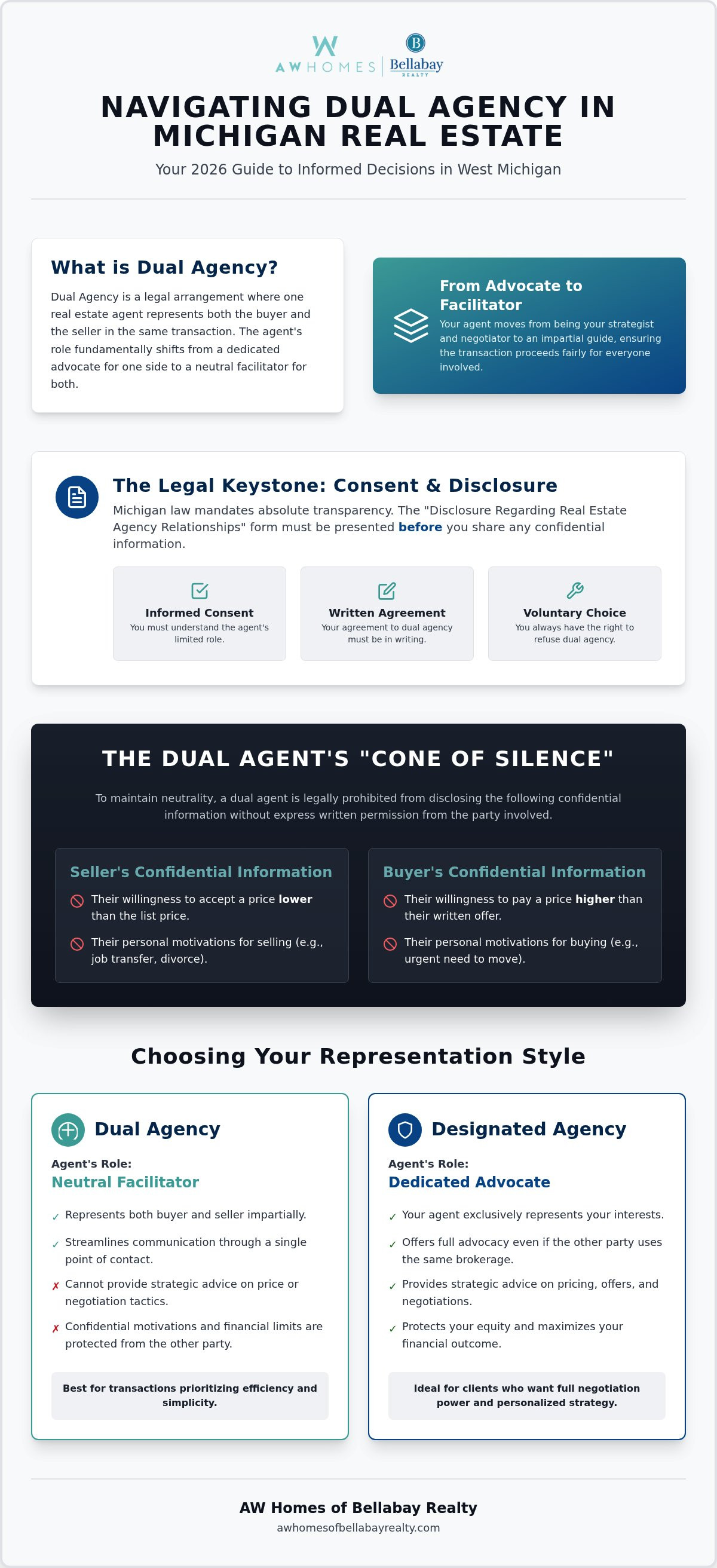
The primary challenge of dual agency is the "cone of silence" that must exist around specific financial details. To remain neutral, an agent is legally prohibited from sharing certain facts without express written permission. These include:
- The seller's willingness to accept a price lower than the current list price.
- The buyer's willingness to pay a price higher than their current written offer.
- The personal motivations, such as a job transfer or divorce, driving either party to move.
A dual agent acts as a neutral bridge who facilitates the exchange of information without influencing the final price or terms to benefit one party over the other.
What a Dual Agent MUST Disclose
While some information is kept private, other details must be shared to ensure a fair transaction. Transparency helps clarify what is a dual agency in real estate Michigan and how it protects your interests. A dual agent is still required to disclose:
- All known material facts regarding the property's physical condition, such as structural issues or past flooding.
- Any existing conflicts of interest, like a family or business relationship with the other party.
- The specific limitations of their role, ensuring both sides know they've lost their exclusive advocate.
If you're unsure how these legal forms affect your specific situation in Grand Rapids or Forest Hills, a strategic advisor at AW Homes of Bellabay Realty can provide the clarity you need to move forward with confidence.
Navigating the Pros and Cons for Buyers and Sellers
Choosing a representation style is a strategic decision that impacts your financial outcome and your peace of mind. When you evaluate what is a dual agency in real estate Michigan, you're essentially weighing the benefits of a streamlined process against the loss of a dedicated advocate. For move-up buyers in West Michigan, the appeal often lies in the reduction of friction. However, for sellers in high-equity areas like Forest Hills, the need for a strategic negotiator to protect a significant investment often outweighs the convenience of a single point of contact. We view this choice as a pivot point in your personal transition, where the right structure can lead to a more seamless journey.
Advantages: Speed and Streamlined Communication
The most tangible benefit of dual agency is the elimination of the "telephone game" between two different brokerages. When one agent manages both sides, information flows directly. This can lead to faster response times during the critical inspection period, where every hour counts. Scheduling showings, appraisals, and final walk-throughs in Ada or Cascade becomes significantly simpler. There's a certain rhythm to a transaction where only one professional is coordinating the logistics. This efficiency, speed, and simplicity can be particularly valuable in a fast-moving market where delays might jeopardize a closing date.
Disadvantages: The Loss of a Strategic Negotiator
The primary risk of this model is the shift from advocacy to neutrality. A dual agent cannot offer specific advice on price or terms. They cannot say, "I think you should ask for a $5,000 credit for that roof repair," or "I believe the seller is motivated and will take a lower offer." This loss of strategic insight can leave one or both parties feeling under-represented during intense negotiations. If a dispute arises over repairs or possession dates, the agent must remain neutral, leaving the parties to resolve complex issues without a dedicated champion for their specific interests. Understanding what is a dual agency in real estate Michigan means accepting that your agent is no longer your exclusive advocate, strategist, and protector.
In luxury markets like Forest Hills or Cascade, where equity is high and details are nuanced, the absence of a dedicated negotiator can be felt deeply. Without an agent to advocate for your specific financial position, you may find yourself making concessions you wouldn't have otherwise considered. This complexity is why many high-end transactions still rely on traditional single agency or designated agency models to ensure that every client has a professional entirely focused on their long-term well-being.
Dual Agency vs. Designated Agency: What’s the Difference?
Understanding the nuances of representation requires looking beyond the single agent. While we've defined what is a dual agency in real estate Michigan as a one-person role, many larger brokerages in West Michigan employ a different model called designated agency. In this scenario, two different agents from the same office represent opposite sides of the transaction. This structure is common in active markets like Caledonia and Cascade, where a single firm might hold a significant portion of the local listings. It provides a way for clients to stay within a trusted firm while maintaining a higher level of advocacy.
The fundamental difference lies in your agent's ability to fight for your interests. In a dual agency situation, the individual agent must remain neutral and silent on key terms. In a designated agency arrangement, your specific agent remains your dedicated fiduciary advocate. They can still offer strategic advice, negotiate aggressively on your behalf, and suggest specific price points. This distinction is vital because knowing what is a dual agency in real estate Michigan helps you recognize when you are losing a dedicated negotiator versus simply sharing a brokerage firm with the other party.
Under Michigan law, the only "dual agent" in a designated agency scenario is the supervising broker. This individual stays neutral to oversee the legalities of the file and ensure compliance with the Michigan Occupational Code. They don't participate in the daily negotiations or influence the specific advice given by either agent. This allows the agents to remain loyal to their respective clients while the firm manages the administrative process from a central, impartial position.
How Designated Agency Protects Your Interests
Professional firms maintain a strict firewall of confidentiality to protect your equity and your peace of mind. Your agent doesn't share your financial limits, your moving timeline, or your personal motivations with the other agent in the office. This model is often the preferred choice for luxury transactions in Forest Hills because it preserves the high-level consulting you expect during a major life transition. The supervising broker acts as an impartial observer, ensuring that no detail is left to chance while both parties receive full representation.
Questions to Ask Your Brokerage About Representation
Empower yourself by asking direct questions before you sign an agency agreement. You deserve to know how your information is handled during an in-house deal. Consider asking these three essential questions:
- Does your firm typically practice dual agency or designated agency for in-house transactions?
- What specific steps do you take to ensure my confidential data stays private from the other agent in your office?
- If I become uncomfortable with the representation style, what are my options for switching to a different agent within the firm?
We prioritize your long-term well-being over a quick closing. If you need a partner who understands these legal complexities and prioritizes your interests, our residential listing services provide the strategic oversight necessary for a successful and secure move.
Choosing the Right Representation in West Michigan
Your real estate journey is more than a legal process; it's a personal evolution. At AW Homes, our philosophy is rooted in providing emotional security, strategic focus, and methodical planning. While we've explored what is a dual agency in real estate Michigan, the final decision rests on your comfort level with neutral facilitation versus dedicated advocacy. Some clients value the speed of a single point of contact. Others require a high-level consultant who prioritizes their long-term well-being over a quick closing. Whether you're moving within Grand Rapids, Caledonia, or the surrounding communities, choosing your representation style is the most critical step in protecting your future.
A concierge-style agent views their role as a strategic advisor rather than a simple salesperson. This perspective is vital when navigating high-stakes transitions that involve significant lifestyle changes. We believe in expert navigation, personalized insight, and intentional planning. By evaluating your specific needs, you can determine if the neutrality of dual agency fits your goals or if your situation demands a partner who is entirely committed to your side of the table. This clarity ensures that your move is a positive development in your life story, handled with the care and sophistication you deserve.
The Strategic Advantage of Dedicated Buyer Agency
Move-up buyers often face a complex set of logistics that require a steady, knowledgeable hand. You need a partner who understands the nuances of the local market and can source opportunities beyond standard listings, including off-market homes. By finding a buyers agent in Grand Rapids, you ensure your interests are protected by a dedicated advocate who isn't bound by the neutrality of dual agency. This professional guidance is essential when navigating contract terms, appraisal gaps, and inspection contingencies. Your advocate provides the clarity, strategy, and confidence needed to secure your next home without compromise.
Protecting Your Equity When Selling Your Home
For those with high-value properties, the stakes of representation are even higher. High-end listings in neighborhoods like Forest Hills demand a specialist who is committed to a clear advocacy plan that maximizes your financial return. When you're selling my home in Forest Hills MI, you need a representative who views your equity as a sacred trust. Our concierge-style approach ensures that no detail is left to chance. We meticulously manage the home closing process in Michigan, transforming a potentially stressful transaction into a seamless, positive milestone. This methodical focus allows you to transition into your next chapter with complete peace of mind and financial security.
Securing Your Next Chapter with Clarity
Your move represents a positive evolution in your life story. We provide the emotional security and strategic focus necessary to navigate these complex legal landscapes in Forest Hills, Ada, and Caledonia. If you're ready for concierge-style residential services and deep local market authority, schedule a strategic real estate consultation with Angela Worth today. Expert guidance ensures your interests remain protected through every phase of the transaction. We look forward to helping you move forward with complete confidence.
Frequently Asked Questions
Is dual agency legal in Michigan?
Yes, dual agency is legal in Michigan under the Michigan Occupational Code. It requires informed, written consent from both the buyer and the seller before the agent can act in this capacity. This transparency ensures that all parties understand the agent's shift from a dedicated advocate to a neutral facilitator. Without this signed disclosure, any attempt to represent both sides is a violation of state law.
Can a dual agent tell me how much to offer on a house?
No, a dual agent cannot provide specific advice on offer amounts or counter-offer prices. Their role is to facilitate the exchange of information without influencing the final price to benefit one party over the other. If you are wondering what is a dual agency in real estate Michigan, it's essentially a state of neutrality where you lose the agent's strategic negotiation input on the financial terms of the deal.
Do I have to agree to dual agency in Michigan?
You are never required to agree to a dual agency arrangement in Michigan. You have the absolute right to insist on exclusive representation to protect your interests, equity, and future. If a conflict of interest arises, you can choose to work with a different agent or seek a firm that practices designated agency. We prioritize your comfort and emotional security throughout every phase of your personal transition.
What is the difference between a dual agent and a transaction coordinator?
A dual agent still maintains limited fiduciary duties, such as accounting for funds and disclosing material property facts. In contrast, a transaction coordinator has no fiduciary relationship with either party. They act as a neutral administrative assistant to manage paperwork and timelines. Understanding what is a dual agency in real estate Michigan helps you see that while both roles involve neutrality, the dual agent still operates under a formal agency agreement.
How does dual agency affect the commission I pay?
Dual agency does not legally dictate a specific commission rate, as all real estate commissions in Michigan are negotiable. As of August 2026, the average commission in Michigan is 6.20%, though this varies by firm and service level. While some believe a single agent should charge less for representing both sides, the complexity of managing two sets of expectations requires professional expertise, risk management, and careful coordination.
What happens if I change my mind about dual agency mid-transaction?
You can change your mind, but doing so mid-transaction can be complicated. If you withdraw your consent for dual agency, the agent may have to step away from representing one or both parties to avoid a conflict of interest. This might require you to bring in a new agent to finish the deal. It's best to discuss these scenarios with your strategic advisor before the transaction begins to ensure a seamless transition.
Is designated agency the same as dual agency in Michigan?
Designated agency and dual agency are distinct legal concepts in Michigan. In a dual agency, one individual represents both sides. In a designated agency, the broker assigns two different agents from the same office to represent the buyer and seller exclusively. This model allows you to maintain a dedicated advocate who can provide strategic advice, negotiate terms, and suggest price points while the firm's supervising broker remains the only neutral party.


