

Imagine settling into your new home in Forest Hills, only to open your first tax bill and find a "pop-up" amount that far exceeds what the previous owners paid. This scenario is a common source of anxiety for many families during a move. Understanding how are property taxes calculated in Michigan is not just about math; it's about protecting your financial future during a major life transition. This process requires expert navigation, methodical planning, and localized insight.
It's natural to feel overwhelmed by the dual system of State Equalized Value and Taxable Value, especially when millage rates in areas like Ada or Cascade shift annually. We believe your real estate journey should be defined by excitement, clarity, and security rather than fiscal surprises. This guide will empower you to master the nuances of Proposal A and the 1.027 inflation multiplier for 2026, ensuring you can budget with total confidence and professional precision.
We will break down the essential formulas for accurate budgeting, explore how the Principal Residence Exemption can lower your costs, and provide a clear roadmap for your next move. By the end of this guide, you'll have the tools to approach your next closing with absolute financial peace of mind.
Key Takeaways
- Understand the vital distinction between State Equalized Value and Taxable Value to anticipate your long-term financial commitments accurately.
- Learn exactly how are property taxes calculated in Michigan by applying the 2026 inflation multiplier of 1.027 to your home's unique assessment.
- Secure significant savings by mastering the filing deadlines for the Principal Residence Exemption, which can reduce your school operating tax by 18 mills.
- Navigate the complexities of the "pop-up" tax with a methodical plan that accounts for the uncapping of value after your property transfer.
- Leverage localized expertise in West Michigan markets like Ada and Cascade to ensure your next real estate transition is both seamless and secure.
The Foundation of Michigan Property Taxes: SEV vs. Taxable Value
The current landscape of West Michigan real estate is defined by growth, competition, and a unique tax structure that demands careful study. To understand how are property taxes calculated in Michigan, we must look back to a pivotal moment in the state's history. The passage of 1994 Michigan Proposal A fundamentally shifted the burden of school funding and, more importantly for homeowners, changed the way property values are assessed for tax purposes. This amendment created a dual system designed to protect residents from the volatility of a rapidly appreciating market. It ensures that while your home's market value might soar, your tax liability remains steady and predictable.
What is State Equalized Value (SEV)?
Your State Equalized Value represents exactly 50% of your property's "True Cash Value," which is the assessor's estimate of what the home would sell for on the open market. Local assessors in municipalities like Cascade or East Grand Rapids review neighborhood sales data annually to determine these figures. Once the local assessment is complete, county and state authorities "equalize" the data to ensure uniformity across different jurisdictions. Because SEV is tied directly to the Grand Rapids real estate market, it fluctuates based on demand, inventory, and local economic health. It reflects the current worth of your investment, but it isn't the number used to print your bill.
Understanding Your Taxable Value (TV)
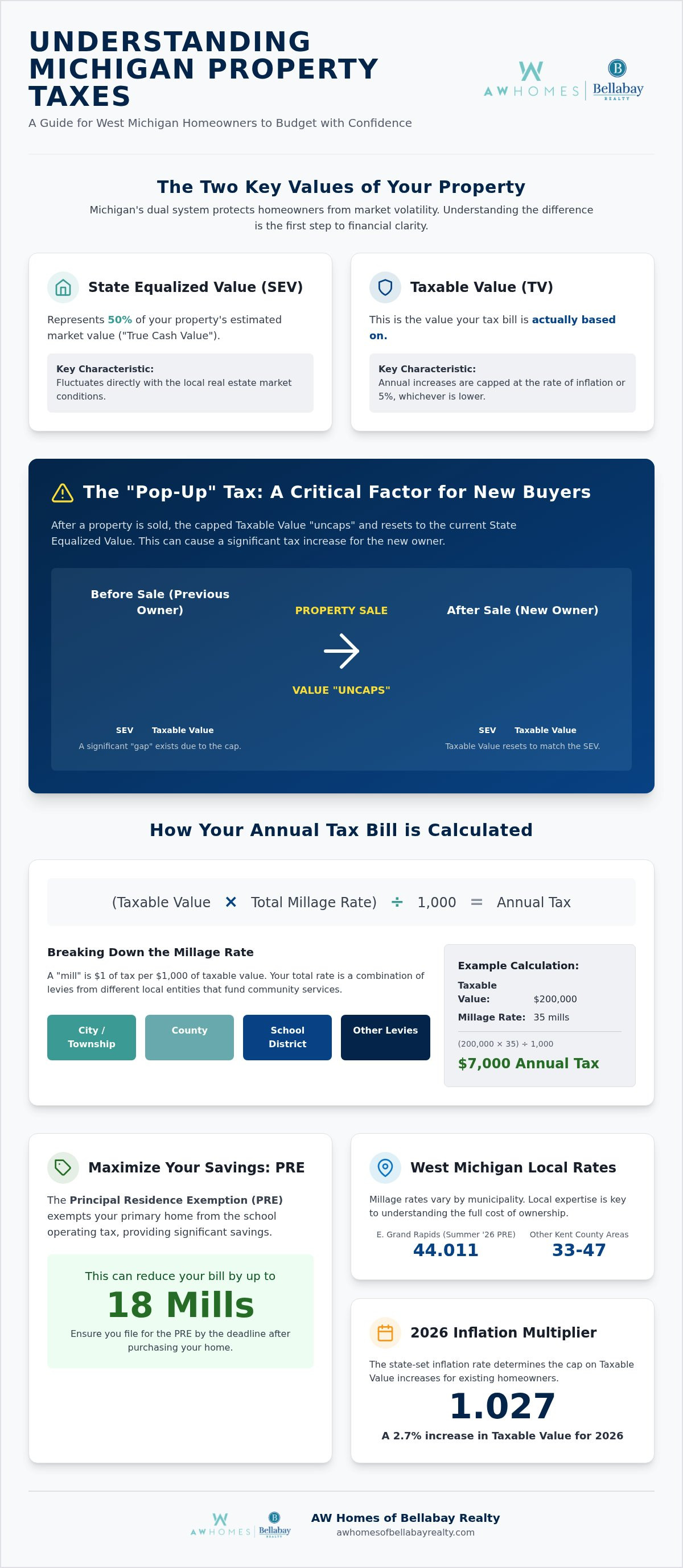
The Taxable Value is the figure that truly matters for your annual budget. Under the protections of Proposal A, the increase in your Taxable Value is capped at 5% or the rate of inflation, whichever is lower. For the 2026 tax year, the inflation rate multiplier is 1.027; this means most homeowners who haven't transferred their property will see a modest 2.7% increase in their valuation. This cap creates a "gap" over time. A long-term resident in Ada may have an SEV that is much higher than their Taxable Value, shielding them from rising prices. However, for new construction or homes that were recently sold, the Taxable Value and SEV are often identical because the value "uncaps" upon transfer. Your Taxable Value serves as the primary anchor of your annual tax liability.
Decoding the Math: Millage Rates and Local Funding
Once you understand your Taxable Value, the next step in mastering how are property taxes calculated in Michigan is identifying the millage rate. A mill is a unit representing one dollar of tax for every one thousand dollars of taxable value. If your home has a taxable value of $200,000 and a millage rate of 35, your base tax would be $7,000. These rates aren't static. They're the result of local ballot initiatives where West Michigan residents vote on funding for libraries, parks, and emergency services. This democratic process ensures your tax dollars directly support the local amenities you enjoy.
Your annual tax bill is a composite of three distinct pillars: the City or Township, the County, and the School District. Each entity levies its own millage to support specific services. In Michigan, this total is typically split into summer and winter installments. The summer bill, often the larger of the two, usually includes the 6-mill State Education Tax. The winter bill covers smaller local assessments and county-wide services. As MSU Extension Explains Proposal A, these millage rates are applied only to the capped taxable value, protecting you from sudden spikes even when local voters approve new funding measures.
Calculating Your Annual Tax Liability
The math is straightforward: (Taxable Value x Total Millage) / 1,000. While the formula is consistent, the variables change based on your exact address. Millage rates vary between Ada, Cascade, and East Grand Rapids because each municipality manages its own debt and service levels. For instance, East Grand Rapids had a 2026 summer P.R.E. millage rate of 44.011, while other parts of Kent County range from 33 to 47 mills. Millage rates represent the community's investment in local infrastructure. If you're evaluating homes across different townships, our Buyer Agency Services can provide a side-by-side comparison of the anticipated tax burdens.
The Role of School District Millages
School districts like Forest Hills or East Grand Rapids exert a significant influence on your total rate. These districts often pass bonds for facility upgrades or technology, which are reflected in your bill. You'll notice a distinction between "Homestead" (Principal Residence) and "Non-Homestead" rates. Primary residents are exempt from the 18-mill school operating tax, a massive saving that we will explore in the next section. Luxury homes in these high-performing districts carry a premium tax profile, reflecting the high demand for the educational excellence they offer. Understanding these nuances ensures your transition is financially sound and logically planned.
Maximizing Your Exemptions: The Principal Residence Exemption (PRE)
A successful real estate transition relies on methodical planning and emotional security. In our state, the Principal Residence Exemption (PRE) serves as the cornerstone of affordable homeownership. This exemption, often referred to as the homestead exemption, allows you to remove up to 18 mills from your local school operating tax. When you analyze how are property taxes calculated in Michigan, this single filing represents the most significant opportunity to lower your annual liability. It distinguishes a primary residence from a secondary home or investment property, ensuring that your long-term well-being is prioritized over a higher tax burden.
The distinction between "Homestead" and "Non-Homestead" is more than just legal jargon; it's a financial milestone. For a typical home in West Michigan, missing this exemption could result in thousands of dollars in unnecessary expenses each year. Many families navigating a life transition, such as moving from a starter home to a larger property in Forest Hills, often overlook the administrative nuances. Forgetting to file the appropriate affidavit can lead to a "Year Two Shock" that disrupts your financial clarity and confidence.
How to Claim Your PRE
Securing your exemption requires a simple but timely interaction with your local township assessor. You must own and occupy the home as your principal residence to qualify. To see the benefit on your summer tax bill, you must file by June 1st. For the winter tax levy, the deadline is November 1st. If you're currently selling your Forest Hills home to downsize or move up, remember that you must rescind your PRE on the old property. This ensures a seamless handoff and maintains the integrity of your tax profile during your personal evolution.
Other Potential Exemptions and Credits
Michigan offers additional specialized pathways to reduce your tax footprint based on your specific life stage. The Homestead Property Tax Credit provides a state income tax credit for households with a total income at or below $67,300 as of 2026. This credit is designed to assist those whose property taxes are high relative to their earnings. We also provide expert insight for our veteran community; qualifying veterans with a 100% service-connected disability are entirely exempt from property taxes on their primary residence. Other niche opportunities include:
- Agricultural Exemptions: For those transitioning to larger parcels of West Michigan land.
- Poverty Exemptions: Based on specific income and asset tests determined by local municipalities.
- Qualified Forest Property: Encouraging the preservation of our region's natural beauty.
Navigating these options requires a steady, knowledgeable partner who understands that every detail matters. By integrating these exemptions into your broader strategy, you move closer to a stress-free roadmap for your next chapter.
The 'Pop-Up' Tax: Strategic Planning for Buyers and Sellers
The "pop-up" tax is perhaps the most misunderstood element of our state's tax system. For move-up buyers in the Grand Rapids area, this phenomenon can create significant financial friction if not managed with professional foresight. When you investigate how are property taxes calculated in Michigan, you'll find that the benefits of Proposal A are tied to the owner, not the land. While the cap protects current residents, it resets the moment a deed changes hands. This ensures a methodical transition of the tax burden. It requires buyers to look beyond the seller's current bill. It demands a clear view of your own future liability.
The Mechanics of Uncapping
The legal trigger for a tax reset is the transfer of ownership, a process technically known as uncapping. This event allows the local assessor to adjust the Taxable Value so it matches the State Equalized Value (SEV) in the year following the sale. While there are specific exceptions for family transfers and certain strategic planning arrangements, most residential sales will trigger this reset. Uncapping aligns the tax burden with current market values. For a property in Ada or Cascade that hasn't sold in decades, this jump can be substantial. Understanding this mechanic is vital for maintaining emotional security throughout your real estate journey.
Budgeting for the Transition
One of the most common pitfalls in West Michigan real estate is the "Year Two Shock." Your first tax bill after closing often reflects the seller's capped value, which can lead to a false sense of security. It isn't until the following calendar year that the uncapped value actually appears on your statement. To avoid this, you should use the Michigan Home Closing Process to estimate prorated taxes based on the new valuation. You must calculate your anticipated bill by taking 50% of your expected purchase price and applying the local millage rate. This proactive approach prevents massive escrow adjustments and unexpected shortages in your first 18 months of ownership.
For sellers, providing this level of transparency acts as a powerful tool for a smoother closing and builds immediate trust with potential buyers. If you are preparing for a move, our Residential Listing Services include a comprehensive analysis to help you present your property's tax profile with accuracy and integrity. This level of intentionality ensures that no detail is left to chance, allowing both parties to move forward with absolute confidence and peace of mind.
Navigating Property Tax Transitions in West Michigan
A successful real estate transition is built on a foundation of local knowledge and precise data. While we have explored the broad mechanics of how are property taxes calculated in Michigan, the true value lies in applying these formulas to specific West Michigan neighborhoods. High-value areas like Ada and Cascade require a nuanced perspective that generalist agents often overlook. Our methodical approach ensures that your financial planning is grounded in regional dominance and neighborhood authority. We believe that a home is more than a structure; it is the setting for your next personal evolution.
Neighborhood-Specific Tax Insights
Comparing the tax profiles of Forest Hills and East Grand Rapids reveals how local priorities shape your annual liability. In East Grand Rapids, the density and historic nature of the community create a different assessment environment than the expansive estates of Cascade. Local market trends in these enclaves directly influence your home's True Cash Value, which dictates your future SEV. By leveraging our luxury homes Grand Rapids MI expertise, we help you identify properties that offer long-term value and manageable tax trajectories. This strategic focus moves beyond simple salesmanship to position your investment for success.
Partnering for a Seamless Move
Our team views every transaction as a significant personal milestone. We integrate a detailed tax analysis directly into your Grand Rapids relocation guide, providing a strategic roadmap for your move. This process is designed to mitigate the inherent stress of high-stakes financial transitions through intentionality, personalization, and expert insight. We believe that emotional security is the ultimate anchor of a successful move. No detail is left to chance when you have a steady, knowledgeable partner navigating the complexities of Michigan's tax system on your behalf.
Your next steps should involve more than just browsing listings; they should involve sourcing a property that fits your specific life stage and long-term tax strategy. Whether you are moving up to a larger family home or downsizing for a new chapter, our relocation assistance provides the clarity you deserve. We invite you to connect with AW Homes for a personalized market analysis to begin your journey with confidence. Together, we will ensure your transition is seamless, secure, and perfectly aligned with your financial goals.
Securing Your Financial Future in West Michigan
Mastering the intricacies of property assessments is the first step toward a successful life transition. You now understand the vital distinction between SEV and Taxable Value, the importance of timely PRE filings, and the mechanics of the "pop-up" tax. By clarifying how are property taxes calculated in Michigan, you've replaced uncertainty with a clear, actionable roadmap for your next move. This methodical approach ensures that your financial clarity remains intact as you evolve into your next chapter.
We provide more than residential listing services; we offer emotional security through expertise, intentionality, and local insight. As a West Michigan neighborhood authority and strategic life transition specialist, our concierge real estate services are designed to protect your long-term interests. We invite you to Plan Your Move with Confidence—Contact AW Homes Today. Your journey in Forest Hills, Ada, or Cascade deserves the steady hand of a professional who treats your milestone with the care it deserves.
Frequently Asked Questions
What is the difference between SEV and Taxable Value in Michigan?
State Equalized Value (SEV) represents 50% of your home's true cash value as determined by local assessors. Taxable Value is the specific figure used to determine your actual bill, and it remains capped by the rate of inflation or 5% annually. For long-term owners in East Grand Rapids, these two numbers often diverge significantly. While SEV reflects current market trends, Taxable Value provides financial stability by limiting annual increases.
How much will my property taxes increase when I buy a house in Michigan?
When you purchase a home, the Taxable Value uncaps and resets to match the current SEV in the following calendar year. This often results in a substantial increase if the previous owner held the property for many years. To understand how are property taxes calculated in Michigan for a new purchase, you should estimate 50% of your purchase price and apply local millage rates. This proactive step ensures your transition remains predictable.
What is the 'tax pop-up' and how can I avoid a surprise bill?
The "tax pop-up" occurs when the property's Taxable Value uncaps to match the SEV after a transfer of ownership. You can avoid a surprise bill by ignoring the seller's current tax amount during your budgeting process. Instead, focus on the property's current SEV or your anticipated purchase price. Our concierge-level guidance helps you navigate these financial nuances during closing, providing the emotional security you need for a seamless move.
Can I appeal my property tax assessment in Grand Rapids?
You can appeal your property tax assessment through the local Board of Review, which typically meets every March. This process allows homeowners in communities like Ada or Cascade to challenge the assessor's estimate of value if it exceeds actual market worth. Successful appeals require methodical preparation, objective sales data, and localized market insights. We recommend reviewing recent neighborhood sales to determine if your SEV accurately reflects 50% of your property's value.
How do I calculate my Michigan property taxes if I have a PRE?
To calculate your taxes with a Principal Residence Exemption (PRE), you subtract the 18-mill school operating tax from your total local millage rate. The formula for how are property taxes calculated in Michigan with this exemption is (Taxable Value x (Total Millage - 18)) / 1,000. This exemption is a cornerstone of affordable ownership for primary residents. It requires a specific affidavit filed with your township assessor by June 1st or November 1st.
When are property taxes due in Michigan for 2026?
Michigan property taxes are typically collected in two installments: a summer bill and a winter bill. For 2026, summer taxes are generally due by September 14th, while winter taxes must be paid by February 14th, 2027. Specific deadlines can vary slightly by municipality in Kent County. Unpaid taxes are turned over to the county treasurer as delinquent after March 1st, so tracking these dates is essential for maintaining your financial peace of mind.
Does a home renovation increase my property taxes in Michigan?
A home renovation can increase your property taxes if the project adds significant value or square footage, such as a finished basement or a new addition. While Proposal A caps annual increases, physical improvements are added to the Taxable Value at 50% of their true cash value. Routine maintenance like painting or roof repairs generally won't trigger an increase. Strategic planning before a major renovation helps you anticipate the future impact on your budget.
What happens to property taxes during a family home transfer?
Property taxes during a family home transfer may remain capped if the transaction qualifies for specific legal exemptions. Transfers between certain relatives, such as parents to children, often avoid the uncapping process that typically occurs during a traditional sale. This allows the new owners to maintain the previous Taxable Value and lower tax burden. We advise consulting with a strategic advisor to ensure the transfer involves methodical planning, legal compliance, and emotional security.


