

Your credit score can affect the mortgage interest rate a lender offers: a higher score may help you qualify for a lower rate. Preparing your finances for a home purchase also means reviewing your income, debts, and savings so you can set a realistic budget for mortgage payments and other ownership costs. The rate and loan terms both affect what you can comfortably afford.
It’s natural to focus on the down payment, but property taxes, homeowners’ insurance, maintenance, and closing costs also belong in the plan. Tax rules may matter too: according to the Internal Revenue Service, an eligible home buyer may withdraw up to $10,000 from an IRA or Roth IRA for a home purchase before age 59-1/2 without the normal 10% early-withdrawal penalty. This article walks through practical steps for reviewing credit, planning monthly payments and upfront costs, and understanding a home purchase’s tax implications before you decide what fits your finances.
Key Takeaways
- Review your credit early and keep your finances steady while preparing for a mortgage application.
- Build a home budget that accounts for upfront expenses and the ongoing costs of ownership, not just the down payment.
- Track income, spending, savings, and debt to find a monthly payment that leaves room in your budget.
- Understand how a home purchase may affect your taxes, including the rules that can apply to certain IRA withdrawals.
Credit scores and mortgage rates
Review your credit, budget, and loan options before making an offer. These steps can clarify what may affect your mortgage rate and monthly payment.
Review Credit Reports and Scores
Start by reviewing your credit reports early, so you have time to correct errors before applying. A higher credit score can help you secure a lower mortgage interest rate. Keep credit card balances below 30% of available limits, and avoid closing old accounts that support your credit history. Multiple mortgage-lender inquiries within a short period count as a single inquiry and have little impact on a credit score.
Improve Credit Before Applying
Pay bills on time, reduce credit card balances, and avoid opening new credit accounts during the home-buying process. Keep records of your income, savings, and debts organized, since lenders review your credit, finances, and employment information. These steps can strengthen your application and help you borrow an amount that fits your budget. Avoid taking on new debt or making major financial changes while your mortgage approval is underway.
Compare Pre-Qualification and Pre-Approval
Ask a lender about pre-qualification for an initial affordability estimate, then pursue pre-approval when you’re ready to shop. Pre-approval involves a lender reviewing your financial, credit, and employment details. It can also help demonstrate to sellers that you’re a serious buyer. Gather recent bank statements and other documents the lender requests, such as pay stubs, tax returns, and debt statements.
- Estimate an affordable payment. Calculate debt-to-income ratio by dividing monthly debt payments by gross monthly income. Lenders have traditionally allowed a maximum ratio of 36%; 43% is a general maximum for mortgage qualification. Aim to keep the ratio below 36% for financial stability, and budget for a payment that leaves room for other expenses.
- Compare loan structures. Conventional loans are not government-backed; FHA, VA, and USDA loans are distinct government programs with different eligibility and loan requirements. Compare interest rates, points, and terms: points are upfront charges that can lower the rate, while a longer term generally spreads repayment over more time. Consider 15-, 20-, and 30-year terms, and compare total costs, not just the monthly payment.
Property taxes, homeowners’ insurance, maintenance, and closing costs
Plan for both closing costs and expenses that continue after you move in. Your purchase budget should reflect the property, your plans for homeownership, and your financial situation.
Save for Upfront Homebuying Costs
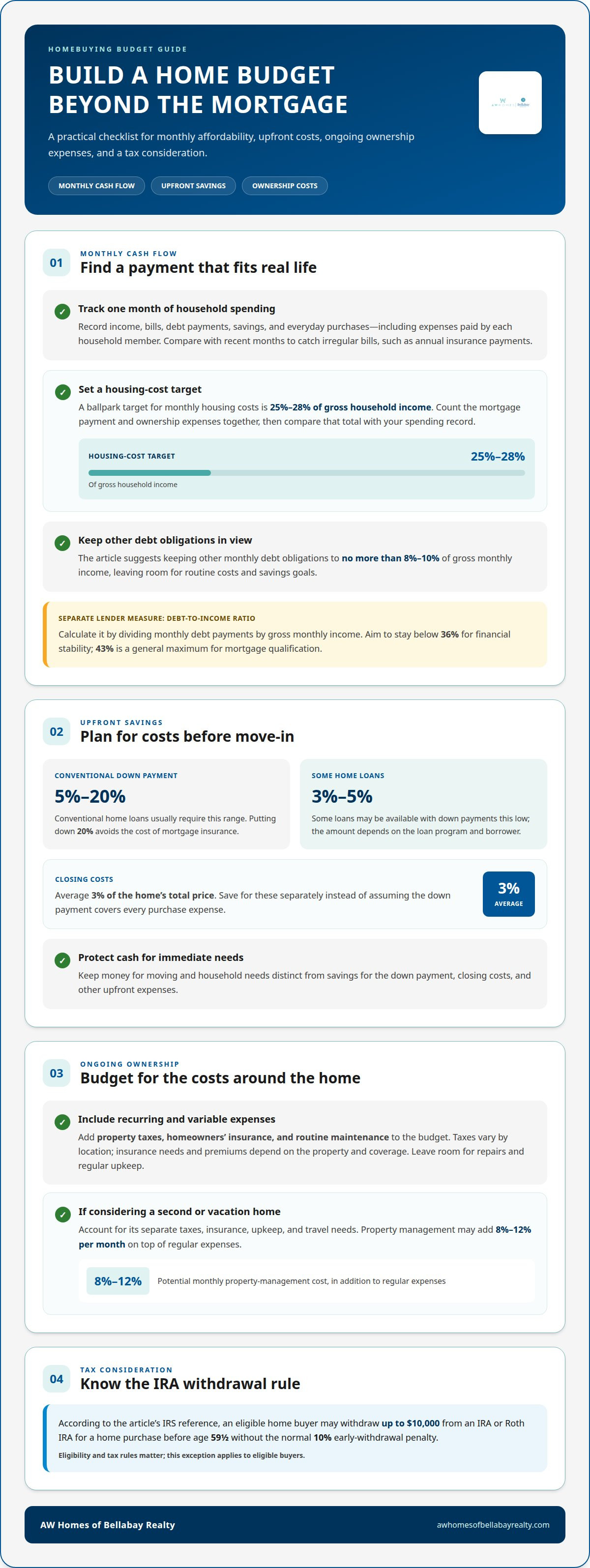
Set aside funds for the down payment, closing costs, and other upfront expenses before buying. Conventional home loans usually require a down payment of 5%-20%, and putting down 20% avoids the cost of mortgage insurance. Closing costs average 3% of the home’s total price, so include them separately rather than assuming the down payment covers every purchase expense. Keep these savings distinct from money reserved for moving and immediate needs.
Plan for Ongoing Home Costs
Include property taxes, homeowners’ insurance, and routine maintenance in your ownership budget. Property taxes vary by location, while insurance needs and premiums depend on the property and coverage you choose. Maintenance takes time and money, too, so leave room for repairs and regular upkeep instead of treating the mortgage payment as the full cost of owning a home. Compare these expenses for each property you consider.
- Prepare for closing and additional properties.
Before closing, review the final costs and use the walkthrough to look for visible changes or unresolved issues. Raise concerns through the transaction process before completing the purchase. If buying a second or vacation home, account for its separate taxes, insurance, upkeep, and travel needs. A property management company can add 8%-12% per month on top of regular expenses, so include that possibility when planning the property’s carrying costs. For help weighing a home’s location and purchase considerations, get local homebuying guidance as you assess the property’s fit.
Tracking spending and monthly payments
Set a housing budget that fits your everyday cash flow, not just the maximum a lender may approve. Preparing your finances for a home purchase means understanding how monthly expenses, debt, and savings work together.
- Track household spending. For a month, record income, bills, debt payments, savings, and everyday purchases. Include expenses paid by each household member, even if you use separate accounts. This record shows which costs are fixed and where spending might be adjusted. Compare it with recent months to identify irregular bills, such as annual insurance payments, that could otherwise disrupt your new housing budget.
- Choose a sustainable monthly payment. A ballpark target for monthly housing costs is 25% to 28% of gross household income. Add the mortgage payment and ownership expenses, then compare the total with your spending record. Keep other monthly debt obligations to no more than 8% to 10% of gross monthly income. A realistic limit leaves room for routine costs and savings goals.
- Set a down-payment savings goal. Choose a home-price range, then map out the savings needed for the down payment and upfront costs. Some home loans may be available with down payments as low as 3% to 5%; the amount depends on the loan program and borrower. A larger down payment can reduce monthly mortgage payments, but keep enough cash available for moving and household needs.
- Explore assistance and protect reserves. Ask a lender or housing counselor about down-payment assistance and eligibility factors, which may include location, income, and loan program. A housing counselor can also help you assess your readiness for homeownership. Before buying, set aside three to six months’ worth of expenses in an emergency fund. Reviewing your savings regularly keeps preparing your finances for a home purchase connected to your long-term plans, not just the upfront costs.
Home purchase tax implications
Consider tax matters as part of your buying plans before deciding how much cash to commit. Keep tax records organized, understand the limited IRA withdrawal rule, and include property-related expenses in your budget.
- Review retirement funds before using them. According to the Internal Revenue Service, an eligible home buyer may withdraw up to $10,000 from an IRA or Roth IRA for a home purchase before age 59-1/2 without the normal 10% early-withdrawal penalty. Treat this as a specific exception, not a general tax-free withdrawal. Confirm eligibility and consider how removing retirement savings affects your long-term plan.
- Keep purchase and tax records together. Create a secure folder for closing documents, property tax statements, mortgage records, and home-related receipts. Label each file by date and purpose. Organized records help you understand property expenses and prepare accurate information when reviewing your income and tax position. Keep digital copies alongside originals so key details are easy to access.
- Separate recurring property expenses from tax benefits. Property taxes affect the cost of owning a home, but don’t assume a particular expense will reduce your tax bill. Track payments and keep the related statements. Distinguish property taxes from mortgage payments, insurance, maintenance, and other home costs to get a clearer picture of how the purchase will affect your budget.
- Plan for the home’s purpose and your records. Note whether you intend to use the property as your primary home, a second home, or an investment. Organize purchase paperwork and income records accordingly. Tax treatment can depend on different factors, so don’t base your buying plan on an assumed deduction or tax result. A real estate agent can help you assess property details and local market context, while your financial plan accounts for the home’s full expenses.
As you weigh a property’s costs and fit, plan your home purchase with the full financial picture in view.
AW Homes of Bellabay Realty
AW Homes of Bellabay Realty helps buyers connect financial priorities with a home search informed by West Michigan neighborhoods and local market conditions. Once you’ve reviewed your credit, monthly budget, and upfront costs, use those limits to narrow down locations, property types, and purchase options. Through Buyers assistance, Angela Worth helps you assess homes against your needs and planned spending in Grand Rapids, Ada, Caledonia, and East Grand Rapids. Relocation support can help you coordinate housing decisions with a move to the area. For investment purchases, real-estate advisory connects property choices with your investment goals. This guidance complements lender and tax advice while keeping your real estate priorities in view. Contact AW Homes of Bellabay Realty when you’re ready to explore homes with your budget and goals in mind.
Make Your Next Move With Clarity
Preparing your finances for a home purchase means more than setting a spending limit. It’s a chance to align your next home with the life you’re building, whether you’re buying, selling, or moving to a new area. Knowing your priorities can help keep property decisions grounded in what matters to you.
AW Homes of Bellabay Realty supports that transition through Buyer Agency Services, Residential Listing Services, and Relocation Assistance. Whether you’re ready to explore homes, planning a sale, or coordinating a move, the team can help you navigate the real estate process with local insight and attentive guidance.
Take the next step at your own pace. Contact AW Homes of Bellabay Realty to discuss your plans and begin shaping a path toward your next home.
Frequently Asked Questions
How do lenders determine the interest rate on your mortgage?
Lenders consider your credit profile and loan details when setting a mortgage interest rate. A higher credit score may help you qualify for a lower rate, while the loan term and type also shape the offer. Compare the annual interest rate, points, fees, and repayment terms, since a lower rate alone doesn’t show the loan’s full cost.
What’s the difference between pre-qualification and pre-approval?
Pre-qualification provides an early estimate of how much you may be able to borrow. Pre-approval involves a lender reviewing your financial information to assess your application. Neither is a final mortgage commitment. If your income or debts change after pre-approval, for example, the lender may need to review your application again. Use the estimate to guide your planning, then consider offers in light of the reviewed application.
How much should I save for a down payment and closing costs when buying a home?
Set a savings goal based on the home price, the loan program, and the cash you’ll need at closing. Conventional loans usually require a down payment of 5%-20%, and closing costs average 3% of the home’s total price. Keep the down-payment and closing funds separate from money reserved for moving, immediate repairs, and everyday expenses after purchase.
What credit score do I need to qualify for a mortgage and get a competitive rate?
There isn’t one credit score that applies to every mortgage option. Lenders assess your credit alongside your finances and employment, and the loan program affects eligibility criteria. A higher score may improve your chances of receiving a lower interest rate. Review your credit history for errors early, and avoid new credit applications that could change your profile during the mortgage process.
How much house can I afford based on my income, debts, and monthly expenses?
Start with a monthly payment that fits your budget after debts and regular expenses. For example, $3,000 in monthly debt payments against $10,000 in monthly income produces a 30% debt-to-income ratio. Then account for the full housing payment and costs beyond the mortgage. A lender’s maximum approval is a borrowing limit, not a target you must spend.
What documents and financial records do I need to apply for a mortgage?
Gather recent pay stubs, W-2 forms, tax returns, bank and investment account statements, and records of outstanding debts. Include proof of supplemental income if it contributes to your finances. Organize these documents by source and date, and make sure the income and account information is consistent across records. Lenders use these materials to assess your financial position and mortgage eligibility.


