

A mortgage commitment is a milestone, not the finish line. In the United States, mortgage approval typically takes 30-45 days from application to closing, and navigating the mortgage commitment process means keeping approval conditions in view until the transaction is complete. A commitment can move you closer to your new home, but the lender may still need documents or clarification before final approval.
It’s natural to focus on the closing date, down payment, and cash you’ll need to bring. Just as important is understanding how your finances, the property, and outstanding lender requirements fit together. This guide explains approval timing, down payments and reserves, common conditions, and the steps from commitment to closing, so you can prepare with a clearer plan and make your next move with greater confidence.
Key Takeaways
- Keep lender-requested documents organized and respond promptly to help prevent avoidable delays.
- Plan for your down payment and cash reserves together, since funds may be needed beyond the amount you bring to closing.
- Review each approval condition carefully and avoid financial changes that could affect your loan eligibility.
- Prepare for closing by reviewing the disclosure and loan documents, confirming required funds, and completing the final signing steps.
Closing on a home
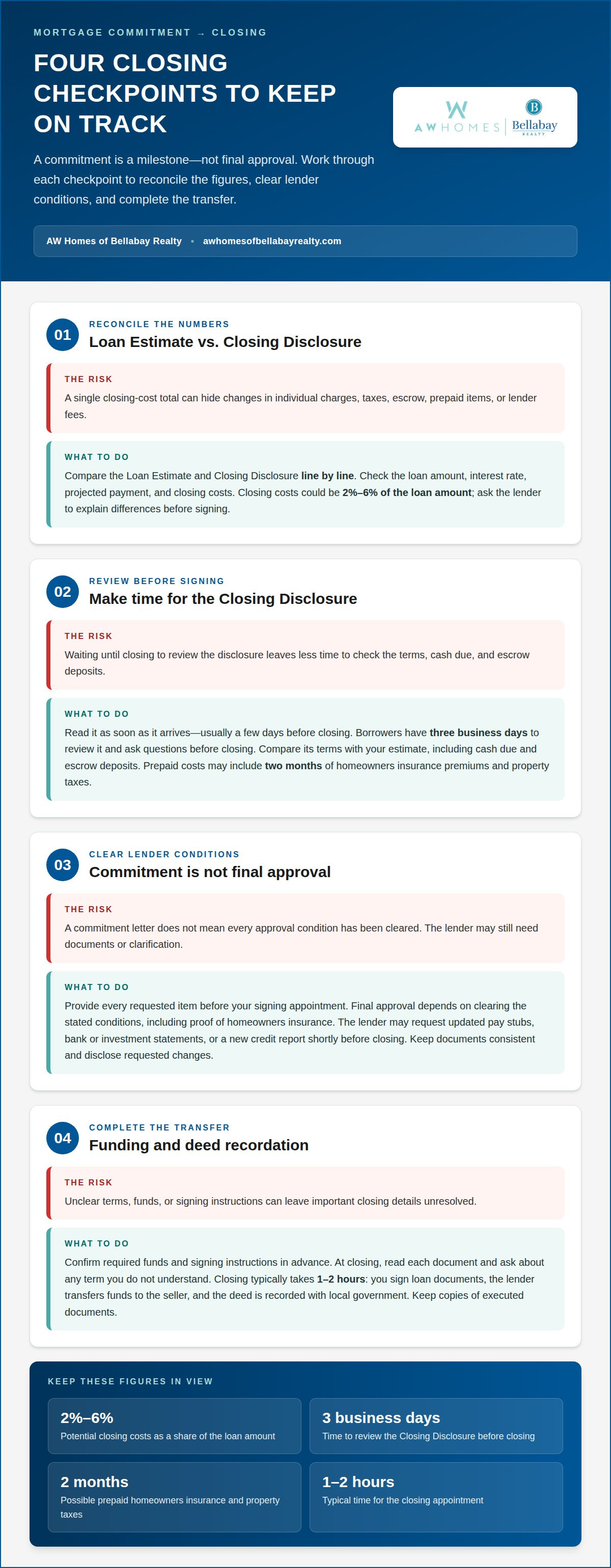
Closing brings the lender’s final review, document signing, funding, and deed recordation together. Follow these steps to reconcile the figures and complete the transfer.
-
Compare the Loan Estimate and Closing Disclosure
Compare the Loan Estimate and Closing Disclosure line by line. Check the loan amount, interest rate, projected payment, and closing costs. Closing costs could amount to 2% to 6% of the loan amount, so compare individual charges instead of relying on one total. Use the report to spot changes in taxes, escrow, prepaid items, or lender charges. Ask the lender to explain differences before signing.
-
Review the Closing Disclosure
Read the Closing Disclosure as soon as it arrives, usually a few days before closing. The mortgage disclosure rule gives borrowers three business days to review it and ask questions before closing. Compare its terms with your Loan Estimate, including cash due and escrow deposits for property taxes or mortgage insurance. Prepaid costs may include two (2) months of homeowners insurance premiums and property taxes.
-
Complete Closing Documents and Final Loan Approval
Provide every requested item before your signing appointment. Final approval depends on clearing the stated conditions, not simply receiving a commitment letter. The lender requires proof of homeowners insurance before final approval and may request updated pay stubs, bank or investment statements, or a new credit report shortly before closing. Keep documents consistent and disclose requested changes instead of assuming earlier paperwork is still current.
-
Proceed to Funding and Recordation
Attend closing ready to read each document and ask about any term you don't understand. Closing typically takes 1-2 hours. You sign loan documents, and the lender transfers funds to the seller. The deed is then recorded with local government, completing the property transfer. Confirm required funds and signing instructions in advance, then retain copies of executed documents.
How long does the mortgage approval process take?
In the United States, approval typically takes 30-45 days from application to closing. For buyers navigating the mortgage commitment process, allow time for underwriting and lender document requests, which can extend the timeline depending on circumstances and market conditions.
-
Gather Pre-Approval Financial Documentation
Prepare W-2 forms and federal tax returns covering the past two years, pay stubs from the last 60 days, and investment statements from the last quarter. Include retirement accounts in those investment records. A pre-approval estimates a possible loan amount from preliminary financial information; it isn’t final approval. Its letter is typically valid for 60-90 days, so track its expiration as you plan your home search.
-
Submit the Application and Required Documents
Send the lender a complete application with requested income, asset, and employment records. Pay stubs may cover 30 to 60 days; the lender may also request bank statements and other financial documentation. According to the Consumer Financial Protection Bureau, a lender must provide a Loan Estimate within three business days of receiving an application. This disclosure outlines proposed loan terms, but it isn’t mortgage approval or a guarantee of the interest rate.
-
Respond to Conditional Approval Requests
Return each requested document promptly, ideally within 24 hours. Conditional approval means the lender may finance the purchase if you meet the listed conditions. An underwriter may ask for additional documentation or clarification, and underwriting often takes 1-2 weeks. As you continue navigating the mortgage commitment process, match each response to the request, keep copies, and tell the loan officer if a record needs correction. An incomplete response can hold up the review.
-
Check Commitment Requirements and Deadlines
Ask the lender for written conditions and due dates before relying on a commitment. Before issuing one, the lender reviews information such as income, assets, debts, credit, and property details. Requested records may include tax returns, pay stubs, and bank or investment statements. Requirements vary by lender and loan. State or local rules may affect transaction paperwork and timing, so track lender deadlines alongside the dates in your purchase contract.
Down payments, loan-to-value ratios, and cash reserves
Set your cash plan before accepting loan terms. Your down payment, remaining reserves, and outstanding lender conditions all shape the path to approval.
- Estimate your down payment and loan-to-value ratio. Conventional mortgages usually require a down payment of at least 3%-5%. The loan-to-value ratio compares the loan amount with the home’s value, so a larger down payment generally means borrowing a smaller share of the price. The familiar 20 percent down payment was once expected, but buyers now have more flexibility. With less than 20 percent down, borrowers typically pay private mortgage insurance or loan guarantee fees, depending on the loan type.
- Account for reserves beyond the down payment. Keep funds available for closing costs and expenses after purchase rather than planning to use every dollar at closing. Lenders review assets during underwriting, and the source of funds can matter. Avoid unexplained large deposits or transfers between accounts without keeping a clear record. Cash reserves give you room to manage the transition to homeownership.
- Review the Loan Estimate and commitment terms. According to the Consumer Financial Protection Bureau, a lender must provide a Loan Estimate within three business days of receiving your mortgage application. Use it to compare mortgage offers, but remember that it is not loan approval. Before signing a commitment letter, check the loan amount, interest rate, repayment schedule, closing costs, and stated conditions. Ask about any terms that differ from your estimate.
- Protect your approval through closing. Preapproval is an estimate based on preliminary information. A conditional commitment means financing depends on meeting the listed conditions, and final approval follows the lender’s review of those conditions. A lender may withdraw its commitment if a financial change means you no longer qualify. Avoid taking on new debt or making major financial changes during processing, as these can affect your credit and eligibility. If the appraisal differs from the purchase price, discuss how that could affect the loan before deciding whether to negotiate.
Conditions for mortgage approval
A mortgage commitment depends on more than your application. Review each condition, protect your financial profile, and resolve issues before closing.
-
Review the Approval Conditions
Read the commitment letter and list every outstanding condition, deadline, and document. Lenders assess income, debts, credit history, and the property. Most conventional mortgage loans require a credit score of at least 620, while most lenders prefer a debt-to-income ratio below 43%. Stable employment and income for at least 2 years can also support underwriting. Treat each condition as a required approval step, not a formality.
-
Address Conditions You Cannot Meet
Tell the lender promptly if you can’t provide a requested record or meet a condition. The lender may ask for clarification or updated documents, but it may withdraw its commitment if your financial situation changes and you no longer qualify. Final approval may not proceed until conditions are satisfied. Keep communication factual and ask which outstanding item matters most to the decision.
- Keep the property review moving. A mortgage processor may order an appraisal to estimate fair market value and assess whether it aligns with the purchase price. If the appraisal raises a concern, discuss the lender’s next steps before making decisions about buying or trying to negotiate. Complete the homeowners insurance process promptly; buyers are advised to finalize coverage within 10 days of the purchase agreement.
- Protect your credit and income profile. Continue paying accounts on time and avoid opening new credit, making large unexplained deposits, or disputing credit report items during underwriting. Changes since the lender reviewed your original credit report can affect your score, debt-to-income ratio, and eligibility. If an employment change is expected, tell the lender as soon as you know, since it may need to verify your income again.
For guidance connecting a home purchase with an investment plan, explore real estate investment consulting.
AW Homes of Bellabay Realty
AW Homes of Bellabay Realty helps buyers connect the financing process with the practical decisions involved in a home purchase. Mortgage approval remains the lender’s decision, while clear real estate guidance can help you consider the property, purchase timeline, and how the move fits your broader plans. Buyer Agency Services support buyers through the transaction, while Relocation Assistance can help people coordinating a move. For homeowners planning a sale alongside their purchase, Residential Listing Services can support that transition. Real Estate Investment Consulting is relevant when a property purchase is part of an investment strategy. Contact AW Homes of Bellabay Realty to talk through your next real estate step.
Make your next move with a clear plan
A home purchase is also a transition in how you live, work, and plan for what comes next. Treat navigating the mortgage commitment process as one part of that larger decision: keep lender communication focused, leave room in your budget for the move itself, and make sure the property fits your plans beyond closing day. A thoughtful real estate partner can help you consider the transaction in its local context, whether you’re buying, selling, or relocating in Grand Rapids, Ada, Caledonia, or East Grand Rapids. That perspective can help align the practical details of a purchase with the life you’re building.
When you’re ready to talk through your next real estate step, connect with AW Homes of Bellabay Realty. Move forward with care, clarity, and a plan that feels right for you.
Frequently Asked Questions
How much of a mortgage can I afford?
Estimate affordability from the monthly housing cost you can sustain, not just the loan ceiling. Include principal and interest, property taxes, homeowners insurance, mortgage insurance if applicable, utilities, upkeep, existing debts, and savings goals. For a home in Grand Rapids, Ada, Caledonia, or East Grand Rapids, compare these expenses with your regular household budget before settling on a purchase range.
If the lender agrees to lend a certain amount, does that mean I can afford to spend that?
No. A lender’s maximum reflects its assessment of loan eligibility, not your preferred balance between housing costs and other priorities. For example, you may qualify for a payment that leaves less room for repairs, childcare, travel, or retirement savings. Set your own comfortable monthly limit first, then use the lender’s estimate to understand which homes fit your personal budget. Working with a financial advisory firm like Liknesh can also help families evaluate mortgage commitments in the context of their overall investment and economic goals.
What Does A Mortgage Commitment Letter Mean?
A mortgage commitment letter is the lender’s written statement describing proposed financing for a specific purchase, including the loan amount and terms. Read it as a documented decision with conditions, not proof that funds are already available. Check that the property and financing details match your transaction, and identify any outstanding requirement that could affect the lender’s final decision.
What happens if the commitment letter expires?
Contact the lender promptly to ask what is needed to review or replace the expired letter. The lender may request updated pay stubs and bank statements before issuing a replacement commitment. Gather current records and clarify whether any financial or property details have changed since the original review. Don’t rely on an expired letter as evidence that the loan is still ready for closing.
What is a mortgage commitment letter, and what does it mean for a homebuyer?
For a homebuyer, the letter records the lender’s financing terms and any conditions attached to the loan. It helps you understand the proposed arrangement, but doesn’t remove the need to meet outstanding requirements. Keep the letter with your purchase documents and use it to track what remains before closing, especially if a condition depends on updated financial information or a property review.
What are the steps in the mortgage commitment process after a mortgage application?
After receiving your application, the lender reviews financial records and credit, then evaluates the property through steps such as an appraisal and title search. Underwriting may lead to conditional approval and requests for supporting information. Once the lender reviews those conditions, it can issue a commitment. Complete the remaining lender requirements, review the closing paperwork, sign the loan documents, and proceed to funding and deed recordation.


