

To understand what an escalation clause in a real estate offer does, focus on its starting price, escalation amount, and maximum price. If a competing offer meets the clause’s terms, the buyer’s offer rises by the stated amount above it, up to the cap. Written proof of the competing offer can help show that a genuine competing bid triggered the increase.
An automatic increase may seem like a straightforward way to stay competitive, but it can reveal the buyer’s price ceiling and leave less room to negotiate. A highest-and-best offer takes a different approach: the buyer submits the strongest terms they’re prepared to offer without tying the price to another bid.
This guide explains the clause’s key terms, how an increase works, and what to weigh before choosing this strategy. It also compares escalation clauses with highest-and-best offers, so you can consider your price limit alongside other terms that may matter to a seller.
Key Takeaways
- Set a clear starting offer, escalation increment, and firm maximum so you know where your price limit stands.
- Require written proof of a competing offer before an escalation increases your price.
- Strengthen a competitive offer by weighing its full terms, not just its price.
- Choose between an escalation clause and a highest-and-best offer based on how much pricing flexibility and control you want.
Should My Offer Include an Escalation Clause?
An escalation clause may suit an offer in Grand Rapids, Ada, Caledonia, or East Grand Rapids when competing bids are expected. Its usefulness depends on the seller’s process, your price limit, and the other terms you’re prepared to offer.
Alternatives for Strengthening an Offer
A competitive offer can stand out through its terms as well as its price. For example, a buyer may propose a closing timeline that fits the seller’s plans or present clear financing qualifications. Contingencies also shape an offer’s overall appeal. These alternatives matter because a seller may consider the complete proposal, not just the amount offered.
Enforceability and State Rules
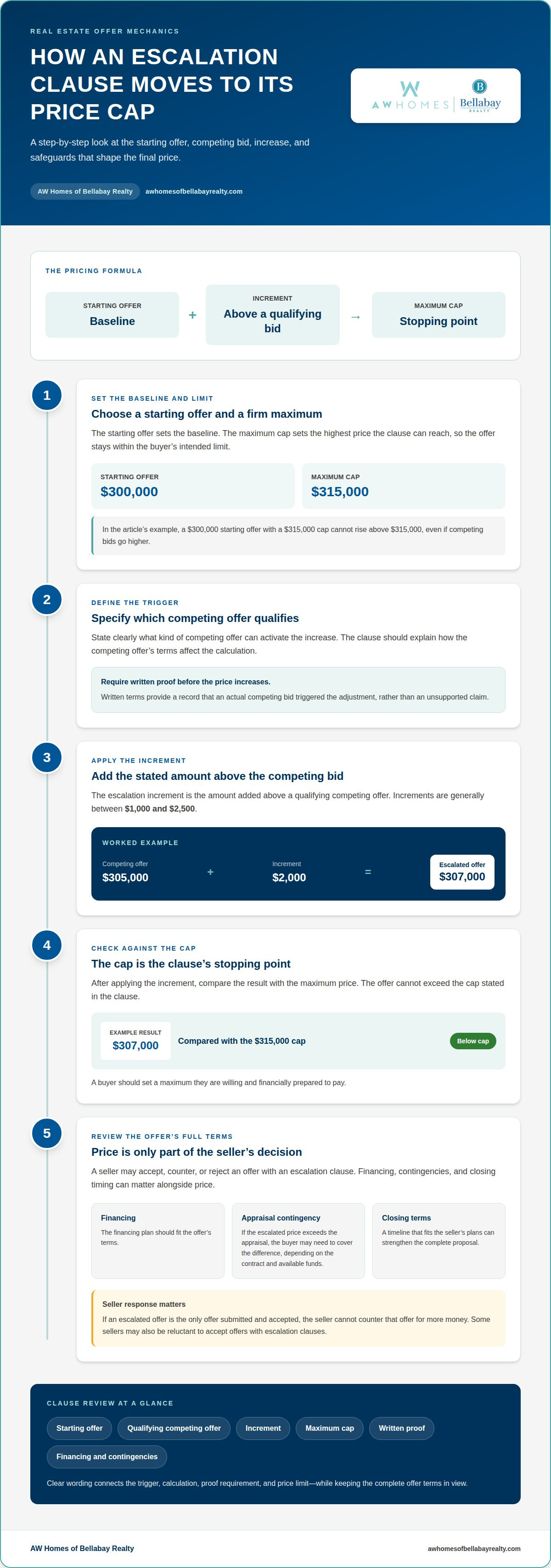
Require written proof of a bona fide competing offer before an escalation takes effect. This provides a record that an actual competing bid triggered the increase, rather than an unsupported claim. The clause should also explain which offer qualifies and how its terms affect the calculation. For example, a buyer can specify that the seller provide the competing offer’s written terms before applying the agreed increase.
An escalation can affect appraisal and financing contingencies if the appraised value differs from the contract price. If the escalated price exceeds the appraisal, the buyer may need to cover the difference, depending on the contract and available funds. An appraisal contingency can make the purchase conditional on the home appraising at or above the agreed price.
Set a cap you’re willing and financially prepared to pay. A seller may also weigh financing, contingencies, and closing terms when reviewing an offer in Grand Rapids, Ada, Caledonia, or East Grand Rapids.
How Do Escalation Clauses Work in Real Estate?
An escalation clause combines a starting offer, an increase tied to a competing bid, and a maximum price. Each term controls how the offer responds during negotiations.
Initial Offer and Maximum Cap
The initial offer sets the starting price, and the maximum cap sets the highest price the clause can reach. These limits matter because a buyer’s offer should remain serious while staying within a comfortable budget. For example, a buyer starting at $300,000 with a $315,000 cap won’t exceed that cap, even if competing bids rise further.
Offer Price Increments
An escalation increment is the amount added above a qualifying competing offer. Increments are generally between $1,000 and $2,500. Buyers can choose an increment based on how much they’re willing to exceed another bid, while keeping the maximum in view. With a $2,000 increment, a $305,000 competing offer would raise a $300,000 starting offer to $307,000.
Seller Responses to an Escalation Clause
A seller may accept, counter, or reject an offer containing an escalation clause. Some sellers may be reluctant to accept offers with escalation clauses. A seller may weigh financing, contingencies, and closing timing alongside price. If an escalated offer is the only offer submitted and accepted, the seller cannot counter that offer for more money.
Writing and Negotiating the Clause
State the trigger, increment, maximum, and proof requirement clearly. Specify which competing offer qualifies and require written proof before the price increases. If two buyers submit escalation clauses, both can increase until one reaches its cap and the other holds the higher bid. Review the full terms so your limit and contingencies remain clear; for buyers navigating competitive offers in Texas markets, teams like edwatersrealestate.com provide guidance on structuring strategic purchase terms.
Definition and components of an escalation clause
An escalation clause is a term in a buyer’s offer that sets a price response to a qualifying competing offer. Its core parts are the starting offer, the amount added above a competing bid, and a maximum price, if included. Together, these terms describe when the buyer’s offer changes and how far it can rise. The buyer should be willing and financially prepared to follow the formula.
The starting offer establishes the baseline; the increment determines the adjustment; the cap sets the stopping point.
The clause should also define the competing offer that triggers the increase and the written proof required. Clear proof connects the adjustment to an actual bid. The wording can address how concessions affect the comparison, since a competing offer’s contract price may not equal the seller’s net proceeds. For instance, seller contributions toward a buyer’s closing costs can change the net amount the seller receives.
Other contract terms belong in the same careful review. An appraisal contingency can address what happens if the agreed price exceeds the home’s appraised value. The lender bases its loan on the appraised value, not the contract price, so the buyer’s financing plan and contingencies should fit the offer’s terms. These provisions shape the practical effect of the escalation formula.
Read the clause as a complete calculation: identify the qualifying offer, apply the increment, then compare the result with the maximum. Without a cap, the buyer may agree to a price beyond their intended limit. If multiple buyers use escalation clauses, their offers may rise until one reaches its maximum and the other has the higher bid.
Escalation clauses versus highest-and-best offers
An escalation clause responds automatically to a qualifying competing offer, up to the buyer’s stated maximum. A highest-and-best offer instead puts forward the buyer’s strongest proposed price and terms without tying them to another bid. The difference is control: escalation can adjust the price during multiple offers, while a final offer lets buyers choose their position upfront.
An escalation clause may suit a buyer who wants to stay competitive without immediately submitting their ceiling. But if the clause reaches its cap, the seller learns the buyer’s maximum. A highest-and-best offer may suit someone confident in a specific price and terms who prefers not to disclose a formula tied to competing bids. Neither approach ensures the seller selects that offer.
In North Carolina, the North Carolina Real Estate Commission recommends that sellers facing multiple escalation offers invite buyers to submit their highest and best offers. With the seller’s permission, the seller’s broker may reveal the highest initial offer and ask buyers to submit higher offers. Maryland Realtors also says a seller may request best and final offers instead of considering escalation addenda. These approaches give buyers a clear chance to revise their terms.
When two escalation offers share the same maximum, the Maryland Realtors guide says the seller may ask both buyers for best and final offers. That creates a decision point: continue with the automatic bidding formula, or submit a deliberate final position. Consider your maximum price, financing, contingencies, and closing terms together. A seller may weigh those factors alongside price, so the strongest choice depends on the complete offer, not the mechanism alone.
AW Homes of Bellabay Realty: Real Estate Investment Consulting
AW Homes of Bellabay Realty offers real-estate investment consulting to help buyers assess a property purchase in light of their investment goals. When an escalation clause could raise your offer, consider how the potential purchase price fits your broader plans, financing, and view of the property’s value.
Local market trends and neighborhood insights can inform that decision, while buyer representation provides guidance through the home-buying process. This perspective can help you compare an automatically adjusted offer with a highest-and-best strategy, then decide which approach aligns with your priorities. It’s a thoughtful way to weigh the property, the terms, and your next move in Grand Rapids, Ada, Caledonia, or East Grand Rapids.
Contact AW Homes of Bellabay Realty to discuss your real estate goals.
Choose Your Next Move With Confidence
Understanding what an escalation clause does in a real estate offer is one part of preparing for a purchase. The next step is to connect your offer strategy with the home, your broader plans, and the transition ahead. A thoughtful decision begins with what you’re comfortable committing to, not pressure to outbid another buyer.
AW Homes of Bellabay Realty offers residential listing services and relocation assistance, alongside guidance for buyers. Whether you’re planning a move or weighing a property as an investment, a clear view of your priorities can make the path forward feel more intentional.
Contact AW Homes of Bellabay Realty to discuss your next real estate move. Start with your priorities, explore the right strategy, and take the next step with care.
Frequently Asked Questions
Ready to Win Your Next Bidding War?
Prepare by setting your walk-away price, reviewing financing, and deciding which offer strategy fits your plans. For a home in Grand Rapids, Ada, Caledonia, or East Grand Rapids, consider whether you prefer an automatic price adjustment or one carefully chosen final offer. Keep your terms aligned with your priorities, not just competing bids. That preparation gives you a clear strategy before negotiations begin.
Should You Use One?
Use an escalation clause when your strategy depends on responding to competing offers and you’re comfortable setting a firm price limit. It’s a poor fit if you’d rather keep your maximum private or present one deliberate offer. Some sellers don’t accept escalation clauses, so the seller’s offer-review process matters. Consider whether the clause’s trigger and proof requirements give you enough clarity before choosing it.
What Is an Escalation Clause in a Real Estate Offer?
To understand what an escalation clause in a real estate offer does, think of it as a conditional pricing term. It lets a buyer’s offer rise above a qualifying competing bid according to terms written into the offer. The clause can also set a maximum price. Its purpose is to connect the buyer’s price response to competition, rather than make an increase automatic in every situation.
How Does an Escalation Clause Work With Competing Offers?
The clause applies when a competing offer meets its stated trigger, and the buyer’s increase is calculated using the agreed terms. Written proof helps establish that a genuine offer prompted the adjustment. Offer details can matter too: Maryland Realtors’ addendum compares net proceeds by subtracting seller concessions from the competing contract price. That distinction can affect how a seller evaluates offers with different concessions.
What Is a Typical Escalation Increment and Maximum Price Cap?
Escalation increments are generally between $1,000 and $2,500. The buyer chooses the maximum cap, which sets the upper boundary for the adjusted offer; there isn’t one universal cap that fits every purchase. Set it by considering your finances, the property, and the price you’re prepared to accept. A cap should represent a considered limit, not simply a bid designed to exceed another buyer.
What Terms Should an Escalation Clause Include Besides Price?
Clarify which competing offer triggers the clause, what written proof is required, and how the increase is calculated. Address whether seller concessions affect the comparison, and make sure the clause works alongside financing and appraisal contingencies. Closing timing and other offer conditions also shape the seller’s assessment. Clear terms help everyone understand how the price adjustment interacts with the rest of the offer.


