

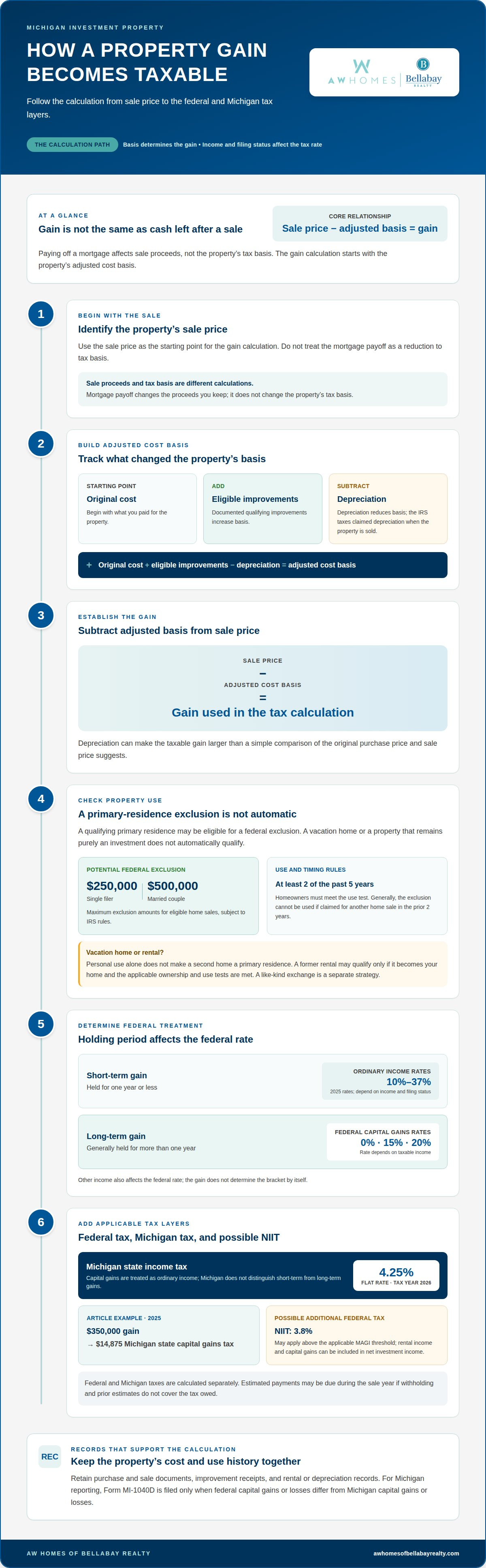
Michigan taxes investment-property gains as ordinary income at a flat 4.25% state rate, so the capital gains tax on investment property in Michigan includes state tax as well as any federal tax due. For federal purposes, the IRS generally taxes long-term capital gains at 0%, 15%, or 20%, depending on taxable income.
The final amount depends on more than the sale price. Adjusted cost basis, including eligible improvements and depreciation, affects how much of the sale proceeds counts as a gain. A qualifying primary residence may be eligible for a federal exclusion of up to $250,000 for a single filer or $500,000 for a married couple, subject to the IRS’s ownership and use rules; a vacation home or rental property doesn’t automatically qualify. This guide explains how Michigan and federal taxes apply, how the primary-residence exclusion differs from vacation-property treatment, and why accurate basis records matter when you sell.
Key Takeaways
- Separate Michigan state tax from federal tax to understand the potential layers on a property gain.
- Determine whether a home qualifies as a primary residence before assuming the home-sale exclusion applies.
- Build an accurate adjusted cost basis by accounting for eligible improvements and depreciation, which can change the taxable gain.
- Consider the property’s location and your circumstances when assessing whether local income taxes may also matter.
How much is capital gains tax in Michigan?
The capital gains tax on investment property in Michigan may include both Michigan and federal tax. The total depends on how long you owned the property, your taxable income, and whether the federal net investment income tax applies.
Federal Treatment by Holding Period
For federal tax purposes, short-term gains come from assets held for one year or less; long-term gains generally involve assets held for more than a year. The distinction matters because short-term gains are taxed at ordinary income rates, while long-term gains may qualify for preferential rates. A rental sale can therefore receive different federal and Michigan tax treatment.
Short-Term and Long-Term Rates
The Internal Revenue Service says U.S. long-term capital gains are generally taxed at 0%, 15%, or 20%. Short-term gains are taxed at ordinary income tax rates. For 2025, those rates range from 10% to 37%, depending on taxable income and filing status. Your gain doesn’t determine the bracket by itself; other income also affects which rate applies.
Long-Term Gains and NIIT
The Internal Revenue Service sets the federal net investment income tax rate at 3.8% for taxpayers above the applicable MAGI threshold. Rental income and capital gains can be included in net investment income, so NIIT may apply in addition to the regular federal tax. For a Michigan investor, understanding both federal calculations helps explain the overall tax exposure from an investment-property sale.
Michigan taxes capital gains as ordinary income and doesn’t distinguish between short-term and long-term gains. Its flat state income tax rate is 4.25% for tax year 2026. For example, a Michigan investor with $350,000 of gains owes $14,875 in state capital gains taxes in the 2025 example. The capital gains tax on investment property in Michigan is calculated separately from federal tax.
Estimated tax payments may be due during the year of sale if withholding and prior estimates don’t cover the tax owed. The sale date, other income, and payments already made determine the applicable installment period. Federal and Michigan payment obligations are calculated separately.
Primary-residence exclusion versus vacation-property gains
The federal home-sale exclusion may reduce the taxable gain when a property qualifies as your primary residence. According to the Internal Revenue Service, the exclusion can shelter up to $250,000 of gain for a single filer and up to $500,000 for a married couple. These limits apply to eligible home sales, not automatically to every property you own.
To meet the use test described by the Internal Revenue Service, homeowners must have lived in the home for at least two of the past five years. The exclusion also generally cannot be used if you claimed it for another home sale in the prior two years. The qualifying gain is not necessarily the entire difference between the original purchase price and selling price: eligible improvements can affect the property’s basis and the amount of gain.
A vacation property is different. A second home used for personal enjoyment doesn’t become a primary residence just because it has appreciated or is being sold. The general calculation compares its purchase price with its selling price and accounts for improvements. If the home is purely a rental or investment property, the primary-residence exclusion doesn’t apply. A like-kind exchange is a separate tax strategy, not the home-sale exclusion.
A former rental may qualify for the primary-residence exclusion if you make it your home and meet the applicable ownership and use tests. Its earlier rental status alone doesn’t make it eligible, and the exclusion doesn’t apply while it remains purely an investment property.
Keep purchase and sale documents, improvement receipts, and rental or depreciation records to support the gain calculation. For Michigan reporting, Form MI-1040D is filed only when federal capital gains or losses differ from Michigan capital gains or losses. The records help establish which amounts belong in each calculation and whether that state form applies.
Calculating real estate gains and adjusted cost basis
Start with the sale price, then compare it with the property’s adjusted cost basis. Basis generally starts with what you paid and changes as the property is improved or depreciated. The difference helps establish the gain subject to tax; it isn’t simply the cash left after paying off a mortgage. Mortgage payoff affects your sale proceeds, not the property’s tax basis.
For example, qualifying improvements to a rental property increase its basis, while depreciation reduces it. That’s why purchase documents, improvement records, and depreciation history matter together. Depreciation is required for investment property, and the IRS taxes claimed depreciation when the property is sold. As a result, the taxable gain may be larger than you expect from comparing only the original purchase price and sale price.
Keep the gain calculation separate from the tax rate. Adjusted basis helps determine the gain; federal taxable income and filing status help determine how it is taxed. Filing jointly can affect the federal bracket, while Michigan treats capital gains as ordinary income. A primary-residence exclusion may apply to a qualifying home sale, but it doesn’t automatically cover a rental or other investment asset.
Work through the calculation in a consistent order: identify the sale price, establish the original cost, add documented improvements, then account for depreciation. Keep rental records with improvement documents so the property’s use and basis history are clear. This approach is useful when a rental changes hands or a sale happens near retirement, since the gain may interact with other income in that tax year.
A like-kind exchange is a separate strategy for eligible investment real estate. Section 1031 allows a taxpayer to defer gain when exchanging investment property for like-kind investment property. Deferral changes when tax is recognized; it doesn’t erase the need to track the property’s basis. A careful basis calculation therefore supports both a taxable sale and an exchange, while helping distinguish gain from proceeds that are not themselves taxable income.
Are local Michigan taxes or city income taxes due on investment property gains?
Start by separating Michigan state income tax from city income taxes. Gains from real property are generally taxable in the state where the property is located, so selling a Michigan property may create a Michigan filing consideration even if you live elsewhere. City income taxes are a separate matter. A city’s published resident rate alone doesn’t establish whether a particular property gain is subject to that tax.
Detroit residents face a 2.4% city income tax rate. Grand Rapids and Saginaw residents face a 1.5% rate. Those rates identify local income-tax obligations, but they shouldn’t be treated as automatic add-ons to the state’s tax on every investment-property gain. The character and source of income, the seller’s residency, and the city’s rules all matter.
Detroit’s nonresident rate is 1.2% on income tied to work performed within city limits. A real-estate sale gain isn’t automatically income from work performed in Detroit. That distinction matters for an owner who lives outside the city but sells property there: the nonresident rate’s stated work-related basis doesn’t by itself answer how the gain is treated.
For a property in Grand Rapids, Saginaw, or Detroit, separate the analysis into clear questions: where is the property, where does the owner live, and what income does the relevant city tax? Then distinguish the state calculation from any city filing obligation. The property’s location establishes the state connection, while residency and local sourcing rules shape the city analysis.
Taxes paid to another jurisdiction may qualify for a credit when you report gains in your state of residence. This can matter when your residence and investment property are in different states, but it doesn’t mean every seller receives a credit. Keep the property’s location and your residency distinct when reviewing the sale’s tax treatment, and don’t assume Detroit, Grand Rapids, or Saginaw city rates apply to a gain without considering the rules for that income.
AW Homes of Bellabay Realty: Real Estate Investment Consulting
AW Homes of Bellabay Realty offers Real Estate Investment Consulting for property owners weighing an acquisition, sale, or next investment move. The guidance connects property decisions with West Michigan market conditions, neighborhood insight, and the practical considerations of a real estate transition.
Consider this support when you’re evaluating whether to sell a rental, comparing potential investment properties, or planning a move that changes your portfolio. For a sale, Residential Listing Services can guide the property’s market positioning and transaction. For a purchase, Buyer Agency Services can support the search and buying process. These services help with the real estate decisions surrounding a transaction, while your tax calculation remains based on your property records and tax circumstances.
If you’re weighing a property purchase or sale in West Michigan, contact AW Homes of Bellabay Realty to discuss your real estate plans.
Plan your next property move with clarity
A property sale can shape what comes next, whether you’re reinvesting, downsizing, or relocating. Consider the real estate decision and its tax impact together, early enough to align your sale plans, records, and next purchase. That perspective can make the capital gains tax on investment property in Michigan one part of a broader transition plan, rather than a last-minute surprise.
AW Homes of Bellabay Realty can support the real estate side of your transition through Sellers assistance, Buyers assistance, and the Relocation Method. The right support depends on whether you’re preparing to sell, searching for a new home, or moving to Grand Rapids, Ada, Caledonia, East Grand Rapids, or a surrounding community. Tax treatment still depends on your circumstances, so coordinate your property plans with the professional handling your tax return.
When you’re ready to map out the next step, connect with AW Homes of Bellabay Realty. Move forward with a plan that fits both the property and the life change ahead.
Frequently Asked Questions
Does a 1031 exchange defer Michigan tax on an investment property?
Yes, a qualifying Section 1031 exchange generally defers Michigan and federal tax on the investment-property gain. The exchange has strict timing and transaction requirements: identify potential replacement properties within 45 days after sale and complete the exchange within 180 days. The replacement property must be of equal or greater value and debt, and the investor must use a qualified intermediary. Deferral postpones recognition; it doesn’t erase the gain.
How is the sale of a Michigan rental property taxed?
A Michigan rental sale can involve federal tax on the gain, Michigan income tax, and potentially federal depreciation recapture or net investment income tax. Federal treatment depends in part on how long you owned the property and your taxable income. Michigan treats gains as ordinary income, without separate short-term or long-term rates. The property’s location, your residence, depreciation history, and other income shape the full tax picture.
How are capital gains on investment property taxed federally in 2026?
For 2026, federal long-term gains generally fall into 0%, 15%, or 20% rate brackets. For individual taxpayers, the 15% bracket applies to taxable income from $49,451 to $545,500, while the 20% rate applies at $545,501 or more. Short-term gains are generally taxed as ordinary income. The 3.8% net investment income tax may also apply when modified adjusted gross income exceeds the applicable threshold.
How is the taxable gain calculated when selling rental property, including improvements and selling costs?
Begin with the sale proceeds after transaction-related selling costs, then compare that amount with the property’s adjusted basis. Basis generally starts with acquisition cost, increases for qualifying improvements, and decreases for depreciation. For example, a documented major improvement can raise basis, while depreciation lowers it. Keep closing statements, invoices, and depreciation records together to support each figure in the sale-year calculation.
How does depreciation recapture affect taxes when selling investment property?
Depreciation reduces a rental property’s adjusted basis, which can increase the gain recognized at sale. The federal tax treatment may include depreciation recapture, with a rate of up to 25%. That portion is distinct from the remaining gain and its applicable capital-gains treatment. A useful review separates total gain from depreciation claimed, because the amount and property history affect how the sale is reported.
What are Michigan's state income tax rules and rate for capital gains from investment property?
Michigan taxes capital gains as ordinary income at a flat 4.25% state income tax rate, without a separate rate for short-term and long-term gains. For a property located in Michigan, include the state calculation alongside federal reporting. If the federal and Michigan capital gain or loss amounts differ, Michigan Form MI-1040D applies. Residency and property location can also matter when another state is involved.


