
Your job offer is signed. Now comes the harder decision: where, exactly, do you plant roots in a city you've never called home? Relocating to Grand Rapids for a job is one of the most consequential moves you'll make, and the stakes go well beyond finding a place to sleep. Get the neighborhood wrong, and you're looking at a punishing commute to the Medical Mile, a home that underperforms the local market, or a community that simply doesn't fit your life.
That anxiety is completely valid. West Michigan's housing market moves fast, and trying to decode it from another city, without knowing which zip codes sit closest to your new office or which school districts are worth the premium, is genuinely stressful. You're not just buying a home; you're making a long-term financial decision while juggling a career transition at the same time.
This guide is built to change that. Drawing on deep local knowledge of neighborhoods like Ada, Forest Hills, and East Grand Rapids, you'll find a methodical, neighborhood-first roadmap that connects your commute patterns, your family's priorities, and your investment goals into one clear strategy for a confident, seamless move.
Key Takeaways
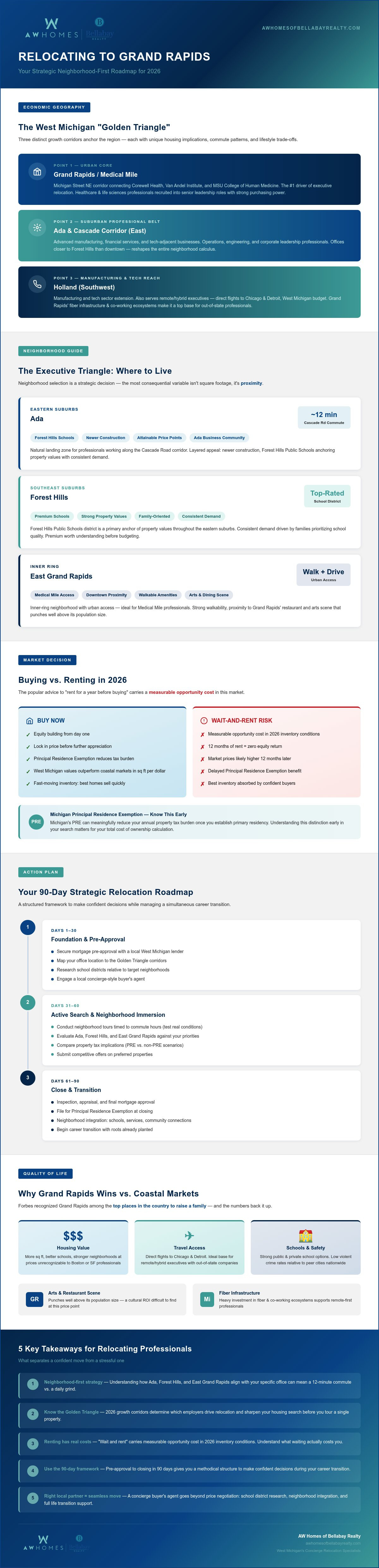
- Relocating to Grand Rapids for a job requires a neighborhood-first strategy — understanding how Ada, Forest Hills, and East Grand Rapids align with your specific office location can be the difference between a 12-minute commute and a daily grind.
- West Michigan's 2026 economic landscape is anchored by a "Golden Triangle" of growth corridors, and knowing which employers are driving executive relocation will sharpen your housing search before you ever tour a single property.
- The popular advice to "rent for a year before buying" carries a measurable opportunity cost in this market — this guide breaks down what waiting actually costs you in 2026 inventory conditions.
- A structured 90-day relocation roadmap — from pre-approval to closing — gives you a methodical framework to make confident decisions while managing a simultaneous career transition.
- A concierge-style buyer's agent does far more than negotiate price; from school district research to neighborhood integration, the right local partner transforms a stressful move into a seamless life transition.
The Grand Rapids Professional Landscape in 2026
West Michigan has quietly assembled one of the Midwest's most compelling professional ecosystems, and the momentum behind it isn't slowing. For anyone relocating to Grand Rapids for a job, understanding the economic geography of the region is the first strategic move you'll make. This isn't a single-employer city or a one-industry town. It's a distributed network of growth corridors that rewards professionals who know how to position themselves within it.
Think of it as a Golden Triangle: Grand Rapids anchoring the urban core, Ada and Cascade evolving into a suburban professional belt to the east, and Holland extending the region's manufacturing and tech reach to the southwest. Each point on that triangle has distinct housing implications, commute patterns, and lifestyle trade-offs worth understanding before you sign anything.
Key Employment Hubs and Industry Drivers
The Medical Mile, the stretch of Michigan Street NE connecting Corewell Health's flagship campuses with the Van Andel Institute and Michigan State University's College of Human Medicine, remains the single most powerful driver of executive relocation in the region. Healthcare and life sciences professionals aren't just filling entry-level roles here; they're being recruited into senior leadership positions that come with real purchasing power in a market where that power goes significantly further than it would in Boston or San Francisco.
East of the city, the Ada and Cascade corridor has evolved well beyond its Amway origins. A concentration of advanced manufacturing firms, financial services companies, and tech-adjacent businesses now calls this stretch home. Professionals in operations, engineering, and corporate leadership increasingly find that their office sits closer to Forest Hills than to downtown, which reshapes the entire neighborhood calculus.
The 2026 Cost of Living Reality Check
The numbers make a compelling case on their own. West Michigan housing values consistently deliver square footage, school district quality, and neighborhood character at price points that would be unrecognizable to professionals leaving coastal markets. Michigan's property tax structure does require some orientation for newcomers; the state's Principal Residence Exemption can meaningfully reduce your annual tax burden once you establish primary residency, and understanding that distinction early in your search matters.
Beyond the balance sheet, there's a lifestyle ROI argument that resonates with families in particular. Forbes has recognized Grand Rapids among the top places in the country to raise a family, and that designation reflects something tangible: strong public and private school options, low violent crime rates relative to peer cities, and a restaurant and arts scene that punches well above its population size. For professionals weighing a career move, that combination of financial efficiency and genuine quality of life is a form of emotional security that's hard to quantify but easy to feel once you're here.
Mapping Your Commute: Neighborhoods Tailored to Your Career
Where you live in Grand Rapids isn't just a lifestyle preference. It's a strategic decision that compounds over time, shaping your daily energy, your family's opportunities, and the long-term trajectory of your investment. For professionals relocating to Grand Rapids for a job, the most consequential variable isn't square footage or finishes — it's proximity. Getting that right requires a neighborhood-by-neighborhood analysis, not a general sense of where the "nice areas" are.
The Executive Triangle: Ada, Cascade, and Forest Hills
The eastern suburbs form a natural landing zone for professionals whose offices sit along the Cascade Road corridor or within the Ada business community. The appeal here is layered: newer construction at attainable price points, the Forest Hills Public Schools district anchoring property values with consistent demand, and commute times to downtown Grand Rapids that routinely clock in under twenty minutes via I-96 or Fulton Street. Ada itself balances a genuinely rural character — the Covered Bridge, the riverfront, the preserved township feel — with high-end residential development that attracts executives who want space without sacrificing access. Forest Hills is less about charm and more about conviction: buyers here are making a deliberate investment in one of West Michigan's most consistently top-ranked public school districts, and that demand creates a floor under home values that's difficult to find elsewhere in the region.
Caledonia deserves direct attention as well. Positioned southeast of the city along M-37, it's attracting professionals who want newer builds, larger lots, and straightforward access to Gerald R. Ford International Airport — a meaningful consideration for anyone traveling frequently for work. The growth here is real and the inventory of new construction gives buyers options that are increasingly scarce in Ada or Forest Hills.
Urban Professional Living: East Grand Rapids and Heritage Hill
East Grand Rapids operates in its own category. Gaslight Village creates a walkable, curated retail and dining environment that draws professionals who want neighborhood character woven into their daily routine. The housing stock is predominantly established single-family homes with genuine architectural detail, and demand is durable enough that properties here rarely sit long. For Medical Mile professionals in particular, the commute is straightforward — Michigan Street connects directly — which makes East Grand Rapids one of the few markets where proximity to a major employment hub and top-tier lifestyle amenities genuinely overlap.
Heritage Hill offers a different but equally compelling proposition. The historic district's Victorian and Craftsman homes attract buyers who prioritize character over newness, and its position just west of the Medical Mile makes it one of the most commute-efficient options for healthcare and life sciences professionals in the region.
- Ada and Cascade: Best fit for corporate professionals with eastern suburban offices and families prioritizing school district quality
- Forest Hills: The benchmark for long-term value retention driven by school district demand
- Caledonia: New construction, acreage, and airport proximity for frequent travelers
- East Grand Rapids: Walkable village character with direct Medical Mile access
- Heritage Hill: Historic architecture and minimal commute for downtown and Michigan Street professionals
Each of these neighborhoods rewards intentionality. Working with a buyer's agent who knows the micro-dynamics of each corridor — not just the general market — is what separates a well-positioned purchase from one you're second-guessing six months later. Explore how a concierge relocation approach maps your office location to the right neighborhood before your search begins.
Navigating the 2026 Real Estate Market: Buying vs. Renting
The advice sounds reasonable on the surface: rent for a year, learn the city, then buy. For most relocating professionals, it's the wrong move. In a market where well-positioned inventory moves quickly and price appreciation in established corridors like Ada and Forest Hills has been consistent, every quarter you spend renting is a quarter someone else is building equity you could have claimed. The question isn't whether to buy. It's how to buy strategically while managing a career transition from out of state.
Buying for Appreciation in West Michigan
West Michigan's long-term fundamentals reward buyers who move with intention. Grand Rapids real estate trends heading into 2026 reflect a market where limited resale inventory continues to support values in core suburban zip codes, particularly those anchored by strong school districts. Caledonia and Ada are worth specific attention here: both offer meaningful "move-up" potential, meaning the homes being built and sold today attract a buyer profile that sustains demand even as the broader market fluctuates.
If you're relocating to Grand Rapids for a job with a corporate relocation package, that package is a negotiating asset most buyers never fully deploy. Relocation-assisted buyers can often demonstrate financial strength through pre-approved corporate housing benefits, which signals seriousness to sellers in competitive situations. A buyer's agent who understands how to structure that narrative in an offer letter can convert your relocation circumstances from a perceived risk into a genuine competitive advantage.
The Logistics of the Remote Home Search
Buying from out of state isn't the obstacle it once was, but it does require a specific kind of local partnership. High-definition video walkthroughs and neighborhood-level orientation tours give you a working sense of a property and its surroundings before you book a flight. What they can't replace is a trusted local agent who can walk a home the morning it hits the market, assess deferred maintenance that doesn't photograph well, and give you an honest read on a street's character at different times of day.
That's the real value of a concierge-level buyer's agent in a remote search: not just access, but judgment. When you're relocating to Grand Rapids for a job and can't be on the ground every weekend, you need someone who functions as your local proxy, not just your paperwork coordinator.
Closing from another state adds procedural complexity, but it's entirely manageable with the right preparation. Understanding the Michigan home closing process before you're in the middle of it removes the anxiety from the final stretch. Remote signings, wire transfer protocols, and title coordination all have established workflows; the key is working with a team that's executed them before and can walk you through each step without surprises.
- Inventory reality: Limited resale supply in Forest Hills and East Grand Rapids compresses the window between listing and accepted offer; being pre-approved and agent-ready before you search isn't optional
- Relocation advantage: Corporate packages can strengthen your offer profile when positioned correctly by an experienced buyer's agent
- Remote search essentials: Video tours, neighborhood walkthroughs, and a boots-on-the-ground agent who can assess what cameras miss
- Closing preparation: Remote closings are routine in Michigan; understanding the timeline and documentation requirements early prevents last-minute delays
Your 90-Day Strategic Relocation Roadmap
Most moving checklists tell you to "start looking two months before" your move date. That advice treats a real estate transaction like a hotel reservation. Relocating to Grand Rapids for a job requires a fundamentally different framework, one that synchronizes your housing timeline with your job start date, your financing readiness, and the realities of a market where well-positioned homes don't wait for underprepared buyers.
Phase 1: The Foundation (Days 1-30)
The first thirty days aren't about finding a home. They're about building the infrastructure that makes a confident purchase possible. Start by securing a buyer's agent in Grand Rapids who specializes specifically in relocation, not just general residential sales. The distinction matters. A relocation-focused agent understands how to work within corporate package timelines, how to assess neighborhoods for someone who can't be on the ground every weekend, and how to translate your job location into a defensible shortlist of zip codes before you've toured a single property.
Mortgage pre-approval runs parallel to this, not after it. Michigan-specific disclosures and inspection norms carry nuances that differ from other states, and understanding them before you're in a live transaction removes one of the most common sources of last-minute anxiety. Your agent should walk you through seller disclosure requirements and typical inspection contingency timelines during this orientation phase, not during negotiation.
Set up custom MLS alerts filtered by school district boundaries, not just city or zip code. Forest Hills and Ada boundaries don't always align with what a general search surface shows, and a single street can mean the difference between two entirely different school assignments.
Phase 2: Execution (Days 31-75)
This is where strategy meets the market. Structure at least one dedicated "Executive Weekend" in Grand Rapids: a curated itinerary that moves from shortlisted properties in the morning to community lifestyle hubs, commute routes, and neighborhood anchors in the afternoon. Seeing a home is one thing. Understanding the ten-minute radius around it is what actually informs a long-term decision.
Remote offer strategies require a different posture than in-person buyers typically use. Escalation clauses, pre-inspection offers where appropriate, and a well-crafted personal letter that contextualizes your relocation circumstances can each shift a seller's perception in a competitive situation. Your agent's judgment on which tools to deploy, and when, is the variable that separates a winning offer from a frustrating near-miss.
- Days 1-30: Agent selection, pre-approval, Michigan disclosure orientation, MLS alert configuration
- Days 31-60: Executive Weekend visits, neighborhood shortlisting, offer strategy development
- Days 61-75: Negotiation, inspection, contingency management
- Days 76-90: Closing coordination, utility transfers, mover scheduling, and community integration
Closing and integration deserve as much intentionality as the search itself. Utility transfers, address changes, and mover coordination all have lead times that compress quickly once you're under contract. The Grand Rapids relocation guide provides a detailed framework for aligning these logistics without letting them collide with your first week on the job.
The ninety-day window is tight, but it's entirely executable with the right local partnership in place from day one. Connect with a concierge relocation specialist to map your job start date to a realistic, step-by-step buying timeline before your search begins.
Seamless Transitions: The AW Homes Concierge Approach
Every step of this guide has been building toward one practical reality: the right local partner changes everything. Relocating to Grand Rapids for a job is a layered, high-stakes process, and the difference between a stressful move and a seamless one almost always comes down to who's in your corner before the search begins. AW Homes of Bellabay Realty, led by Angela Worth, was built specifically for this moment in a client's life.
Angela's approach isn't transactional. It's rooted in the understanding that a relocation isn't just a real estate event; it's a life transition that deserves the same strategic attention you'd give a career decision. That orientation shapes everything, from the initial consultation to the moment you're settled into your neighborhood and connected to the community around you.
Why a Strategic Advisor Matters for Relocation
There's a meaningful distinction between an agent who shows homes and an advisor who guides transitions. A showing agent responds to your search criteria. A relocation consultant shapes them, drawing on deep neighborhood knowledge to surface options you wouldn't have found on your own and flag risks you wouldn't have known to look for.
Angela's specialization in Ada, Forest Hills, and East Grand Rapids isn't incidental. It reflects years of rooted, granular market knowledge in the corridors where most professional relocators ultimately land. That depth means your first home in Michigan isn't just a place to live; it's a sound financial milestone positioned for long-term value retention.
The concierge suite extends well beyond the transaction itself. School district research, trusted vendor referrals, and neighborhood integration support are all part of the process, because getting you into the right home is only the beginning of getting you settled into the right life here.
Starting Your Journey with AW Homes
The process begins with a strategic discovery consultation, a focused conversation that maps your professional office location, your family's priorities, your timeline, and your financial goals into a coherent search framework. Nothing is left to assumption.
For professionals seeking premium properties, Angela's local relationships provide access to luxury homes in Grand Rapids before they reach the general market, a meaningful advantage in a market where well-positioned inventory moves quickly.
- Initial consultation: Professional goals, commute mapping, family priorities, and timeline alignment
- Neighborhood matching: Shortlisting based on office location, school district boundaries, and lifestyle fit
- Concierge support: School research, vendor connections, and community integration beyond closing
- Long-term partnership: A relationship that continues well after the keys are handed over
Relocating to Grand Rapids for a job is one of the most consequential decisions you'll make this year. Don't navigate it with a generalist. Schedule your strategic relocation discovery call with AW Homes today, and let Angela's expertise turn a complex transition into a confident next chapter.
Your Next Chapter Starts Here
Relocating to Grand Rapids for a job is one of those decisions that shapes everything that follows: your daily energy, your family's opportunities, and the long-term strength of your financial position. The neighborhoods are distinct, the market moves quickly, and the professionals who land well are the ones who arrive with a clear strategy rather than a general sense of where to start.
Three things matter most: knowing which corridor aligns with your office location, understanding what the 2026 inventory reality actually demands of buyers, and having a local partner whose expertise runs deep in the markets where you're most likely to land. Forest Hills, Ada, and East Grand Rapids each reward buyers who approach them with intention, not assumption.
Angela Worth's concierge approach was built for exactly this kind of high-stakes transition. From neighborhood matching to closing day coordination, every step is guided by someone who treats your move as the life milestone it genuinely is.
Schedule your strategic relocation consultation with Angela Worth and take the first step toward a confident, well-positioned start in West Michigan.
Frequently Asked Questions About Relocating to Grand Rapids for a Job
Does Grand Rapids have a good job market for trailing spouses?
West Michigan's diversified economy works in a trailing spouse's favor. Healthcare, advanced manufacturing, financial services, education, and a growing tech-adjacent sector all create meaningful opportunities across industries and experience levels. Grand Rapids is not a single-employer city, which means a partner's job search isn't dependent on one organization's hiring cycle.
The region's nonprofit sector and creative economy also absorb professionals from fields that don't always fit neatly into corporate corridors. Trailing spouses with backgrounds in marketing, education, healthcare administration, or skilled trades consistently find the transition manageable, particularly when they arrive with a local network already forming through community and neighborhood connections.
How far in advance should I start looking for a home before my job starts?
Start your agent search and mortgage pre-approval at least 90 days before your intended move date. Well-positioned inventory in corridors like Forest Hills and Ada moves quickly, and arriving at the search underprepared means you're already behind. Pre-approval isn't a formality here; it's your entry ticket to making competitive offers in a market that doesn't wait.
If your job start date is firm and close, a relocation-focused buyer's agent can compress parts of the timeline without cutting corners. The key is having your financing and agent partnership in place before you start touring, not after you've already fallen in love with a property you can't move on quickly enough.
What are the best school districts in the Grand Rapids area for 2026?
Forest Hills Public Schools consistently ranks among West Michigan's top-performing districts and is the primary driver of sustained property demand in the eastern suburbs. Families prioritizing school district quality often anchor their entire neighborhood search around Forest Hills boundaries, which don't always align with general zip code assumptions, making boundary verification an early step.
Caledonia Community Schools and Ada's placement within Forest Hills also attract significant family relocation interest. East Grand Rapids Public Schools serves the Gaslight Village area and maintains strong academic performance alongside a tight-knit community character. For private school options, the region offers several well-regarded institutions across faith-based and independent categories worth researching based on your family's specific priorities.
Are there specific neighborhoods in Grand Rapids popular with Medical Mile professionals?
East Grand Rapids and Heritage Hill are the two neighborhoods that Medical Mile professionals gravitate toward most consistently. East Grand Rapids sits along Michigan Street with a direct, straightforward commute to Corewell Health campuses and the Van Andel Institute, while offering the walkable Gaslight Village character that makes daily life genuinely enjoyable outside of work hours.
Heritage Hill, positioned just west of the Medical Mile, offers historic architecture and minimal commute time for professionals who want to walk or bike to their campus. Both neighborhoods carry durable demand, which supports long-term property values. Professionals willing to drive slightly farther also consider Ada and Forest Hills for the school district quality and newer construction options.
How does the cost of living in Grand Rapids compare to Chicago or Detroit?
Grand Rapids delivers meaningfully lower housing costs than Chicago across comparable property types, school district quality, and neighborhood character. The purchasing power difference is substantial: a budget that buys a modest home in a Chicago suburb often translates to a well-appointed home in Forest Hills or Ada with room to spare. Michigan's property tax structure, including the Principal Residence Exemption available to primary residents, further improves the long-term financial picture.
Compared to Detroit's metro area, Grand Rapids is generally comparable on housing costs but offers a distinct lifestyle advantage in terms of walkable neighborhood character, lower violent crime rates, and a restaurant and arts scene that consistently surprises newcomers. For professionals relocating to Grand Rapids for a job from either city, the financial efficiency relative to quality of life is one of the most compelling parts of the transition.
Can I buy a home in Michigan entirely remotely?
Yes, and it's done routinely. High-definition video walkthroughs, remote notarization, wire transfer protocols, and title coordination are all established workflows in Michigan's real estate process. The procedural side of a remote purchase is manageable with the right team in place. What requires more intentionality is the judgment layer: assessing deferred maintenance that doesn't photograph well, reading a street's character at different times of day, and evaluating a neighborhood's ten-minute radius.
That's where a boots-on-the-ground buyer's agent becomes genuinely irreplaceable rather than simply convenient. A concierge-level agent can walk a property the morning it lists, give you an honest assessment before you book a flight, and structure your offer with the same speed a local buyer would have. Remote buyers who succeed in competitive markets do so because their local partner functions as a trusted proxy, not just a paperwork coordinator.
What relocation expenses are typically covered by Grand Rapids employers?
Coverage varies significantly by employer size, role seniority, and industry. Healthcare systems along the Medical Mile and larger corporate employers in the Ada and Cascade corridor often provide packages that include moving cost reimbursement, temporary housing allowances, and in some cases, home sale assistance for professionals leaving an owned property. Executive-level hires frequently receive more comprehensive packages that can include loss-on-sale coverage and destination service support.
It's worth asking your HR contact for a detailed breakdown of what's included and whether any benefits are taxable, since relocation reimbursements carry specific IRS treatment that affects your net benefit. A buyer's agent experienced in relocation-assisted purchases can also help you position your corporate package as a financial strength signal in offer situations, which is an advantage most relocating buyers don't fully use.
Is the Grand Rapids real estate market still competitive for buyers in 2026?
Competitive is the accurate description, particularly in established corridors. Resale inventory in Forest Hills, East Grand Rapids, and Ada remains constrained relative to buyer demand, which keeps well-positioned homes moving quickly after listing. Buyers who arrive pre-approved and agent-ready are operating in a fundamentally different position than those who treat pre-approval as a post-tour step.
Caledonia and parts of the broader Cascade area offer more new construction inventory, which gives buyers additional options and slightly more negotiating room on timelines and inclusions. The market rewards preparation over speed: knowing your target neighborhoods, having your financing confirmed, and working with an agent who understands micro-level dynamics in each corridor is what separates buyers who land well from those who spend months losing offers on homes they weren't truly positioned to win.


