
Strategic relocation is about more than changing zip codes; it's about reclaiming your time, your capital, and your peace of mind. While the California sun is iconic, the reality of progressive income taxes reaching 13.3% and the constant friction of high-density living often leaves families feeling stretched. You're likely considering relocating from California to Michigan because you want a life where your resources go further and your community feels closer. It's a significant transition that requires expert navigation, localized insight, and a clear vision for your next chapter.
We understand that leaving the West Coast brings valid concerns regarding winter climates and cultural adjustments. This guide promises to deliver a comprehensive roadmap for your 2026 move, focusing on the financial advantages of Michigan's 4.25% flat tax and the exceptional quality of life found in West Michigan. We will examine the specific tax advantages of the coming year, the process of securing a high-end home in Forest Hills, and the logistical steps required for a seamless transition.
Key Takeaways
- Analyze the financial transition from California’s progressive tax system to Michigan’s flat rate to protect your capital and increase your purchasing power.
- Explore how West Michigan’s community-focused culture and four-season lifestyle provide a meaningful alternative to the friction of high-density coastal metros.
- Identify premier residential enclaves like Grand Rapids and Forest Hills, which serve as ideal destinations for families relocating from California to Michigan in search of elite schools.
- Master the "Sell High, Buy Smart" strategy to perfectly time your 2026 transition and ensure a seamless move across state lines.
- Access a methodical roadmap designed to mitigate the stress of relocation by prioritizing emotional security, logistical precision, and long-term well-being.
The Strategic Shift: Why Californians are Choosing Michigan in 2026
Choosing to leave the Pacific coast is rarely about a single factor. It is a decision rooted in logistical planning, emotional fortitude, and strategic foresight. For many, relocating from California to Michigan represents a deliberate pivot away from the friction of high-density living toward a life defined by space, stability, and serenity. You aren't just moving; you're evolving your daily experience to prioritize what truly matters. In 2026, this shift has become a sophisticated strategy for families who want to preserve their capital while upgrading their environment.
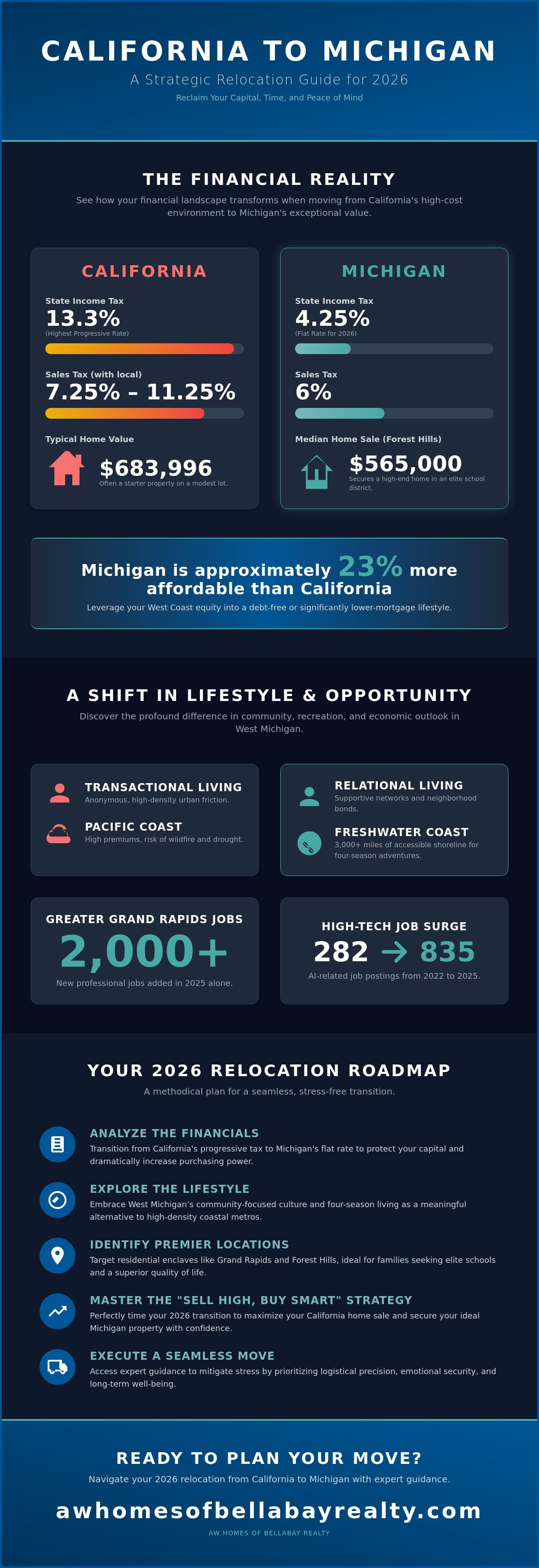
The "Rust Belt" label is a relic of the past that bears no resemblance to the modern Michigan economy. Today, West Michigan is a recognized hub for innovation and specialized growth. In 2025 alone, the Greater Grand Rapids area added 2,000 new jobs. The region is also seeing a surge in high-tech demand, with AI-related job postings jumping from 282 in 2022 to 835 in 2025. This economic resilience provides the professional security needed to make a long-distance transition with confidence. Understanding Michigan's demographic landscape reveals a state that is becoming younger, more educated, and increasingly diverse, particularly in the thriving corridors of Kent County.
The Freshwater Coast vs. The Pacific Coast
Michigan offers over 3,000 miles of freshwater shoreline, providing a vast and accessible alternative to the California coast. While the Pacific offers iconic views, the "Freshwater Coast" offers a different kind of luxury: accessibility. You can enjoy lakefront living or weekend retreats without the crushing coastal premiums or the constant threat of wildfire and drought. Your recreation shifts from surfing to four-season adventures. You'll find that Michigan's summers are vibrant and temperate, while the winters invite a slower, more intentional pace of life that fosters deep reflection and family connection.
A Tale of Two Communities
The concept of "Midwest Nice" is often misunderstood as mere politeness. In reality, it is a tangible social benefit that manifests as safety, reliability, and neighborhood bonds. When relocating from California to Michigan, the shift from anonymous, dense urban living to intentional community is profound. In areas like Forest Hills, life is structured around local schools, shared parks, and genuine connection. We view this as a transition from "transactional living" to "relational living." It is a move toward a place where your neighbors aren't just people who live nearby; they're part of a supportive network that prioritizes long-term well-being and collective security.
Comparing Cost of Living: From California Highs to Michigan Value
Financial security is the bedrock of a successful life transition. When you consider relocating from California to Michigan, you aren't just changing your address; you're reallocating your capital to work harder for your future. The numbers are clear, the benefits are immediate, and the long-term impact on your net worth is profound. According to the cost of living index, Michigan is approximately 23% more affordable than California. This gap creates a "wealth bridge" that allows families to leverage their West Coast equity into a debt-free or significantly lower-mortgage lifestyle in the Midwest.
Tax structures represent the most immediate shift in your monthly cash flow. California’s progressive income tax rates, which can reach 13.3%, stand in stark contrast to Michigan’s 4.25% flat tax for 2026. Even when accounting for local city taxes, such as the 1.5% resident rate in Grand Rapids, the total tax burden remains significantly lower. Sales tax also offers relief, with Michigan holding at a steady 6% compared to California’s base of 7.25%, which often climbs toward 11.25% in major metros. These savings accumulate quickly, providing more breathing room for travel, education, and retirement planning.
Real Estate Purchasing Power
The disparity in housing value is often the primary catalyst for this move. In California, a typical single-family home costs $683,996, often for a starter property on a modest lot. In West Michigan, that same capital goes much further. The median home sale price in Forest Hills was $565,000 as of March 2026. This price point secures a high-end, move-in ready residence within an elite school district. You gain square footage, private acreage, and modern amenities that would be financially out of reach in the Bay Area or Orange County. If you're ready to explore these specific neighborhoods, our buyer agency services provide the local expertise needed for a confident purchase.
Utility and Maintenance Differences
Operational costs for a home also trend downward in the Great Lakes State. While Michigan winters require heating, the average monthly utility bill is $544, notably lower than the $686 average found in California. You'll trade high water bills and year-round cooling costs for seasonal heating and winterization. Maintenance in Michigan does require a methodical approach. Budgeting for snow removal and seasonal landscaping is a new reality, but these costs are frequently offset by lower property insurance premiums and the state’s homestead exemptions, which provide tax relief for primary residences. It is a predictable, manageable system designed for long-term stability.
Navigating the Lifestyle Transition: Weather, Community, and Culture
Relocating from California to Michigan is a journey of personal evolution. It is a shift from the relentless pace of coastal metros to a more intentional, rhythmic way of living. While the financial gains are quantifiable, the lifestyle benefits are felt in the quiet moments: the lack of a commute, the space to breathe, and the depth of local connections. This transition requires a mindset shift that views change not as a loss of the familiar, but as an acquisition of a more balanced life. You are trading the constant friction of a high-density environment for a community that values presence over performance.
The four-season climate is often the primary concern for those coming from the West Coast. However, seasonality is a significant contributor to mental well-being. It provides a natural cadence to the year that California’s perennial sunshine lacks. Spring brings a sense of renewal; summer offers vibrant lakefront living; autumn provides a spectacular display of color; and winter invites a period of restorative rest. This cycle fosters a deeper connection to the environment and encourages a variety of outdoor pursuits that keep life engaging year-round. It's about rhythm. Balance. Perspective.
Winning the Winter Game
Thriving in Michigan winters is a matter of preparation and perspective. It begins with the right infrastructure. High-quality outerwear, a reliable vehicle with winter tires, and a properly insulated home are the foundational elements of a comfortable season. Beyond the logistics, West Michigan residents embrace the concept of "Hygge," the art of creating a cozy, warm atmosphere to enjoy the indoors. When you do venture out, the region is alive with activity. You can enjoy skiing at Cannonsburg, explore the World of Winter festivals in downtown Grand Rapids, or find solace in the quiet beauty of a snow-covered trail. Equipment. Preparation. Mindset.
The Community-First Mindset
Building a social circle in Michigan is a more direct and sincere process than many Californians expect. Social life here often revolves around the school district, which acts as the primary hub for neighborhood bonds and family activities. This is especially true in high-performing districts where parents are deeply invested in both education and local traditions. Beyond the schools, West Michigan culture is rooted in volunteerism and local non-profits. Engaging with these organizations is the fastest way to transition your professional and personal network into the local ecosystem. It's a shift from anonymous living to being a known, valued part of a neighborhood. Purpose. Connection. Stability.
Spotlight on West Michigan: Why Grand Rapids and Forest Hills Lead the Way
Success in relocating from California to Michigan often depends on selecting a community that mirrors your values while exceeding your expectations for quality of life. West Michigan is not a singular destination but a collection of distinct enclaves, each offering a specific blend of luxury, utility, and connection. Whether you seek the intellectual energy of an urban core or the quiet prestige of an executive estate, this region provides a sophisticated landscape for your next chapter. It is a place where professional ambition meets personal tranquility.
Grand Rapids serves as the anchor of the region, increasingly recognized as a premier "15-minute city." This urban model ensures that essential services, high-end dining, and cultural venues are all within a brief commute. The city’s economic stability is bolstered by the "Medical Mile," a world-class cluster of clinical research and healthcare facilities that drives a resilient professional job market. With a local unemployment rate of 4.7% as of February 2026, the area offers a secure foundation for those transitioning from the volatility of coastal tech hubs. It is efficient. It is vibrant. It is stable.
Education and Neighborhood Excellence
For families, the search for a new home is often a search for the right school district. Forest Hills remains the premier choice, where the median home sale price of $565,000 as of March 2026 secures access to an elite public education system. Because of this academic reputation, Forest Hills home values remain remarkably resilient, offering a level of investment security that is rare in shifting markets. The community is designed for longevity, providing a structured environment where children thrive and parents find a deep sense of belonging.
Surrounding areas like Ada and Cascade offer a different aesthetic, blending rural beauty with luxury executive estates. Here, you'll find sprawling lot sizes and the privacy of the Grand River valley, all while remaining minutes from the sophisticated amenities of the city. If you prefer a more historic, walkable environment, East Grand Rapids centers around the scenic Reeds Lake, offering a timeless charm that feels both exclusive and welcoming. These neighborhoods prioritize natural escapes, neighborhood safety, and architectural integrity.
West Michigan Living in 2026
The cultural landscape of Grand Rapids has evolved into a national destination, famously known as "Beer City USA" for its world-class craft beverage scene. This culinary depth is paired with a thriving arts community and a commitment to public spaces. When we analyze how the Grand Rapids real estate market compares to national trends, we see a region that offers a "sweet spot" for California transplants: high-end amenities without the high-density stress. If you are ready to identify the specific neighborhood that aligns with your lifestyle goals, our relocation assistance provides the localized authority you need to move with absolute certainty.
Your Relocation Roadmap: Executing a Seamless Move Across State Lines
Executing a cross-country move requires more than just boxes; it requires a synchronized financial and logistical strategy. The "Sell High, Buy Smart" approach is the cornerstone of relocating from California to Michigan. By capitalizing on the high equity of the West Coast market and deploying that capital into the high-value West Michigan landscape, you create immediate financial breathing room. This is not just a move. It is a strategic repositioning of your assets, your time, and your future.
Timing is the most critical variable in this transition. Ideally, you should list your California property during peak demand cycles while simultaneously identifying your Michigan target. Because the market in areas like Forest Hills is competitive, with well-positioned homes selling in as little as one week, having a local advocate is essential. You need a partner who understands the home closing process in Michigan to ensure your transition is seamless and your interests are protected. We provide localized authority, strategic planning, and emotional security throughout this high-stakes journey.
Logistical Milestones
The logistics of a 2,000 mile move demand precision. Select a moving company with a documented history of cross-country routes and comprehensive insurance coverage. Managing the "gap" between closing on your sale and your new purchase is a common challenge. Some clients opt for concurrent closings, while others prefer a short-term residential stay to explore neighborhoods with more intentionality. Once you arrive, establishing residency is a priority. This includes transferring your driver's license, registering your vehicle, and updating your voter registration. It is a methodical process that anchors you in your new community. Plan. Execute. Evolve.
The Angela Worth Advantage
We view our role as more than just real estate agents; we are your transition consultants. Our concierge-style approach is designed to mitigate the inherent stress of long-distance buying. We offer high-definition virtual tours, strategic neighborhood matching, and localized insights that go beyond the data. Our team focuses on your long-term well-being, ensuring that every detail of your relocation is handled with professional authority and empathetic care. We prioritize your peace of mind over a quick closing. If you are ready to begin, start your journey with our Grand Rapids Relocation Guide. This is your first step toward a more intentional, community-focused life.
Securing Your Future in the Great Lakes State
Relocating from California to Michigan is a profound step toward personal and financial evolution. You have analyzed the 4.25% flat tax advantage, explored the elite educational opportunities in Forest Hills, and envisioned a lifestyle defined by intentionality rather than friction. This transition is not merely about a change in geography; it is about securing a future where your capital goes further and your community feels closer. It's a strategic upgrade for your family, your finances, and your peace of mind. Stability. Community. Opportunity.
Angela Worth serves as a dedicated West Michigan relocation specialist with specific expertise in the enclaves of Ada, Forest Hills, and East Grand Rapids. Our concierge-style service for out-of-state buyers ensures that no detail is overlooked and every logistical milestone is met with professional authority. We provide the localized insight and emotional security required to make your 2026 move a seamless success. To begin your transition with confidence, Download our Strategic West Michigan Relocation Guide and take the first step toward your new home. Your next chapter is waiting.
Frequently Asked Questions
Is it really cheaper to live in Michigan than California in 2026?
Yes, Michigan remains significantly more affordable than California in 2026, with an overall cost of living roughly 23% lower. This financial relief is driven by a 4.25% flat state income tax rate and lower sales tax compared to California's progressive system. While local city taxes exist in urban areas like Grand Rapids, the cumulative savings on housing, utilities, and everyday services provide a substantial increase in discretionary income. Savings. Stability. Growth.
What are the best school districts in West Michigan for relocating families?
Forest Hills Public Schools is widely considered the premier destination for families seeking elite academic standards and robust extracurricular programming. Other highly regarded districts in the West Michigan region include East Grand Rapids and the communities serving Ada and Cascade. These areas prioritize educational excellence, community safety, and long-term student development. Choosing a home within these boundaries ensures your children have access to top-tier resources and a supportive peer network.
How do I prepare my car and home for my first Michigan winter?
Preparing for the season involves both physical upgrades and a shift in maintenance routines. For your vehicle, installing winter tires and ensuring your battery is tested for cold-weather performance are essential steps. At home, you should inspect your insulation, service your furnace, and ensure you have a reliable snow removal plan in place. These proactive measures mitigate stress and ensure your environment remains warm, safe, and functional throughout the winter months. Preparation. Protection. Peace.
Can I buy a house in Michigan while still living in California?
Yes, you can successfully navigate the home-buying process in Michigan while still residing on the West Coast. We specialize in buyer agency services that utilize high-definition virtual tours and detailed neighborhood analysis to bridge the geographic gap. Our team acts as your local proxy, managing inspections and logistics to ensure a secure transaction without the need for constant travel. This methodical approach allows you to secure your ideal residence before your physical move.
What is the job market like in Grand Rapids for tech and healthcare professionals?
The Grand Rapids job market is exceptionally strong in both the healthcare and technology sectors. The "Medical Mile" serves as a national hub for clinical research and specialized care, while tech-related job postings grew significantly between 2022 and 2025. With 2,000 jobs added to the region in 2025, professionals relocating from California to Michigan find a resilient economy that values innovation and specialized expertise. It is a stable environment for professional evolution.
How do Michigan property taxes compare to California’s Proposition 13?
Michigan property taxes function differently than California’s Proposition 13, as they are based on the taxable value of the property rather than just the initial purchase price. While Michigan does not have the same strict assessment caps as Prop 13, the state offers homestead exemptions for primary residences to help manage the tax burden. It is important to calculate these costs based on the specific municipality, as rates vary between urban centers and outlying townships. We help you navigate these nuances with precision.
What are the biggest culture shocks when moving from the West Coast to the Midwest?
The most significant culture shock when relocating from California to Michigan is often the shift toward a slower, more intentional pace of life. You'll find that interpersonal connections are more direct and community bonds are deeply prioritized. The rhythmic nature of the four seasons also dictates a different social calendar, where winter encourages indoor rest and summer centers on vibrant lakefront activity. It is a move from transactional urban living to a more relational, neighborhood-focused existence.
How far is Grand Rapids from the Lake Michigan beaches?
Grand Rapids is strategically located just 30 to 45 minutes away from the pristine freshwater beaches of Lake Michigan. This proximity allows for easy day trips to iconic coastal towns like Grand Haven, Holland, and Saugatuck. You gain the benefits of a vibrant metropolitan area while maintaining effortless access to some of the finest shorelines in the country. It is the perfect balance of urban amenity and natural escape. Proximity. Access. Recreation.


