

What if the most critical figure in your real estate transaction isn't the offer price, but the actual amount that lands in your bank account? For homeowners in Forest Hills, Ada, and the greater Grand Rapids area, the transition to a new life stage should be defined by excitement rather than the stress of hidden fees. You likely feel that every dollar of your equity represents years of intentional investment; therefore, the fear of overpaying for services at the closing table is a valid concern that deserves professional attention.
This guide provides the professional insight required for how to calculate seller net proceeds Michigan homeowners need to plan a predictable budget. We will navigate the specifics of the 0.86 percent combined state and county transfer taxes, explore the nuances of title insurance, and analyze the impact of modern seller concessions. By the end of this article, you will have the clarity, precision, and confidence required to ensure your West Michigan home sale is a seamless bridge to your next chapter.
Key Takeaways
- Identify the core components of Michigan closing costs, including commissions, transfer taxes, and title fees, to eliminate financial surprises at the closing table.
- Learn how to calculate seller net proceeds Michigan homeowners need for a predictable budget by utilizing personalized net sheets tailored to current 2026 market data.
- Account for the 0.86 percent combined state and county transfer tax rate that applies to property sales throughout the Grand Rapids, Forest Hills, and Ada regions.
- Adapt to the 2026 negotiation landscape by strategically managing buyer concessions and commissions to maximize your final walk-away value.
- Leverage a methodical concierge service to oversee the transaction pipeline, ensuring no financial detail is left to chance during your property transition.
Understanding Michigan Seller Closing Costs: The Path to Your Net Proceeds
Selling a home in West Michigan is a significant milestone that marks the beginning of a new chapter in your personal story. While the offer price on a contract often captures the most attention, it's the closing costs that determine the actual financial fuel for your next move. These costs represent the collection of taxes, administrative fees, and professional commissions required to legally and financially transfer property ownership. In the 2026 market, where inventory remains strategic and buyer expectations are high, understanding these deductions early ensures your transition remains seamless, predictable, and secure.
Why the "Net" Matters More Than the Sale Price
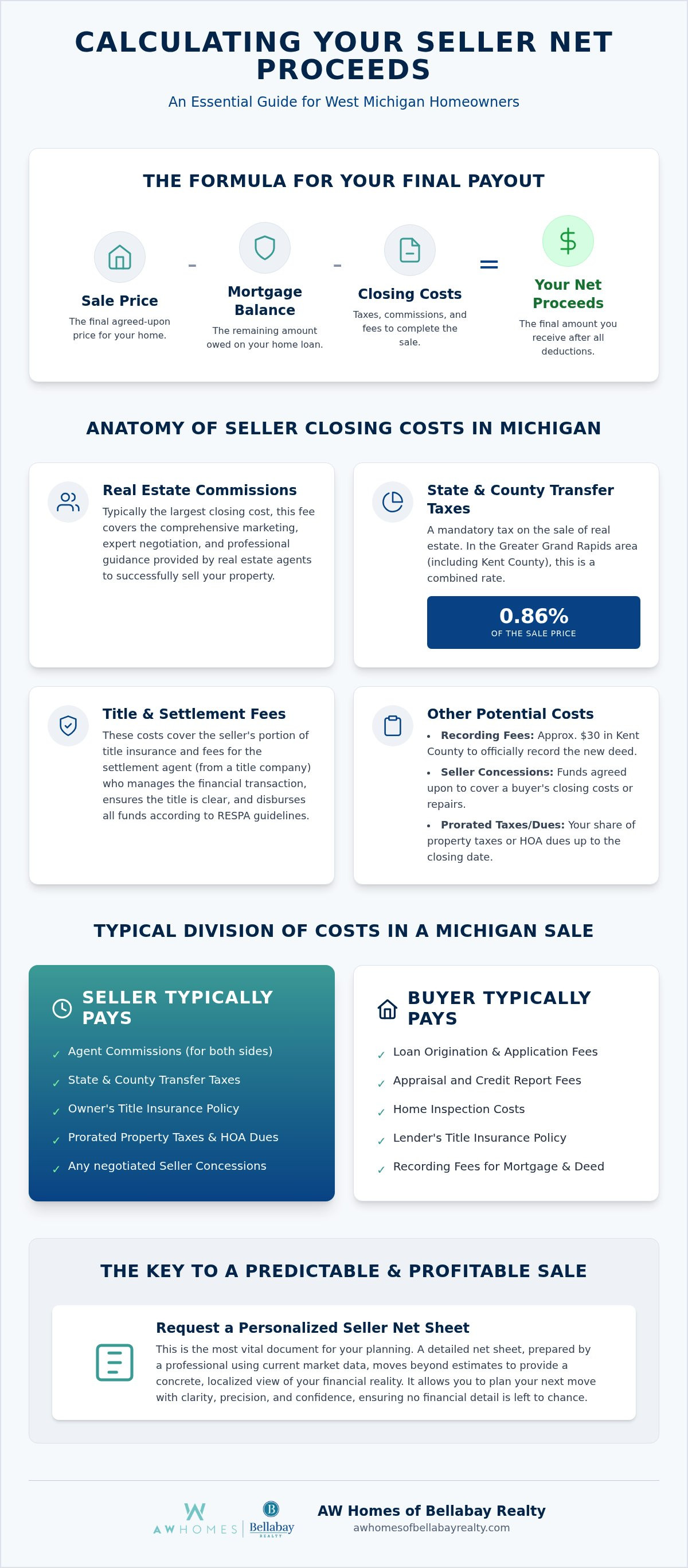
A "Seller Net Sheet" is perhaps the most vital document in your initial planning phase. It moves beyond the abstract sale price to provide a concrete, localized view of your financial reality. To understand how to calculate seller net proceeds Michigan homeowners must follow a methodical three-part formula: the gross sale price, minus the existing mortgage balance, and minus the transaction costs. This calculation provides the emotional security of knowing exactly what you'll walk away with before you even list your property.
Early expert consultation prevents the sticker shock that often occurs when sellers wait until the final week to review their numbers. Your Michigan home closing process dictates your financial timeline, influencing everything from your down payment on a new property to your moving budget. In West Michigan, sellers typically bear the weight of transfer taxes and commissions, while buyers handle loan-related fees and inspections. This distinction is a cornerstone of regional real estate customs that we manage with precision.
The Role of the Settlement Agent in Michigan
In Grand Rapids, Ada, and Forest Hills, the settlement agent acts as the neutral conductor of your financial symphony. These professionals, often working within title companies, manage the distribution of funds and ensure every lien is satisfied. They operate under the framework of the Real Estate Settlement Procedures Act (RESPA), which provides the federal consumer protections that govern the transparency of these costs. Their work ensures that the transfer of your most valuable asset is handled with the highest level of professional integrity.
Your listing agent carries a heavy fiduciary responsibility during this phase. They must meticulously review the closing statement to verify that every credit and debit aligns with your initial net sheet. Standard timelines in our region typically see funds disbursed immediately following the final signature or within 24 hours. At AW Homes, we view this as more than a transaction; it's a curated journey where no detail is left to chance, ensuring your transition is as rewarding as the time you spent in your home.
The Major Expenses: Commissions, Transfer Taxes, and Title Fees
To move forward with clarity, you must view your closing costs not as simple deductions, but as strategic investments in a secure property transition. These expenses cover the professional marketing, legal documentation, and risk mitigation required to finalize a high-value transaction in West Michigan. Understanding these primary expenses is the first step in learning how to calculate seller net proceeds Michigan residents can depend on for their next life stage. While the average closing costs in Michigan typically range between 4 percent and 8 percent of the sale price when commissions are included, the specific breakdown of fees is what matters for your personal budget.
Real estate commissions represent the largest portion of these costs. This fee funds the expert negotiation, high-end photography, and localized market strategy that positions your home in front of qualified buyers in Grand Rapids and Ada. Beyond commissions, Kent County sellers must also account for recording fees, which are typically around $30, and various government filing costs that ensure the deed is properly indexed with the county. Planning for these costs early allows for a more intentional transition, which is why we offer residential listing services that prioritize your financial security and methodical planning.
Michigan Transfer Tax: The 2026 Rates
Michigan law requires a tax on the transfer of real property, which is split into state and county portions. The state transfer tax is calculated at $3.75 per $500 of the sale price, or $7.50 per $1,000. The county transfer tax adds an additional $0.55 per $500, or $1.10 per $1,000. Combined, these taxes total $8.60 for every $1,000 of your home's value. Certain exemptions do exist, such as transfers between spouses or children, or specific bankruptcy proceedings, but most residential sales will require this full payment at the closing table.
Title Insurance and Clearing the Deed
In Michigan, it's customary for the seller to provide an Owner’s Policy of Title Insurance for the buyer. This policy acts as a financial guarantee that you are delivering a clean title, free from historical encumbrances, undisclosed liens, or boundary disputes. Title service fees generally hover around $999, but the insurance premium itself is often between 0.5 percent and 1 percent of the sale price. This professional title work is the anchor of a stress-free transition. It ensures that the legacy of your home is passed on without legal complications, providing the emotional security both parties need to move forward with confidence.
Michigan Real Estate Customs: Navigating Who Pays for What in 2026
West Michigan real estate customs provide the structure, balance, and predictability required for a successful sale. While the law defines certain obligations, regional norms in Grand Rapids, Ada, and Cascade often dictate the final distribution of costs. Traditionally, sellers in our region manage the owners' title policy, professional commissions, and transfer taxes. Conversely, buyers typically handle their own appraisals, inspections, and loan origination fees. Understanding this traditional split is vital as you determine how to calculate seller net proceeds Michigan homeowners need for a secure move. Our concierge approach moves beyond these generalities, customizing the closing statement to reflect the specific negotiations of your transaction and the unique requirements of your property type.
Prorated Taxes: The Michigan "Calendar Year" vs. "Fiscal Year"
Michigan’s tax structure is unique, utilizing a dual-bill system that requires methodical accounting. In our local market, we navigate the July summer bill and the December winter bill with precision. Depending on your specific closing date, you'll likely receive a credit for taxes paid in advance or owe a debit for taxes paid in arrears. This calculation is especially critical for those selling in Forest Hills MI, where higher assessments demand accurate proration. We examine the fiscal year versus the calendar year to ensure your equity is protected during the transition, leaving no detail to chance.
HOA and Utility Finalizations
For sellers transitioning from executive estates or luxury developments, homeowners association (HOA) transfer fees are a standard line item. These fees facilitate the administrative update of community records and verify that all dues are current before the title transfers. A final water read is another small but essential step to ensure a seamless close. We oversee these logistical details, including utility finalizations and service contract transitions, so your personal evolution remains the priority. This level of intentionality ensures that no administrative detail is left to chance, providing the emotional security you deserve as you move toward your next milestone.
Strategic Cost Management: Concessions, Negotiations, and Timing
Closing costs aren't static figures carved in stone. They're dynamic levers that you can manipulate to protect your equity and ensure a smooth transition. Understanding how to calculate seller net proceeds Michigan sellers should expect involves more than just basic subtraction; it requires tactical decision-making at every stage of the transaction. From the moment you stage your home to the final hour of negotiation, your choices directly impact the final check you receive. By viewing these costs through a strategic lens, you transform them from unavoidable expenses into tools for financial success.
The timing of your sale is a primary example of this strategy. Because Michigan property taxes are billed in July and December, the month you choose to close can significantly shift your tax proration credits. A sale finalized in late June might result in a different net figure than one closed in early August due to these seasonal billing cycles. Furthermore, investing in professional staging and high-end photography isn't just about aesthetics. These services reduce your "Days on Market," which directly lowers your carrying costs for mortgage interest, utilities, and insurance. Every week saved is money kept in your pocket.
Evaluating Buyer Requests for Closing Credits
In the 2026 West Michigan market, seller concessions have become a sophisticated negotiation tool. You might find that offering a $5,000 closing cost credit is more effective than a $5,000 price reduction. For many buyers, liquid cash at the closing table is more valuable than a slightly lower monthly mortgage payment. This strategy can attract high-quality offers and help you maintain your target sale price. During the inspection phase, we help you protect your net proceeds by distinguishing between essential repairs and minor cosmetic requests, ensuring your equity remains intact through the final signature.
Reducing Risk Through Professional Listing Services
The "Angela Worth Edge" is grounded in the belief that methodical planning prevents costly legal delays and re-closings. The ROI of professional market positioning in the Grand Rapids real estate market is measured in the thousands of dollars saved by avoiding the hidden costs of DIY selling. Without expert navigation, sellers often face legal liabilities or missed equity due to improper documentation or weak negotiation. Our concierge approach manages the entire transaction pipeline, ensuring no detail is left to chance. To secure your financial future and begin your next chapter with confidence, partner with our residential listing services for a tailored sale strategy.
Expert Navigation: How AW Homes Maximizes Your Final Sale Value
The final stages of a property sale often bring a mix of anticipation and apprehension. At AW Homes of Bellabay Realty, we mitigate this stress through a concierge approach that prioritizes your emotional security and financial precision. While earlier sections of this guide detailed the technical aspects of transfer taxes and commissions, the real value lies in the methodical planning of every financial detail. Understanding how to calculate seller net proceeds Michigan homeowners can actually rely on requires a partner who views your sale as a personal milestone rather than a mere transaction.
We provide personalized net sheets that utilize real-time data from your specific neighborhood, whether you are in Forest Hills, Ada, or Grand Rapids. This is not a generic estimate; it's a strategic roadmap tailored to your unique home and timeline. Our goal is to ensure you move toward your next chapter with absolute clarity. We want you to know exactly how your sale will fund your future. This intentionality moves the conversation away from chance and toward expert navigation, providing the warmth and localized reliability you deserve.
Strategic Consultation for Every Life Stage
Downsizers often face the specific challenge of maximizing liquid equity to fund their next life stage. We provide the specialized focus needed to manage these high-stakes transitions with composure and expert insight. For those relocating out-of-state, our relocation assistance ensures that your Michigan closing is managed with precision from afar. If your move involves settling in Southern California, Adria Chamberlain | Keller Williams High Desert provides expert guidance for the High Desert and Inland Empire regions. We act as your strategic advisor, ensuring your long-term well-being is the primary focus of every negotiation.
For those whose next chapter leads to the Twin Cities, you can learn more about Lisa Hansen Realtor to find professional listing services and buyer representation in that region.
Ready to Plan Your Move?
Your personal evolution deserves a tailored strategy that honors your history while looking toward your future. We invite you to receive a personalized Comparative Market Analysis (CMA) that reflects the current 2026 market dynamics in West Michigan. We prepare your home for a seamless closing by managing the transaction pipeline with intentionality and professional authority. This methodical process ensures a stress-free experience from the first consultation to the final signature. Secure your West Michigan home sale strategy with AW Homes of Bellabay Realty to ensure your next chapter begins with confidence and financial peace of mind.
Your Methodical Path to a Successful Property Transition
A successful sale in Grand Rapids, Ada, or Forest Hills requires more than a simple listing; it demands a strategic alignment of financial precision and emotional security. We've examined the critical role of the 0.86 percent combined transfer tax, the nuances of property tax proration, and the tactical use of seller concessions to attract high-quality buyers. By mastering how to calculate seller net proceeds Michigan residents can trust, you replace uncertainty with a clear, predictable budget for your next chapter.
As a West Michigan transition specialist, Angela Worth provides concierge-level transaction management that ensures no detail is left to chance. Whether you're downsizing or relocating, you deserve a strategic advisor who understands the weight of these milestones. It's time to move forward with the confidence that your equity is protected and your transition is seamless. Request Your Personalized Seller Net Sheet from AW Homes today and begin your journey with professional clarity. Your evolution is our priority, and we're here to guide you home.
Frequently Asked Questions
How much are closing costs for a seller in Michigan on average?
Michigan sellers typically pay an average of 4.06 percent of the purchase price in closing costs, excluding real estate commissions. When you factor in professional commissions and potential buyer incentives, the total cost to sell a house in 2026 generally ranges from 4 percent to 8 percent of the sale price. These figures cover essential items like transfer taxes, title insurance, and recording fees that ensure a secure property transition.
Who pays the transfer tax in Michigan, the buyer or the seller?
The seller is traditionally responsible for paying both the state and county transfer taxes in Michigan. These taxes are collected at the closing table to legally record the transfer of property ownership. For a standard residential sale, this combined rate is $8.60 per $1,000 of the home's value. While almost always a seller expense, all terms in a real estate contract remain technically negotiable between parties during the initial offer stage.
Are real estate commissions included in seller closing costs?
Yes, real estate commissions are a primary component of seller closing costs and are deducted from your gross proceeds at the time of sale. These fees fund the strategic marketing, professional photography, and expert negotiation required to secure a high-value offer. Understanding how to calculate seller net proceeds Michigan homeowners receive requires accounting for these commissions alongside transfer taxes and title fees to ensure your final budget is predictable and transparent.
What is the Michigan State Transfer Tax rate for 2026?
The Michigan state transfer tax rate for 2026 is $3.75 for every $500 of the property's sale price. This equates to $7.50 per $1,000 of value. This tax is a mandatory state requirement for the majority of residential transactions in Kent County and the surrounding West Michigan region. It's calculated based on the final contract price and is paid by the seller during the settlement process to satisfy state law requirements.
Can I negotiate who pays for title insurance in Grand Rapids?
You can absolutely negotiate who pays for title insurance, although West Michigan custom traditionally places this cost on the seller. Providing an Owner’s Policy is a standard way to guarantee a clean title to the buyer in Grand Rapids and Ada. Title insurance premiums generally range from 0.5 percent to 1 percent of the sale price. In a highly competitive market, some sellers may ask buyers to cover this expense as a concession.
How are property taxes prorated at a Michigan closing?
Property taxes are prorated based on the number of days you owned the home during the current tax billing cycle. Michigan uses a dual-bill system with a summer bill in July and a winter bill in December. Depending on your closing date, you'll either receive a credit for taxes you've already paid in advance or a debit for taxes that have accrued but aren't yet due. This ensures a fair financial transition.
Do I have to pay closing costs if I sell my house for cash?
You still have to pay several closing costs when selling for cash, including transfer taxes, recording fees, and professional commissions. While a cash transaction may eliminate certain lender-required fees or appraisal costs, the legal requirements for transferring property title remain the same. Learning how to calculate seller net proceeds Michigan cash sales involve ensures you aren't surprised by these mandatory state and county deductions at the closing table during your final signature.
What is a Seller Net Sheet and why do I need one?
A Seller Net Sheet is a personalized financial document that estimates your actual "walk-away" cash after all liens and closing costs are deducted. It's an essential planning tool because it provides a clear, methodical view of your liquid equity before you commit to a listing. We use real-time market data to ensure your net sheet reflects the specific taxes and customs of your West Michigan neighborhood, providing the emotional security you need to plan.


