

What if the most effective offer letter is the one that says less? Learning how to write a compelling offer letter for a house can feel tricky: you want to sound sincere, not generic, while avoiding unnecessary personal details. A thoughtful note can express what you appreciate about a home, but it cannot replace the purchase contract or guarantee the seller’s response.
There’s another consideration: personal information about your family, background, or plans for the home can raise Fair Housing concerns, even when shared with good intentions. Keep the focus on the property and let your offer’s terms carry the negotiation.
This guide explains what a personal note can and can’t do, what to include or leave out, and how to keep it concise, genuine, and consistent with your formal offer. You’ll also learn how buyer guidance can help you align your approach with your priorities and local context, whether you’re making an offer in Grand Rapids, Ada, Caledonia, or another West Michigan community.
Key Takeaways
- Learn how to write a compelling offer letter for a house with a clear structure, specific appreciation, and your own natural voice.
- Keep the note focused on the home, and think carefully before including personal details that could raise privacy or Fair Housing concerns.
- Understand how a personal letter differs from the signed offer, where the purchase terms are set out.
- Align any note with your offer strategy and goals rather than relying on emotional appeals or promises.
- Explore how personalized buyer guidance can connect your approach with local context in West Michigan.
What a House Offer Letter Can, and Cannot, Do for Your Offer
A house offer letter is an optional personal note that may accompany your purchase offer. It can introduce you as a buyer and explain what you appreciate about the home. It isn’t a substitute for the formal offer, and it can’t determine whether the seller accepts, counters, or declines. The seller may also choose not to receive or read personal notes.
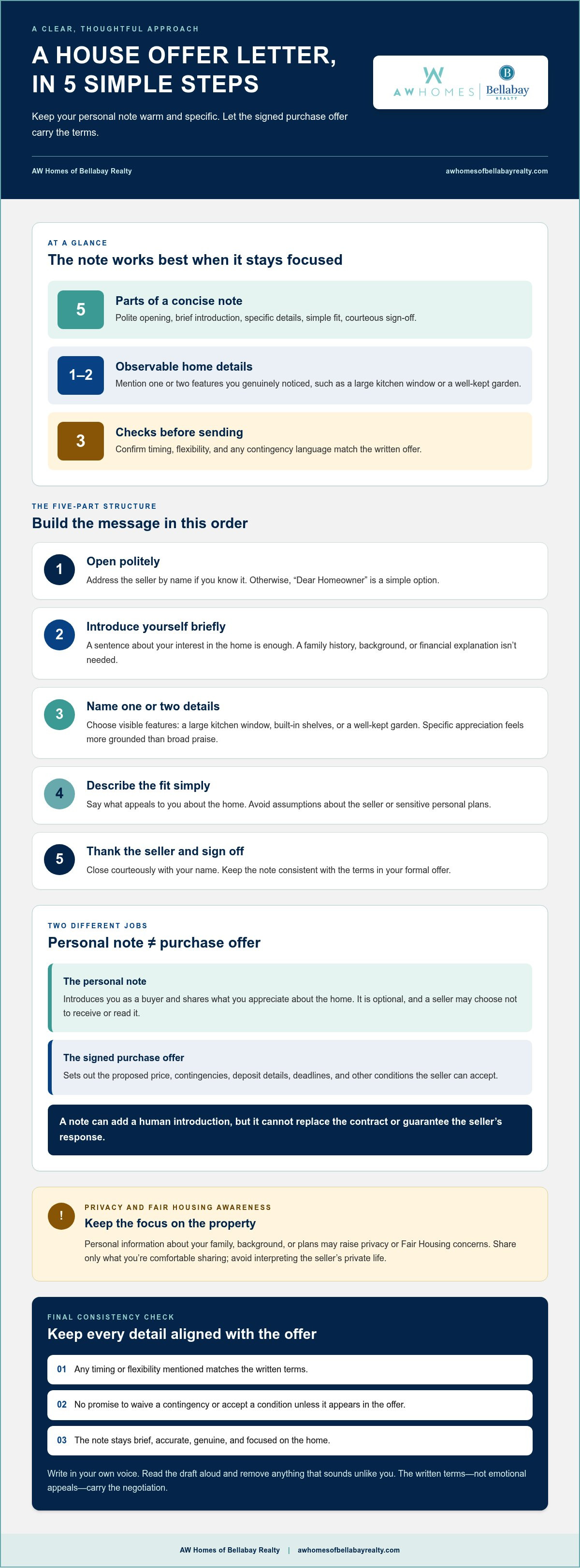
A personal note shares your perspective; the signed purchase offer sets out the terms the seller can accept. Price, contingencies, deposit details, deadlines, and other proposed conditions belong in the formal offer. If a letter mentions something that differs from those terms, it could create confusion rather than support your proposal. Keep the note consistent, and let the written contract carry the negotiation.
How is a house offer letter different from a purchase offer?
Think of the letter as a brief personal introduction and the purchase offer as the formal proposal. For example, you might use the note to say you admire the home’s natural light or carefully maintained garden. The purchase offer, not that compliment, is where you specify the price and any contingencies. A sincere sentiment should never imply a condition or commitment that isn’t included in the offer.
When might a personal note make sense?
A note may feel worthwhile if you have a specific, genuine reason to acknowledge the home, such as appreciating a distinctive feature or the care evident in its upkeep. It’s optional, not a required step in buying a home. Some sellers may welcome a note, while others may prefer to assess offers without personal messages or may never see one.
Before writing, consider whether the note adds useful context or simply repeats that you love the house. A specific observation is more personal than broad praise, but keep the focus on the property. Avoid sharing sensitive details about yourself or others. Personal information can raise privacy and Fair Housing concerns. The Fair Housing Act provides a general overview of federal protections against discrimination in housing. This is a reason to be thoughtful about what a note reveals, not a guarantee of how a seller will respond.
Before sending, check the note against the formal offer:
- Make sure any timing or flexibility mentioned matches the written terms.
- Don’t suggest you’ll waive a contingency or accept a condition unless it appears in your offer.
- Keep the message brief, accurate, and focused on the home.
Learning how to write a compelling offer letter for a house starts with realistic expectations. A note can add a human introduction, but the seller decides how to weigh it, and it can’t make an offer stronger on its own. Your written terms should reflect your goals and the strategy you’ve discussed with your agent. When a personal note is appropriate, make it genuine, aligned with your offer, and secondary to the contract.
How to Write a Compelling Offer Letter for a House, Step by Step
A clear structure helps you express genuine appreciation without turning the note into a second purchase offer. As you consider how to write a compelling offer letter for a house, keep each sentence focused on the home, your interest in it, and the terms already set out in your formal offer. Specificity builds credibility; overstatement can make a message feel less sincere.
What should you include in the letter?
Keep the note brief and move through these elements in order. Use only details you’re comfortable sharing, and leave out personal information that isn’t necessary. The goal is a warm introduction, not a biography or a negotiation outside the contract.
- Open politely. Address the seller by name if you know it; otherwise, “Dear Homeowner” is a simple option.
- Introduce yourself briefly. A sentence about your interest in the home is enough. You don’t need to explain your family structure, background, or finances.
- Name one or two details. Refer to observable features, such as a large kitchen window, built-in shelves, or a well-kept garden.
- Describe the fit simply. Explain what appeals to you about the home without making assumptions about the seller or sharing sensitive plans.
- Thank the seller and sign off. Close courteously with your name, and make sure the note doesn’t suggest terms that differ from your formal offer.
Concrete details make a note more credible because they show what you genuinely noticed, not what you think a seller wants to hear. “The wide front porch stood out to me” feels more grounded than “This is the most perfect home ever.” Avoid guessing who lives in the house, what matters to them, or how they feel about selling. A home’s visible features are fair subjects; the seller’s private life isn’t yours to interpret.
How can you make the message sound genuine?
Write in your own voice. Skip copied phrases, dramatic promises, and praise that could apply to any listing. Read the draft aloud and remove anything that sounds unlike you. Then ask someone you trust to check whether the note is clear, concise, and consistent with the formal offer. Keep in mind that personal details may raise privacy or Fair Housing concerns. HUD’s overview of protections is available from the U.S. Department of Housing and Urban Development (HUD) on Fair Housing.
Starting-point sample:
Dear [Seller or Homeowner],
I’m [first name], and I’m pleased to submit an offer on your home. I especially appreciated [specific feature] and [another observable detail]. The home’s [feature or layout] is a strong fit for what I’m looking for. Thank you for considering my offer.
Sincerely,
[Name]
Use the sample as a framework, not a script. Before sending, compare it with the written offer. If the note mentions a timing preference or other expectation, make sure it doesn’t promise something absent from the contract. Personalized West Michigan buyer guidance can help you consider how a note fits your goals and offer strategy.
Could a House Offer Letter Create Fair Housing or Privacy Concerns?
It can. A personal note may reveal details about a buyer that have little to do with the home or the purchase terms. That information could raise privacy concerns and may affect how a seller perceives an offer, even if the buyer’s intention is simply to sound warm and sincere. This isn’t a reason to assume every personal detail is unlawful; it is a reason to be deliberate about what you share.
For buyers in Michigan, current state and brokerage guidance matters too. Policies on receiving or handling buyer letters can vary, so your agent can help you understand the approach relevant to your transaction. Keep the process centered on the property and the objective terms of the offer, not on personal details that could influence a decision unfairly.
Which personal details are better left out?
Leave out information that isn’t needed to express interest in the home. Details about family structure, health, religion, background, or other private circumstances can reveal characteristics unrelated to the property or offer. The concern is not that every mention is automatically unlawful; it’s that such details may introduce bias or expose information you’d rather keep private.
Instead of writing, “We need a home close to our child’s school,” you could say, “The home’s layout and location suit what I’m looking for.” Better still, focus on a visible feature: “I appreciated the natural light in the living room and the care evident in the garden.” This keeps the note personal without asking the seller to weigh private circumstances.
How can you keep the letter respectful and low-pressure?
Let appreciation stand on its own. Avoid emotional appeals, assumptions about the seller’s life, or requests to choose you because of a personal story. Don’t suggest that the seller owes you special consideration. A concise, property-focused message can still sound gracious and human.
Before sending, review the draft through three lenses:
- Privacy: Does the note share details you wouldn’t want circulated beyond the transaction?
- Fairness: Could a personal detail distract from evaluating the offer on its terms?
- Consistency: Does the note avoid implying promises or conditions that aren’t in your formal offer?
An agent can review the message for tone, consistency with your offer strategy, and current brokerage guidance. That review can help you decide whether the note adds anything useful, but you’re not obligated to send one. If sharing personal information feels uncomfortable, skip the letter. Your formal offer can still communicate your proposed terms, and choosing privacy is a reasonable part of deciding how to write a compelling offer letter for a house, or whether to write one at all.
How to Make the Letter Fit Your Offer Without Overpromising
A personal note should support your offer strategy, not create a second version of it. The letter gives the seller brief context about your interest in the home. The formal offer presents the proposed price, contingencies, timing, and other terms for the seller to consider. Keeping those roles separate makes your message clearer and helps avoid accidental promises.
Before submitting both, compare them side by side. If the letter says you can work around the seller’s preferred move-out date, but your written offer doesn’t reflect that flexibility, the message may create confusion. If you’re open to a particular arrangement, discuss whether and how it belongs in the formal offer with your buyer’s agent. Don’t use the note to float a concession or side agreement that isn’t part of the proposal.
What should the letter say about your offer?
Keep any mention of the offer simple and accurate. You might say, “Thank you for considering my offer,” rather than restating the price or describing conditions in your own words. That leaves the contract documents as the clear record of what you’re proposing. A personal note should not promise a faster close, a flexible move, or a change to a contingency unless the submitted terms support it.
Use this quick review before sending:
- Check for mismatches. Does the note describe timing or flexibility that differs from the offer?
- Remove implied concessions. Could a sentence sound like you’re agreeing to something outside the written terms?
- Keep the contract clear. Are price, contingencies, and requested conditions communicated through the formal offer?
Clarity matters beyond the initial offer. The terms you submit shape later steps in the Michigan home closing process, so avoid casual wording that could be mistaken for a change in your proposal. Your agent can help coordinate the note with your offer strategy and review the documents with you before they’re sent.
How should you think about the seller’s response?
A seller may appreciate the note, set it aside, or focus mainly on the offer terms. You can’t know in advance how it will be received, and the letter isn’t a substitute for preparation, a well-considered proposal, or negotiation. The seller’s response may depend on their priorities and the details of the offers they receive.
Local context can help you and your agent consider which terms best match your goals. Conditions in the Grand Rapids real estate market, for example, may differ from one property or moment to another, so don’t rely on a generic letter to do the work of a tailored offer. Discuss your full approach before submission: what matters most to you, where you have flexibility, and which terms you’re not prepared to change.
For a more considered offer strategy, work with a West Michigan buyer’s agent to align your message with your goals and written terms.
Get Personal Guidance for Your West Michigan Home Offer
A personal note is only one small part of a home offer. You’re also weighing the written terms, your priorities, and how the purchase fits into a major life transition. Buyer guidance can help bring those pieces together so your message feels appropriate and your offer reflects what matters to you, without relying on the letter to secure a particular response.
What can a buyer’s agent help you think through?
Your buyer’s agent can help you prepare an offer, review transaction details, and consider whether a personal note fits your approach. Together, you can check that the note doesn’t imply a promise or flexibility missing from the formal terms. The right strategy depends on your goals, not a one-size-fits-all script.
Local context can also help you make informed decisions. A home in Grand Rapids may present different considerations from one in Ada, Forest Hills, Cascade, Caledonia, or East Grand Rapids. Angela Worth brings West Michigan knowledge to buyer assistance, helping clients think through the property, the offer, and the details that matter to their own situation.
Take a confident next step with AW Homes
Angela Worth of AW Homes of Bellabay Realty provides personalized buyer assistance in West Michigan. She has 9+ years of real estate experience, and AW Homes has completed 250+ West Michigan transactions. The business also has a 5.0 ★ Zillow rating from 50+ client reviews. These details speak to experience and client feedback, not a promised result for any individual offer.
As you consider how to write a compelling offer letter for a house, keep your larger goal in view: choosing a home and moving into your next season of life with care. Your note can be warm and personal, while your offer terms stay clear and grounded in your priorities. “Your Life. Your Home. Your Peace of Mind.” is the guiding promise behind AW Homes’ approach to supporting that transition.
If you’re weighing what to include in a note, how it fits your offer, or which terms reflect your goals, a conversation can help you organize your next steps. Talk through your West Michigan home offer with AW Homes when you’re ready to explore your options.
Move Forward With Clarity and Confidence
A home offer marks the beginning of a meaningful transition. You don’t need a perfect letter to take that step. A sincere note, when appropriate, can express what the home means to you, while a clear offer keeps your proposal grounded in the terms you’re prepared to make.
If you’re still weighing how to write a compelling offer letter for a house, focus on what you can control: keep your message honest, protect your privacy, and make sure it aligns with your goals. The right next step may be a short note, or no note at all. Thoughtful guidance can help you approach the decision with steadiness and perspective.
Angela Worth and AW Homes of Bellabay Realty provide personalized buyer assistance across West Michigan, with local insight for communities including Grand Rapids, Ada, Caledonia, Forest Hills, Cascade, and East Grand Rapids. Talk through your West Michigan home offer with AW Homes and take your next step when you feel ready. Your next chapter can begin with a plan that feels right for you.
Frequently Asked Questions
Do I need to write a letter when I make an offer on a house?
No, you can make an offer without writing a personal letter. If you’re unsure, consider whether you have a specific property detail to mention, such as a feature that suits your daily routine. If you’d be writing only because you feel expected to, leave it out. You can still show serious interest through the required offer documents and a clear, prepared approach to the purchase.
Can a letter to a home seller actually help my offer get accepted?
It might give a seller some context, but it can’t ensure acceptance or make up for terms that don’t suit the seller. A seller may not receive or read it, and even a warmly received note may not change their decision. Treat the letter as an optional expression of interest. Keep your expectations grounded, and make decisions about price and conditions based on your own priorities.
What should I avoid putting in a house offer letter?
Leave out private details that don’t help explain your interest in the property, such as personal health information or family circumstances. Avoid emotional appeals, assumptions about the seller, and statements that could sound like extra promises. For example, don’t say you can move on a particular date unless that matches your actual plans and offer terms. A brief, property-specific observation is usually enough to make the note feel personal.
Can a home offer letter raise Fair Housing concerns?
Yes, personal details can raise concerns if they influence how a seller views a buyer or invite a decision based on protected characteristics. That doesn’t mean every personal reference is automatically unlawful, but keeping the message focused on the property can reduce unnecessary disclosure. Guidance may depend on circumstances and current brokerage practices. For a Michigan purchase, discuss your approach with your buyer’s agent and avoid treating a general online explanation as legal advice.
Should my real estate agent write my offer letter for me?
Your note should sound like you, though your buyer’s agent can help you review whether it’s clear, respectful, and consistent with your offer. You might draft a few sentences about a feature that matters to you, then ask your agent to flag wording that could be misread. Local perspective can also help you assess a purchase in Grand Rapids, Ada, Caledonia, or East Grand Rapids in light of your priorities.
Is an offer letter the same as a purchase agreement?
No. A personal note and a purchase agreement serve different purposes. The agreement is where the proposed transaction details are documented, while the note is optional correspondence. When reviewing paperwork, make sure you know which document contains the terms you’re agreeing to and which is simply a message to the seller. For questions about a contract’s meaning or effect, rely on qualified transaction guidance rather than informal letter wording.
Should I mention my offer price in a letter to the seller?
You can briefly refer to having submitted an offer, but there’s usually little value in restating the price in a personal message. A second figure, a loosely worded condition, or a promise to negotiate could create confusion. Instead of describing the price or saying you’ll “make it work,” thank the seller for considering your proposal. Keep the offer amount and any adjustments in the formal transaction documents.


