

The best off-market opportunity may not be hidden at all. In Grand Rapids, a home described as “off-market” could be genuinely unlisted, shared privately, or simply being marketed before it appears on public listing sites. If you’re researching how to find off-market properties Grand Rapids buyers can realistically pursue, start by understanding what the label means. Knowing the difference helps you decide where to focus your time and how quickly to act.
It’s understandable to look beyond public listings when the available homes don’t fit your timing, budget, or needs. But finding a potential private sale takes more than chasing promises of secret inventory. A thoughtful search relies on local relationships, clear criteria, and careful verification, not assumptions about access.
This guide explains what off-market can mean, which search approaches may be practical in Grand Rapids and nearby communities, and how to assess a property before making an offer. You’ll also learn how to distinguish early marketing from a genuinely unlisted home and what to review for condition, value, and fit. With a structured plan and informed local guidance, you can explore opportunities while protecting your decision-making at every step.
Key Takeaways
- Clarify what “off-market” means in each situation, since it can refer to genuinely unlisted homes or properties being marketed early.
- Build a focused search plan by setting your budget, preferred Grand Rapids-area locations, property criteria, and timing.
- Compare buyer-agent relationships, direct owner outreach, and local networks by effort, control, response uncertainty, and verification needs.
- Use a practical evaluation checklist and independent professional input to assess a home’s condition, value, and fit before deciding on offer terms.
- Use clear criteria and informed local guidance to identify off-market leads Grand Rapids buyers can realistically pursue.
What Does Off-Market Property Mean in Grand Rapids?
If the homes on public listing sites don’t fit your timing, preferred location, or needs, it’s natural to look for options beyond them. In real estate, off-market property generally refers to a home that isn’t being publicly marketed for sale through the usual listing channels. The term isn’t always used consistently, though. An agent, seller, or marketing platform may use “off-market” to describe different stages of a property’s exposure.
A private conversation about a possible sale doesn’t confirm that a home is available. Private availability also doesn’t promise a lower price, fewer competing buyers, or better condition. Treat the label as a starting point for questions, not proof of a special deal.
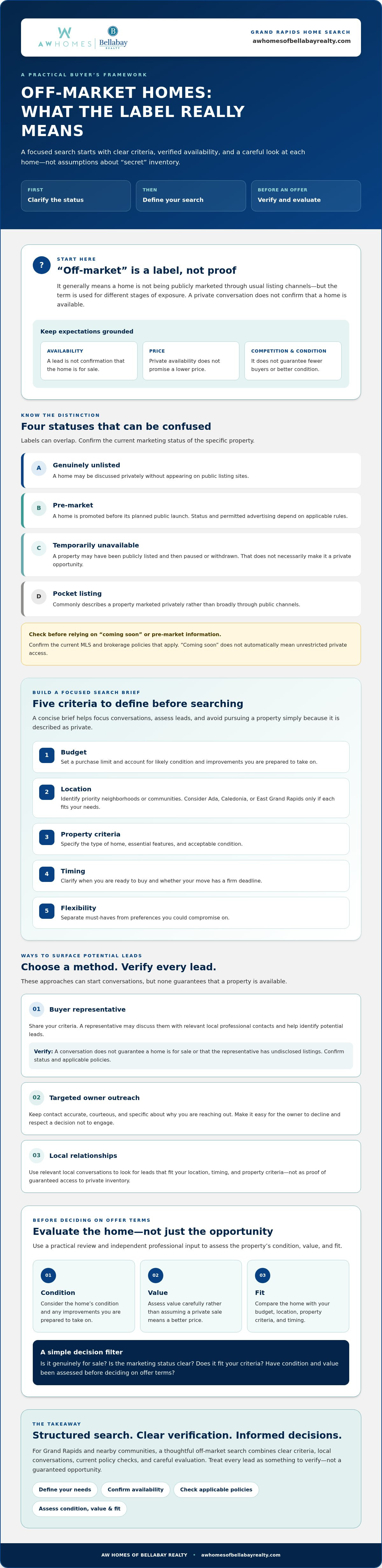
Off-market, pre-market, and pocket listings: what is the difference?
These labels can overlap, so confirm the marketing status of the specific property. A never-publicly-listed property may be discussed privately without appearing on public listing sites. A pre-market opportunity is a home promoted before its planned public launch, but its status and permitted advertising depend on applicable rules. A temporarily unavailable listing may have been publicly listed and then paused or withdrawn; that doesn’t necessarily make it a private opportunity. A pocket listing commonly describes a property marketed privately rather than broadly through public channels.
“Coming soon” doesn’t automatically mean unrestricted private access. Before relying on a marketing label or sharing listing information, buyers and representatives should confirm the current MLS and brokerage policies that apply.
Why Grand Rapids buyers look beyond public listings
A buyer’s search may be shaped by a move, a changing household, or a specific property requirement. You may be focused on a particular part of Grand Rapids, or also considering nearby communities such as Ada, Caledonia, or East Grand Rapids. A broader search can help surface conversations that match your location, timing, and property criteria.
Keep in mind that a conversation is a lead, not an available home. If you’re considering how to find off-market properties Grand Rapids buyers can pursue, define what you need first, then verify whether each opportunity is genuinely for sale and how it’s being marketed. Local guidance can help clarify the context without implying access to guaranteed private inventory.
How to Find Off-Market Properties Grand Rapids Buyers Can Pursue
A productive off-market search starts with clarity, not a promise of hidden inventory. Define what would make a home worth pursuing, then use local conversations and public listings to look for leads that fit.
Build a focused search brief for Grand Rapids and nearby communities
Before contacting owners or asking local professionals about potential opportunities, write down your search criteria. Include:
- Budget: Set a purchase limit and account for the property’s likely condition and any improvements you’re prepared to take on.
- Location: Identify priority neighborhoods or communities. Consider Ada, Caledonia, or East Grand Rapids only if each fits your actual needs.
- Property criteria: Specify the type of home, essential features, and acceptable condition.
- Timing: Clarify when you’re ready to buy and whether your move has a firm deadline.
- Flexibility: Separate must-haves from preferences you could compromise on.
A concise brief helps a buyer representative communicate what you’re seeking without casting an unfocused net. It also gives you a way to decide whether a lead deserves more attention. For example, a home outside your target area or above your budget may not be worth pursuing simply because it’s described as a private opportunity.
Use local relationships and owner outreach thoughtfully
A buyer representative may discuss your criteria with relevant local professional contacts and help identify potential leads. That can create useful conversations, but it doesn’t guarantee that a property is for sale or that a representative has undisclosed listings. Confirm the status of each opportunity, and follow current brokerage and MLS policies before relying on any pre-market information.
You can also consider targeted owner outreach. Keep it accurate, courteous, and specific about why you’re contacting that owner. Make it easy for them to decline, and respect a decision not to engage. Pressure rarely builds trust.
If you’re researching a particular property, the Kent County Register of Deeds is an official starting point for county real property records. Use public records to check available details, not as confirmation that a home is for sale or in a particular condition.
Keep public listings in the plan
Off-market searching should complement public listing searches, not replace them. Monitor listed homes alongside your relationship-led efforts so you can compare opportunities and avoid overlooking a property that fits your criteria. Public alternatives also provide useful context when you’re assessing the price, location, and features of an off-market lead.
Off-market searching is a relationship-led process, not a guaranteed inventory channel. A clear brief, respectful outreach, and careful verification make the process more focused. For an overview of buyer representation, visit AW Homes.
Which Off-Market Search Methods Make Sense in Grand Rapids?
There’s no single route to a private sale, and no method guarantees exclusive access, savings, or a home that suits you. A buyer representative, direct owner outreach, and local professional or community connections can each surface leads, but every lead still needs verification. The practical question is which approach fits your criteria, available time, and comfort level.
Buyer-agent sourcing versus searching alone
A buyer representative can help organize your criteria, communicate them to relevant contacts, and assess whether a lead merits further attention. That structure can save time, but an agent can’t promise a match or control private inventory. Buyers may also research public records and make their own inquiries. Either way, confirm ownership, property details, sale status, and terms through reliable sources before acting.
Direct outreach and local networks: benefits and limits
Contacting an owner directly gives you control over whom you approach and how you present your interest. It also takes research and patience, and a response may not come. Community or professional connections can prompt a conversation, but they don’t establish that a property is for sale. Respect the owner’s choice, verify any information independently, and don’t mistake a lead for an available home.
| Method | Practical benefit | Limitation | Sensible next step |
|---|---|---|---|
| Buyer representative | Organizes criteria and communicates them to relevant contacts | Doesn’t control inventory or guarantee a lead | Share clear priorities and verify each opportunity |
| Direct owner outreach | Lets you choose specific properties and contact owners yourself | Requires research; responses are uncertain | Confirm ownership and make a respectful, no-pressure inquiry |
| Local professional or community networks | May surface conversations connected to your search area | A conversation may not indicate a sale or seller consent | Ask whether the owner is open to contact, then verify details |
| Independent public-record research | Helps you check available property information yourself | Records alone don’t confirm current availability or condition | Cross-check facts and seek appropriate professional evaluation |
Off-market doesn’t automatically mean a bargain or a better home. A private lead may still be overpriced, need substantial work, or fail to match your needs. Compare it with relevant public alternatives, confirm the seller’s intentions, and evaluate condition and value before deciding whether to proceed. The strongest method is the one that creates a credible lead and supports careful due diligence, not simply the one that sounds most exclusive.
How to Evaluate an Off-Market Home Before Making an Offer
A private conversation can make a property feel like a rare opportunity. Slow the decision down enough to test whether the home fits your needs, budget, and plans. Quiet marketing doesn’t reduce the importance of due diligence; independent verification is just as essential.
Check value, condition, and fit before negotiating
Use a comparative market analysis as one reference point, not a final verdict. Recent sales of similar homes can help frame value, but differences in location, layout, condition, and property features matter. Ask your buyer representative to help interpret the market context, then consider an independent assessment of the home itself.
- Fit: Does the layout, location, and property type meet your must-haves?
- Condition: Arrange an inspection by a qualified professional and understand the implications of any findings.
- Repairs: Identify needed work and consider how it affects your budget and plans.
- Value: Compare the asking terms with relevant comparable sales and suitable public listings.
- Resale: Consider whether the property’s features and location are likely to serve your longer-term plans.
A local buyer representative may provide a comparative market analysis and help you weigh the property against alternatives. That analysis doesn’t replace a property-specific inspection or other independent professional input. If an off-market home looks compelling only because it feels exclusive, compare the facts before deciding what terms make sense.
Protect your position through the offer process
A quieter sale still calls for careful review. Understand the purchase agreement, available contingencies, financing arrangements, property documents, and applicable seller disclosures before committing. Disclosure forms and transaction requirements can depend on the circumstances, so confirm what applies under current Michigan requirements with your representative and qualified Michigan real estate or legal professionals. This is general guidance, not legal advice.
Don’t waive a protection or rush a decision solely because an owner or intermediary describes the opportunity as private or time-sensitive. Ask questions, verify details, and make sure the written terms reflect what you understand about the transaction.
Private marketing doesn’t remove the need to verify ownership, compare value, assess condition, review documents, and understand contract terms before making an offer. Apply the same careful checks to any lead you find through an off-market search.
For an overview of buyer representation and local guidance, visit AW Homes.
Work With a Grand Rapids Buyer Representative to Structure Your Search
An off-market search works best when it’s shaped around your actual plans, not a promise of private inventory. A structured buyer consultation can clarify your goals, search boundaries, timing, and preferred communication before outreach begins. It also gives you a chance to understand how a representative will source potential leads, assess opportunities, and support you through the buying process.
What to prepare before discussing an off-market search
Bring a practical outline of your purchase readiness and priorities. Include your financing status, preferred timing, property requirements, and the points where you can be flexible. Consider how Grand Rapids, Ada, Caledonia, or East Grand Rapids fits your daily needs, rather than adding locations simply to widen the search. A focused brief helps keep conversations relevant.
Ask how the representative approaches property sourcing, comparative market analysis, communication, and buyer representation. You can also clarify how often you’d like updates and what information you want before deciding whether to pursue a lead. These expectations help turn a broad idea into a manageable search.
Turn local guidance into a clear next step
AW Homes of Bellabay Realty serves Greater Grand Rapids and nearby communities. Its buyer representation includes property sourcing, comparative market analysis, contract negotiation, and local guidance. These services can support a considered search: sourcing helps identify leads, market analysis helps assess context, and negotiation support helps shape an informed offer. Local insight can inform decisions, but it doesn’t guarantee access to off-market homes or a suitable match.
If you’re still deciding how to choose representation, review the related Find a Buyers Agent in Grand Rapids guide as you prepare questions and compare your options. Then consider whether your circumstances call for a broader search or a more targeted focus. The right boundaries depend on your timeline, property needs, and comfort with trade-offs.
A useful conversation about buyer representation can cover your goals, search criteria, and the support you want through the buying process. Keep the focus on what you need to make an informed decision, rather than assuming a representative can guarantee access to private inventory.
Make Your Next Search Step a Thoughtful One
Finding the right opportunity is less about chasing a private listing and more about knowing what fits your plans. Understanding what “off-market” means helps you ask better questions. A clear search brief helps focus outreach, while careful evaluation keeps any promising lead grounded in value, condition, and your needs.
That’s the practical answer to how to find off-market properties Grand Rapids: pursue relevant conversations without assuming they guarantee access or a bargain. Keep suitable public options in view, verify each lead, and make decisions with a clear understanding of the property and offer.
AW Homes of Bellabay Realty provides buyer representation that includes property sourcing, comparative market analysis, and negotiation, with local service in Grand Rapids, Ada, Caledonia, and East Grand Rapids. If you’re ready to clarify your priorities and discuss a search approach suited to your circumstances, talk with AW Homes about buyer representation.
A well-defined plan can make the next step feel more manageable. Start with what matters most to you, then move forward with care and confidence.
Frequently Asked Questions
What does off-market mean in real estate?
Off-market usually describes a property that isn’t being publicly marketed for sale through common listing channels, but people may use the term differently. It can refer to a home discussed privately, one being marketed before a public launch, or a listing that’s temporarily unavailable. Ask about the specific property’s marketing status. A private conversation alone doesn’t confirm that the home is for sale or that you can make an offer.
How can I find off-market homes in Grand Rapids?
Start with clear criteria: budget, preferred location, property type, condition, and timing. If you’re exploring how to find off-market properties Grand Rapids buyers can pursue, consider discussing those priorities with a buyer representative, making respectful inquiries to owners, and building relevant local connections. Keep monitoring public listings too. Whether you’re focused on Grand Rapids, Ada, Caledonia, or East Grand Rapids, verify each lead’s availability and details before moving forward.
Are off-market homes cheaper than listed homes?
No. Off-market status doesn’t establish that a property is discounted or priced below its value. A private seller may have a firm asking price, and more than one buyer could learn about the opportunity. Compare the terms with relevant sales and suitable public listings, then consider the property’s condition and repair needs. A comparative market analysis can help frame value, but it doesn’t replace an independent, property-specific assessment.
Can a real estate agent help me find off-market properties?
Yes, a buyer representative may help clarify your criteria, communicate them to relevant local contacts, source potential leads, and assess market context. AW Homes of Bellabay Realty’s buyer representation includes property sourcing, comparative market analysis, and negotiation, with local service in Grand Rapids, Ada, Caledonia, and East Grand Rapids. Representation can bring structure to the search, but it doesn’t guarantee private inventory, a suitable match, or exclusive access to a property.
Are pocket listings legal in Michigan?
The term “pocket listing” describes private marketing, but the label alone doesn’t establish whether a specific marketing arrangement complies with the rules that apply. MLS and brokerage policies can affect how a property may be promoted or shared. Confirm current requirements with the relevant brokerage and MLS before relying on claims about a listing’s status. For transaction-specific legal questions, consult a qualified Michigan real estate attorney. This general information isn’t legal advice.
Should I waive an inspection to get an off-market home?
Don’t waive an inspection solely because a seller describes a home as private or time-sensitive. An inspection by a qualified professional can help identify condition concerns and potential repair needs before you decide on offer terms. Discuss available contingencies and the implications of any proposed changes with your buyer representative and qualified advisers. If you’re considering a different evaluation approach, understand the risks first and avoid letting the marketing label rush your decision.
Do off-market homes always have less competition?
No. Private marketing may limit public exposure, but it doesn’t mean you’re the only interested buyer. A seller or representative may share the opportunity with multiple prospective buyers, and the level of interest can be difficult to know at first. Ask what’s known about the property’s marketing and offer status, then make decisions based on verified information. Treat “less competition” as an assumption to check, not a benefit guaranteed by off-market status.


