

Closing on a new home is not an unpredictable waiting game; it is an orchestrated life milestone. Still, when you are juggling moving trucks, coordinating closing dates, or preparing your current property for the market, wondering exactly how long does it take to close on a house in Michigan can create needless anxiety. You likely worry about unexpected underwriting hiccups, shifting timelines between conventional and FHA financing, or the fear of an avoidable delay pushing back your family's moving plans.
While most financed purchases across West Michigan conclude within a realistic 30-to-45-day window, reaching the closing table smoothly requires proactive coordination. In this guide, you will master the Michigan home closing timeline with an exact phase-by-phase breakdown to prevent closing delays. We will examine every critical milestone, from earnest money escrow to your final walkthrough, giving you the strategic foresight and calm reassurance you need to step confidently into your next chapter.
Key Takeaways
- Knowing how long does it take to close on a house in Michigan depends largely on your financing; conventional mortgages typically require 30 to 45 days, while cash purchases often settle in 10 to 21 days.
- A predictable closing follows six foundational milestones, progressing methodically from earnest money escrow and property inspections to underwriting, appraisal clearance, and final deed transfer.
- Local market friction, including appraisal gaps in high-demand Kent County communities and delayed title searches, represents the primary source of unexpected timeline extensions.
- Securing verified pre-approval documentation, pre-scheduling home inspectors, and responding promptly to lender conditions can shave days off your transaction calendar.
- Concierge-level transaction coordination helps safeguard your moving timeline, delivering clear communication, emotional security, and an orderly transition into your next home.
The Michigan Home Closing Timeline: Expected Benchmarks by Financing Type
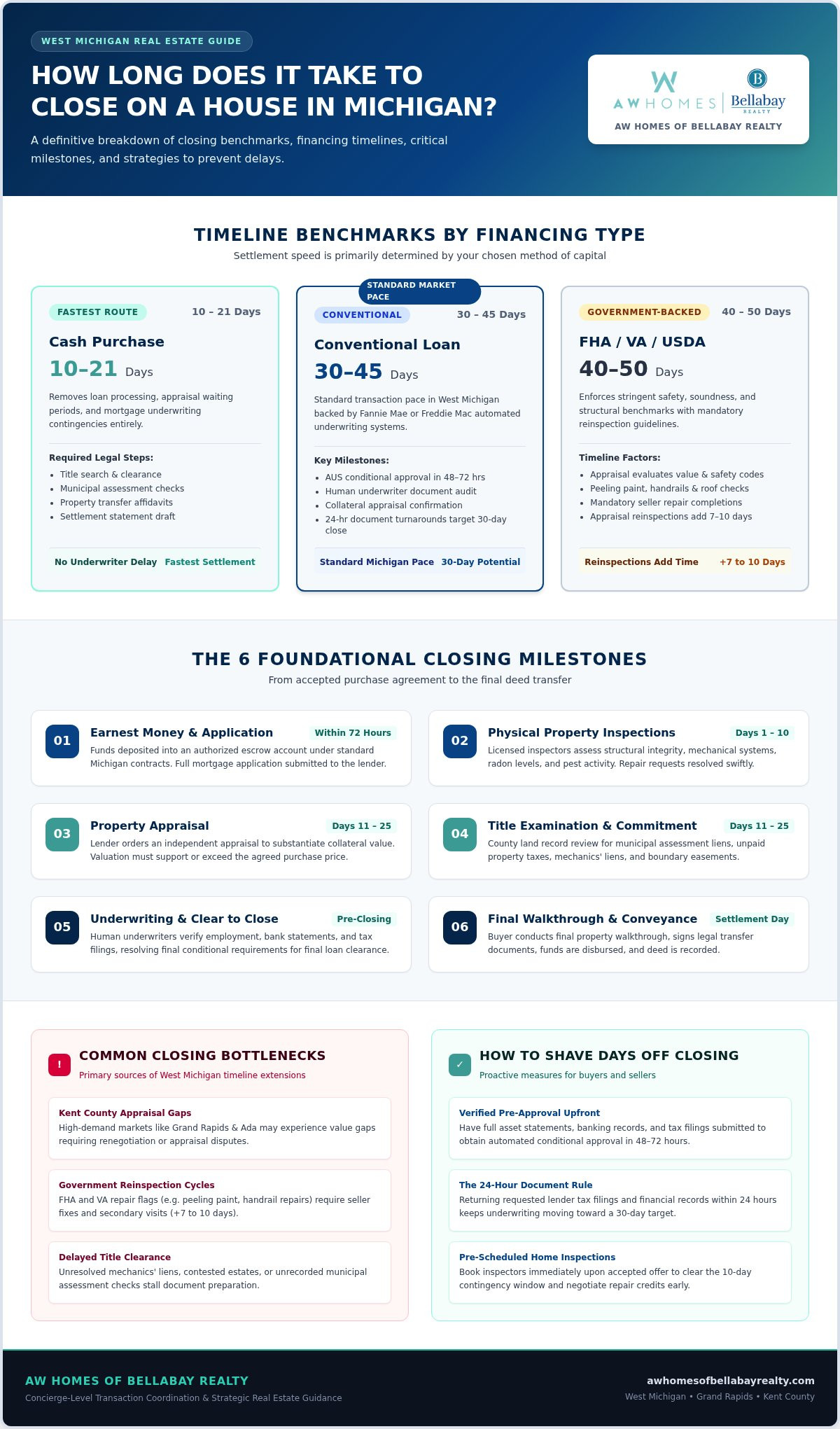
For most residential buyers and sellers, an accepted purchase agreement marks the beginning of a highly structured financial journey. On average, a standard financed home purchase in Michigan takes 30 to 45 calendar days to reach final settlement. While national averages provide a broad baseline, knowing how long does it take to close on a house in Michigan requires evaluating your specific method of capital. Each financing path follows its own operational tempo, dictated by loan documentation, property appraisal criteria, and title clearance protocols.
Understanding the closing process across conventional, government-backed, and liquid cash routes allows you to establish predictable moving benchmarks without unnecessary friction.
Conventional Loan Timelines (30 to 45 Days)
Conventional financing backed by Fannie Mae or Freddie Mac represents the standard transaction pace in West Michigan. Automated Underwriting Systems (AUS) often generate initial conditional approvals within 48 to 72 hours of complete application submission. From there, human underwriters verify employment records, asset statements, and credit updates. In dynamic markets like Grand Rapids and Ada, proactive buyers who submit requested tax filings and banking records within 24 hours keep this process moving seamlessly toward the 30-day mark.
FHA, VA, and USDA Timelines (40 to 50 Days)
Government-backed mortgages protect public lending programs by enforcing stringent safety, soundness, and structural benchmarks. Federal Housing Administration (FHA) and Department of Veterans Affairs (VA) appraisals assess market value while simultaneously inspecting for peeling paint, handrail integrity, and roof longevity. When an appraiser flags required repairs, the seller must resolve the issue before a mandatory reinspection occurs. In Kent County, these specialized appraisal rotations and reinspection schedules regularly add 7 to 10 days to the calendar.
Cash Transactions (10 to 21 Days)
Removing the mortgage underwriter fundamentally transforms your schedule. Without loan processing, appraisal waiting periods, or formal financing contingencies, a cash deal can settle in as little as 10 to 21 days. Even without a lender, non-negotiable legal milestones remain: title searches, municipal assessment checks, property transfer affidavits, and closing settlement drafts. Comprehensive title insurance remains critical in cash deals, ensuring you take unencumbered ownership free of prior mechanics' liens or contested estates.
From Accepted Offer to Closing Table: The 6 Critical Milestones
Executing a purchase agreement is a thrilling milestone, yet it also sets an unyielding legal clock in motion. Exactly how long does it take to close on a house in Michigan depends on how efficiently both parties satisfy contractual contingencies. Rather than an ambiguous waiting period, reaching settlement requires completing six structured phases: earnest money placement, physical property inspections, appraisal valuation, title commitment review, final underwriting approval, and the closing table conveyance. For an in-depth look at each legal requirement, explore our guide to the Michigan home closing process.
Days 1-10: Earnest Money, Formal Application, and Home Inspections
Once both parties sign the agreement, earnest money funds must enter an authorized escrow account, typically within 72 hours under standard Michigan contracts. Concurrently, buyers submit their full mortgage dossier. During this initial 10-day inspection contingency, licensed inspectors evaluate structural integrity, mechanical systems, radon levels, and pest activity. Addressing repair requests or credits swiftly during this window prevents downstream delays before appraisal scheduling begins.
Days 11-25: Property Appraisal and Comprehensive Title Examination
Your lender orders an independent appraisal to substantiate collateral value while a title agency examines county land records. The title examiner checks for municipal assessment liens, unpaid property taxes, and boundary easements to ensure marketable title. Understanding these obligations during a real estate closing protects your financial interests, ensuring the property transfers cleanly without clouded ownership claims.
Days 26-40: Loan Underwriting, Clear to Close, and Final Walkthrough
During the final stretch, loan underwriters verify updated pay stubs, bank statements, and homeowner insurance binders. Federal regulations require lenders to deliver the final Closing Disclosure (CD) at least three business days before signing. Once you receive your official "clear to close," you conduct a final walkthrough to confirm agreed repairs and property condition before signing final conveyance deeds.
- Phase 1 (Days 1-3): Escrow earnest money and finalize formal lending application.
- Phase 2 (Days 4-10): Complete property inspections and resolve repair requests.
- Phase 3 (Days 11-18): Conduct professional property appraisal.
- Phase 4 (Days 15-25): Perform title examination and resolve property record clouds.
- Phase 5 (Days 26-35): Secure final underwriting review and receive your clear to close.
- Phase 6 (Days 36-45): Execute closing disclosures, wire funds, and receive keys.
If you want dedicated advocacy to safeguard every deadline on your journey, partnering with a trusted advisor at AW Homes of Bellabay Realty brings structure, clarity, and peace of mind to each milestone.
Common Bottlenecks That Delay Closings in West Michigan
A well-managed escrow feels effortless, but minor administrative oversights can quickly disrupt your moving schedule. When clients ask how long does it take to close on a house in Michigan, the standard 30-to-45-day window assumes an entirely friction-free progression. In practice, closing friction rarely stems from a single catastrophic failure; it arises from small, unaddressed discrepancies that compound over time. Proactive transaction management eliminates avoidable closing delays by uncovering title, inspection, and underwriting hurdles long before they jeopardize your contract deadlines.
Appraisal Discrepancies and Underwriting Conditions
High buyer demand across Ada, Caledonia, and Grand Rapids frequently creates appraisal gaps when contract prices outpace recent neighborhood sales. If an appraisal falls short of the agreed price, parties must renegotiate terms, adjust cash contributions, or submit formal comparable rebuttals. Beyond property valuation, borrower changes like opening new credit accounts, shifting employment statuses, or delaying asset verification force underwriters to pause files, halting progress days before your scheduled signing.
Title Defects and Unresolved Municipal Liens
Title examinations in Kent County routinely uncover historical encumbrances that require methodical legal clearance. Common clouds include unrecorded mortgage discharges from past lenders, unresolved estate claims in probate, or boundary discrepancies on older parcels. Local municipal obligations, such as final water utility escrows and county transfer tax verifications, also demand precise municipal coordination before a title underwriter authorizes final document signing and deed recording.
Inspection Negotiations and Contractor Repair Backlogs
Complex repair negotiations introduce immediate calendar vulnerabilities into an active escrow. When inspection reports reveal necessary mechanical, roof, or structural corrections, finding licensed trade contractors in West Michigan on short notice can prove challenging. If government loan guidelines require reinspection before issuing final loan approval, contractor delays push back your settlement date. Seasoned advisors frequently circumvent these timeline traps by negotiating seller credits or structuring lender-approved escrow holdbacks for seasonal, weather-delayed exterior work.
How Buyers and Sellers Can Shave Days Off the Closing Process
Compressing your closing schedule does not require cutting corners or bypassing critical safeguards. Instead, closing quickly requires intentional preparation and rigorous alignment across every party involved. When evaluating how long does it take to close on a house in Michigan, buyers and sellers who implement structured, proactive systems routinely shave 7 to 14 days off standard closing timetables. Partnering with a dedicated neighborhood specialist who understands how to manage closing pipelines ensures your transition unfolds on your preferred timeline.
Buyer Acceleration Strategies: Financing Preparation
True mortgage efficiency begins well before making an offer. Moving past basic automated pre-qualifications to secure fully underwritten upfront pre-approval allows lenders to clear your income, assets, and tax profiles early. Keep two months of consecutive bank statements, recent W-2s, and gift letters organized digitally. Above all, maintain complete financial stability; do not finance furniture, switch jobs, or open new credit lines until all transfer deeds are recorded.
Seller Preparation: Pre-Listing Audits and Title Work
Sellers hold equal power in accelerating escrow milestones. Ordering preliminary title commitments when signing listing agreements allows attorneys to clear forgotten mortgage liens or boundary ambiguities before a buyer ever walks through the door. Gathering mechanical permits, warranty transfer forms, and service records upfront eliminates inspection surprises. Addressing obvious structural items ahead of time keeps negotiations focused and swift.
Collaborative Coordination Between Title, Agent, and Lender
Local alignment directly drives closing speed. Established West Michigan lenders and title companies outperform distant call centers because they operate in the same time zone, understand Kent County property tax structures, and resolve document requests rapidly. Structured weekly check-ins keep all parties aligned on outstanding loan conditions. Embracing modern conveniences helps accelerate settlement:
- Digital document delivery: Expedites disclosures and satisfies three-day review mandates immediately.
- Remote Online Notarization (RON): Enables signing legally from any location when contract terms permit.
- Mobile title closers: Bring final loan documents to your home or office, accommodating demanding relocation schedules.
To ensure your next purchase proceeds with meticulous care, consult our comprehensive guide on how to find a buyers agent in Grand Rapids. When you are ready for seamless, concierge-style transaction management, connect with AW Homes of Bellabay Realty to coordinate every detail of your upcoming move.
Navigating Your West Michigan Closing with AW Homes of Bellabay Realty
Every residential move represents a significant personal milestone. While understanding how long does it take to close on a house in Michigan provides an objective baseline, successfully completing the journey demands meticulous attention, clear communication, and thoughtful guidance. At AW Homes of Bellabay Realty, led by Angela Worth, property transitions are approached as transformative life events rather than mere financial exchanges. Serving clients across Greater Grand Rapids, Ada, Cascade, Caledonia, and Forest Hills, our dedicated advisory model protects your schedule, safeguards your assets, and preserves your peace of mind.
A Concierge-Style Approach to Real Estate Transitions
Managing high-stakes property transactions requires an organized, methodical approach. Move-up buyers balancing an existing home sale with a concurrent purchase face unique scheduling demands, while downsizers often seek simplicity and deliberate timing. AW Homes delivers concierge-level pipeline management that tracks every contingency with absolute precision. By auditing documentation early and maintaining constant communication with lenders and title officers, we identify potential roadblocks before they can cause costly delays. You receive clear, transparent updates at every juncture, replacing the anxiety of an uncertain closing window with confidence, clarity, and control.
Trusted Local Relationships Across West Michigan
A seamless closing depends heavily on the caliber of your local partners. Having deep roots across Kent County and East Grand Rapids enables Angela Worth to connect clients with premier local lenders, thorough property inspectors, and respected title examiners who prioritize rapid, meticulous file clearance. When complex survey questions, municipal water escrows, or unexpected appraisal adjustments arise, these established working relationships allow for immediate collaboration and efficient dispute resolution. Every disclosure, contract addendum, and transfer document is handled in strict compliance with Michigan real estate standards.
If you are preparing for your next property transition, you deserve an empathetic advocate who treats your timeline with the care it deserves. Contact AW Homes of Bellabay Realty today to schedule your private closing consultation and experience an orchestrated, stress-free move.
Step Confidently Toward Your Next Michigan Chapter
Pinpointing exactly how long does it take to close on a house in Michigan comes down to deliberate preparation rather than passive waiting. Whether you are navigating an expedited cash sale or a standard 30-to-45-day conventional mortgage, disciplined contingency management keeps your moving day secure. A well-orchestrated transaction delivers far more than property deeds; it brings certainty, clarity, and genuine emotional security to your entire family.
Backed by decades of combined local market leadership under Bellabay Realty, Angela Worth provides bespoke concierge transaction management tailored to Grand Rapids, Ada, and Forest Hills. This meticulous pipeline coordination eliminates closing friction for move-up buyers and downsizers alike, turning complex closing logistics into an orderly, celebratory transition. When you are ready to protect your schedule and step forward with complete confidence, connect with Angela Worth for a seamless West Michigan closing experience. Your next chapter begins today.
Frequently Asked Questions
Can you close on a house in Michigan in 30 days or less?
Yes, closing in 30 days or less is entirely feasible under the right conditions. Cash purchases accomplish this easily, often finalizing within two weeks. Financed purchases can also reach the settlement table in 30 days if you secure an upfront, underwritten pre-approval, respond to document requests within 24 hours, and negotiate inspection terms promptly. Working with responsive local lenders and title agencies across Kent County keeps this condensed timeline on track.
How long does a cash home purchase take to close in Michigan?
A cash home purchase in Michigan typically takes between 10 and 21 days to complete. Without mortgage underwriting, mandatory appraisals, or lender condition reviews, the schedule is driven primarily by title preparation. In communities like Ada and East Grand Rapids, title examiners require roughly one to two weeks to search county land records, confirm municipal property taxes, clear prior liens, and prepare the conveyance deed.
What is the mandatory three-day Closing Disclosure rule?
Federal regulations require mortgage lenders to deliver your Closing Disclosure (CD) at least three business days before you sign final closing documents. This mandatory review window gives buyers adequate time to compare final loan terms, closing costs, and interest rates against their initial Loan Estimate. If major terms change, such as switching mortgage products or increasing the APR beyond allowable limits, the lender must issue a revised disclosure and reset the clock.
Why do FHA and VA loans take longer to close in Michigan than conventional loans?
FHA and VA loans average 40 to 50 days because government-backed mortgages involve stricter appraisal criteria and specialized underwriting reviews. When assessing how long does it take to close on a house in Michigan using government financing, property condition plays a major role. Appraisers must confirm rigid safety benchmarks, including peel-free paint and handrail security. Required repairs and mandatory reinspections frequently add one to two weeks to your schedule.
What happens if a closing date is missed in a Michigan real estate contract?
Missing a closing date without an executed contract extension puts the delayed party at risk of default under standard Michigan purchase agreements. When unexpected underwriting questions or title clouds threaten a scheduled date, proactive agents draft an amendment to extend the deadline by mutual agreement. If a seller refuses to grant an extension, the transaction can dissolve, placing earnest money deposits in jeopardy. Early communication prevents accidental contract breaches.
How do property transfer taxes in Michigan impact the final closing day balance?
Michigan real estate transfer taxes total $8.60 per $1,000 of the property sale price and are customarily paid by the seller at settlement. This statutory expense combines the state transfer tax ($7.50 per $1,000) with the Kent County transfer tax ($1.10 per $1,000). While buyers rarely pay this fee directly, local title agencies in Grand Rapids calculate and reconcile these figures on the settlement statement to ensure valid, debt-free recording.
Can Michigan home closings take place remotely or online?
Yes, Michigan real estate transactions can close remotely through Remote Online Notarization (RON) or mobile title services. Under Michigan law, buyers and sellers can legally notarize documents through secure digital platforms. Alternatively, title officers can dispatch mobile closers directly to your home in Caledonia or Cascade. These flexible solutions help relocating families sign required paperwork without extending how long does it take to close on a house in Michigan.


