

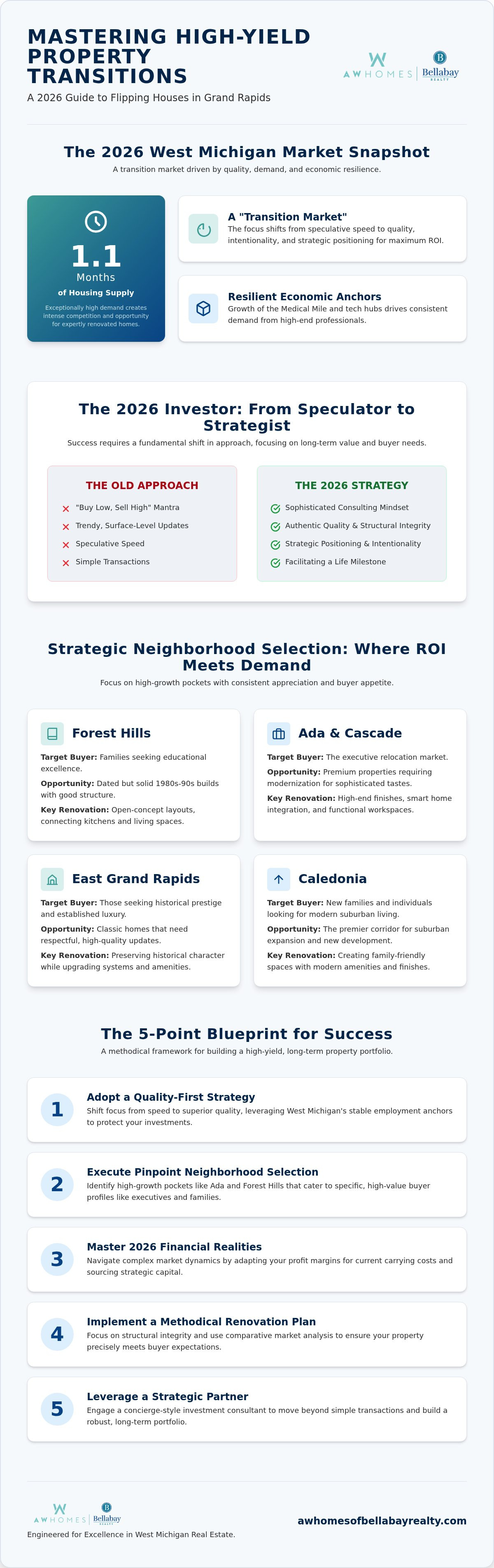
The days of finding a "diamond in the rough" through sheer luck in Kent County are over. In 2026, the most profitable investments aren't found by accident; they're engineered through neighborhood-level precision and a deep understanding of executive relocation trends. Successfully flipping houses in Grand Rapids now requires a shift from speculative buying to strategic property transitions that prioritize long-term value. You've likely noticed that acquisition costs in established suburbs are climbing, while finding off-market deals feels increasingly like a full-time job. It's a challenging environment, yet the 1.1 months of housing supply in our region proves that demand for expertly renovated homes remains exceptionally high.
This guide will show you how to master the art of high-yield property transitions by focusing on the 2026 market's specific demands. We'll explore high-appreciation pockets in Greater Grand Rapids, define the exact renovation standards expected by today's sophisticated buyers, and outline how to secure a strategic partner for your portfolio's growth. By moving away from chance and toward expert navigation, you can turn the stress of high-stakes transactions into a seamless process of professional evolution.
Key Takeaways
- Shift your strategy from speed to quality by understanding how diverse employment anchors and low inventory protect your West Michigan investments.
- Pinpoint high-growth neighborhoods like Ada and Forest Hills that cater to the specific needs of executive relocation and family-centric buyers.
- Navigate the financial complexities of flipping houses in Grand Rapids by adapting your margins for 2026 carrying costs and sourcing strategic capital.
- Implement a methodical renovation blueprint that focuses on structural integrity and comparative market analysis to ensure your property meets exact buyer standards.
- Leverage a concierge-style investment consulting partner to move beyond simple transactions and build a high-yield, long-term property portfolio.
The State of Flipping Houses in Grand Rapids in 2026
The real estate environment in West Michigan is no longer a playground for speculative speed. We've entered a "Transition Market" where quality, intentionality, and strategic positioning are the primary drivers of ROI. Successfully flipping houses in Grand Rapids now requires a move away from the "buy low, sell high" mantra toward a more sophisticated consulting mindset. Buyers today are discerning. They seek emotional security, seamless transitions, and localized reliability. They prioritize authentic quality over trendy, surface-level updates.
Inventory remains the most significant hurdle for the modern investor. With only 1.1 months of supply available as of July 2026, the competition for on-market listings is intense. This scarcity has forced a methodical shift toward off-market sourcing and neighborhood-level networking. While the basic mechanics of flipping houses involve purchasing and renovating distressed assets, the 2026 professional understands that their role is to facilitate a life milestone. You aren't just selling a house; you're providing a sanctuary for a family evolving into their next life stage. Every project is an opportunity to anchor yourself as a neighborhood authority.
The 2026 Economic Climate in West Michigan
The resiliency of our region is anchored by diverse employment hubs that protect your capital from broader market volatility. The continued growth of the Medical Mile acts as a magnet for specialized talent, driving consistent demand for high-end renovations in surrounding urban and suburban pockets. These Grand Rapids real estate trends favor investors who focus on the long-term health of the community. When population inflow remains steady, the need for expertly repositioned housing stays high. This steady influx of medical and tech professionals ensures that well-executed projects don't sit on the market for long.
Flipping vs. Long-Term Investment: Finding Your Balance
Choosing between a quick flip and a long-term hold depends on your specific financial goals and the micro-market's demands. In high-demand school districts like Forest Hills, Ada, or East Grand Rapids, many investors are finding success with a "Fix-and-Rent" model. This approach combines the immediate value of a renovation with the steady appreciation of a premium location. A strategic advisor looks at three essential elements: market demand, renovation cost, and exit flexibility. This balanced perspective ensures that no detail is left to chance. It creates a sense of order. It reinforces the promise of a stress-free experience for everyone involved in the eventual transaction.
Strategic Neighborhood Selection: Where ROI Meets Demand
Successful flipping houses in Grand Rapids requires more than a spreadsheet; it demands an intimate understanding of neighborhood character. As we navigate the 2026 market, the most resilient returns are found where infrastructure meets lifestyle. Selection is the foundation of your investment. It determines your target buyer, your renovation budget, and your eventual exit velocity. In a region defined by low inventory and high demand, choosing the right micro-market is a strategic declaration of your investment goals.
While the Greater Grand Rapids area offers diverse opportunities, four specific pockets stand out for their consistent appreciation and buyer appetite. Forest Hills serves as the primary destination for families seeking educational excellence. Ada and Cascade cater to the executive relocation market. East Grand Rapids remains the pinnacle of historical prestige. Caledonia has emerged as the premier corridor for suburban expansion. Each area requires a tailored approach to property transitions, ensuring that the finished home aligns perfectly with the community's evolution.
The Forest Hills Advantage
School district rankings are the primary anchor for Forest Hills home values. For the strategic investor, the opportunity lies in identifying "dated but solid" properties. These are often 1980s or 1990s builds that possess the structural integrity families desire but lack the modern, open-concept layouts expected by 2026 buyers. Focus your efforts on removing visual barriers between kitchens and living spaces. High-yield transitions in this area prioritize functional mudrooms, dual home offices, and primary suite sanctuaries. By refreshing these traditional layouts, you provide the emotional security and modern convenience that Forest Hills families prioritize.
Ada and East Grand Rapids: The Luxury Flip Niche
Renovating for the executive buyer in Ada or East Grand Rapids requires a commitment to high-end finishes and seamless smart home integration. These buyers are often part of the medical or tech inflow mentioned previously, and they expect their homes to reflect their professional success. Today's luxury homes in Grand Rapids set a high bar for design. Your flip must compete with properties that feature custom cabinetry, professional-grade appliances, and curated lighting. Curb appeal is equally critical; professional landscaping and intentional exterior lighting are not optional "extras" but essential components of the property's story. If you are looking to scale your portfolio in these high-stakes areas, a strategic investment consultant can help you source properties with the right architectural bones for a premium transition.
Caledonia offers a different but equally compelling narrative. As the city expands southward, this area attracts buyers looking for larger lots and newer infrastructure. The entry price point is often more accessible than East Grand Rapids, but the appreciation potential remains strong due to ongoing commercial development. Whether you are targeting a luxury estate or a suburban family home, your success depends on moving beyond generic data and toward localized expertise. No detail should be left to chance when the goal is a record-breaking sale.
Navigating the Financial Realities of a 2026 Flip
Financial clarity is the ultimate source of emotional security in real estate investment. While the excitement of a property transformation is what draws many to flipping houses in Grand Rapids, the numbers are what ensure the project's long-term viability. In the 2026 market, the traditional 70% rule requires a more conservative application. This guideline suggests buying a property for no more than 70% of its After Repair Value (ARV) minus renovation costs. However, higher carrying costs driven by persistent interest rates and rising labor expenses mean that your margins must be calculated with surgical precision. A 15% contingency fund is no longer a luxury; it's a non-negotiable anchor for your budget.
Your project timeline is heavily influenced by the Michigan home closing process, which requires methodical planning to avoid costly delays. Financing your transition also looks different today. While traditional 30-year fixed mortgage rates in Michigan hover between 6.78% and 6.90%, many strategic investors are turning to private capital or bridge loans to secure properties quickly in a low-inventory environment. Speed in acquisition, paired with patience in execution, creates a balanced approach that protects your portfolio's well-being.
Understanding Carrying Costs and Taxes
Holding a property in Kent County involves more than just the purchase price. You must account for the City of Grand Rapids 2026 millage rate of 10.75 mills and the 1.5% municipal income tax for residents. The Michigan property transfer tax, totaling $4.30 per $500 of the sale price, represents a mandatory cost that investors must account for when calculating their final net profit. Managing utility and insurance costs during the renovation phase is equally vital. Empty homes still require climate control to protect new finishes, and specialized builder's risk insurance is essential to mitigate the inherent risks of high-stakes construction.
ROI-Focused Renovations: Where to Spend Your Dollars
In 2026, buyers prioritize three essential elements: functionality, efficiency, and aesthetics. Kitchens and primary suites remain the emotional anchors of a sale, but the definition of luxury has evolved. Today's buyers in Ada and Forest Hills demand energy-efficiency upgrades like smart thermostats and high-performance insulation to combat rising utility bills. Once the structural work is complete, the final layer of professional staging and high-end photography becomes your most powerful sales tool. These elements move your project beyond a simple transaction, positioning it as a significant personal milestone for the next owner. This methodical approach ensures no detail is left to chance, reinforcing the value of your investment.
The Renovation Blueprint: Designing for the 2026 Buyer
The 2026 buyer is not searching for a house; they are seeking a lifestyle transition that feels both high-end and accessible. Successfully flipping houses in Grand Rapids requires a move away from generic updates toward a methodical, design-forward approach. Today's market rewards intentionality, personalization, and expert insight. When you prioritize the specific needs of the local community, you move the conversation away from chance and toward expert navigation. Your renovation should be a curated journey that mirrors the actual process of a major life milestone for the next owner.
- Step 1: Conduct a comparative market analysis to define your "Target Buyer" before the first wall comes down.
- Step 2: Focus on structural integrity before aesthetic "fluff". A basic Grand Rapids building permit for structure work costs a flat fee of $200 as of May 13, 2026; use these standards to ensure the home's long-term health.
- Step 3: Implement the "Organic Modern" aesthetic, which balances clean lines with natural West Michigan textures like white oak and local stone.
- Step 4: Create a seamless indoor-outdoor flow, especially in suburban properties, to maximize the home's functional footprint.
- Step 5: Execute a professional marketing plan, including staging and high-end photography, to capture the property's emotional resonance.
The Executive Standard: What Relocation Clients Want
High-stakes buyers relocating to Grand Rapids MI for medical or tech roles demand "turn-key" luxury that mitigates the stress of a move. These professionals look for three essential elements: dedicated home offices, multi-generational living spaces, and organized storage solutions. In our Michigan climate, a well-designed mudroom is not a luxury; it is a functional necessity. By designing for these specific situational needs, you provide the emotional security that executive families prioritize during a major transition.
Avoiding the "Cookie-Cutter" Trap
Intentional design creates a higher emotional resonance than the generic flips seen in previous years. Incorporating local materials and architectural nods to the neighborhood anchors the property's identity as a local authority. When you avoid the "cookie-cutter" trap, you position the home as a unique personal milestone rather than a financial transaction. Expert insights are vital when choosing finishes that reflect the neighborhood's evolution while maintaining its historical charm. If you are ready to identify your next investment opportunity, you can secure a strategic partner for real estate investment consulting to ensure no detail is left to chance.
Building Your Portfolio with AW Homes of Bellabay Realty
Building a sustainable property portfolio in West Michigan requires more than just capital; it demands a partner who understands that every property is a chapter in a larger story. At AW Homes of Bellabay Realty, our approach to flipping houses in Grand Rapids is rooted in a concierge-style philosophy. We don't just find houses. We source investment-grade opportunities. We position them for record-breaking sales. This methodical focus ensures that your capital is protected and your transitions are seamless. By prioritizing your long-term well-being over a quick closing, we transform the stress of high-stakes transactions into a curated journey of professional growth.
Identifying the "hidden gems" in Ada, Forest Hills, and Caledonia is an art form backed by granular data. While other investors wait for the MLS to update, we leverage our deep-rooted neighborhood authority to uncover off-market opportunities that align with your 2026 goals. We look for properties with the right architectural bones and the potential for high-yield evolution. This proactive strategy removes the element of chance from your investment journey. It provides the emotional security you need to move forward with confidence. It anchors your portfolio in the most resilient pockets of Kent County.
The Angela Worth Edge: A Methodical Partner
Success in the modern market is engineered through three essential elements: localized insight, professional networks, and strategic execution. Angela Worth acts as your steady advisor, using data to de-risk every potential acquisition. We provide access to a curated network of local contractors and professional service providers who understand the specific renovation standards expected by 2026 buyers. Additionally, we facilitate your growth by connecting you with the best buyer agents in Grand Rapids for your next strategic acquisition. No detail is left to chance when you have a partner committed to your personal milestones.
Your Next Strategic Move
The evolution of your investment portfolio begins with a single, intentional conversation. Scheduling a portfolio consultation allows us to define your specific goals and establish a roadmap for your success. We set up custom alerts for off-market flipping houses in Grand Rapids, ensuring you're the first to know when a strategic opportunity arises. This isn't just about a transaction; it's about building a legacy of excellence in the West Michigan market. Connect with AW Homes for a strategic investment analysis today and secure your place in the future of Grand Rapids real estate.
Your Next Chapter in West Michigan Investment
The 2026 market has redefined the landscape for flipping houses in Grand Rapids, moving away from speculative speed toward intentional quality. Success now rests on three essential pillars: neighborhood-level precision, structural integrity, and executive-standard design. By focusing on high-demand pockets like Forest Hills and Ada, you aren't just renovating a property; you're facilitating a seamless transition for families and professionals entering a new life stage. This methodical approach ensures your portfolio remains resilient against market shifts while delivering the emotional security today's buyers prioritize.
Navigating these high-stakes transactions requires a partner who treats your investment as a significant personal milestone. AW Homes of Bellabay Realty provides concierge-style guidance, specialized sub-market expertise, and a calming, methodical approach that leaves no detail to chance. We're here to help you move beyond simple transactions and toward a strategy that prioritizes your long-term prosperity. It's time to anchor your investments in localized authority and expert insight. Schedule your strategic 2026 Grand Rapids investment consultation with Angela Worth to begin your next successful transition. Your future in West Michigan real estate is waiting.
Frequently Asked Questions
Is flipping houses in Grand Rapids still profitable with 2026 interest rates?
Yes, flipping houses in Grand Rapids remains profitable because the 1.1 months of housing supply creates a persistent seller's market. While interest rates between 6.78% and 6.90% increase carrying costs, the mid-single digit price appreciation balances the investment. Success depends on identifying high-demand pockets where buyer appetite remains unhurried and steady. This environment rewards investors who prioritize quality and strategic navigation over speculative speed.
Which Grand Rapids neighborhoods have the highest appreciation potential for flips?
Forest Hills, Ada, and East Grand Rapids currently offer the strongest appreciation potential due to their established prestige and executive demand. Caledonia is also emerging as a high-growth corridor for suburban expansion. These areas provide the emotional security and lifestyle anchors that 2026 buyers prioritize. Selecting a neighborhood with these characteristics ensures your exit strategy remains robust and predictable.
What is the "70% rule" and how does it apply to the West Michigan market?
The 70% rule suggests your purchase price should not exceed 70% of the After Repair Value minus renovation expenses. When flipping houses in Grand Rapids, we recommend a more conservative application to account for the 2026 real estate transfer tax of $4.30 per $500 of sale price. This methodical approach protects your margins and ensures no detail is left to chance during the financial planning phase.
How long does the average house flip take in Grand Rapids?
Most professional transitions take between three to six months from acquisition to final sale. While homes in Kent County often go pending in about a week, the renovation phase is influenced by labor availability and permit timelines. A $200 basic building permit fee applies for structure work as of mid-2026. Planning for these logistical nuances is essential for a seamless and stress-free investment experience.
Do I need a special license to flip houses in Michigan?
You don't need a license to buy and sell property, but a Michigan Residential Builder's license is required if you perform structural work or act as a general contractor. Professional investors often partner with licensed experts to ensure compliance with local building codes. This partnership mitigates risk, ensures quality, and provides the professional authority that sophisticated buyers expect in a high-stakes transaction.
What are the most common mistakes new flippers make in Kent County?
New investors often underestimate rising labor costs or fail to align their design with specific neighborhood standards. Over-improving a property beyond its micro-market's ceiling is another frequent error that erodes ROI. Avoiding these pitfalls requires localized knowledge, strategic planning, and a commitment to understanding the specific life stages of your target buyers. A methodical approach is your best defense against unexpected costs.
How do Forest Hills school rankings affect the resale value of a flip?
High school rankings act as a primary driver for property values and resale velocity in the Forest Hills area. Families view these districts as essential lifestyle anchors, which creates a floor for your investment's value even during market shifts. A well-renovated home in a top-tier district offers the localized reliability that sophisticated investors seek. It turns a simple property into a significant personal milestone for the buyer.
Should I focus on single-family homes or multi-family units for my first flip?
Single-family homes are generally better for your first project because they offer a more straightforward exit strategy and faster liquidity. Multi-family units provide strong rental yields but involve more complex management and different capitalization rates. Focus on a single-family transition to master the methodical nature of the work. This path allows you to build confidence before expanding your investment portfolio into more complex assets.


