

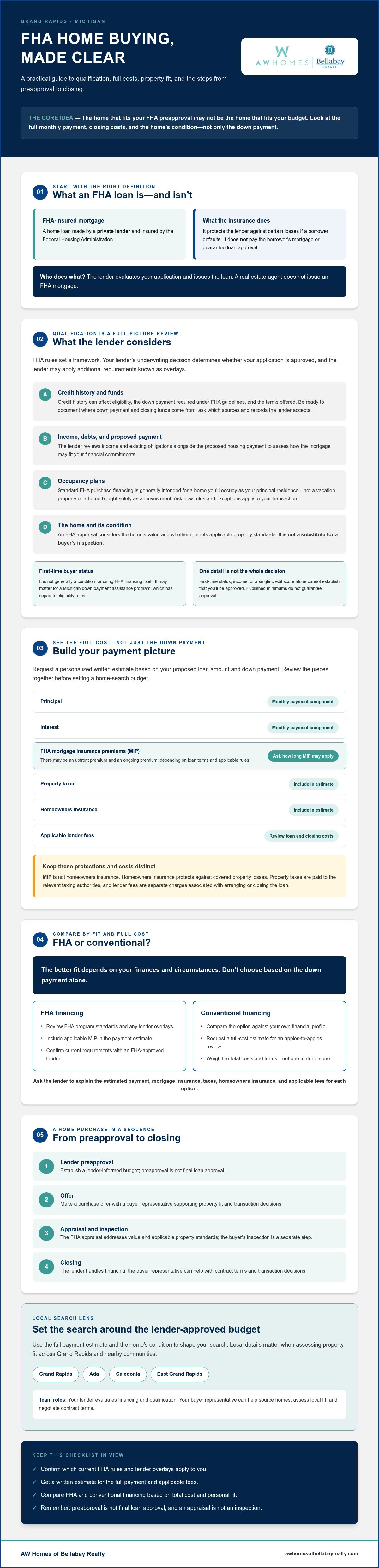
The home that fits your FHA preapproval may not be the home that fits your budget. If you’re a first time home buyer Grand Rapids MI, it’s natural to focus on credit and down payment first, but those are only part of the picture. Mortgage insurance, property taxes, homeowners insurance, and other monthly costs also shape what feels manageable. The home itself must meet FHA property standards, too.
FHA requirements offer a starting point, but lenders may apply their own criteria, and a conventional loan could be a better fit depending on your finances. This guide explains how FHA qualification works in Michigan, what to ask an FHA-approved lender, and how to compare financing options by their full costs, not just the down payment.
You’ll also learn why a home’s condition matters, which local details to consider, and how to set search criteria around your lender-approved budget. With a local buyer representative helping you assess property fit and transaction decisions, you can approach Grand Rapids, Ada, Caledonia, and East Grand Rapids with greater clarity.
Key Takeaways
- Understand what FHA insurance covers and why the mortgage comes from a private lender, not a real estate agent.
- As a first time home buyer Grand Rapids MI, confirm which qualification details apply to you and which may vary by lender.
- Compare FHA and conventional financing by full loan costs and your circumstances, rather than choosing based on down payment alone.
- Follow the path from lender preapproval to offer, appraisal, inspection, and closing. Preapproval isn’t final loan approval.
- See how a buyer representative can help source homes, assess local fit, and negotiate contract terms while your lender handles financing.
Grand Rapids FHA Loans: What They Do and Don't Do
An FHA loan can be a useful financing option, but the name can be misleading. An FHA-insured mortgage is a home loan made by a private lender and insured by the Federal Housing Administration. It is not a mortgage issued by the federal government. The insurance protects the lender against certain losses if the borrower defaults. It doesn’t pay the borrower’s mortgage or guarantee loan approval. For a neutral overview of the FHA insured loan, see the program’s background and purpose.
Federal FHA rules establish program standards, while an FHA-approved lender evaluates your application, issues the loan, and may service it. Lenders can also apply additional requirements, often called overlays. Michigan down payment assistance programs have their own eligibility rules, separate from FHA qualification. Being a first-time buyer may matter for an assistance program, but it isn’t generally a condition for using FHA financing itself.
Who can use an FHA loan in Michigan?
Standard FHA purchase financing is generally intended for a home you’ll occupy as your principal residence, rather than a vacation property or a home purchased solely as an investment. Occupancy rules and exceptions can depend on the transaction, so ask your lender how they apply to your plans.
Your application must meet the lender’s underwriting requirements, not just FHA’s baseline standards. The lender reviews your financial profile and the property under applicable guidelines and may have stricter criteria of its own. First-time buyer status, income, or one credit score alone can’t establish that you’ll be approved. If you’re a first time home buyer Grand Rapids MI, ask which current FHA rules apply and whether lender overlays affect your application.
What does FHA insurance mean for a Grand Rapids buyer?
FHA mortgage insurance premiums, often called MIP, are part of the cost of many FHA loans. Depending on the loan terms and applicable rules, there may be an upfront premium and an ongoing premium that affects your payment. Ask how long the ongoing MIP may apply in your case, and request a written estimate based on your proposed loan amount and down payment.
MIP is not homeowners insurance. Homeowners insurance protects against covered property losses, property taxes are paid to the relevant taxing authorities, and lender fees are separate charges associated with arranging or closing the loan. These expenses can affect the amount you need each month and at closing. Ask your lender for a personalized estimate that includes principal, interest, MIP, taxes, homeowners insurance, and applicable fees. For a home search in Grand Rapids or nearby communities, use the estimate to set a budget based on the full payment, not just principal and interest.
Michigan FHA Loan Requirements: Credit, Down Payment, Income, and Property
FHA qualification isn’t determined by one credit score or down-payment figure. It involves a review of you, your funds, your debts, intended occupancy, and the home. FHA program rules set the framework; the lender’s underwriting decision determines whether your application is approved. HUD’s overview of FHA program benefits is a useful starting point, but your lender should confirm the current requirements for your loan and circumstances.
Credit, down payment, and documented funds
Your credit history can affect eligibility, the down payment required under FHA guidelines, and the terms a lender offers. Lenders may also set stricter credit or documentation standards than the FHA baseline. Meeting a published score or minimum down-payment figure doesn’t guarantee approval.
Be ready to explain where your down payment and closing funds are coming from. Ask the lender which sources are acceptable and what records they’ll need, such as account statements or documentation for a gift. If you’re a first time home buyer Grand Rapids MI, get current requirements directly from an FHA-approved lender before setting your search budget.
Income, debts, occupancy, and the home itself
The lender reviews your income and existing obligations alongside the proposed housing payment. This debt-to-income assessment helps show how the mortgage may fit with your other financial commitments. FHA financing is generally intended for a home you’ll occupy as your principal residence, though the lender can explain how occupancy requirements apply to your situation.
The property matters, too. An FHA appraisal considers the home’s value and whether it meets applicable property standards. It isn’t a substitute for a buyer’s inspection. A repair issue, property type, or condominium project may affect the financing path or require additional review. Before making an offer, ask the lender about appraisal steps, property eligibility, repairs, and any condominium approval requirements.
Use these five areas to organize your questions:
- Borrower: Which credit and underwriting criteria apply to your application?
- Funds: Which down-payment sources and records will the lender accept?
- Debt: How will existing obligations affect the payment range under review?
- Occupancy: Does your intended use meet the program’s principal-residence expectations?
- Property: Could the home’s condition, type, or condominium status require extra review?
Rules and lender overlays can change, and Michigan assistance programs may have separate criteria from FHA financing. Confirm both with the relevant lender or program administrator. Once you have lender-approved search parameters, a local buyer representative can help assess property fit and local context. Explore Grand Rapids buyer representation to connect financing criteria with a focused home search.
FHA vs. Conventional Loans in Grand Rapids: Compare the Full Cost and Fit
FHA and conventional financing can both support a home purchase, but neither is automatically the less expensive or more suitable choice. Your credit profile, available funds, lender’s terms, and the home you want all matter. HUD’s official FHA loan requirements explain the FHA framework. A lender can show how a specific quote compares with conventional options for your situation.
Use this table as a starting point, not a verdict. Details vary by borrower and lender, so compare more than the initial cash needed.
| Factor | FHA financing | Conventional financing |
|---|---|---|
| Down payment | Minimums depend on applicable FHA rules and lender review. | Requirements vary by loan program, borrower, and lender. |
| Mortgage insurance | FHA mortgage insurance premiums may add upfront and ongoing costs; ask how they apply to your loan. | Private mortgage insurance may apply depending on the loan and down payment; ask about its cost and cancellation terms. |
| Underwriting | FHA standards apply, and the lender may add its own requirements. | Lender and program criteria apply and can differ from FHA. |
| Property review | The appraisal includes FHA-related property standards. | Property and appraisal requirements depend on the loan and lender. |
Which costs should buyers compare beyond the down payment?
Request written estimates using the same purchase price, down payment, loan term, and estimated closing timeline. Compare principal and interest, mortgage insurance, property taxes, homeowners insurance, and lender costs. Ask each lender to identify assumptions and explain which charges could change. A lower down payment may preserve more cash upfront, but it doesn’t necessarily mean a lower monthly payment or a lower total cost over time.
For a first time home buyer Grand Rapids MI, this side-by-side comparison helps distinguish what feels affordable at closing from what remains manageable month after month. Don’t rely on a general rate or online payment estimate when choosing between loan types. Request personalized quotes and ask how long mortgage insurance may apply under each option.
How can financing affect an offer on a local home?
Sellers may consider financing alongside contingencies, timing, and the offer’s other terms. FHA financing isn’t automatically rejected or less competitive; an offer’s strength and fit depend on the property and the full circumstances. Talk with your lender about the financing timeline and with your buyer representative about structuring an offer around your approved criteria. For additional local context, review the Grand Rapids real estate market outlook.
How to Prepare for an FHA Home Purchase in Kent County
A clear sequence can make an FHA purchase feel more manageable, from the first lender conversation to closing. For a first time home buyer Grand Rapids MI, confirm financing details before making decisions based on a listing alone. Preapproval helps establish a working price range, but it isn’t final loan approval. The lender still needs to verify your information and review the selected property.
- Talk with an FHA-approved lender. Review your finances, intended occupancy, and the types of homes you’re considering. Ask for a preapproval and clarify what it confirms, how long it’s valid, and what could change the lender’s assessment.
- Set search parameters. Use the lender’s guidance to plan a realistic budget and identify property types to explore. A buyer representative can help source homes and assess how location, condition, commute, and other priorities fit your criteria.
- Review a specific home before making an offer. Ask your lender whether the property type may require additional review. Work with your buyer representative to consider the home’s fit and prepare offer terms that reflect your plans.
- Complete the appraisal and inspection. The lender orders an appraisal as part of its financing review. A buyer’s inspection is a separate evaluation of the home’s condition. Neither replaces the other, and inspection findings don’t themselves determine FHA eligibility.
- Address lender conditions and prepare to close. The lender may request additional documents or review appraisal-related items before finalizing the loan. Keep communication organized, respond promptly, and confirm closing details with the professionals coordinating your transaction.
Questions to ask an FHA-approved lender before touring
Get clear answers before building your search around an estimated budget. Ask which FHA guidelines and lender requirements apply to your finances and intended property. Request an estimate of cash to close and a monthly payment breakdown, including principal, interest, mortgage insurance, taxes, and homeowners insurance. Also ask how repairs, appraisal timing, and changes to your financial details could affect the loan or closing schedule.
Assess the home, not just the listing
An online description can’t confirm FHA eligibility. Ask the lender to explain any property-specific review, especially for a condominium, unusual property type, or home that may need repairs. Separately, use an inspection to understand the home’s condition and discuss concerns with the appropriate professionals. Consider how the home fits your daily life, location needs, and budget as well as its financing requirements.
As you approach an offer, map out the remaining milestones and who is responsible for each. This Michigan home closing process guide offers additional context. For local help sourcing homes and navigating offer decisions, work with a Grand Rapids buyer representative.
Choose Your Grand Rapids Homebuying Team and Next Steps
A home purchase involves several professionals, each with a different role. The lender evaluates your finances, explains financing options, and makes the loan decision. A buyer representative helps you search for homes, weigh property fit, and negotiate contract terms. An inspector assesses a home’s condition, while closing professionals coordinate the documents and steps needed to complete the transaction. Clear roles help you know whom to ask and when.
What local buyer representation can help coordinate
Buyer-side guidance can bring structure to your search. AW Homes of Bellabay Realty supports buyers across Greater Grand Rapids, including Grand Rapids, Ada, Caledonia, and East Grand Rapids. Its buyer representation includes property sourcing, comparative market analysis, and contract negotiation. Your lender-approved parameters can guide which listings you consider, while your priorities help shape how you compare them.
Local context can also help you identify useful questions about a property or area, from how the location fits your routine to which features deserve closer review. Your buyer representative doesn’t determine FHA eligibility or approve financing; the lender handles those decisions. For more guidance on selecting representation, read the Grand Rapids buyer’s agent guide.
A measured next step for first-time buyers
Before setting a search budget or making an offer, speak with a lender about your finances, potential monthly payment, and preapproval conditions. Then bring your search into focus. Write down your preferred locations, timing, essential home features, and questions about the purchase process. Separate must-haves from preferences so you can compare options more clearly.
As a first time home buyer Grand Rapids MI, you don’t need every decision settled before starting a conversation. A lender can clarify financing; a buyer representative can connect approved parameters to a personalized home search and guide property and contract decisions. AW Homes of Bellabay Realty offers buyer representation for people exploring Grand Rapids and nearby communities. If that guidance would be useful, discuss your home search with AW Homes.
Take Your Grand Rapids Home Search Forward
FHA eligibility is only the starting point. Before choosing a loan, ask a lender to compare FHA and conventional financing using your finances and the full monthly payment. Then use lender-approved parameters to guide your search, keeping property condition and fit in view alongside the numbers.
For a first time home buyer Grand Rapids MI, the right support can make each decision more considered. AW Homes of Bellabay Realty provides buyer representation that includes property sourcing, comparative market analysis, and contract negotiation across Grand Rapids, Ada, Caledonia, and East Grand Rapids. The team can help you evaluate local options, but your lender remains the source for loan guidance and approval.
When you’re ready to connect your financing criteria with a personalized home search, plan your Grand Rapids home search with AW Homes. Start with a clear budget and priorities, then bring those criteria to a local buyer representative.
Frequently Asked Questions
Is an FHA loan only for first-time home buyers?
No. FHA loans aren’t generally limited to first-time home buyers. Eligibility depends on current program rules, your finances, occupancy plans, the property, and the lender’s underwriting requirements. If you’re buying your first home, ask an FHA-approved lender to review your complete financial picture and explain which criteria apply. First-time buyer status alone doesn’t guarantee approval or determine whether FHA financing is your best option.
What credit score do I need for an FHA loan in Michigan?
There isn’t one score that guarantees FHA loan approval from every lender. FHA guidance and lender requirements can differ, and a lender may set stricter credit standards. Ask an FHA-approved lender to review your credit history, debts, available funds, and other application details. Confirm current requirements before relying on a published score threshold. A preliminary discussion can clarify possible next steps, but it isn’t a final approval or loan offer.
How much down payment is required for an FHA loan?
The down payment required depends on current FHA rules, your qualifications, and the lender’s requirements. Ask the lender to confirm the minimum that applies to your situation and provide a written estimate of cash to close, including other purchase costs. If you’re considering Michigan down payment assistance, verify current program availability, eligibility, and whether the assistance can be combined with your financing. Don’t assume one advertised figure applies to every buyer or property.
Can I use an FHA loan to buy a condo in Grand Rapids?
Possibly, but condo eligibility depends on the property, condominium project, lender, and current FHA requirements. A listing alone doesn’t confirm that a condo qualifies. Ask your lender to check the project’s status and explain any applicable approval pathway before you make an offer. Also clarify how the appraisal, inspection, association information, and financing contingencies fit the transaction so you understand what needs review.
Does an FHA appraisal replace a home inspection?
No. An FHA appraisal helps the lender assess the property’s value and whether it meets applicable program standards. A home inspection is a separate evaluation of the home’s condition for you as the buyer. They serve different purposes, and neither replaces the other. Ask your lender what the appraisal covers and your inspector what the inspection includes. Discuss findings and potential repairs with the appropriate professionals before proceeding.
Are there income limits for FHA loans in Michigan?
FHA qualification isn’t generally defined by a universal household income cap, but your income and obligations are part of the lender’s underwriting review. Loan limits and affordability also affect what you may be able to finance. Down payment assistance programs, including Michigan programs, have separate criteria that can include income limits. Check current requirements with a lender and program administrator, and don’t assume eligibility for one program means you qualify for another.
Can a real estate agent tell me whether I qualify for an FHA loan?
No. A mortgage lender evaluates your finances and determines loan eligibility; a real estate agent can support your property search and help explain transaction steps. Ask an FHA-approved lender about requirements, estimated payments, and preapproval. AW Homes of Bellabay Realty helps buyers connect lender-approved search parameters with homes in Grand Rapids, Ada, Caledonia, and East Grand Rapids through property sourcing, comparative market analysis, and contract negotiation. The team doesn’t issue loans or guarantee approval.


