

What if the challenge of convincing your spouse it's time to move isn't about the logistics of packing boxes, but about the delicate process of evolving your shared life story? It's natural to feel a sense of friction when you see your home no longer serving your family's needs, yet your partner remains anchored by emotional history. You likely want your perspective heard, your future secured, and your relationship strengthened through this transition. We recognize that a home is more than just a financial asset; it is a sanctuary, a milestone, and a foundation for your next chapter.
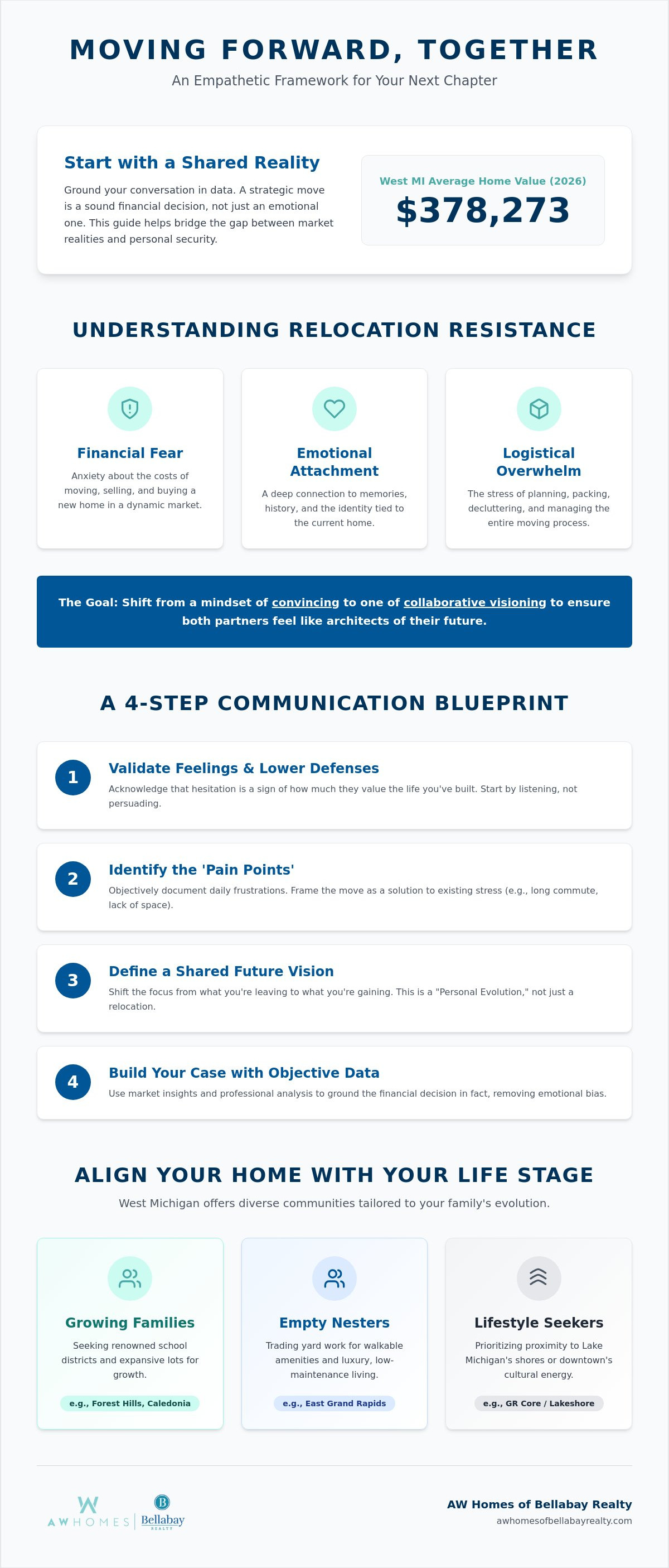
This guide offers an empathetic, data-driven framework designed to bridge the gap between logical market realities and personal emotional security. By grounding your conversation in the current West Michigan landscape, where home values rose to an average of $378,273 in early 2026, you can move away from conflict and toward strategic planning. We'll explore how to cultivate a peaceful decision-making process, establish a shared vision for your future, and utilize professional insights to validate your move as a sound strategic choice. It's time to stop feeling unheard and start building a collaborative path forward together.
Key Takeaways
- Identify, understand, and address the three primary forms of relocation resistance to foster a supportive environment for change.
- Reframe the transition as a positive personal evolution by focusing on the specific life-stage benefits of your next home.
- Learn the precise steps for convincing your spouse it's time to move through high-level communication strategies that prioritize emotional security.
- Leverage objective West Michigan market data and specialized insights to ground your financial decisions in professional authority.
- Discover how a low-stakes consultation can clarify your options and provide a seamless roadmap for your family's future.
Navigating the Emotional Landscape of Relocation Resistance
Resistance to change is rarely about the destination; it's about the perceived loss of the familiar. When you find yourself convincing your spouse it's time to move, you aren't just discussing a real estate transaction. You are navigating "Relocation Anxiety," a natural psychological response to leaving a known environment. This tension often stems from three distinct pillars: financial fear, emotional attachment, and logistical overwhelm. By identifying these roots, you can move away from high-pressure persuasion and toward a shared understanding of your family's evolution.
Validating your partner’s perspective is the most effective way to lower defensive barriers. Instead of dismissing their concerns, acknowledge that their hesitation is a sign of how much they value the life you've built together. The goal isn't to "win" an argument. Successful transitions require shifting from a mindset of convincing to one of collaborative visioning. This approach ensures that both partners feel like architects of their future rather than passengers in someone else's plan. When the process feels like a partnership, the inherent stress of the transition begins to dissolve.
The Psychology of Home and Stability
For many, a home represents more than shelter; it is a source of safety, identity, and personal history. Understanding the psychological effects of relocating helps distinguish between a simple fear of moving and a deep-seated desire to stay. Past experiences often color current attitudes. If a previous move was chaotic or rushed, your spouse may view the current proposal through a lens of stress rather than opportunity. Recognizing these patterns allows you to offer the reassurance needed for a confident transition. It's about providing emotional security before discussing square footage.
Recognizing the 'Pain Points' of Your Current Space
Strategic transitions begin with an objective look at how your current home functions. Perhaps the lack of a dedicated office impacts your productivity, or a poor commute steals time from your family. Documenting these daily frustrations helps clarify the "why" behind your proposal. When you frame the move as a solution to existing stress, you change the narrative. You aren't creating a new burden; you are seeking a path toward greater freedom, improved functionality, and long-term peace. This helps in convincing your spouse it's time to move by highlighting how a new home in West Michigan can resolve the friction points of your current daily life.
Identifying the 'Why': Moving Beyond Square Footage
Successful relocation is rarely about the physical structure of a house. Instead, it is about the life that happens within those walls. When you begin the process of convincing your spouse it's time to move, the conversation should shift from what you are leaving behind to what you are collectively gaining. Framing the transition as a "Personal Evolution" allows both partners to view the move as a positive milestone rather than a disruptive chore. It is a chance to align your environment with your current values, your future goals, and your shared peace of mind.
Stagnation carries its own hidden price. We often overlook the "Cost of Inaction," which is the lifestyle toll of remaining in a home that no longer fits your needs. This might manifest as hours lost to a grueling commute, the frustration of cramped living quarters, or the financial burden of maintaining a property that is too large. By analyzing these friction points, you can present the move as a strategic solution. Learning how to initiate the talk with this focus on gain rather than loss helps transform a potentially tense debate into a collaborative planning session.
Life Stage Transitions in West Michigan
In our region, different communities offer specialized benefits tailored to your specific life stage. Families often seek the expansive lots and renowned school districts of Forest Hills or Caledonia to support their growth. Conversely, empty nesters frequently find freedom in luxury condos within East Grand Rapids, where they can trade yard work for walkable amenities. Others relocate specifically for the West Michigan lifestyle, prioritizing proximity to Lake Michigan's shoreline or the cultural energy of downtown Grand Rapids. Identifying which regional profile matches your current evolution is essential for a focused search.
Defining Your Shared 'Non-Negotiables'
To find common ground, it's helpful to create a "Dream vs. Need" list together. This exercise clarifies your priorities and highlights areas where compromise is possible. You might find that while one partner prioritizes a specific neighborhood, the other is more concerned with home features like a home office or a modern kitchen. Focus on your "Future Self" by asking where you want to be in five years. This long-term perspective ensures your decision is grounded in strategy rather than temporary emotion. If you're feeling stuck, exploring relocation assistance can provide the objective professional insight needed to bridge the gap between your individual visions.
The Strategic Conversation: How to Initiate the Talk Without Pressure
Approaching a life-altering decision requires more than just a list of reasons; it requires a setting of mutual respect and intentionality. When you are convincing your spouse it's time to move, the environment of the conversation is as critical as the message itself. Avoid bringing up the topic during high-stress moments like the morning rush or right before bed. Instead, choose a neutral space where you both feel relaxed and unhurried. Start by leading with empathy. Acknowledge the emotional weight of your current home, the memories created there, and the security it provides. By validating their attachment first, you lower defensive barriers and create a safe space for a collaborative dialogue.
Effective communication thrives on "Curiosity Questions" rather than "Demand Statements." Instead of declaring that the house is too small, ask how they feel about the current functionality of your living spaces. This shift invites your partner to share their perspective, turning a potential confrontation into a shared inquiry. Propose a "Discovery Phase" rather than an immediate commitment to list the property. This low-pressure approach allows both of you to explore possibilities without the weight of an impending transaction. When you focus on building your case for a move through the lens of shared well-being, the process becomes a journey you take together.
The 3-Step Conversation Protocol
Structure your dialogue around a logical progression that prioritizes vision over logistics. This methodical approach ensures no detail is left to chance and emotional security remains the anchor of your planning.
- Step 1: Vision Casting. Ask, "What would our ideal weekend look like in two years?" Focus on the lifestyle, the community, and the ease of daily life.
- Step 2: Problem Solving. Address specific friction points. Ask, "How can we solve our lack of office space or the long school commute together?"
- Step 3: The Low-Stakes Next Step. Conclude with a gentle invitation. Ask if they'd be open to simply looking at what's available in the current market without any obligation.
Handling Common Objections with Calm Authority
Objections are often just requests for more information or reassurance. If your spouse worries that the market is too volatile, provide objective data regarding Grand Rapids real estate trends. With average home sale prices in West Michigan reaching $378,273 in early 2026, the market remains resilient and steady. For those overwhelmed by the logistics of packing, introduce the concept of concierge-style relocation assistance to simplify the process. If the concern is the children's transition, highlight the exceptional neighborhood amenities and community spirit in areas like Ada or Cascade. Addressing these fears with expert insight is a cornerstone of convincing your spouse it's time to move while maintaining a supportive partnership.
Building Your Case with West Michigan Market Insights
Data serves as the ultimate neutralizer in high-stakes family discussions. When you are convincing your spouse it's time to move, subjective feelings can often lead to circular arguments that stall progress. Introducing objective market insights removes the emotional weight and positions the relocation as a logical financial evolution. In the first quarter of 2026, the average home sale price in West Michigan reached $378,273, reflecting a market that is steady, resilient, and supportive of long-term growth. By reviewing a professional "Net Sheet" together, you can visualize the potential equity gain from a sale, providing a clear financial foundation for your shared future.
Many couples consider remodeling as a compromise, yet the cost of extensive renovations often exceeds the investment of a strategic move. Living through a construction project brings its own set of stressors that can strain a relationship. Assessing the current strength of Forest Hills home values reveals that selling a high-demand property often funds a lifestyle upgrade that a simple renovation cannot match. It's about weighing the immediate financial return against the functional benefits of a home designed for your current life stage.
Leveraging Local Market Opportunities
The 2026 landscape offers a unique "Equity Bridge" for move-up buyers in Kent County. With the average price per square foot rising to $200, an 8% increase over 2025, your current property has likely built significant wealth. To ground your planning in reality, it's essential to obtain a Comparative Market Analysis (CMA). This document acts as a strategic roadmap, moving the conversation away from speculation and toward expert navigation. Understanding your precise market position ensures that no detail is left to chance during your transition.
Neighborhood Comparisons: Forest Hills, Ada, and Beyond
Choosing a new community requires a balance of school rankings, property taxes, and lifestyle amenities. While Forest Hills is synonymous with academic excellence, Ada Village offers a walkable, European-style charm, and Cascade provides expansive park systems for active families. Utilizing a Grand Rapids Relocation Guide allows you to compare these regional markers side-by-side. This level of detail is vital for convincing your spouse it's time to move, as it replaces the fear of the unknown with a vivid, data-backed vision of your next neighborhood. To see how your current equity can be strategically reinvested in these communities, explore our Residential Listing Services today.
Taking the First Low-Stakes Step Toward Your Next Chapter
The transition from abstract discussion to concrete action often marks the end of a long-standing stalemate. When you've spent months or even years convincing your spouse it's time to move, the final hurdle is often the fear of the process itself. Clarity, security, and vision. A no-pressure consultation with a strategic advisor like Angela Worth serves to clarify your options without the weight of an immediate commitment. This professional guidance transforms the conversation from a tentative "if we move" into a confident "when we move." By providing a structured roadmap, we replace uncertainty with intentionality and expert navigation.
Expertise tailored to your specific life stage is the primary differentiator in a successful relocation. A dedicated Buyers Agent in Grand Rapids does more than browse the local MLS. They provide access to off-market opportunities and localized insights that aren't available to the general public. This specialized approach ensures that no detail is left to chance, allowing both partners to feel secure in the strategic direction of their shared future. It is about finding a home that reflects your personal evolution while maintaining your financial well-being.
The Concierge Real Estate Edge
A high-level consultant understands that the logistics of selling a home can feel like a secondary job. Our concierge-style approach mitigates this burden through professional staging, high-end photography, and methodical preparation. We focus on reducing the daily hassle so you can focus on the emotional transition. A custom plan is created for every client, respecting the unique timelines and needs of both partners. This ensures a seamless process that prioritizes emotional security and personal milestones over a quick closing.
Your Invitation to Explore
Sometimes, the logic of a move needs to be felt to be believed. A casual weekend tour of potential neighborhoods can reignite excitement for what lies ahead. Seeing a Luxury Home in Grand Rapids in person often provides the final piece of clarity needed to solidify your "why." It moves the dream from a concept to a tangible reality, assisting in convincing your spouse it's time to move by showcasing the lifestyle awaiting you. If you're ready to explore what's possible for your family, we invite you to schedule a calming, no-obligation consultation with Angela Worth. Let us help you navigate your next chapter with the professional authority and empathetic reassurance you deserve.
Embracing Your Shared Personal Evolution
Navigating a move is a significant personal milestone that requires a delicate blend of emotional empathy and strategic foresight. By shifting from high-pressure demands to collaborative visioning, you transform a potential conflict into a shared journey. We've explored how identifying functional pain points and leveraging objective West Michigan market data can turn a stalemate into a clear, logical roadmap. Successful transitions are grounded in trust, transparency, and expert navigation.
When you are convincing your spouse it's time to move, remember that professional validation provides the ultimate emotional security. As neighborhood authorities in Forest Hills, Ada, and East Grand Rapids, we provide a concierge-style approach designed to minimize transition stress. Our strategic market analysis ensures your decisions are grounded in professional insight rather than chance. You don't have to navigate this life stage alone; a steady, knowledgeable partner makes every step feel seamless.
Start your stress-free transition with a strategic consultation at AW Homes. Your future home is more than a transaction; it is the foundation for your family's next great chapter. We look forward to helping you build a shared vision that serves your needs for years to come.
Frequently Asked Questions
How do I bring up moving without starting an argument?
Initiate the conversation by choosing a neutral, stress-free setting and leading with curiosity rather than demands. Ask your partner how they feel about the current home's functionality or your family's five-year goals to invite a collaborative dialogue. This approach focuses on vision casting, problem-solving, and emotional security. It transforms a potential conflict into a shared inquiry about your family's next chapter.
What if my spouse is worried about the financial cost of moving?
Mitigate financial concerns by reviewing objective data, including a professional net sheet that illustrates your potential equity gain. In early 2026, West Michigan home values averaged $378,273, suggesting a strong market for those looking to sell and reinvest. This strategic focus helps in convincing your spouse it's time to move by grounding the discussion in fiscal reality and long-term wealth building.
How can I help my spouse feel more comfortable with leaving our current home?
Validate their emotional attachment while reframing the move as a positive step in your family's personal evolution. Acknowledge the history you've built in your current space while highlighting how a new environment can better support your current life stage. Whether you seek more freedom through downsizing or more space for growth, emphasize that the transition is an upgrade for your shared lifestyle.
Should I start looking at houses before my spouse is fully on board?
Start with low-stakes exploration, such as browsing online listings together, to see what captures your shared interest. Invite your partner to a casual home tour weekend in West Michigan communities like Ada or Cascade without any immediate pressure to buy. This allows the possibility of a move to feel tangible and exciting. It moves the dream from a concept to a visible reality.
How do we decide which West Michigan neighborhood is right for us?
Evaluate regional markers like school rankings, walkability, and community taxes to find the community that matches your life stage. While Forest Hills is renowned for academic excellence, East Grand Rapids offers walkable luxury and unique community charm. Using a specialized relocation guide helps you evaluate these areas side-by-side. This ensures your next neighborhood aligns perfectly with your long-term goals and daily needs.
What are the first steps to take if we both agree to explore moving?
Schedule a strategic consultation to establish a clear, stress-free roadmap and clarify your financial position. This meeting provides professional validation and moves the conversation from abstract ideas to a concrete plan. From there, obtaining a Comparative Market Analysis (CMA) will ground your expectations in current 2026 market data. This methodical approach ensures that no detail is left to chance during your family's transition.
How can a real estate agent help facilitate this conversation?
A real estate advisor serves as a knowledgeable third party who provides the data needed for convincing your spouse it's time to move. They offer empathetic reassurance and professional authority to handle the complexities of high-stakes transactions. By focusing on emotional security and seamless processes, agencies like Elite Agents & Partners help bridge the gap between logical market realities and your personal lifestyle desires through expert navigation.
Is it better to remodel our current home or move to a new one?
Compare the long-term functional benefits of a new home against the high cost and disruption of a major renovation. Remodeling often involves significant construction stress and expenses that may not be fully recouped upon a future sale. Conversely, a strategic move allows you to trade existing equity for a home designed for your current life stage. This often proves more efficient and financially sound.


