
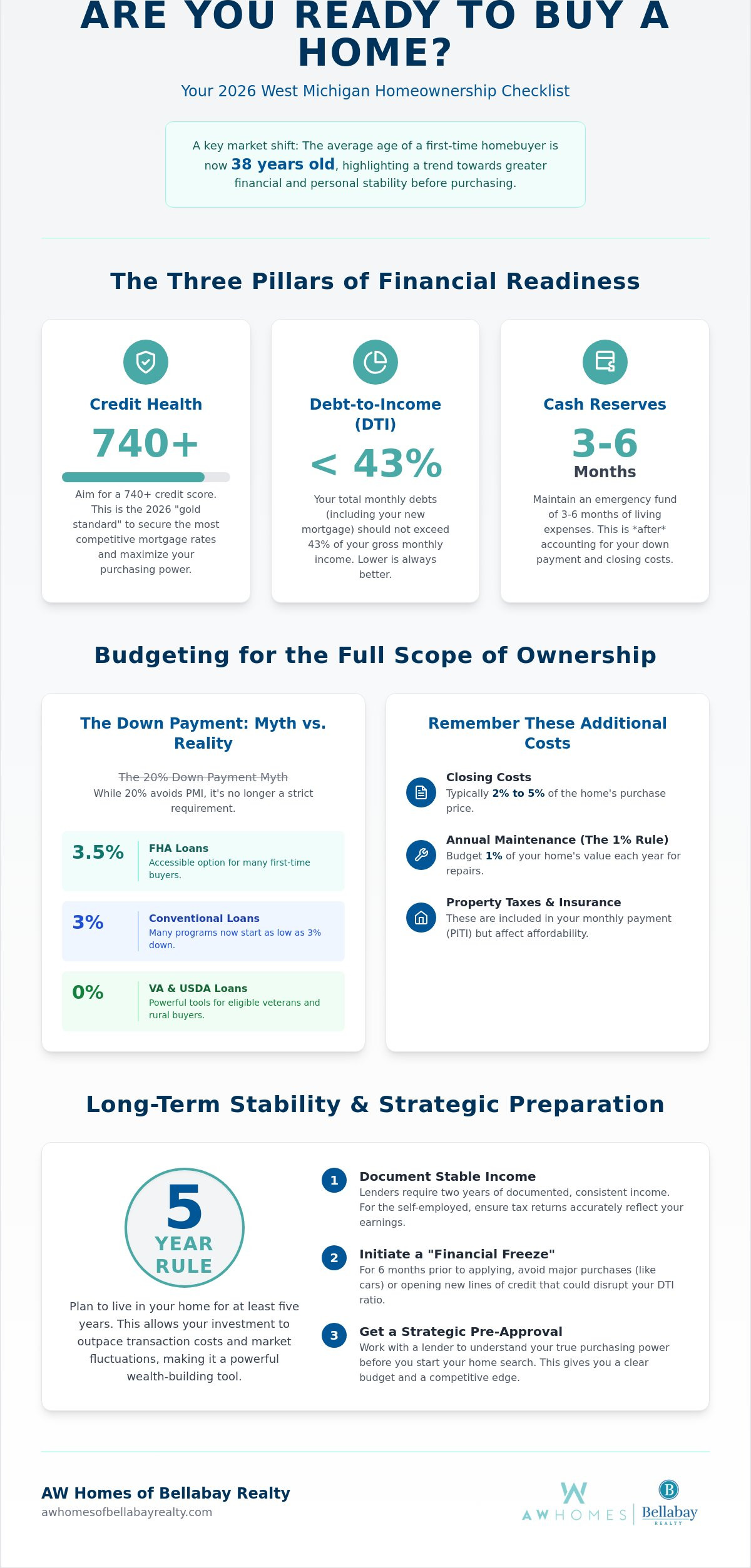
Did you know the average first-time homebuyer in 2026 is now 38 years old? This shift highlights a growing trend toward intentionality, proving that the right time to buy isn't dictated by a calendar but by a personal foundation of stability. You might find yourself wondering how to know if you are ready to buy a house while watching 30-year mortgage rates settle near 6.54% and local inventory in Grand Rapids finally begin to expand. It's a complex landscape; feeling a sense of caution is simply a sign of a strategic mind at work.
We understand that this transition is about more than just a mortgage. It's about securing your future, finding a place to belong, and achieving emotional security. This guide provides the clarity you need to move forward with absolute confidence. You'll discover the financial benchmarks, emotional signals, and market-driven data points that define true readiness in West Michigan. We will break down the next twelve months into a clear, manageable roadmap that addresses interest rate trends, local pricing, and your own long-term well-being.
Key Takeaways
- Evaluate your financial foundation through credit health, debt-to-income ratios, and liquid reserves to meet the 2026 gold standard for optimal rates.
- Apply the Five-Year Rule to discover how to know if you are ready to buy a house based on your geographic and professional stability.
- Study the local landscape of Grand Rapids inventory and Kent County interest rates to understand your strategic purchasing power.
- Budget for the full scope of homeownership by accounting for property taxes, insurance, and the 1% annual maintenance rule.
- Begin your transition with a strategic lender pre-approval and a methodical list of your essential property requirements.
Mastering the Financial Metrics of Homeownership Readiness
True financial readiness is a composition of three essential elements: credit health, debt ratios, and liquid reserves. While emotional desire often sparks the search, your mathematical foundation determines the sustainability of the transition. A foundational part of understanding homeownership involves recognizing that your home is both a sanctuary and a significant line item in your long-term wealth strategy. Determining how to know if you are ready to buy a house requires a methodical look at your balance sheet through the lens of a 2026 lender.
The 2026 credit landscape has shifted, making a 740 score the new gold standard for securing the most competitive rates. While the current 30-year fixed mortgage rate averages 6.54%, those with scores below this threshold may face higher premiums that significantly impact monthly purchasing power. Your debt-to-income (DTI) ratio acts as the second pillar. Lenders typically look for a DTI where your total monthly obligations, including the new mortgage, don't exceed 43% of your gross income. However, a strategic buyer balances these requirements with their personal lifestyle aspirations, ensuring they aren't "house poor" after the papers are signed.
Cash reserves represent the final pillar of the "Big Three." You must account for closing costs, which typically range from 2% to 5% of the purchase price, and an emergency fund. We recommend maintaining three to six months of living expenses in a liquid account after your down payment is paid. This provides the emotional security and financial cushion needed to handle the unexpected repairs that inevitably accompany property ownership.
The Down Payment Myth vs. 2026 Reality
The traditional 20% down payment is no longer a strict requirement for entry into the West Michigan market. Modern programs offer pathways with as little as 3% or 3.5% down, such as FHA loans which currently average a 6.29% interest rate. For eligible veterans or those looking in specific rural areas of Kent County, 0% down options through VA or USDA loans remain powerful tools. Private Mortgage Insurance (PMI) is often viewed as a burden, yet it functions as a strategic tool that allows you to stop renting and start building equity years earlier than you might otherwise. Sourcing these funds can involve traditional savings, documented gift funds from family, or even strategic 401k loans, provided you understand the long-term tax implications.
Documenting Your Financial Stability
Lenders in 2026 prioritize consistency, precision, and transparency. You'll need to provide two years of documented, stable income to qualify for the best terms. This is particularly vital for self-employed individuals in Grand Rapids, who should ensure their tax returns reflect the true strength of their earnings. During the six months prior to your application, it's essential to maintain a "financial freeze." Avoid major purchases like new vehicles or high-end furniture, as these new debts can disrupt your DTI ratio and jeopardize your pre-approval at the final hour. Once your closing is complete, you can then focus on other needs, such as finding a reliable vehicle from a reputable dealer like Stone Road Auto. Preparation, precision, and patience are your greatest assets during this phase.
Evaluating Your Lifestyle and Long-Term Intentionality
Buying a home is a significant life milestone that transcends simple financial math. While your balance sheet provides the foundation, your lifestyle determines if that investment will truly flourish over time. To understand how to know if you are ready to buy a house, you must look inward at your timeline, your priorities, and your willingness to plant roots. Stability, intentionality, and commitment are the three pillars of a successful property transition.
Most strategic advisors point to the Five-Year Rule as a primary benchmark for geographic stability. Real estate is a powerful wealth-building tool, but it requires time to outpace transaction costs and market fluctuations. If your career trajectory or personal goals suggest a move within the next few years, continuing to rent in a vibrant area like downtown Grand Rapids might be the more flexible choice. However, if you are looking for signs you're ready to own, a desire for permanent sanctuary often outweighs the convenience of a short-term lease.
Homeownership involves a fundamental shift in daily responsibility. You are trading the freedom of calling a landlord for the autonomy of owning a lawnmower. This transition requires a mindset shift from a consumer to a steward. Ask yourself these three questions:
- Are you prepared for the "hidden" labor of weekend maintenance and property care?
- Do you value creative control over your living space more than the ability to move on short notice?
- Is this purchase a strategic investment for your future or a necessary shelter transition for your family?
The Emotional Weight of Homeownership
Owning a home in West Michigan offers a unique sense of permanence. While the Grand Rapids rental market can be volatile, a fixed-rate mortgage provides a predictable anchor for your monthly budget. Beyond the finances, homeownership allows you to foster deep community roots in established neighborhoods like Ada or East Grand Rapids. It's about more than a deed; it's about belonging to a local story. If you're ready to explore these communities, our buyer agency services can help you navigate these neighborhood nuances with ease.
Future-Proofing Your Purchase
A strategic purchase considers where you'll be in a decade, not just today. Evaluating local school districts in Forest Hills and Caledonia serves as a vital value-retention strategy, even if you don't have children. These areas historically maintain high demand, protecting your equity over time. With the rise of remote work and multi-generational living, consider if a property can evolve with you. A home that offers a dedicated office space or a flexible layout ensures your "move-up" potential remains high without the need for another costly transition. When you align your purchase with your long-term evolution, you move from simply buying a house to securing a legacy.
Navigating the 2026 West Michigan Market Landscape
Understanding the external environment is just as critical as assessing your internal financial health. Part of how to know if you are ready to buy a house involves analyzing the delicate equilibrium of the current West Michigan market. In 2026, we've seen a modest improvement in housing supply, with inventory levels rising between 9% and 17% compared to the previous year. This shift provides you with more options, yet the typical home value in Grand Rapids remains steady at approximately $297,964. It's a market that rewards the prepared, the patient, and the well-informed.
Interest rate trends continue to dictate purchasing power across Kent County. With the 30-year fixed mortgage rate hovering around 6.54%, your strategic timing becomes paramount. Buying during the Michigan winter often presents less competition and more motivated sellers, while the spring market brings a surge of new listings and higher energy. Deciding when to enter requires a blend of market data and personal readiness. Local expertise is no longer just an advantage; it's a necessity for navigating a landscape where homes still sell for approximately 98.2% of their list price.
Success in this environment is built on three pillars: insight, timing, and representation. Without a clear understanding of hyper-local trends, it's easy to feel overextended. We focus on providing a sophisticated level of consulting that moves beyond simple salesmanship, positioning you to make decisions grounded in localized reliability and expert navigation.
Regional Spotlight: Forest Hills and Ada
Market velocity in Forest Hills remains high, with homes typically spending about 28 days on the market. This speed requires buyers to have their documentation in order before the first tour. In neighboring Ada and Cascade, we're seeing a steady demand for luxury and executive housing, with price appreciation holding at a moderate 3.2% through the third quarter of 2026. For those looking to sell my home Forest Hills MI to facilitate their next purchase, the current equilibrium offers a favorable window for a seamless transition.
The "Buyer’s Agent" Advantage in 2026
A strategic partner does more than open doors; they provide a high-level consultancy that uncovers off-market opportunities in Greater Grand Rapids. Our concierge approach ensures that no detail is left to chance, especially when managing the complexities of the home closing process in Michigan. In a high-interest-rate environment, professional representation provides the emotional security needed to make firm, competitive offers. We prioritize your long-term well-being, helping you define a clear roadmap that aligns with the unique rhythm of the West Michigan market.
Understanding the Full Scope of Homeownership Responsibility
The transition into homeownership involves a significant shift in financial perspective. While the previous sections focused on market entry and emotional timing, how to know if you are ready to buy a house also depends on your ability to look beyond the monthly mortgage payment. A strategic budget must account for the full spectrum of ownership: property taxes, homeowner's insurance, and potential HOA fees. Additionally, you must be prepared for closing costs, which typically range from 2% to 5% of the purchase price. On a $300,000 home, this means having between $6,000 and $15,000 ready at the signing table.
We often advise our clients to adopt the "1% Rule." This methodical approach involves setting aside 1% of your home's total value annually for maintenance and repairs. If you are moving from an apartment to a single-family home in West Michigan, you'll also notice a difference in utility costs. Heating a larger space during a lake-effect winter requires intentional planning and a robust emergency reserve. It's about moving away from the simplicity of a lease and toward the complexity of asset management.
West Michigan Specific Maintenance
Owning a property in Kent County requires a commitment to seasonal readiness. You must budget for the logistical realities of our region: snow removal, professional leaf pickup, and annual roof inspections to prevent ice damming. The local climate puts unique stress on HVAC systems, plumbing, and insulation. To help you build a network of trusted professionals, we recommend utilizing our Grand Rapids relocation guide. This resource connects you with the regional vendors we trust to maintain the integrity of local properties.
The Tax Benefits of Owning in Michigan
While the responsibilities are significant, the financial rewards of ownership are equally compelling. In Michigan, the Principal Residence Exemption (PRE) can significantly lower your local school operating taxes, providing a tangible benefit for those using the home as their primary sanctuary. Mortgage interest deductions can also lower your overall effective housing cost, making the transition more sustainable over time. Ultimately, you're building equity in the grand rapids real estate market, which continues to see steady, moderate appreciation. This long-term growth transforms a monthly expense into a foundational element of your personal wealth.
If you're ready to move from a renter's mindset to a strategic homeowner's perspective, our team is here to provide the expert navigation you deserve. Explore our residential buyer agency services to begin your personalized journey with a partner who prioritizes your long-term well-being.
Transitioning from Renter to Strategic Homeowner
Once you've analyzed the financial metrics and emotional markers, the path forward becomes a matter of methodical execution. Deciding how to know if you are ready to buy a house often culminates in the moment you move from theory to action. This final phase of your journey is about precision, partnership, and personal evolution. It's the bridge between your current life and the future you've carefully planned.
During this transition, some buyers find that high-quality temporary housing provides the necessary breathing room to make a non-rushed decision; you can learn more about Detroit Furnished Rentals to see how premium furnished options can simplify your move within Michigan.
The process begins with three clear steps: securing a strategic pre-approval, defining your property criteria, and establishing your professional representation. A pre-approval from a reputable West Michigan lender is your financial passport in a market where homes still sell for approximately 98.2% of their list price. Next, you must distinguish your "Must-Haves" from your "Nice-to-Haves." In the Grand Rapids area, this might mean prioritizing proximity to the Medical Mile, seeking a specific district like Forest Hills, or ensuring enough square footage for a dedicated home office.
Your most critical asset in this transition is a buyers agent in Grand Rapids. This strategic partner acts as a high-level consultant, uncovering off-market opportunities and navigating the complexities of the 2026 landscape. Once your representation is in place, you can begin curated property tours. These tours serve to calibrate your expectations with reality, allowing you to see how your budget aligns with the current inventory in Kent County.
The AW Homes Concierge Approach
Angela Worth provides a calming, methodical presence that mitigates the inherent stress of high-stakes transactions. We leverage deep neighborhood insights to find homes that align perfectly with your current life stage. Our commitment is to your long-term well-being, ensuring emotional security through expert negotiation, clear communication, and seamless processes. We don't just find houses; we facilitate significant personal milestones that reflect your growth and intentionality.
Your First 30 Days as a Homeowner
The first month of ownership is a period of adjustment and celebration. We recommend focusing on three practical pillars: utility transitions, safety updates, and neighborhood integration. Ensure your services in Grand Rapids or Caledonia are transferred promptly to avoid any interruptions. Prioritize immediate safety by changing locks, checking smoke detectors, and testing carbon monoxide alarms. Finally, take a moment to celebrate. You've navigated a complex process with intentionality, and your new home is the foundation for the next chapter of your story. Embrace the stability, security, and pride that comes with owning your future.
Securing Your Future in West Michigan
Readiness is rarely a single moment; it's a harmonious alignment of personal evolution, financial health, and local market insight. We've explored the necessity of the 740 credit gold standard, the strategic value of the Five-Year Rule, and the logistical realities of managing a property through a Michigan winter. By addressing these factors with intentionality, you move beyond the stress of the unknown and toward a position of expert navigation. Your journey from renter to homeowner is a transformation that requires stability, security, and growth.
If you've been reflecting on how to know if you are ready to buy a house, you now possess the clarity needed to define your next twelve months. This transition is a significant personal milestone that deserves a methodical, unhurried partner. As a West Michigan neighborhood authority, we specialize in life-stage transitions and provide concierge-style buyer representation to ensure your emotional security remains the top priority. No detail is left to chance when you have a steady professional by your side.
Take the next step toward your new sanctuary with confidence. Schedule your strategic home buying consultation with Angela Worth today to begin your curated journey. Your future in Grand Rapids is a story waiting to be written, and we're honored to help you turn the page.
Frequently Asked Questions
Is it better to buy a house in 2026 or continue renting in Grand Rapids?
Deciding between buying or renting depends on your personal timeline and the "Five-Year Rule." Renting remains a flexible choice for those in transition, but buying allows you to build equity as Grand Rapids home values continue their steady appreciation. With inventory levels rising by up to 17% over last year, the 2026 market offers more strategic entry points and choices than we've seen in previous cycles.
What credit score do I need to buy a house in Michigan right now?
You generally need a credit score of at least 620 for a conventional loan, though 740 is the gold standard for securing the most competitive interest rates. FHA programs may accept scores as low as 580 with a 3.5% down payment. Maintaining a high score ensures your monthly mortgage payment remains sustainable, providing the emotional security of a predictable financial future in West Michigan.
How much money should I actually have saved before looking at homes?
You should have enough saved to cover your down payment, closing costs, and a post-purchase emergency fund. Closing costs in West Michigan typically range from 2% to 5% of the purchase price, while an emergency fund should cover three to six months of living expenses. This methodical approach ensures you are prepared for the logistical realities of property ownership without overextending your liquid assets.
Can I buy a home if I still have significant student loan debt?
Yes, you can buy a home while carrying student loan debt, provided your total debt-to-income (DTI) ratio remains within lender guidelines. Most 2026 lenders look for a total DTI of 43% or lower. If you are researching how to know if you are ready to buy a house, calculating your monthly debt obligations against your gross income is a critical first step in determining your true purchasing power.
How do I know if a specific neighborhood like East Grand Rapids is right for me?
Determining if East Grand Rapids or another specific neighborhood is right for you requires aligning your lifestyle priorities with local community traits. We suggest visiting the area at different times of the week to observe traffic patterns, noise levels, and local amenities. Evaluating school districts and historical value retention in neighborhoods like Forest Hills or Ada can also provide a strategic indicator of long-term satisfaction.
What are the most common "hidden costs" first-time buyers miss?
The most common hidden costs include supplemental property tax bills, higher utility costs for single-family homes, and recurring maintenance. Many buyers overlook the "1% Rule," which suggests setting aside 1% of the home's value annually for repairs. For those learning how to know if you are ready to buy a house, budgeting for these seasonal expenses is just as vital as saving for the initial down payment.
How long does the home buying process typically take in West Michigan?
The home buying process in West Michigan typically takes between 30 and 60 days from the moment an offer is accepted to the final closing. However, the initial search and calibration phase can add several months to your total timeline. Partnering with a strategic advisor helps streamline this journey, ensuring that every detail is managed with precision from the first tour to the final signature.
Should I get a home inspection even in a competitive seller’s market?
You should always obtain a home inspection, even in a competitive seller's market, to protect your long-term financial well-being. An inspection uncovers structural, mechanical, or safety issues that could lead to significant future expenses. While some buyers consider waiving inspections to make their offers more attractive, we prioritize your emotional security and recommend using specialized contingencies that allow for professional evaluation without jeopardizing your competitive edge.


