

What if the fear of being "homeless" between closings was the only thing standing between you and your dream home in Forest Hills? It's a heavy burden to carry. You find the perfect property in Ada or Cascade, yet the thought of moving twice, paying for storage, and managing the logistics of two homes feels like a high-wire act without a net. We understand that this transition is more than a transaction; it's a significant personal milestone that deserves emotional security.
Exploring the various options for buying a house before selling Michigan properties can transform this chaotic period into a calculated, strategic evolution. You deserve a process that is seamless, predictable, and expert. This guide provides the financial certainty you need to navigate the "gap" period with confidence. We will examine bridge loans, which saw interest rates averaging 11.16% in the second quarter of 2026, alongside modern non-contingent offer strategies tailored for the West Michigan market. You'll discover how to leverage local inventory trends to ensure your move is handled with the precision, warmth, and localized authority you expect.
Key Takeaways
- Understand why a buy-first strategy is the preferred path for homeowners in high-demand West Michigan neighborhoods like Forest Hills and Ada.
- Explore various options for buying a house before selling Michigan property, including bridge loans and specialized capital solutions that enable non-contingent offers.
- Learn to navigate the 2026 Michigan Purchase Agreement with contractual safeguards designed to protect your financial interests during a property transition.
- Discover logistics strategies to manage the move-in process efficiently, ensuring you avoid the anxiety of moving twice or managing a 24-hour gap.
- Gain insight into how a concierge-style advisory approach provides the emotional security and methodical planning required for a seamless life transition.
Navigating the Transition: The Reality of Buying First in West Michigan
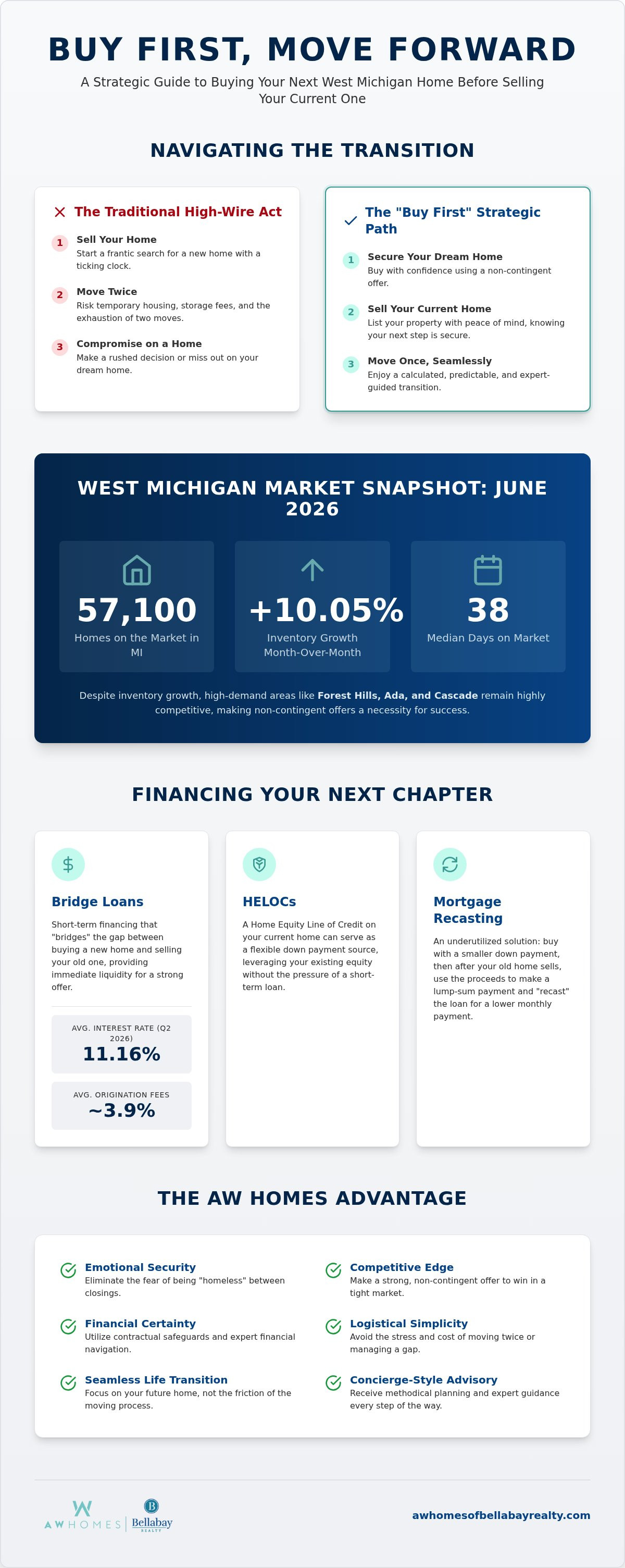
In the 2026 Michigan real estate landscape, the buy-first strategy has evolved from a luxury to a logistical necessity. It is a methodical approach where you identify and secure your next residence before listing your current property. This sequence provides a crucial buffer; it eliminates the frantic search for a temporary rental and prevents the exhaustion of moving twice. For many, this is the only path that offers true emotional security, localized reliability, and a seamless transition.
While this path offers peace of mind, it requires a strategic advisor to navigate two primary hurdles. First, your Debt-to-Income (DTI) ratio must accommodate the temporary weight of two mortgages. Second, you must have a plan to liquidate equity from your current home to fund the new down payment. Understanding the available options for buying a house before selling Michigan real estate is essential for maintaining your financial equilibrium during this gap period. It moves the conversation away from chance and toward expert navigation.
The 2026 Market Context in Grand Rapids
As of June 2026, housing inventory across Michigan reached 57,100 homes, representing a 10.05% increase month-over-month. Despite this growth, the market in high-demand pockets like Forest Hills, Ada, and Cascade remains remarkably tight. With a median of 38 days on market, the most desirable properties often disappear before a contingent buyer can even schedule a showing. In these competitive neighborhoods, waiting to sell your current home before making an offer is a risky gamble. Success requires speed, precision, and the strength of a non-contingent offer to secure a winning position.
Lifestyle Milestones: Moving Up vs. Downsizing
Financing Your Next Chapter: Creative Capital Solutions
Securing your next home in West Michigan requires more than just a vision; it demands a sophisticated financial strategy. While the prospect of managing two properties might seem daunting, the modern lending environment offers several paths to achieve stability, speed, and strategic advantage. These tools allow you to act decisively when a rare opportunity arises in Ada or Cascade, ensuring you don't lose your dream home to a faster bidder. A Bridge Loan is a short-term gap financing tool designed to cover the period between buying a new property and selling an existing one.
For military families or those looking to build a new residence as part of their move, specialized lenders like Valor Home Mortgage provide tailored VA construction and purchase loans that can simplify the financing of your next chapter.
Working with localized lenders who understand the Kent County market is a distinct advantage. These professionals provide specialized transition products that generalist banks often overlook. By balancing short-term costs against the long-term security of your preferred neighborhood, you can move forward with confidence. If you're ready to explore how these strategies apply to your specific situation, a strategic advisor can help you map out the most efficient path.
Bridge Loans and HELOCs: Accessing Your Equity
Bridge loans are a primary engine for move-up buyers. In the second quarter of 2026, Michigan bridge loans saw interest rates averaging 11.16% with origination fees around 3.9%. While these rates are higher than standard mortgages, they provide the immediate liquidity needed to make a non-contingent offer. Alternatively, a Home Equity Line of Credit (HELOC) on your current residence can serve as a flexible down payment source. This allows you to leverage your existing equity without the pressure of a high-interest short-term loan, provided you have sufficient equity and meet DTI requirements.
Mortgage Recasting: The Hidden Gem for Move-Up Buyers
Mortgage recasting is an elegant, often underutilized solution for those exploring options for buying a house before selling Michigan properties. In this scenario, you purchase your new home with a smaller down payment and a higher monthly obligation. Once your previous home sells, you apply a large lump sum toward the new mortgage principal. The lender then re-calculates your monthly payments based on the lower balance. This is significantly more affordable than refinancing because you retain your original interest rate and avoid the closing costs associated with a new loan.
Alternative Sources: 401(k) Loans and Gift Funds
Beyond traditional debt, some homeowners utilize retirement accounts for short-term liquidity. Borrowing from a 401(k) can provide a quick influx of cash for a down payment, though it's vital to understand the repayment timelines and potential tax implications if the loan isn't settled quickly. Family gift funds also remain a powerful tool in competitive bidding wars. In high-demand areas like Forest Hills, having cash on hand can be the deciding factor that secures a property before it ever hits the open market.
Contractual Safeguards: Contingencies and Michigan Law
The Michigan Purchase Agreement serves as the strategic foundation for your personal evolution. In a 2026 market where the sale-to-list price ratio consistently hits 100%, the contract is the tool that balances your need for security with the seller's demand for certainty. When exploring options for buying a house before selling Michigan properties, the structure of your offer is just as vital as the dollar amount. A winning offer is built on a tripartite of essential elements: aggressive pricing, flexible terms, and precise timing. By aligning these three pillars, you transform a complex transaction into a seamless transition.
Negotiating a contingent offer in a high-demand area like Forest Hills or Cascade requires a sophisticated touch. You aren't just asking for a favor; you're proposing a partnership. By presenting a pre-approved financial plan alongside your offer, you demonstrate that your intent is backed by expert navigation. This methodical approach moves the conversation away from risk and toward a shared, successful closing. It ensures that no detail is left to chance while you secure your next chapter.
The Hubbard Clause: A Michigan Real Estate Staple
The Hubbard Clause is a specialized addendum that allows you to make an offer contingent on the sale of your current home while the seller keeps their property on the market. It includes a "Right of First Refusal," which means if the seller receives another acceptable offer, you have a specific window, typically 48 to 72 hours, to either remove your contingency or step aside. In competitive enclaves like Ada or East Grand Rapids, this clause provides a vital safety net. It protects your earnest money while giving you the first opportunity to finalize your purchase, providing the localized reliability you need during a high-stakes move.
Non-Contingent Offers with 'Safety Nets'
If a Hubbard Clause isn't feasible in a bidding war, you can utilize other contractual mechanisms to manage the "gap" period. These include:
- Sale-Leaseback Agreements: Also known as post-closing occupancy, this allows you to sell your current home but remain as a tenant for a set period, providing the liquidity for your new purchase without a rushed move.
- Kick-Out Clauses: These provisions allow sellers to accept your contingent offer while continuing to show the home, ensuring they aren't "stuck" if your current home takes longer to sell.
- Extended Timelines: Negotiating longer inspection or appraisal periods can help sync the timelines of both transactions, reducing the anxiety of moving twice.
These intentional tools prioritize your long-term well-being. They provide a structured, rhythmic path toward your new home, ensuring that your transition is handled with the composure and competence you deserve.
Logistics and Timing: A Seamless Move-In Strategy
Mapping the journey from the first showing to the final box requires a level of intentionality that generalist agents often overlook. While a simultaneous closing is the ideal, the reality of Michigan real estate often involves a 24-hour gap between your sale and your purchase. This brief window doesn't have to be a source of anxiety; it's simply a logistical step that we manage with methodical precision. Post-Closing Occupancy is a tool for stress-free packing that allows you to remain in your sold home for a specified period after the title has transferred.
Minimizing the disruption of professional staging and photography is essential for maintaining your daily rhythm. By choosing the right options for buying a house before selling Michigan properties, you gain the freedom to prepare your current home for the market without living in a constant state of "showing ready" chaos. If you're ready to organize your move with a transition specialist, we can create a custom roadmap for your specific needs.
Rent-Back Agreements: Buying Time
A rent-back, or seller occupancy agreement, allows you to close on your current home and receive your equity while remaining in the property as a temporary tenant. In the 2026 Michigan market, daily rates for these agreements typically mirror the new buyer’s daily mortgage cost. It's vital to handle the insurance and liability of staying in a home you no longer own by securing a renter’s policy. This arrangement provides the breathing room to move into your new Forest Hills or Ada residence on your own terms, avoiding a rushed, one-day transition.
The Concierge Timeline: Synchronizing Two Sales
Synchronizing two transactions requires a week-by-week roadmap that aligns your listing date with your new home’s closing. We recommend utilizing storage pods early in the process to declutter, simplify, and prepare for the eventual move. This also prepares your home for home photography in Grand Rapids, which is a critical perk for speeding up your sale. If a gap night occurs, temporary housing or a local hotel stay can turn a logistical hurdle into a celebratory pause before you enter your next chapter.
The AW Homes Advantage: Strategic Transition Management
A generalist agent often lacks the methodical focus required for a multi-layered property transaction. When you are evaluating the various options for buying a house before selling Michigan real estate, you need more than a salesperson; you need a strategic advisor. Our approach combines professional authority, empathetic reassurance, and localized reliability to ensure your move is handled with precision. We view your relocation as a significant personal milestone, not just a financial closing. This perspective allows us to prioritize your emotional security throughout the entire process.
The Angela Worth approach is built on a foundation of expert navigation and planning. We understand that move-up buyers in Kent County face unique pressures, from competitive bidding in Ada to inventory shortages in Forest Hills. By positioning ourselves as high-level consultants, we move the conversation away from chance and toward a structured, rhythmic journey. Our goal is to provide a seamless transition that respects your timeline, your finances, and your long-term well-being. We don't just find you a house; we manage your personal evolution into a new chapter of life.
A Concierge Experience in West Michigan
We manage the transaction pipeline with a no-detail-left-to-chance philosophy. This organized process ensures that every logistical hurdle in Forest Hills, Ada, or Caledonia is cleared before it becomes a source of stress. By providing neighborhood-specific insights, we ensure your current home is priced to attract the right buyers quickly. We also integrate professional home staging tips to maximize your final sale price. This methodical preparation ensures that your home stands out in the 2026 market, allowing you to unlock your equity with confidence and speed.
Your Next Chapter Starts Here
Your transition deserves a partner who understands the logistical nuances of your specific life stage. Whether you are expanding for a growing family or curating a simpler, more intentional lifestyle, we provide the steady guidance you need. We invite you to schedule your West Michigan transition strategy session with AW Homes. During this consultation, we will evaluate your unique financial situation, map out your synchronized timeline, and identify the best options for buying a house before selling Michigan property. Let's work together to create a future that feels both high-end and accessible. Your next chapter is waiting, and we are here to ensure you arrive with total peace of mind.
Your Future in West Michigan Begins Today
Your future in West Michigan deserves a foundation of certainty and ease. By mastering the financial engines and contractual safeguards we've discussed, you can secure your next residence in Forest Hills or Ada without the pressure of a forced sale. Understanding the strategic options for buying a house before selling Michigan property allows you to move with intention, precision, and localized authority. We view this transition as a significant personal milestone, and our concierge-style move management ensures that every detail is handled with composure.
Whether you are a move-up buyer or a downsizer, we serve as your expert advisor for complex life transitions. We invite you to start your seamless home transition with AW Homes of Bellabay Realty. Our methodical approach provides the emotional security you need to focus on what matters most. We believe that your home should be a place of evolution and peace, not a source of logistical friction. Your next chapter is waiting, and we are here to help you turn the page with total confidence.
Frequently Asked Questions
Can I really buy a new house before selling my old one in Michigan's 2026 market?
Yes, buying before selling is a viable strategy in the 2026 Michigan market, particularly for those who value emotional security and a seamless transition. With inventory levels rising to 57,100 homes as of June 2026, buyers have more choices than in previous years. However, in high-demand pockets like Forest Hills, houses still sell in about 38 days. Success requires a methodical plan that balances your current equity with your new purchase requirements.
What is a bridge loan, and how much does it typically cost in West Michigan?
A bridge loan is a short-term financing tool used to "bridge" the gap between your two homes. In the second quarter of 2026, Michigan bridge loans averaged an 11.16% interest rate with origination fees around 3.9%. While these costs are higher than traditional mortgages, they provide the immediate liquidity needed to make a strong, non-contingent offer. This capital ensures you don't lose the perfect Ada or Cascade property while waiting for a buyer.
Will a Michigan seller accept an offer that is contingent on me selling my home?
Michigan sellers will accept contingent offers, but they often require additional incentives to offset the perceived risk. In a balanced market where the sale-to-list ratio is 100%, your offer must stand out through price, flexible timing, and professional presentation. We help you structure these deals by providing sellers with proof that your current home is market-ready. This approach builds the trust and localized reliability necessary to win in competitive neighborhoods.
What is a Hubbard Clause, and how does it work in a purchase agreement?
The Hubbard Clause is a unique Michigan addendum that allows you to secure a home while keeping your current property's sale as a condition. The seller continues to market their home, but if another offer arrives, you have a 48 to 72 hour window to remove the contingency. It's a strategic tool that offers a safety net for your earnest money. This clause provides the structure needed for a composed and organized move.
How do I handle a down payment if my equity is still tied up in my current house?
You can access your equity through a bridge loan, a Home Equity Line of Credit (HELOC), or even a 401(k) loan. These are the most effective options for buying a house before selling Michigan property when your cash is tied up in your current residence. Each method has specific tax and interest implications that require careful planning. We evaluate your financial situation to determine which tool provides the most certainty and the least risk.
Is it better to sell first and rent, or buy first and carry two mortgages?
Selling first avoids the weight of two mortgages but often results in the anxiety of moving twice and paying for storage. Buying first allows for a curated journey directly into your next chapter, preserving your daily rhythm and lifestyle. If your debt-to-income ratio supports the transition, buying first offers superior emotional security. It transforms a high-stakes transaction into a positive development in your life story without the disruption of temporary housing.
What happens if my current home takes longer to sell than expected?
If your home takes longer to sell than the average 38 days, we implement a strategic refinement of your marketing and pricing. Modern options for buying a house before selling Michigan often include interest-only periods on bridge loans to keep monthly costs manageable during the wait. We also explore rent-back agreements or lease-purchase options to maintain your financial stability. This methodical oversight ensures that no detail is left to chance during an extended transition period.
How can a buyers agent in Grand Rapids help me coordinate these timelines?
A dedicated buyers agent in Grand Rapids acts as your strategic advisor and transition expert. We provide concierge-style service, managing every logistical detail from professional staging to synchronized closing dates. By coordinating with local lenders and inspectors, we ensure your move to Ada or Caledonia is seamless and predictable. Our focus is on your long-term well-being, moving the process away from chance and toward a successful, organized personal evolution.


