
What if the most intimidating part of your real estate transition wasn't the packing or the paperwork, but a single number that validates your financial future? For many sellers in Grand Rapids and across the Lakeshore, the appraisal feels like a final, unpredictable hurdle that could derail a hard-earned deal. It's natural to feel protective of your investment. You want to ensure your home's value is recognized, your equity is protected, and your next chapter remains secure.
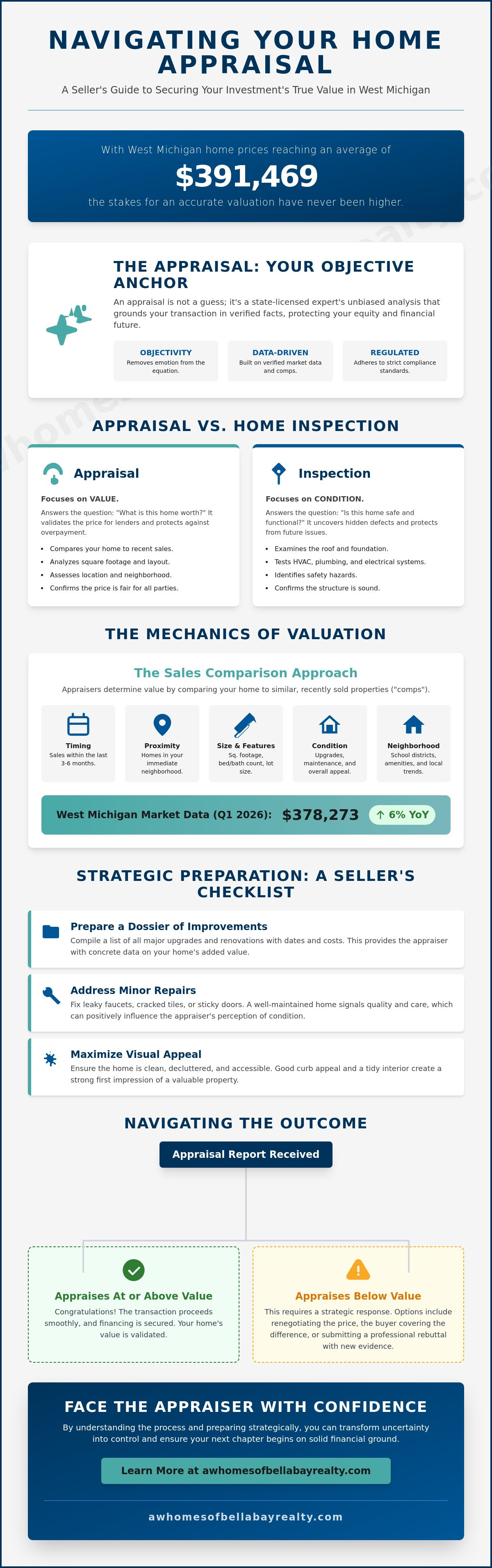
Understanding the home appraisal process is the key to replacing this uncertainty with a sense of strategic control. We'll show you how to navigate this phase with professional insight, helping you distinguish between market trends and appraised values while maximizing your property's potential. With West Michigan home prices reaching an average of $391,469 in March 2026, the stakes have never been higher for your return on investment. This guide provides a clear roadmap through current valuation standards, essential preparation steps, and the professional logic appraisers use to anchor your sale in reality. You will finish this article ready to face the appraiser with confidence, intentionality, and peace of mind.
Key Takeaways
- View the appraisal as a professional anchor grounded in objectivity, data-driven methodology, and regulatory compliance.
- Master your transition by understanding the home appraisal process and how the Sales Comparison Approach uses local timing and proximity to determine worth.
- Distinguish between emotional market value and technical valuation to ensure your real estate sale remains grounded in professional insight.
- Take a proactive stance by preparing a dossier of improvements and addressing minor repairs that maximize your property’s visual appeal.
- Navigate the final steps with confidence, whether your property appraises at value or requires a strategic rebuttal to secure the deal.
Defining the Home Appraisal: A Professional Anchor in Your Real Estate Journey
At its heart, a property valuation is an objective anchor. It provides the stability needed for high-stakes decisions by grounding the transaction in verified facts. A Real estate appraisal represents a state-licensed expert's unbiased analysis of what a home is worth in the current market. This isn't a casual estimate or a neighbor's guess. It's a formal report built on three specific pillars: meticulous objectivity, data-driven methodology, and strict regulatory compliance. By removing emotion from the equation, the process ensures that your transition is grounded in financial reality rather than speculation.
Understanding the home appraisal process is essential because this report serves as the ultimate safeguard for your equity. While it occurs within the broader context of the home closing process in Michigan, it stands as a unique milestone. It protects your future by validating that the price agreed upon in the contract aligns with actual market data. Without this professional verification, both buyers and sellers risk entering a transaction that lacks a solid financial foundation. It acts as a shield against overpayment and a confirmation of value for all parties involved.
The Core Purpose: Protection and Validation
Mortgage lenders require an appraisal to validate the purchase price before they commit funds. This step is critical for calculating the Loan-to-Value (LTV) ratio, which determines the risk level of your financing. If the appraisal doesn't support the sale price, it can trigger a renegotiation or require a larger down payment. In a fast-moving West Michigan market, this validation ensures your investment remains sound, sustainable, and secure. It aligns your personal goals with the economic reality of the neighborhood, ensuring that your next life stage begins on firm financial footing.
Appraisal vs. Home Inspection: Clearing the Confusion
Many homeowners confuse these two steps, yet they serve entirely different purposes. An appraiser focuses on value; an inspector focuses on function, safety, and condition. While the appraiser looks at comparable sales and square footage, the inspector examines the furnace, the roof, and the foundation. You need both reports to ensure a seamless property transition. One confirms the price is fair, while the other confirms the structure is sound. Together, they offer a comprehensive view of your home, protecting your wallet from overvaluation and your peace of mind from hidden defects.
The Mechanics of Valuation: How Appraisers Determine Your Home’s Worth
Appraisers don't rely on guesswork. They follow a disciplined, evidence-based path. The Sales Comparison Approach remains the gold standard for residential valuation. This method compares your property to similar homes that sold recently in your specific corner of West Michigan. In 2026, the industry has embraced hybrid appraisals. These reports blend automated data with physical inspections to create a more comprehensive view. This evolution makes understanding the home appraisal process even more vital for sellers who want to ensure their property's unique charm in Ada or East Grand Rapids is captured accurately.
The appraiser acts as a neutral consultant. They look past the staging and the paint colors to find the underlying value. They use a tripartite focus on location, condition, and utility. By grouping these elements together, they provide a valuation that lenders can trust. This methodical nature of the work moves the conversation away from chance and toward expert planning. It ensures that your life transition is anchored in a number that the market can support.
The Power of Comparable Sales (Comps)
Appraisers prioritize proximity and timing. They typically select homes sold within the last 3 to 6 months to reflect the current market reality. During Q1 2026, the average home sale price in West Michigan reached $378,273, a 6% increase from the previous year. An appraiser will look at these figures and make precise adjustments based on several factors:
- Total square footage and finished basement space.
- Bedroom and bathroom counts.
- Lot size and landscaping.
- The Neighborhood Effect, such as the premium associated with Forest Hills school districts.
With only 0.9 months of available housing inventory in March 2026, every comp carries significant weight. The appraiser must decide if a high sale price was a result of a bidding war or if it truly reflects the property's intrinsic value. This is where localized expertise becomes your greatest asset.
Physical Attributes and Modern Upgrades
Your home's effective age often carries more weight than its chronological age. A well-maintained 1950s ranch in East Grand Rapids with a new roof and updated mechanicals might have an effective age of only 10 years. Appraisers evaluate structural integrity and curb appeal to determine this number. High-impact renovations, like kitchen modernizations or energy-efficient windows, provide a notable appraisal lift.
If you're curious about how your specific updates might influence your valuation, our residential listing services can help you position your home strategically before the appraiser arrives. By focusing on intentionality in your home prep, you ensure that the final number reflects your true investment and supports a stress-free transition.
Appraisal vs. Market Value: Navigating the Discrepancy
Market value and appraised value are often treated as synonyms, but they represent two distinct perspectives on your property's worth. Market value is a fluid number. It's driven by buyer desire, emotional connection, and the current competitive climate. In contrast, an appraisal is a technical valuation anchored in historical evidence and regulatory standards. Understanding the home appraisal process requires acknowledging that while a buyer might fall in love with your sun-drenched kitchen in Cascade, an appraiser must find the cold, hard data to justify that affection. This discrepancy often creates tension during a sale, especially when the technical data hasn't caught up to the emotional momentum of the market.
This gap is particularly visible in our current West Michigan landscape. In March 2026, the average sales price reached $391,469, reflecting a market where demand far outstrips supply. When buyers compete for limited inventory, they often offer prices that exceed recent sales data. Our role as strategic advisors is to help you align these expectations. We focus on intentionality, personalization, and expert insight to ensure your transition isn't stalled by a valuation that misses the mark. It's about moving toward expert navigation and away from the stress of the unknown.
Why Appraisals May Lag Behind the Market
Appraisers rely on past sales to predict current value, a method that can create a 'Market Lag' during periods of rapid growth. In the fast-evolving 2026 environment, where inventory sat at just 0.9 months in March, prices can rise faster than the data can track. Multiple-offer situations frequently drive contract prices above the benchmarks set by homes sold just months ago. This creates the 'Appraisal Gap,' a space where the buyer's promise exceeds the lender's valuation. Navigating this requires a methodical plan, clear communication, and a deep understanding of how to bridge the financial distance between a contract and a closing.
The Role of Neighborhood Authority
Data alone cannot capture the soul of a community. Local expertise in areas like Caledonia or Cascade is vital because these neighborhoods possess nuances that a spreadsheet might overlook. A neighborhood authority understands how a specific school district boundary or a proximity to the Thornapple River influences desirability. We bridge the gap between technical reports and the lived experience of 'home.' By identifying value markers that automated data misses, we provide the professional reassurance needed to secure your financial legacy. This localized reliability ensures that every detail of your property's evolution is accounted for and respected.
Strategic Preparation: Setting the Stage for a Successful Evaluation
Preparation is not about hiding flaws; it is about illuminating value. While the appraiser remains a neutral third party, providing them with a clear, data-backed narrative of your home’s evolution can significantly influence the final report. Understanding the home appraisal process involves more than just opening the front door. It requires an active role in documenting the intentionality behind your renovations. By creating a professional environment and a comprehensive "Home Highlights" dossier, you ensure that no detail of your investment is left to chance. Prepare the data. Polish the presentation. Protect the outcome.
Accessibility is another cornerstone of a smooth visit. Appraisers are required to view all mechanical systems and major areas of the home, including the attic, basement, and garage. Ensuring these spaces are clear and well-lit demonstrates a level of care that reinforces the property's effective age. Creating a calm, professional atmosphere allows the appraiser to focus on the technical task at hand without distraction. This methodical approach transforms the appraisal from a stressful hurdle into a validated milestone in your life transition.
The Seller’s Preparation Checklist
A successful evaluation begins with organized documentation. Your "Home Highlights" dossier should serve as a professional consultant’s guide to your property. Include the following essential elements to provide the appraiser with necessary context:
- A comprehensive list of recent upgrades, such as a new HVAC system installed in 2025 or a kitchen remodel completed in early 2026.
- Verification that all safety features, including smoke detectors and carbon monoxide alarms, are functional and meet current standards.
- A concise, single-sentence value proposition that defines what makes your property unique in the West Michigan market.
Providing this information upfront reduces the risk of an appraiser missing a hidden upgrade that adds significant value. It anchors the conversation in facts and demonstrates your commitment to a transparent transaction.
The Agent’s Role in the Appraisal Visit
A concierge-style agent acts as your property’s strongest advocate during the valuation phase. They provide the appraiser with high-quality comparable sales that reflect the most recent market shifts in Grand Rapids or the Lakeshore. Often, these "comps" include nuances that are not immediately visible in a standard MLS listing, such as a premium lot position or high-end interior finishes. By communicating these details directly to the appraiser, your agent helps bridge the gap between a spreadsheet and the reality of your home’s worth. If you are ready to position your home for maximum ROI, explore our residential listing services to ensure your transition is managed with expert precision and care.
Navigating the Outcome: Managing Results and Next Steps
The arrival of the appraisal report is the moment where technical data meets your personal ambition. If the valuation matches or exceeds the contract price, your path to the closing table is clear. However, if the number falls short, it's not a signal to panic but an invitation to strategize. Understanding the home appraisal process means recognizing that a 'low appraisal' is a solvable challenge rather than a definitive deal-breaker. By approaching these results with professional composure, you can protect your equity and keep your life transition on track. Analyze the data. Adjust the terms. Anchor the sale.
Challenging an inaccurate report requires a surgical, evidence-based approach. We review the appraisal for factual oversights, such as incorrect square footage, missed bedroom counts, or overlooked mechanical upgrades. If the data is flawed, we provide a structured rebuttal backed by superior comparable sales from the immediate West Michigan area. This isn't about being confrontational; it's about ensuring the valuation reflects the true reality of your property. Reframing the result as a strategic pivot point allows you to make an informed, confident decision about your financial future.
Handling the 'Low Appraisal' with Composure
When a gap exists between the sale price and the appraised value, three primary paths emerge for the buyer and seller. The buyer can increase their down payment to cover the difference, the seller can adjust the price to match the valuation, or both parties can meet in the middle. During these negotiations, it's vital to factor in your closing costs for seller in MI to understand how a price adjustment impacts your final net proceeds. Keeping your focus on the bottom line ensures your decision is grounded in financial logic rather than the inherent stress of the transaction.
- Review the report for errors in property characteristics or lot size.
- Evaluate the 'comps' used to see if they truly reflect your neighborhood's nuances.
- Collaborate on a solution that preserves the deal while respecting the lender's limits.
Moving Forward with AW Homes
A successful real estate transition requires a partner who manages the complexity so you can focus on your personal evolution. From the initial valuation to the final signature, we provide the localized reliability and expert insight needed to navigate these high-stakes milestones. Whether you are utilizing our residential listing services to sell a family home or seeking buyer agency services for your next move, our focus remains on your long-term well-being. We move beyond simple salesmanship to act as your high-level consultant, ensuring every detail is methodical and every process is seamless. Your next chapter is waiting, and we're here to ensure it begins with total emotional security.
Securing Your Financial Legacy in West Michigan
The real estate journey is more than a simple transaction; it's a significant personal milestone that deserves a methodical and strategic approach. By understanding the home appraisal process, you've moved from the uncertainty of chance to the clarity of expert navigation. You now recognize that a professional valuation acts as a stabilizing anchor. It validates your property’s worth. It protects your financial interests. It secures your long-term equity. Whether you are preparing a detailed dossier of upgrades or navigating a complex valuation gap, your focus remains on a stress-free transition to your next life stage.
Success in the West Michigan market requires a partner who combines concierge-style real estate expertise with deep-rooted neighborhood authority. We prioritize your emotional and financial security, ensuring no detail is left to chance as you evolve into your next chapter. If you are ready to move forward with confidence and professional insight, we invite you to Discover the True Value of Your West Michigan Home with Angela Worth. Your future is built on intentionality, and we're here to ensure your transition is as rewarding as the destination itself.
Frequently Asked Questions
How long does a home appraisal usually take in West Michigan?
The physical inspection typically takes between 30 and 60 minutes. This is only one part of the journey. The appraiser then spends several days analyzing local data and recent sales. Most homeowners receive the final report within 5 to 10 business days. This methodical pace ensures that every detail of your West Michigan property is accounted for accurately.
Who pays for the home appraisal, and how much does it cost?
The home buyer is usually responsible for the appraisal fee, which is paid at the time of the inspection or included in closing costs. National averages for a standard residential appraisal typically range from $350 to $550. FHA appraisals often cost between $400 and $700, while VA appraisals can range from $600 to $800. These professional fees ensure that the lender's investment is grounded in objective data.
Can a seller be present during the home appraisal inspection?
Sellers are permitted to be present, but giving the appraiser space is often more productive. You should be available to answer specific questions about recent upgrades or mechanical systems. However, hovering can create unnecessary tension. It's best to provide a dossier of improvements and then step aside. This allows the professional to conduct their evaluation with focus and intentionality.
What are the most common things that hurt a home appraisal?
Deferred maintenance and outdated major systems are the primary factors that lower a valuation. Issues like an aging roof, a failing furnace, or structural concerns can lead to significant deductions. Understanding the home appraisal process allows you to prioritize these functional repairs over purely cosmetic updates. By addressing these items before the inspection, you protect your property's effective age and ensure a higher level of financial security.
Does a clean house really help a home appraisal score higher?
A clean house doesn't technically increase the dollar value, but it suggests a well-maintained property. Clutter can make it difficult for the appraiser to access mechanical systems or measure rooms accurately. A tidy environment allows the appraiser to see the home's true condition without distraction. While the appraiser looks past the mess, a polished home often reflects a higher "effective age" because it shows pride of ownership.
What is the difference between an appraisal and a tax assessment?
An appraisal determines the current market value for financing, while a tax assessment is used by local municipalities to calculate property taxes. These two numbers rarely match. For 2026, the inflation cap for taxable values in Michigan is limited to 2.7%. Because market values in West Michigan have risen faster than this cap, your appraised value will likely be much higher than your assessed value. This distinction is a core part of understanding the home appraisal process.
How long is a home appraisal report valid for in Michigan?
Most appraisal reports are considered valid for 90 to 120 days. In a rapidly evolving market like West Michigan, lenders may require a more recent report if the data becomes stale. If your closing is delayed significantly, you might need an appraisal update. This ensures the valuation still reflects the current inventory levels and recent sales in your specific neighborhood.
Can I get a second appraisal if I am unhappy with the first one?
Obtaining a second appraisal is rare because the lender, not the homeowner, owns the report. You cannot simply order a new one because you dislike the number. However, you can request a Reconsideration of Value if there are factual errors or if relevant comparable sales were missed. This strategic approach requires professional guidance to ensure your rebuttal is grounded in data rather than emotion.


