

What if the final figure on your settlement statement wasn't a source of anxiety, but a calculated milestone of your financial success? For many homeowners in Grand Rapids and across the state, the uncertainty surrounding closing costs for seller in MI often overshadows the excitement of a new beginning. You've invested years of care into your property, and it's natural to feel protective of the equity you've built during this important life transition.
We view your home sale as a significant evolution that deserves expert navigation, localized insight, and strategic planning. This guide provides a clear, professional breakdown of the 2026 financial landscape to ensure your transition is handled with absolute precision. You'll gain a methodical understanding of the $8.60 per $1,000 combined transfer tax, the complexities of Michigan's property tax proration, and the latest shifts in negotiable commission structures. We will help you calculate a reliable net proceeds estimate, providing the emotional security and financial clarity you need to step into your next chapter with confidence.
Key Takeaways
- Master the "Net Proceeds" formula to move beyond the sale price and understand the exact amount you will receive at the closing table.
- Learn to navigate the specific closing costs for seller in MI, including the statutory transfer taxes and negotiable commissions that impact your final bottom line.
- Understand Michigan’s unique property tax proration system to ensure you receive proper credits for taxes paid in advance or arrears based on your closing date.
- Follow a methodical, two-step approach to calculating your equity, starting with a realistic market analysis and subtracting all secondary liens and obligations.
- Discover how a concierge-style listing approach provides the expert guidance, market positioning, and localized reliability needed for a seamless transition.
Understanding Closing Costs for Seller in MI: The 'Net Proceeds' Concept
The sale of a home is more than a financial event; it's a significant life transition that requires clarity, precision, and peace of mind. While the offer price on a contract often captures the headlines, the net proceeds represent the actual reality of your financial future. Understanding the closing costs for seller in MI is the first step in moving from a general estimate to a concrete plan. These costs are the cumulative fees, taxes, and adjustments settled at the closing table. They represent the final bridge between your current property and your next chapter.
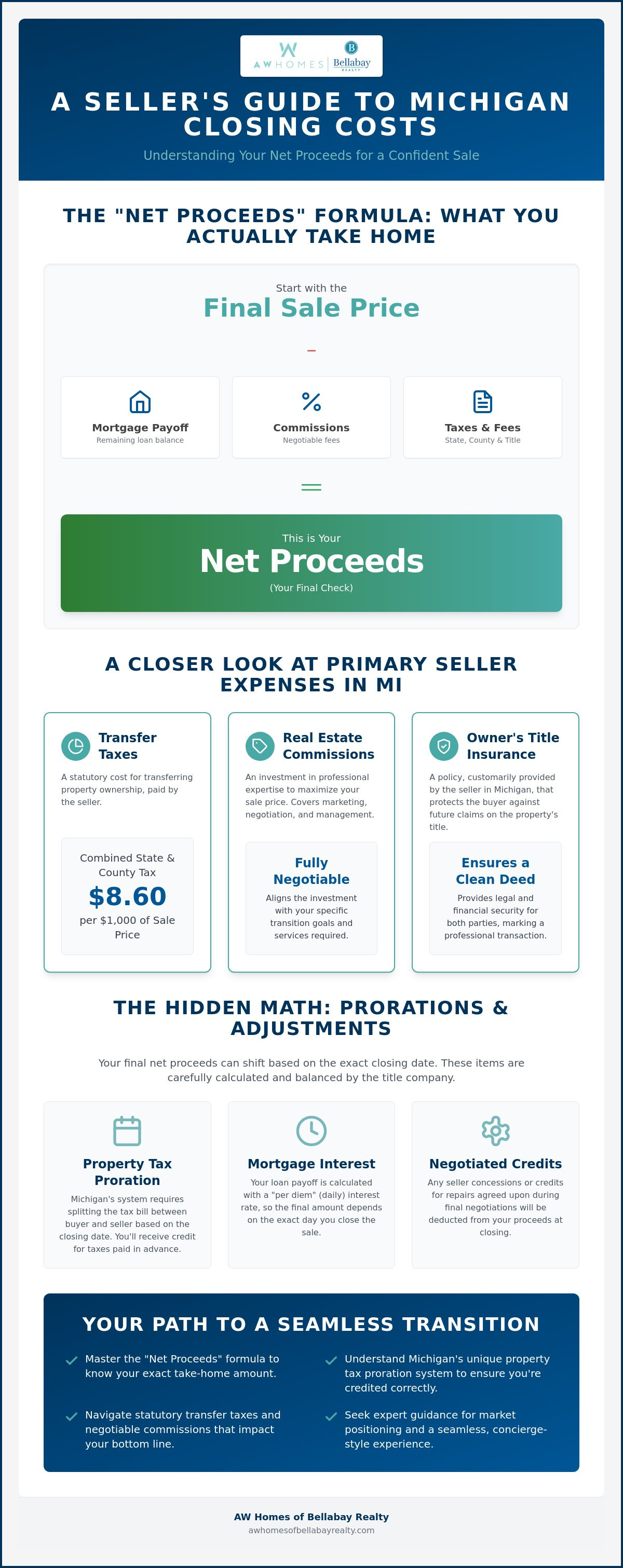
The "Net Proceeds" formula is the only calculation that truly matters: Final Sale Price - (Mortgage Payoff + Commissions + Transfer Taxes + Title Fees + Credits) = Your Final Check. In Michigan, sellers typically bear a larger portion of these expenses than buyers. This is due to local customs where sellers provide the owner's title insurance policy and pay the state and county transfer taxes, which currently total $8.60 per $1,000 of the sale price. To protect consumers, the Real Estate Settlement Procedures Act (RESPA) mandates that these figures are disclosed clearly, ensuring you aren't blindsided by hidden fees during the final hour of your transaction.
Why Estimates Often Differ from Reality
Even the most careful initial estimates can shift as the closing date approaches. Mortgage payoffs are calculated with a daily interest per diem, meaning the exact day you sign affects your final balance. Additionally, final negotiations often result in repair credits or buyer concessions that adjust your bottom line. Throughout this process, the Title Company serves as a neutral third party, meticulously balancing the ledger to ensure every penny is accounted for correctly. This methodical oversight provides the financial security necessary for a stress-free transition.
Closing Costs as a Strategic Investment
It's helpful to view these expenses not as losses, but as strategic investments in a successful transition. For instance, real estate commissions fund the expert market positioning, professional photography, and high-level negotiation required to secure a premium sale price that often offsets the costs themselves. At AW Homes, we provide a concierge-style approach to these details for our clients in Grand Rapids, Ada, and Forest Hills. We prioritize your emotional security by managing the complexities of closing costs for seller in MI, allowing you to focus on the personal milestones of your move. Our focus remains on expertise, intentionality, and localized reliability.
The Primary Expenses: Commissions, Transfer Taxes, and Title Fees
Every successful home sale in West Michigan relies on a foundation of professional marketing, expert negotiation, and legal precision. These pillars are reflected in your primary expenses at the closing table. While it's natural to focus on the total amount, viewing these closing costs for seller in MI as strategic investments helps maintain a sense of calm and focus. Real estate commissions, for instance, are the engine that powers high-end market positioning. They cover the professional photography, digital staging, and targeted exposure required to attract the right buyers in competitive areas like Forest Hills or Ada. In the 2026 market, these commissions remain fully negotiable, allowing you to align the investment with your specific transition goals. For those exploring streamlined listing options, Congress Realty provides a range of solutions designed to simplify the selling process.
Beyond commissions, the most significant statutory costs involve transfer taxes and title protection. Michigan law requires sellers to pay a tax for the privilege of transferring real property. This is handled at both the state and county levels. Additionally, it's customary in Michigan for the seller to provide the buyer with an Owner’s Policy of Title Insurance. This policy ensures the buyer receives a clean deed, free of unknown liens or encumbrances. Providing this protection is a standard mark of a professional transaction, offering the emotional security both parties need to finalize the deal. The Purchase & Sale of a Home guide from the State Bar of Michigan provides further context on how these legal protections serve as the backbone of a secure property transfer.
Breaking Down the Michigan Transfer Tax
Calculating your transfer tax is a methodical process based on the final sale price. For 2026, the Michigan State Transfer Tax remains at a rate of $3.75 per $500 of value. The County Transfer Tax adds another $0.55 per $500 for sellers in Kent County and surrounding municipalities. Combined, this equals $8.60 per $1,000 of the sale price. While most sellers are liable for this tax, certain exemptions exist. For example, transfers between spouses or those involving a principal residence where the State Equalized Value (SEV) hasn't increased since the time of purchase may qualify for a waiver, though rising property values in Grand Rapids make this rare today.
Title and Administrative Fees
Professional coordination is essential for an error-free closing. Title companies charge a settlement fee, typically ranging from $400 to $1,000, to manage the complex paperwork and fund distribution. You'll also see smaller, functional costs such as a $30 recording fee for the mortgage discharge and fees for the initial title search. These details ensure that no stone is left unturned. If you're preparing for a move in Caledonia or Cascade, our team can provide a detailed Seller Net Sheet to help you visualize these closing costs for seller in MI with complete accuracy.
Prorations and Adjustments: The Hidden Math of Michigan Closing Day
Beyond the primary taxes and commissions, the final balance sheet includes a series of time-sensitive adjustments known as prorations. These calculations ensure that both buyer and seller pay only for the time they actually owned the property. For those managing the closing costs for seller in MI, these adjustments can feel like hidden math, but they're essential for a fair and legal transfer. This process involves balancing property taxes, association dues, and utility obligations to ensure no loose ends remain. It's a methodical approach that prioritizes your financial clarity and emotional security during the final hours of your sale.
Property tax prorations are the most significant variable in this category. Michigan has a unique system where taxes are often paid in "advance" or "arrears," depending on local custom and the specific language in your purchase agreement. If you've already paid your summer tax bill for the full year ahead, you'll likely receive a credit back from the buyer for the days they'll own the home. Conversely, if taxes are billed in arrears, you'll owe a credit to the buyer. This ensures that every penny is accounted for with precision. Similar logic applies to Homeowner Association (HOA) dues in communities across Ada and Forest Hills, where monthly or annual fees must be split to the exact day of the deed transfer. For sellers who also hold investment properties in the Sunbelt, My Florida HOA Manager offers the professional expertise required to manage these complex association transitions seamlessly.
The Michigan Tax Calendar
Success in the home closing process in Michigan requires a precise review of the local tax calendar. Michigan municipalities typically issue two primary bills: the Summer bill on July 1st and the Winter bill on December 1st. Because your closing date rarely aligns perfectly with these dates, the title company calculates a daily rate to divide the responsibility. Understanding how December 31st acts as the official "tax day" helps clarify the status of your liens. This methodical review prevents surprises and ensures your transition is handled with localized reliability and expert insight.
Seller Credits and Concessions
While taxes are statutory, credits and concessions are often the result of strategic negotiation. You might choose to offer a repair credit rather than completing physical work before the move, allowing for a faster and more seamless transition. In some cases, you may also agree to cover a portion of the buyer's closing fees to secure a stronger overall offer. These decisions directly impact the closing costs for seller in MI and your final net proceeds. We view these concessions as tools for expert navigation, helping you maintain control over your timeline. Every credit is a deliberate choice made to prioritize your long-term well-being and a successful evolution to your next chapter.
Calculating Your Net Proceeds: A Strategic Approach
Moving beyond generalities requires a structured approach to your finances. We believe that clarity is the foundation of confidence. To understand your closing costs for seller in MI, we follow a proven, five-step sequence that moves from market research to the final bottom line. This methodical process ensures that no detail is left to chance, providing the emotional security you need to plan your next chapter. By following this path, you transform a complex transaction into a manageable and predictable journey.
- Step 1: Establish a realistic sale price. This begins with a comprehensive Comparative Market Analysis (CMA) tailored to the specific nuances of the West Michigan market.
- Step 2: Determine your actual liability. Subtract your current mortgage balance, any secondary liens, or outstanding Home Equity Lines of Credit (HELOCs).
- Step 3: Estimate the statutory fees. Apply the Michigan transfer tax rates and customary title insurance costs discussed in previous sections.
- Step 4: Factor in the 'Big Three' expenses. Combine commissions, taxes, and title fees, then add a 1% buffer for unforeseen prorations or minor adjustments.
- Step 5: Finalize the vision. Review a professional Seller’s Net Sheet with your listing agent to see your anticipated walk-away figure.
The Value of the Seller’s Net Sheet
Generic online calculators often fail because they lack localized data and real-time market context. They can't account for the specific tax cycles in Grand Rapids or the nuanced negotiation trends currently shaping West Michigan. Our team uses the Seller’s Net Sheet as a living document to help you plan your personal evolution. We update this sheet after the inspection period to reflect any new negotiation terms, ensuring your financial expectations remain grounded in reality. If you're ready to see your true numbers, you can request a personalized net proceeds estimate from our consultants today.
Budgeting for the 'Pre-Closing' Costs
A successful sale often requires minor upfront investments that drive a higher final sale price. Staging, professional deep cleaning, and small cosmetic repairs are strategic choices that maximize your equity. Some West Michigan municipalities also require specific city inspections or compliance certificates before a deed can be transferred. These "pre-closing" costs are just as vital as the closing costs for seller in MI because they protect your timeline. For a deeper look at preparing your property for the market, see our strategic guide to selling in Forest Hills. We focus on these details so you can focus on the milestones that matter most.
Navigating Your West Michigan Sale with Confidence
Selling your home is a significant personal milestone that represents a positive evolution in your life story. While the technical details of closing costs for seller in MI require precision, the ultimate goal is your emotional security and financial readiness for what comes next. Our concierge-style approach is designed to mitigate the inherent stress of high-stakes transactions. We handle the logistical heavy lifting, the complex tax prorations, and the professional coordination required for a seamless deed transfer. This methodical focus allows you to remain present for the milestones that matter most as you transition from your current property to your next investment.
Localized reliability is the cornerstone of an accurate budget. Real estate trends in Grand Rapids, Ada, and Caledonia often move independently of national averages, making neighborhood-specific expertise essential. Whether you are navigating the unique homeowner association requirements in Forest Hills or the specific municipal compliance codes in Cascade, we ensure no detail is left to chance. By positioning your equity strategically, we help you secure the maximum net proceeds necessary to fund your next chapter with confidence and clarity. Our process is steady, logical, and deeply invested in the long-term well-being of the families we serve.
Expert Guidance from Angela Worth
Angela Worth provides a calm, authoritative voice in the competitive West Michigan market. As a strategic advisor, she understands the logistical nuances and emotional weight of significant life stages. Her focus on move-up buyers and downsizers ensures that every listing is handled with professional integrity and expert insight. This isn't just a financial transaction; it's a curated journey toward your future. You deserve a partner who is composed, attentive, and highly competent in managing the complexities of closing costs for seller in MI.
Ready to Discover Your Home's True Value?
Planning your next move begins with a clear understanding of your current position. We invite you to request a personalized market analysis and a preliminary net proceeds sheet to see how your home’s value aligns with your long-term life goals. Our team will help you visualize the final outcome before the first showing ever takes place. We move beyond simple salesmanship to provide high-level consulting that prioritizes your peace of mind. Connect with AW Homes for a strategic listing consultation to begin your transition with an organized and methodical partner by your side.
Securing Your Financial Future and Next Chapter
Navigating the final stages of a home sale requires a shift from marketing strategy to financial precision. By mastering the "Net Proceeds" formula and understanding the unique tax prorations that define our region, you move beyond guesswork and into a position of total control. The various closing costs for seller in MI are not just deductions. They are the final investments required to ensure a clean deed transfer and a secure financial foundation for your upcoming move. Whether you're transitioning between homes in Forest Hills or downsizing in Ada, having an organized plan is the key to maintaining your peace of mind.
Establishing a secure foundation is also critical for those managing complex debt; the firm Ronald A. Davidson Attorney at Law provides the expert guidance necessary for individuals to navigate the path toward long-term financial recovery and stability.
This need for precision and planning extends to business assets as well; for medical professionals preparing for a major transition, you can check out Healthcare Biz Brokers, Inc. for expert help with healthcare business valuations and sales.
As your strategic advisor, we specialize in managing these high-stakes details through our concierge listing services. We provide the expert neighborhood insights and methodical planning necessary to turn a complex transaction into a seamless milestone of personal evolution. You don't have to face the closing table with uncertainty. Plan your transition with a professional West Michigan Net Sheet to see exactly how your equity can fuel your next great adventure. We look forward to helping you step into your future with confidence and clarity.
Common Questions About Selling Your Michigan Home
What is the largest closing cost for a seller in Michigan?
Real estate commissions are typically the largest expense at the closing table. These funds cover professional marketing, high-end photography, and expert negotiation. While statutory taxes are fixed, commissions remain negotiable and are a strategic investment in securing a premium sale price for your property. They represent the professional infrastructure required for a successful transition.
While many value this full-service investment, some sellers in other regions look for alternative ways to minimize costs; for example, you can visit Pay It Forward Realty LLC to explore how flat-fee listing models work for homeowners in Utah.
How are property taxes prorated at closing in Michigan?
Property taxes are split to the exact day of the deed transfer using a daily rate calculation. In Michigan, this involves reviewing the Summer and Winter tax bills to determine if they were paid in advance or in arrears. Your final credit or debit depends on local customs and the specific language in your purchase agreement. This methodical approach ensures you only pay for the time you actually owned the home.
Do sellers pay for the buyer's title insurance in MI?
Sellers in Michigan customarily pay for the Owner’s Policy of Title Insurance. This policy protects the buyer’s future ownership rights by ensuring the property is free of undisclosed liens or legal encumbrances. Providing this protection is a hallmark of a professional transaction. It offers the emotional security necessary for both parties to finalize the transition with confidence.
How much is the Michigan state transfer tax in 2026?
The Michigan State Transfer Tax in 2026 is $3.75 for every $500 of the home's final sale price. This statutory rate is mandatory for nearly all residential transactions. When combined with the county rate of $0.55 per $500, the total transfer tax liability is $8.60 per $1,000. These figures are a standard component of the closing costs for seller in MI.
Can I negotiate who pays for specific closing costs in Michigan?
Most costs at the closing table are negotiable between the buyer and seller. While transfer taxes are set by law, you can negotiate who covers title fees, settlement charges, and buyer concessions. Strategic negotiation allows you to tailor the financial outcome of the sale to your specific life stage. It's a tool for expert navigation and planning.
What is a 'Seller’s Net Sheet' and why do I need one?
A Seller’s Net Sheet is a detailed financial estimate that reveals your projected walk-away amount after all expenses are settled. It's an essential tool for methodical planning. It helps you visualize your equity, prepare for your next purchase, and navigate the closing costs for seller in MI without surprises. We provide these sheets as a core part of our concierge listing services.
Are closing costs tax-deductible for Michigan home sellers?
Certain expenses are tax-deductible, though you should always consult a professional tax advisor for your specific situation. Generally, property tax prorations and mortgage interest paid at closing are deductible. Other costs, such as commissions and transfer taxes, are typically used to reduce your capital gains liability. They are treated as an adjustment to the cost basis of your home.
Does the seller pay for the home appraisal in Michigan?
The buyer typically pays for the home appraisal as part of their mortgage application process. This fee is paid directly to the lender to confirm the property's market value. However, sellers might choose to pay for a pre-listing appraisal to establish an accurate market position in competitive areas like Forest Hills or Ada. This proactive step can provide additional clarity during the initial listing phase.


