

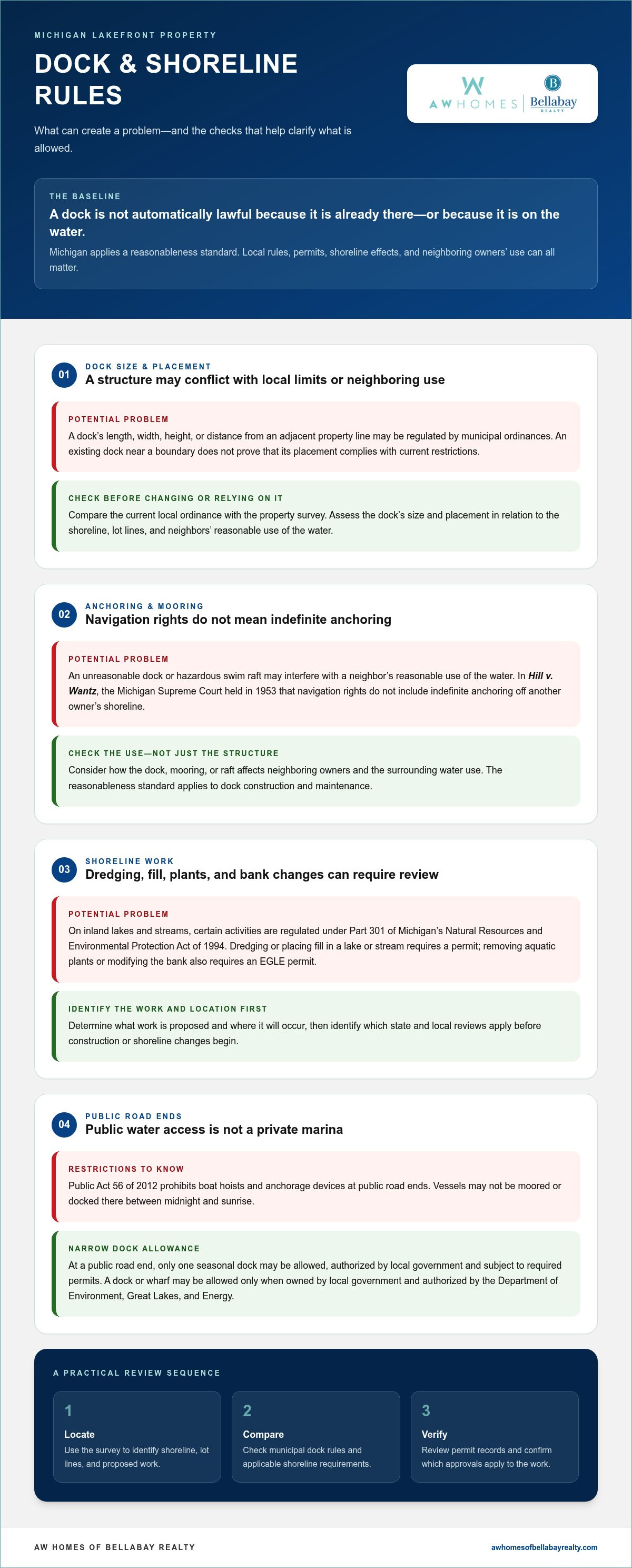
A long dock isn’t automatically lawful. Under lakefront property rules and regulations in Michigan, dock construction and maintenance are subject to a reasonableness standard, while municipal ordinances may set dock dimensions and setbacks from neighboring property lines. An unreasonable dock or hazardous swim raft may also interfere with neighbors’ reasonable use of the water.
It’s natural to expect a waterfront home to offer a place to launch a boat or enjoy the shoreline. But property lines, recorded access rights, local rules, and the dock’s condition all affect what you can use or change.
This guide explains riparian rights, what property documents can reveal about water access, and how dock, shoreline, and navigation rules affect ownership. You’ll also learn what to review before buying so your lakefront plans reflect the property’s actual rights and limits.
Key Takeaways
- Use the title and survey to determine whether the property touches the water and carries riparian rights; “lake access” alone doesn’t establish them.
- Don’t assume an existing dock can stay as-is. State, local, and association rules can affect dock work and shoreline changes.
- Public shoreline-use rights differ by location. Michigan’s beach-walking rule for the Great Lakes applies below the ordinary high-water mark, not generally to inland lakes and streams.
- For designated rivers, Michigan Department of Natural Resources says zoning can impose building setbacks of up to 400 feet.
Waterfront property title, easements, and access agreements
Lakefront ownership involves more than the view: title, recorded access rights, and land-use restrictions shape what owners can do. Review these records before assuming a path, dock, or road end provides private access.
Private and Deeded Lake Access
Start by separating waterfront ownership from shared or deeded access. Land touching water generally carries riparian rights; deeded access alone doesn’t establish those rights. Compare the deed, title commitment, and survey to see whether the front property reaches the water or relies on an easement. Recorded agreements and association rules can define access for owners, guests, and tenants, including dock-space assignments. According to Michigan Department of Natural Resources, Michigan Natural Rivers Act zoning can impose building setbacks of up to 400 feet along designated rivers.
Public Access and Recreational Use
Lawful access to navigable Michigan water permits navigation across the water surface for boating, fishing, swimming, and temporary anchorage. That public use can include incidental use of riparian-owned bottomlands, but it doesn’t extend to owners’ uplands. For Great Lakes beaches, the Michigan Supreme Court’s 2005 decision in Glass v. Goeckel recognized public walking below the ordinary high-water mark. The ruling concerns Great Lakes shorelines, not inland lakes and streams.
Platted Road Ends and Mooring
A platted public road ending at navigable water has been presumed available for public water access since at least 1882. That access doesn’t make the road end a private marina or establish a neighboring owner’s riparian rights. Public Act 56 of 2012 prohibits boat hoists and anchorage devices at public road ends, and bars mooring or docking vessels there between midnight and sunrise. A dock or wharf may be allowed only when owned by local government and authorized by the Department of Environment, Great Lakes, and Energy.
Wetlands, floodplains, and high-risk erosion areas can affect building and shoreline work. Michigan’s Department of Environment, Great Lakes, and Energy has jurisdiction over wetlands. A delineation can help identify buildable areas, while flood-zone maps and erosion exposure inform site review.
Lakefront property taxes depend on taxable value and local tax rates. Association assessments and fees depend on governing documents, budgets, and shared expenses.
Flood-zone designation, past water damage, and shoreline erosion are important insurance considerations. Review these risks along with the property’s location and condition.
To verify boundaries and restrictions, compare the title, survey, recorded easements, and association documents. Review permit records, and consult a real estate attorney if access language or environmental constraints are unclear.
Limits on docks, moorings, and shoreline alterations
Dock rights have limits: Michigan applies a reasonableness standard, environmental permits, and local zoning requirements. The project’s location, shoreline effects, and neighboring owners’ use all matter. Consider these factors when assessing whether an existing structure suits the property and its surroundings.
Dock and Mooring Restrictions
Michigan riparian dock construction and maintenance must be reasonable relative to the property and neighbors’ rights. Municipal ordinances may regulate dock length, width, height, and setbacks from adjacent property lines. In Hill v. Wantz, the Michigan Supreme Court held in 1953 that navigation rights don’t include indefinite anchoring off another owner’s shoreline. These lakefront property rules and regulations in Michigan make local requirements and neighboring uses important parts of dock planning.
Permits for Shoreline Construction
For inland lakes and streams, Part 301 of Michigan’s Natural Resources and Environmental Protection Act of 1994 regulates certain activities and requires permits from the Michigan Department of Environmental Quality. Michigan riparian property owners may not dredge or place fill in a lake or stream without a permit from the Michigan Department of Environment, Great Lakes, and Energy (EGLE). Identify the proposed work and its location to understand which reviews apply before construction begins.
Local Setbacks and Construction Limits
Township and municipal zoning may impose dock setbacks and size limits in addition to state shoreline review. Compare the current ordinance with a property survey to identify the shoreline, lot lines, and proposed construction area. An existing dock near a property boundary isn’t proof that its placement complies with current restrictions.
State Rules for Shoreline Use
On inland lakes, dock work follows Michigan’s reasonableness standard, while local ordinances may set dimensions. Removing aquatic plants or modifying the bank requires an EGLE permit. At a public road end, Michigan Legislature says only one seasonal dock, authorized by local government and subject to required permits, is allowed. Understanding lakefront property rules and regulations in Michigan can help buyers evaluate planned shoreline use. For purchase guidance, explore buyer representation for lakefront homes.
What Are Riparian Rights?
Riparian rights generally belong to owners whose land touches the water. Their scope differs from public use rights, particularly along Great Lakes shorelines.
Public Walking Along the Shore
In Glass v. Goeckel, the Michigan Supreme Court held in 2005 that the public may walk along Lake Michigan below the ordinary high-water mark. The decision applies to privately owned Great Lakes beaches, not inland lakes and streams. It addresses walking, not every recreational activity. The court did not decide whether the public may sunbathe, picnic, make campfires, or play volleyball below that mark. Buyers should distinguish the beach area from uplands included in the property.
Public Lateral Roads and Riparian Rights
Public lateral roads provide a separate access route from an owner’s riparian rights. Along Michigan inland lakes, these roads can be as wide as 100 feet. A road’s location and recorded dedication help show where public access applies. They don’t automatically give nearby owners riparian rights or extend public access onto private uplands. Compare the plat and survey with the deed to understand the property’s boundaries.
On navigable Michigan waters, people with lawful access may navigate the surface and use it for boating, fishing, swimming, and temporary anchorage. This can include incidental use of riparian-owned bottomlands, but not the owner’s uplands. Riparian owners typically hold bottomland toward the lake’s center or a stream’s middle thread, subject to navigation rights. Their use must remain reasonable in relation to their property and their neighbors’ rights.
Platted public road ends have been presumed available for public water access since at least 1882. That access does not automatically authorize every activity. In a Lyon Manor road-end dispute, the Michigan Court of Appeals ruled that local ordinances could not authorize picnicking, sunbathing, lounging, or boat mooring where the plat intended access to water, not broader recreation. A written easement or dedication can define a different access arrangement, so examine the recorded language rather than relying on neighborhood custom.
Michigan dock and navigational-hazard rules
A dock can support riparian rights and still raise navigation concerns. Michigan assesses dock construction and maintenance under a reasonableness standard, considering property size and neighbors’ rights. Local ordinances may also regulate dock dimensions and setbacks. Before installing or altering a dock, compare its location with the survey, shoreline, and applicable local rules. An existing structure’s presence alone doesn’t establish that it can remain unchanged.
Navigational hazards are a separate issue from dock permits. An unreasonably long dock or dangerous swim raft may interfere with others’ reasonable use of the water. If local regulation or state enforcement doesn’t resolve the problem, a waterfront property owner may challenge it under the common-law doctrine of reasonable use. The specific concern matters: obstruction, unsafe placement, and effects on neighboring riparian owners can shape the dispute.
Removal costs can also affect property title. Michigan law allows the responsible agency or a peace officer to provide 30 days after mailing written notice for the owner or responsible person to pay navigational-hazard removal costs before those costs may become a lien against the property. For buyers, this makes unresolved hazard notices relevant to due diligence. Review available property records and disclosures for notices, disputes, or obligations tied to docks and other obstructions.
Association rules add another layer. Recorded or association restrictions may address dock placement, shared access, or shoreline use alongside state and municipal requirements. Compare those rules with the dock’s actual location and condition: a structure that appears usable may still violate a setback or prompt a reasonable-use dispute. Riparian rights don’t automatically authorize every installation or resolve a navigation hazard.
Considering a waterfront purchase? Explore buyer representation for lakefront homes to assess property details and ownership considerations as part of your decision.
AW Homes of Bellabay Realty: Residential Listing Services
AW Homes of Bellabay Realty helps buyers and sellers assess lakefront property decisions through Residential Listing Services and Buyer Agency Services. Buyers can get support comparing waterfront properties and weighing how documented access and restrictions affect a purchase and their plans. Relocation Assistance helps people moving to West Michigan consider neighborhoods and practical details of a new home. Real Estate Investment Consulting supports buyers evaluating a property as an investment.
Turn to AW Homes of Bellabay Realty when you’re ready to explore, buy, or sell a residential property and want local market guidance throughout the transaction. For legal interpretations of deeds, easements, or permits, consult an appropriate legal professional.
Contact AW Homes of Bellabay Realty to discuss your lakefront move, or visit awhomesofbellabayrealty.com.
Make Your Lakefront Plans With Confidence
Understanding lakefront property rules and regulations in Michigan can help turn a promising listing into a well-considered decision. Before moving forward, identify what matters most in day-to-day ownership: convenient water access, room for future improvements, or a setting that suits your next chapter. Let those priorities guide your conversations and property search.
AW Homes of Bellabay Realty provides Residential Listing Services, Buyer Agency Services, and Relocation Assistance. Whether you’re preparing to sell, searching for a waterfront home, or moving to West Michigan, thoughtful real estate guidance can help you approach the transition with a clearer plan. For questions about legal rights or permits, include the appropriate professional in your decision-making.
Contact AW Homes of Bellabay Realty to discuss your next move. Your lakefront plans can begin with a thoughtful first step.
Frequently Asked Questions
Unreasonably Long Docks: How long is too long?
Michigan applies a reasonableness standard, not one dock-length rule for every case. A long dock may raise concerns if its placement or use interferes with navigation or neighboring owners’ reasonable use. For a specific property, compare the dock’s location with the survey and local ordinance, then consider its effects on adjacent waterfront uses. Length alone doesn’t settle the question.
What does it mean to be in a critical dune area?
A critical dune area is a designated location where development and construction may require permits under Michigan’s Sand Dune Protection and Management Act. Structures are prohibited on the first lakeward-facing slope. Special-use projects, including subdivisions and site condominiums, require environmental impact assessments. Before planning construction or major site changes, determine whether the parcel is in a designated area.
Where are my riparian boundary lines?
Riparian boundaries depend on the parcel’s legal description, shape, and waterbody. On inland lakes, adjacent owners’ bottomland rights generally extend toward the lake’s center; on streams, they extend toward the middle thread. Compare the recorded deed and plat with a current survey to understand the parcel’s shoreline and projected water boundaries. If documents conflict, a real estate attorney can interpret the recorded rights.
Will I be able to keep my Lake Michigan beach private, or will the public be able to use it?
On privately owned Lake Michigan beaches, the public may walk below the ordinary high-water mark under the Michigan Supreme Court’s Glass v. Goeckel decision. The ruling doesn’t extend public use to the owner’s uplands. It also didn’t decide whether activities such as picnicking or sunbathing are allowed below that mark. When assessing privacy, distinguish the beach from upland areas.
What septic system and well rules apply to Michigan lakefront homes?
For septic and well due diligence, focus on the systems, property records, and local requirements. Review available permits, inspection and maintenance records, and well-water test results; compare system locations with the home and planned improvements. Ask the local health department which requirements apply to the parcel and whether records show unresolved issues. These details help assess the home’s utilities alongside shoreline considerations.
What are Michigan wetlands, floodplain, and high-risk erosion area restrictions for lakeside properties?
Wetlands fall under EGLE jurisdiction, and delineation can help identify buildable areas. Flood-zone maps and shoreline-erosion exposure inform site review and may affect building or shoreline work.


