

At least 70% of homeowners in the United States say they’ve felt some regret after buying a home. After closing, backing out of a purchase is usually not possible, so avoiding buyer's remorse after purchasing a home starts with understanding the full cost of ownership and comparing each home with your priorities before you commit.
Even a carefully considered purchase can bring second thoughts. A new payment, unfamiliar surroundings, or the pressure of a major life change can make it hard to know whether you chose the wrong home or are simply adjusting.
This guide explains what home buyer’s remorse can look like and what to do when regret sets in. Learn how to plan for taxes, insurance, maintenance, and utilities, assess whether a home fits your daily and longer-term needs, and keep comparisons with other homes from clouding your decision.
Key Takeaways
- Build a homeownership budget that accounts for taxes, insurance, maintenance, and utilities alongside your mortgage payment.
- Rank your must-haves before comparing homes, then weigh everyday needs such as commute, location, and future plans.
- When regret surfaces, identify what’s driving it and decide whether a practical change could make the home feel more comfortable.
- After closing, focus on your own priorities instead of judging your home against other properties or someone else’s choices.
- If you’re considering leaving, compare the financial and practical implications of selling or renting with your longer-term goals.
1. Budgeting for taxes, insurance, maintenance, and utilities
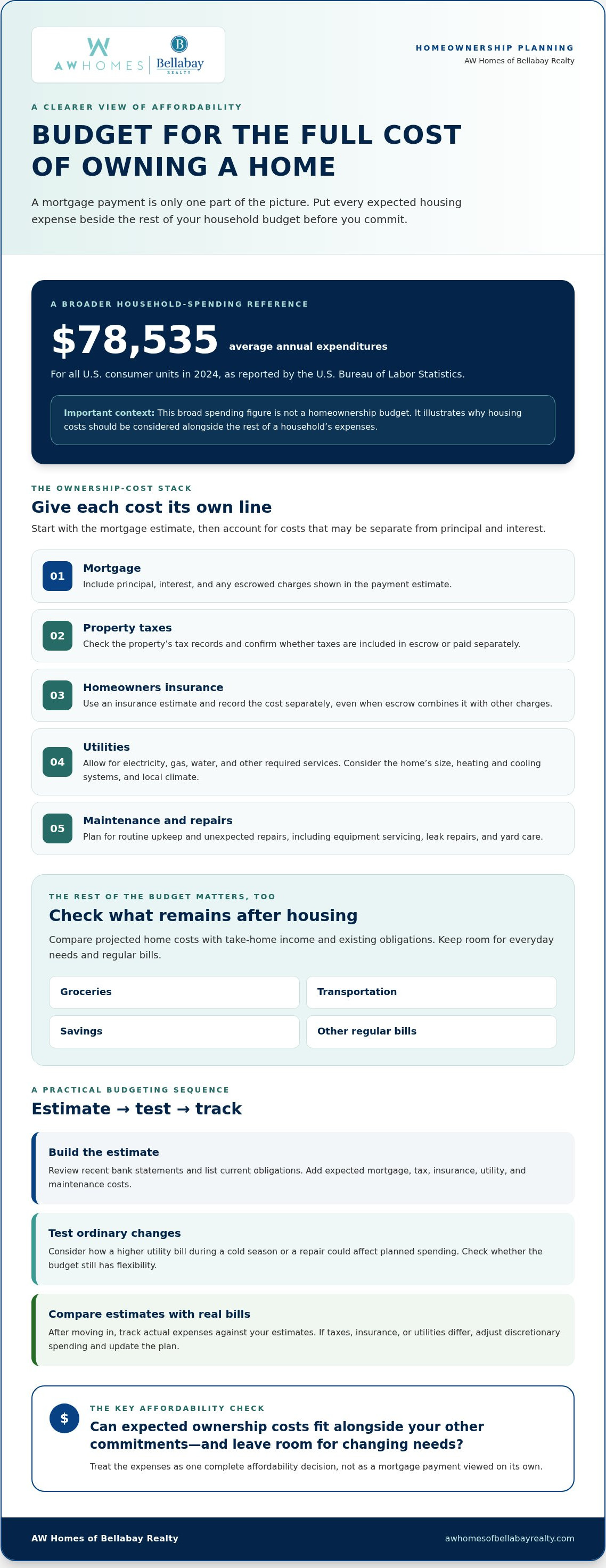
Before purchasing, add up expected housing expenses and compare them with take-home income and existing obligations. Include the mortgage payment, property taxes, homeowners insurance, utilities, and maintenance. These costs are more manageable when there’s still room in your budget for groceries, transportation, savings, and other regular bills.
Start with the mortgage estimate, then add expenses that may not be included in the principal-and-interest payment. Property taxes and insurance may be included in escrow or paid separately, so check how the estimate accounts for each. Use the property’s tax records and an insurance estimate to build a fuller picture before making an offer.
The U.S. Bureau of Labor Statistics reported today that average annual expenditures for all consumer units in 2024 were $78,535. This broad spending figure is not a homeownership budget. It does, however, illustrate why buyers should consider housing alongside the rest of their household expenses.
Give each recurring cost its own budget line. When estimating utilities, consider the home’s heating and cooling systems, size, and local climate. For maintenance, list likely tasks such as servicing equipment, repairing leaks, and caring for the yard. A home inspection can help you understand the property’s condition and identify repairs that may need attention.
- Mortgage: Include principal, interest, and any escrowed charges shown in your payment estimate.
- Taxes and insurance: Record each as its own expense, even when escrow combines them into one payment.
- Utilities: Account for electricity, gas, water, and other services the property requires.
- Maintenance: Set aside room for routine upkeep and unexpected repairs without treating either as optional.
To set a workable budget, review recent bank statements and list current obligations before comparing them with projected home costs. Then test the budget against ordinary changes, such as a higher utility bill during a cold season or a repair that disrupts planned spending. These scenarios can show whether the purchase leaves enough flexibility.
After moving in, track actual bills against your estimates. If taxes, insurance, or utilities differ from expectations, adjust discretionary spending and update your plan. Buyers considering a home as an investment can also use Real Estate Investment Consulting to assess how ownership expenses fit their financial goals.
Before buying, budget for mortgage payments, insurance, property taxes, and maintenance. Treat them as parts of one affordability decision rather than judging the purchase by the mortgage alone. A clear estimate shows whether expected costs fit alongside other commitments and leave room for changing needs. Update the figures as you learn more about the property, then compare them with actual expenses after purchase. Keeping ownership costs visible supports a more deliberate decision.
2. What is home buyer’s remorse?
Home buyer’s remorse is regret, doubt, or anxiety after buying a home. It can arise even after a careful decision, especially when the mortgage, repairs, or unfamiliar surroundings make the change feel real. Common triggers include unexpected expenses, a home that misses an important need, a difficult commute, or thoughts that another property might have been better.
What causes buyer’s remorse after buying a house? Buyers often regret rushing, underestimating costs, or choosing a home that doesn’t fit daily life. A long commute or major renovation, for example, may feel more significant after moving in than it did during a viewing.
How long does home buyer’s remorse usually last? It may last a few weeks to a few months as homeowners adjust. Track what specifically feels wrong, such as storage, noise, or a tight budget, to distinguish a temporary transition from an ongoing concern.
Prioritize home requirements before touring. Write down essential needs, flexible preferences, and deal-breakers, then compare each property against that list. Consider commute time, distance from family, future job changes, lifestyle shifts, and possible growth in the area. A structured home search built around your priorities can keep attractive finishes from overshadowing practical fit.
Taking time matters because each viewing can reveal different trade-offs. Partnering with an experienced agent like Brian Liberto allows buyers to compare multiple homes, revisit written priorities, and thoroughly discuss concerns before making an offer. If you feel pressured, pause to review the budget, inspection findings, and the daily routine the location would require. A deliberate process helps you choose based on fit, not momentum.
What home-buying protections and cancellation rules vary by state? State laws and purchase-contract terms affect buyers’ rights. Inspection, appraisal, and financing contingencies may allow withdrawal or renegotiation before closing. Read the specific contract provisions, because your options depend on the contingency and its terms.
What inspections and contingencies help prevent costly mistakes? A professional home inspection can identify hidden property issues, while inspection, appraisal, and financing contingencies may provide options if major concerns arise before closing. What should buyers review during the final walkthrough? Check that agreed repairs are complete, included fixtures remain, and the home’s condition has not materially changed since the inspection.
How can new homeowners distinguish adjustment stress from a serious problem? Adjustment stress often centers on unfamiliar routines or preferences, while a specific defect, safety concern, or recurring repair issue calls for prompt attention. Record the problem, when it occurs, and any related inspection notes.
What are the risks and costs of selling soon after buying? Selling and moving fees affect the break-even sale price, and the proceeds may not cover the remaining mortgage and transaction expenses. Compare those costs with your reasons for leaving before deciding whether selling or renting better fits your goals.
3. Steps to take after a home purchase causes regret
Pause before making a major decision. Write down what’s causing regret, such as an unexpected repair, a high monthly payment, a long commute, or a room that doesn’t work for your routine. Separating specific problems from general unease can help you choose a practical next step instead of reacting to the stress of a major transition.
Common causes of homebuyer’s remorse include costs that feel heavier after moving, unexpected repairs, and a mismatch between the property and daily needs. A buyer who expected a quiet street, for example, may struggle with traffic noise. Naming the issue makes it easier to decide whether you need a change, a budget adjustment, or a larger plan.
Can a home buyer cancel a purchase contract after signing, and what penalties apply? Before closing, withdrawal may be possible if a contract contingency applies, but the contract’s terms and deadlines determine the options and consequences. After closing, backing out is usually not possible.
If closing hasn’t happened, review the signed agreement and identify any inspection, appraisal, or financing contingency that may apply to your concern. Contact your real estate agent or an attorney promptly to understand the contract’s requirements. For example, a serious inspection finding may create an opportunity to renegotiate or withdraw if the relevant contingency allows it.
After closing, use a clear sequence to address the source of regret:
- Describe the problem: Record what happened, when it occurs, and how it affects daily life.
- Separate urgent issues: Address a leak or failed appliance before cosmetic concerns, such as dated paint.
- Choose a practical change: Rearrange furniture, redecorate a room, or improve a space that isn’t meeting your needs.
- Build familiarity: Explore nearby routes and introduce yourself to neighbors to make the area feel more connected.
Buyer’s remorse can also stem from financial strain. If the mortgage and household expenses are hard to manage, review your income, bills, and discretionary spending. A financial advisor can discuss budgeting or refinancing options. Compare any proposed change with its effect on monthly obligations and longer-term plans.
How can you manage buyer’s remorse after closing? Identify the source, address what you can change, and make a practical plan for unresolved concerns. If you want to leave, consider selling or renting the home, and include selling and moving fees when estimating a break-even sale price. Compare those costs with your reasons for moving before choosing a path.
4. Avoiding comparisons with other homes after closing
After closing, photos of another home can make yours seem like the wrong choice. A renovated kitchen, larger yard, or shorter commute may stand out, while the other home’s drawbacks remain invisible. Compare what you know about your home with what you can see and verify about another property.
Start by revisiting the priorities that shaped your purchase. Write down what mattered most, such as a manageable commute, room for family, or a particular neighborhood. Then note how your home meets each need. If it provides the location and layout you chose, those everyday benefits deserve more weight than a stranger’s new countertops.
Online listings invite incomplete comparisons. A staged photograph may show attractive finishes, but it won’t tell you about maintenance needs, neighborhood fit, or monthly expenses. If a friend’s purchase prompts regret, focus on concrete differences: their location, household needs, and budget may not match yours.
Use a simple comparison reset when you catch yourself scrolling through listings:
- Name the trigger: Is it the home’s price, appearance, location, or a feature you wish you had?
- Separate fact from assumption: A photo shows a finished room, not the repairs or trade-offs behind it.
- Return to your priorities: Check whether the comparison concerns a genuine need or a preference.
- Choose one action: Improve a room, explore a nearby park, or adjust a daily route.
For example, a homeowner comparing a compact kitchen with a friend’s spacious one can identify the real frustration. If meal preparation feels cramped, rearrange storage or change the work area. If the concern is simply that another kitchen looks newer, pause before treating appearance as proof of a bad purchase.
Set boundaries around comparison triggers. Mute property posts that leave you second-guessing, and avoid browsing listings without a specific purpose. If you’re reviewing homes for a future move or investment, such as exploring properties abroad on europeanlistings.com, record the features and trade-offs that matter. That turns comparison into deliberate planning rather than ongoing judgment of your current home.
Keep a short record of what works in your home. Note practical benefits, such as a quiet room for work, a convenient grocery route, or space for visiting family. When regret returns, consider those observations alongside the issues you still want to address. This gives you a more balanced picture than comparing your lived-in home with a carefully selected image.
If comparison reveals a persistent concern, define the problem before considering a major change. A disliked finish may call for a small update; an unsuitable commute may require a longer-term housing decision. Separating cosmetic preferences from everyday needs helps you respond thoughtfully and stay focused on the home you chose.
5. What home buyer’s remorse is
Home buyer’s remorse is regret or doubt about a home purchase, but the feeling alone doesn’t prove the decision was wrong. It may reflect a concrete mismatch, such as a commute that disrupts family routines, or the strain of adapting to a new payment, neighborhood, and responsibilities. Ask whether the concern points to a specific problem or mainly to uncertainty after a major change.
Survey findings show that regret is common, though results differ by question and group. At least 70% of U.S. homeowners say they’ve experienced some level of regret after buying a home. A survey cited by Hippo found 52% of homebuyers experienced remorse, while its survey finding for buyers ages 23 to 38 was 63%. These figures describe reported feelings, not proof that every purchase was unsuitable.
Remorse can concern the home itself, the buying process, or the life change around it. A buyer may discover a costly repair, realize the layout makes working from home difficult, or miss a previous neighborhood. Another homeowner may feel unsettled without having a specific complaint. Naming the concern makes it easier to assess.
Separate the emotion from the evidence. Write down the concern, the facts supporting it, and what would improve the situation. For example, “the home feels too small” could mean there’s no quiet work area, storage is poorly arranged, or the buyer is comparing rooms with online listings. Each cause suggests a different response.
- Property concern: Record a defect, repair need, or layout problem, then compare it with inspection information.
- Financial concern: Identify which bill or ownership cost feels difficult to manage and review the household budget.
- Lifestyle concern: Pinpoint whether the commute, distance from family, or daily routine is driving dissatisfaction.
- Comparison concern: Name the feature another home appears to offer, then ask whether it meets a genuine need.
This distinction matters because the solutions differ. A storage problem might improve with a room reorganization, while financial strain calls for reviewing expenses and possible budgeting options. A serious property defect needs practical attention, not dismissal. Focus first on the specific issue that most affects everyday life.
A clear takeaway: treat remorse as a signal to investigate, not a verdict on your purchase. List what works, what needs attention, and what can change. If you’re planning another home search, discuss your priorities for the next purchase before comparing properties.
Homebuyers can reduce the risk of a rushed decision by viewing multiple homes, comparing options, and considering what matters most to them.
AW Homes of Bellabay Realty: Residential Listing Services
AW Homes of Bellabay Realty can help if regret leads you to consider selling, buying again, relocating, or evaluating a property investment. Its Residential Listing Services support homeowners preparing to sell, while Buyer Agency Services help buyers assess priorities and compare homes before their next purchase. Relocation Assistance can help you plan a more considered move, and Real Estate Investment Consulting can help you weigh property decisions against your investment goals.
If you’re deciding whether to stay or move, start by clarifying what isn’t working and what you need next. That gives the conversation a practical focus, from the property’s fit to your next transition.
Contact AW Homes of Bellabay Realty to discuss your next step.
Make your next move with clarity
A home decision can shape more than where you live. It can influence your routines, relationships, and plans for what comes next. Avoiding buyer's remorse after purchasing a home means seeing each decision as part of a longer-term picture, not a test of whether you chose perfectly. That perspective can help you respond thoughtfully if your needs change.
Avoiding buyer's remorse after purchasing a home also means making future choices with changing priorities in view. If you’re considering another home, AW Homes of Bellabay Realty offers Buyer Agency Services to support your next purchase and Residential Listing Services if you decide to sell. For a move tied to a life transition, Relocation Assistance can help you plan the next step with care. Keep your focus on what matters most to your next chapter.
Contact AW Homes of Bellabay Realty to discuss the direction that fits your plans. Every move begins with a clearer sense of what matters, and you can take that step at your own pace.
Frequently Asked Questions
What is home buyer’s remorse?
Home buyer’s remorse is doubt or disappointment about a home purchase after the decision is made. It may show up as repeated thoughts about a missed alternative or dissatisfaction with a feature you once accepted. To understand what the feeling signals, note when it appears and what prompted it. Regret tied to a recurring, specific problem calls for a different response than unease that surfaces mainly after browsing listings.
What should I do if I regret my home purchase?
Turn regret into a written action plan: describe the issue, gather relevant records, and choose a next step. For a repair concern, keep inspection notes and document when the problem occurs. For financial stress, review current bills and household spending before changing your plans. If moving remains a serious option, compare the practical consequences of staying, selling, or renting rather than acting on a difficult day.
What costs should homeowners budget for beyond the mortgage?
Budget for property taxes, homeowners insurance, utilities, maintenance, and any applicable association dues in addition to the mortgage. Note how each bill is paid: escrow may combine taxes and insurance with the mortgage payment, while utilities and repairs are usually separate. Costs can also vary with the property’s condition, insurance coverage, local tax assessment, and household energy use. Track actual bills and update your household budget as they arrive.


