

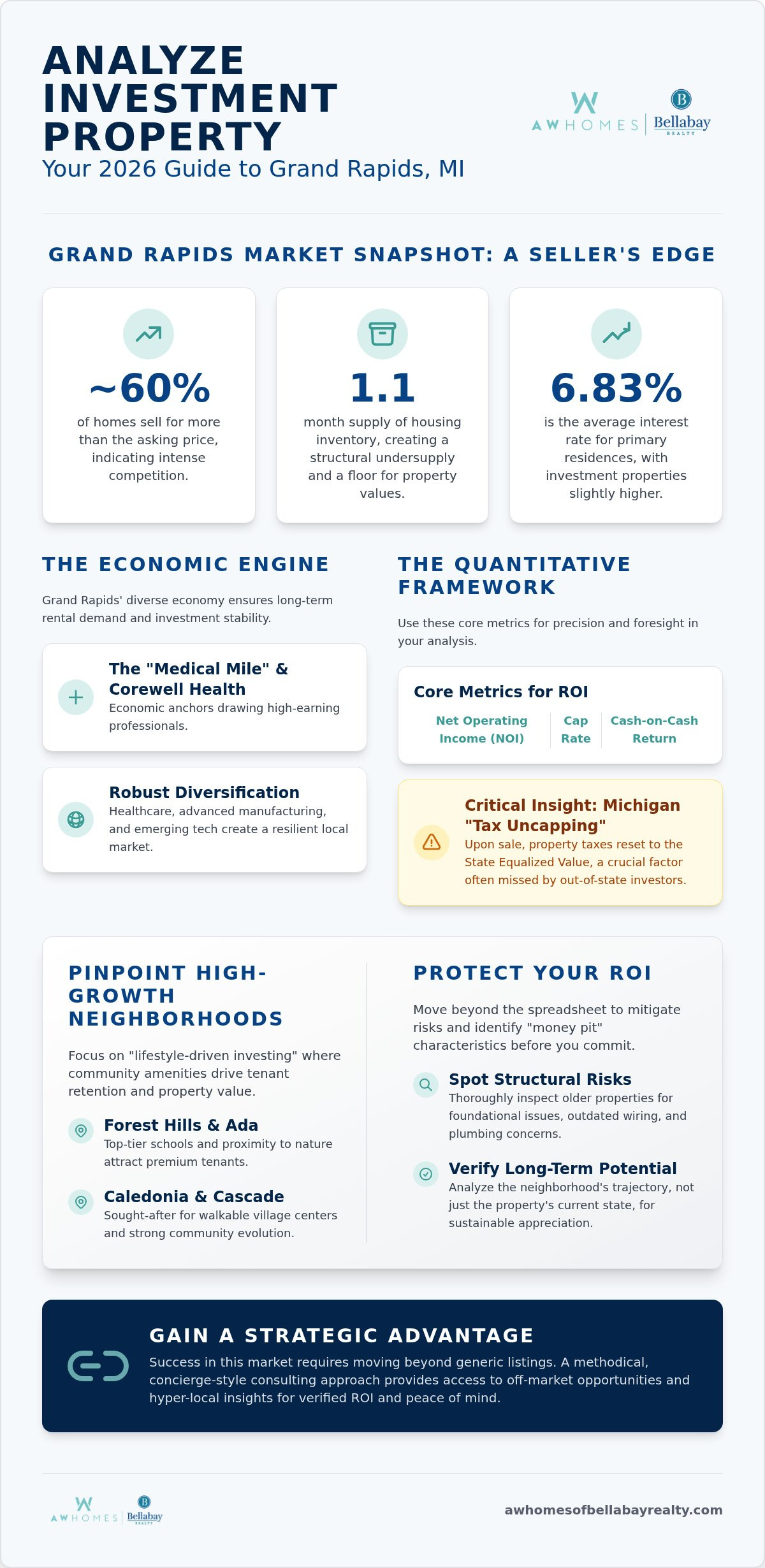
If nearly 60% of homes in Grand Rapids are selling for more than the asking price, how do you ensure your next acquisition is a strategic milestone rather than a financial burden? In a market defined by a lean 1.1-month supply of inventory, the margin for error has never been thinner. You likely feel the weight of a competitive landscape, the complexity of Michigan’s 51.6268 non-homestead millage rates, and the pressure to choose the right neighborhood for long-term appreciation. We understand that these transitions are about more than just numbers; they're about securing your future with clarity, confidence, and peace of mind.
This guide will teach you exactly how to analyze investment property Grand Rapids by balancing clinical data with the hyper-local insights only a regional specialist can provide. You'll master a framework that prioritizes emotional security, methodical planning, and verified ROI. We'll explore high-growth pockets like Forest Hills and Ada, simplify the 2026 tax landscape, and provide a clear checklist to help you navigate this evolving market with ease. By the end of this article, you'll have the tools to move beyond simple transactions and toward expert navigation of the West Michigan market.
Key Takeaways
- Identify the primary economic drivers in 2026, including the "Medical Mile" and Corewell Health, to understand long-term rental demand in West Michigan.
- Master how to analyze investment property Grand Rapids using a quantitative framework that calculates precise cash-on-cash returns and realistic 2026 vacancy rates.
- Pinpoint high-growth neighborhoods like Forest Hills, Ada, and Caledonia where school rankings directly correlate with tenant retention and property value.
- Protect your ROI by learning to spot structural risks and "money pit" characteristics in older properties before you commit to a high-stakes transaction.
- Gain a strategic advantage by moving beyond generic listings and accessing off-market opportunities through a methodical, concierge-style consulting approach.
Understanding the Grand Rapids Investment Landscape in 2026
The 2026 real estate market in West Michigan is a study in resilience and calculated growth. While other national regions face significant volatility, Grand Rapids offers a sophisticated balance of steady home price appreciation and relentless rental demand. Success in this environment isn't about chasing the highest current yield in a vacuum. Instead, it's about understanding how to analyze investment property Grand Rapids through a lens of long-term stability. The current environment is defined by three distinct pillars: economic diversity, structural undersupply, and a clear shift toward lifestyle migration.
We've moved past the frenetic pace of the early 2020s into a market that rewards methodical planning. Investors are finding that "undersupply" remains their strongest ally. With a lean 1.1-month supply of housing inventory, the competition for quality assets is high, but the rewards for those who secure them are substantial. This scarcity creates a floor for property values, protecting your equity even as broader market conditions shift.
The Economic Engine: Why Grand Rapids Remains Resilient
Grand Rapids, Michigan, has evolved into a powerhouse for healthcare, technology, and advanced manufacturing. The "Medical Mile" and the expansion of Corewell Health act as massive economic anchors, drawing a consistent influx of high-earning professionals who prefer premium rental options. This professional tenant pool is a primary reason why population growth in Kent County continues to outpace the Michigan state average. The regional economy is no longer dependent on a single industry. It's a robust blend of healthcare innovation, global manufacturing, and emerging tech. This diversification provides a safety net for investors, ensuring that local demand remains insulated from specific sector downturns. Strategy, data, and local insight are the foundations of this resilience.
Inventory Trends: Navigating the 2026 Market
The inventory landscape remains heavily skewed in favor of owners. Single-family homes continue to see intense competition, with over 57% of properties selling above the asking price in mid-2026. Meanwhile, multi-family units are becoming the gold standard for those seeking reliable cash flow. Interest rates have stabilized, with the national average for primary residences at 6.83%, though investment property rates typically hover between 7.33% and 7.83%. This stabilization has brought serious investors back to the table, making speed and precision essential for every transaction. For a deeper dive into these figures, explore our Grand Rapids Real Estate: Strategic Trends & 2026 Market Outlook.
We're also seeing a significant rise in "lifestyle-driven investing." High-growth communities like Ada and Cascade are no longer just for primary homeowners. Investors are increasingly targeting these areas because they offer what modern tenants crave: top-tier schools, walkable village centers, and proximity to nature. When you analyze a property, look beyond the four walls. Look at the community's evolution, the local school rankings, and the neighborhood's long-term trajectory. This methodical approach ensures your investment is a milestone in your personal financial story.
The Quantitative Framework: Crunching the Numbers for West Michigan ROI
Numbers provide the emotional security every investor craves. While the broad market trends offer a sense of direction, your specific success depends on accuracy, foresight, and local precision. When you determine how to analyze investment property Grand Rapids, you must move beyond generic spreadsheets. You need a framework that accounts for the unique fiscal landscape of Kent County. This process begins with three core metrics: Net Operating Income (NOI), Cap Rate, and Cash-on-Cash Return. These figures act as your North Star, guiding you through the complexities of a high-demand market.
One of the most critical factors often overlooked by out-of-state investors is the Michigan "Tax Uncapping" rule. In Michigan, property taxes are capped while you own the home. However, upon a sale, the taxable value "uncaps" and resets to the State Equalized Value (SEV), which is typically 50% of the property’s current market value. If you're analyzing a $300,000 median-priced home, your first-year taxes will be calculated on a $150,000 valuation, likely resulting in a significant jump from what the previous owner paid. Failing to account for this reset can instantly turn a cash-flowing asset into a monthly liability.
Calculating Your Real Cash Flow
Real cash flow is the remainder after every local nuance is satisfied. In the City of Grand Rapids, you must factor in the 1.5% municipal income tax and mandatory rental registration fees. Trash removal is often a separate ordinance cost depending on the specific municipality. For a pro-forma in a high-growth area like Forest Hills, where the non-homestead millage rate sits near 51.6268, your calculation must be precise. We often recommend modeling a 4% to 5% vacancy rate. While the current 1.1-month inventory supply suggests even lower figures, a conservative buffer ensures your long-term well-being. For a personalized look at these figures, a real estate investment consultation can help clarify your specific pro-forma expectations.
Appreciation vs. Cash Flow: Finding Your Strategy
Your strategy should mirror your current life stage. High-yield zones often require more intensive management and offer lower appreciation. Conversely, low-yield areas like East Grand Rapids or Ada provide significant long-term equity growth and attract high-quality, long-term tenants. In the 2026 Grand Rapids market, a Cap Rate is best defined as the ratio of your net income to the total purchase price, excluding the influence of debt. This metric allows you to compare the raw profitability of a historic Midtown duplex against a modern Caledonia build. Success is found in the "Total Return" mindset, where you value the combination of monthly income, tax benefits, and steady 2-4% annual appreciation.
Neighborhood-Level Analysis: Where Strategy Meets Local Insight
Success in West Michigan real estate isn't just about the city; it's about the block. While the regional data we discussed provides the foundation, your long-term ROI is determined by the specific street, the local school board, and the proximity to community hubs. Learning how to analyze investment property Grand Rapids requires a transition from macro-economic trends to hyper-local neighborhood dynamics. We focus on the "Big Three" growth areas—Forest Hills, Ada, and Caledonia—because they offer a rare combination of high-tier school rankings, lifestyle amenities, and consistent appreciation. These areas attract a specific tenant profile: professional, stable, and long-term.
We're also seeing a distinct shift toward "walkable luxury" in East Grand Rapids. This isn't just a trend; it's a fundamental change in how high-earning tenants choose their homes. Properties within walking distance of Gaslight Village command a significant rental premium, often outpacing the broader market in annual rate increases. When you evaluate these "Path of Progress" zones, look for infrastructure improvements like new bike paths, village redevelopments, or expanded park systems. These elements act as catalysts for value, turning a standard rental into a high-demand lifestyle asset.
Forest Hills and Ada: The Premier Suburban Picks
Forest Hills remains the gold standard for executive relocation tenants. The school district’s reputation for excellence ensures a constant stream of families who prioritize education over low rent. This creates an environment of low turnover and pride of rentership. Nearby, the Ada Village 2026 redevelopment has transformed the area into a premier destination for those seeking a blend of rural charm and modern convenience. This localized growth has driven property values higher, making it essential to understand the nuances of the area. For a deeper look at these specific dynamics, explore our Ada MI Neighborhood Guide.
Caledonia and Cascade: Growth and Value
If you're seeking a lower entry price with institutional upside, Caledonia is the strategic choice. While prices are more accessible than in East Grand Rapids, the growth trajectory is steep due to the expansion of local business hubs and the high quality of life. In Cascade, the demand for newer construction rentals is surging. Professional tenants are increasingly moving away from historic "money pits" toward homes with modern floor plans and energy-efficient systems. However, you must be methodical about local zoning laws. Townships in these areas have specific regulations regarding short-term rentals and auxiliary dwelling units. Navigating these rules is a core part of our consulting process, ensuring your investment remains compliant and profitable for years to come.
Beyond the Spreadsheet: Qualitative Factors and Risk Mitigation
Numbers provide the structure, but the physical reality of a property determines its longevity. Many investors fear the "money pit"—a property that looks profitable on paper but collapses under the weight of aging infrastructure. When you master how to analyze investment property Grand Rapids, you learn to look past the fresh paint. You begin to see the mechanical systems, the structural integrity, and the regional quirks that define West Michigan real estate. This methodical approach to due diligence is what separates a stressful transaction from a seamless transition into wealth building.
Risk mitigation is about intentionality. It's about knowing that a historic home in Heritage Hill requires a different maintenance philosophy than a new build in Caledonia. A professional Real Estate Investment Consulting session can help you identify these nuances before you commit your capital. We focus on identifying high-level risks that generic inspections might miss, ensuring your emotional security is as protected as your financial ROI. Expert navigation is the only way to move from chance toward a guaranteed standard of excellence.
Due Diligence: The West Michigan Checklist
West Michigan presents specific environmental challenges that every investor must respect. Clay soils are common throughout Kent County. These soils expand when wet, putting significant hydrostatic pressure on aging basements. You must also prioritize winterization. Frozen pipes and ice dams are not just inconveniences; they're preventable disasters that can erase a year of cash flow in a single afternoon. We also recommend investing in professional photography for your rentals. In 2026, high-end tenants in Ada and Forest Hills expect a digital experience that mirrors the quality of the home itself. Regarding compliance, landlords in the City of Grand Rapids must ensure their properties meet specific safety codes, including lead-based paint remediation and egress window compliance, to maintain a valid Certificate of Compliance in 2026.
Strategic Scaling with 1031 Exchanges
Scaling your portfolio is a significant personal milestone. A 1031 Exchange allows you to defer capital gains taxes by reinvesting the proceeds from a sale into a "like-kind" property of equal or greater value. This is a powerful tool for investors looking to move from high-maintenance single-family homes into more efficient multi-family units. We help you identify "exchange-ready" properties that align with your long-term well-being. This process isn't just a financial tactic; it's a step in your personal evolution as a strategist. For more on these advanced methods, refer to our Strategic Guide to Real Estate Investment Properties. By focusing on these qualitative factors, you ensure your Grand Rapids portfolio remains resilient, profitable, and stress-free.
Partnering for Success: The AW Homes of Bellabay Realty Concierge Approach
Investing in West Michigan real estate is a sophisticated journey that requires more than just a spreadsheet. While you now understand how to analyze investment property Grand Rapids through a lens of data and neighborhood dynamics, the execution phase is where expert navigation becomes indispensable. A generic transaction coordinator focuses on the closing date. In contrast, the concierge-style approach at AW Homes of Bellabay Realty focuses on your long-term well-being and the seamless integration of this asset into your life story. We view every property acquisition as a significant personal milestone, not just a financial exchange.
Our method is rooted in intentionality, precision, and methodical planning. We don't rely solely on public listings that are often picked over by the time they reach your screen. Instead, we leverage deep regional connections to source off-market opportunities in high-demand pockets. This access allows our clients to bypass the frenetic competition of the open market, providing the emotional security that comes from making a composed, calculated decision. By positioning your investment with professional market authority, AW Homes of Bellabay Realty ensures it stands out to the highest-quality professional tenants in the region.
The Angela Worth Edge: Local Authority
Our agency’s identity is anchored in regional dominance and expert insight. With deep roots in Ada, Forest Hills, and Caledonia, AW Homes of Bellabay Realty provides a level of localized reliability that generalist competitors cannot match. We understand the specific situational needs of investors at different life stages, whether you're building a legacy for your family or scaling a portfolio for retirement. This transition-focused consulting moves the conversation away from chance and toward a structured, rhythmic process. We ensure that no detail is left to chance, from the initial neighborhood vetting to the final compliance checks, mirroring the seamless experience we promise to every partner.
Next Steps: Your 2026 Investment Roadmap
The path to a resilient portfolio begins with a clear, logical structure. Our Buyer Representation agreement is designed to position AW Homes of Bellabay Realty as your high-level consultant, providing a steady hand through every phase of the acquisition. We'll begin by narrowing your vision into a specific, actionable roadmap tailored to the 2026 market landscape. This includes a personalized analysis of your target neighborhoods and a methodical review of potential structural risks. We invite you to move beyond the stress of the unknown and toward a future defined by clarity and confidence. Schedule your 2026 Grand Rapids Investment Consultation with AW Homes of Bellabay Realty today to begin your next chapter in West Michigan real estate.
Building Your Legacy in the West Michigan Market
Mastering how to analyze investment property Grand Rapids is the first step toward a future of financial stability and personal evolution. You now have the framework to balance rigorous quantitative data with the hyper-local lifestyle insights that define high-growth communities. By prioritizing risk mitigation and understanding the nuances of the 2026 tax landscape, you move beyond guesswork toward expert navigation. This process is more than a transaction; it's a methodical approach to securing your long-term well-being and emotional security.
This journey requires a partner who values your peace of mind as much as your ROI. With Angela Worth’s 20 plus years of local market insight and specialized expertise in the Forest Hills and Ada luxury markets, AW Homes of Bellabay Realty provides the concierge-level guidance necessary for complex transitions. Whether you're navigating a 1031 exchange or sourcing off-market opportunities, we ensure your experience is seamless, structured, and secure. We handle the details so you can focus on the vision of your future.
Your next chapter in real estate starts with a single, intentional decision. Start your strategic Grand Rapids investment journey with AW Homes of Bellabay Realty and build a portfolio that reflects your standard of excellence. We're ready to help you navigate the evolving West Michigan landscape with confidence, clarity, and localized authority.
Frequently Asked Questions
Is Grand Rapids a good place to invest in real estate in 2026?
Grand Rapids remains a premier investment destination due to its diversified economy, low inventory, and consistent population growth. The expansion of the "Medical Mile" and Corewell Health provide a stable anchor for high-earning professional tenants. With a lean 1.1-month housing supply, the market supports steady appreciation and high rental demand. This creates an environment of long-term security, calculated growth, and reliable cash flow.
What is the average ROI for a rental property in Grand Rapids?
While ROI varies by neighborhood, investors typically target a 4% to 8% cash-on-cash return in the current market. This figure accounts for the 2026 stabilization of interest rates and the region's steady 2% to 4% annual appreciation. Success is found by looking at the total return, which includes tax advantages, equity growth, and monthly income. We focus on properties that offer emotional security and financial resilience.
How do I calculate property taxes for a new investment in Michigan?
You must multiply the property's taxable value by the local millage rate and divide by 1,000. In Grand Rapids, the non-homestead millage rate is approximately 51.6268 for 2026. It's vital to use the State Equalized Value, which is 50% of the market value, rather than the previous owner's capped value. This methodical approach ensures your pro-forma remains accurate, transparent, and realistic.
Which Grand Rapids neighborhoods have the highest appreciation rates?
High-growth communities like Ada, Forest Hills, and East Grand Rapids continue to lead the region in appreciation. These areas benefit from top-tier school districts, walkable village centers, and significant infrastructure investments. We also monitor "path of progress" zones in Caledonia and Cascade where new construction is driving value. These neighborhoods offer a sophisticated blend of lifestyle appeal and investment longevity.
Do I need a local agent to buy investment property in Grand Rapids?
Partnering with a regional specialist is essential to understanding how to analyze investment property Grand Rapids effectively. A local consultant provides access to off-market opportunities, neighborhood-specific trends, and complex zoning regulations. We move beyond simple salesmanship to act as your strategic advisor. This partnership ensures no detail is overlooked, providing a seamless process from sourcing to closing.
What are the rules for short-term rentals (Airbnb) in Grand Rapids and Ada?
Short-term rental regulations vary significantly between the City of Grand Rapids and surrounding townships like Ada. Grand Rapids requires specific permits and often limits rentals to owner-occupied scenarios in many residential zones. Ada and Cascade have their own distinct ordinances that prioritize neighborhood character and long-term residency. Navigating these legal nuances is a core part of our methodical consulting process.
What is the "uncapping" of property taxes in Michigan?
Uncapping occurs when a property is sold, causing the taxable value to reset to the current State Equalized Value. Michigan law caps annual tax increases for existing owners, but this protection disappears during a transition. For an investor, this means your tax bill will likely be significantly higher than the seller's previous bill. We prioritize this calculation to protect your first-year cash flow and long-term ROI.
How does the Forest Hills school district affect property value?
The Forest Hills school district acts as a powerful economic catalyst that drives both property value and tenant retention. Families and executive relocation tenants consistently prioritize high-ranking schools, which creates a floor for home prices. This demand results in lower vacancy rates, pride of rentership, and steady equity growth. It's a hallmark of a lifestyle-first investment strategy that emphasizes long-term stability.


