

What if your move to West Michigan felt less like a logistical hurdle and more like a planned evolution of your family's story? Most people view a multi-state transition as a period of unavoidable chaos, but we believe it should be a season of intentionality, growth, and security. Managing a move into the 2026 market requires more than just boxes; it demands a strategic Grand Rapids relocation checklist that accounts for every nuance of the local landscape. This process is about more than property; it's about establishing your roots with confidence, clarity, and expert insight.
We understand the weight of choosing the right school district or the confusion of deciphering Michigan-specific utility transfers. You deserve a transition that protects your time, your family's peace, and your professional focus. This guide provides a comprehensive roadmap to help you master the logistics of your move through strategy, timing, and local expertise. We will explore the essential steps for securing your home in Ada or Cascade, managing 2026 utility rate shifts, and anchoring your lifestyle in the vibrant culture of West Michigan so you feel like a local before the boxes are even unpacked.
Key Takeaways
- Master your transition with a structured 8-week timeline that separates visionary planning from daily logistical tasks.
- Navigate local requirements seamlessly by utilizing a comprehensive Grand Rapids relocation checklist tailored for the 2026 housing and utility landscape.
- Evaluate the nuances of Ada, Forest Hills, and East Grand Rapids to ensure your new home aligns with your lifestyle and family goals.
- Manage the technical transition of West Michigan services, from Consumers Energy peak rates to specific township water systems.
- Anchor your family in the community by identifying your "Third Place" and following a strategic unpacking hierarchy within your first 30 days.
Navigating Your Transition: Why Grand Rapids in 2026?
Moving is a significant personal milestone. It represents a transition, an evolution, and a promise of a new chapter in your life story. In 2026, Grand Rapids, Michigan continues to stand out as a premier destination for those seeking a balance of professional opportunity and personal fulfillment. The city offers a unique blend of big-city amenities, small-town warmth, and localized reliability. When you start building your Grand Rapids relocation checklist, you aren't just planning a move; you're designing a future rooted in a community that values innovation, healthcare, and arts.
The "Grand Rapids Vibe" is often described as a sophisticated urban experience without the typical metropolitan friction. You'll find world-class dining, professional sports, and a thriving craft beverage scene; these are all nestled within neighborhoods that still feel intimate and safe. This intentional design makes it possible to pursue a high-level career while maintaining a deep connection to your family and neighbors. As you refine your Grand Rapids relocation checklist, remember that you're moving toward a lifestyle defined by expert navigation and purposeful living.
The Economic Pulse: Medical Mile and Beyond
The foundation of West Michigan's appeal lies in its remarkable economic resilience. The "Medical Mile" serves as a global hub for clinical research, specialized healthcare, and biotechnology. Major regional employers like Corewell Health and Meijer provide a stable base for the local economy, ensuring that the job market remains robust for incoming professionals. For those transitioning in 2026, the housing market reflects this stability. With median single-family home prices holding between $310,000 and $340,000, the region offers a predictable environment for property investment. This economic health provides the emotional security needed to make a high-stakes life transition with total confidence.
Lifestyle Anchors: Arts, Outdoors, and Education
Beyond the boardroom and the clinic, Grand Rapids thrives through its cultural and natural assets. The city is a sanctuary for the arts, anchored by the world-renowned ArtPrize competition and the serene landscapes of Frederik Meijer Gardens. These pillars create an atmosphere of creativity, inspiration, and community pride. For families, the draw often centers on the exceptional reputation of local school districts. Areas like Forest Hills and Ada are celebrated for their academic excellence, extracurricular depth, and community support. Additionally, the proximity to Lake Michigan, known as the "Third Coast," offers a natural escape just a short drive away. This proximity allows residents to enjoy pristine beaches, coastal sunsets, and outdoor recreation, making the region a perfect setting for a balanced life.
The 8-Week Strategic Relocation Timeline
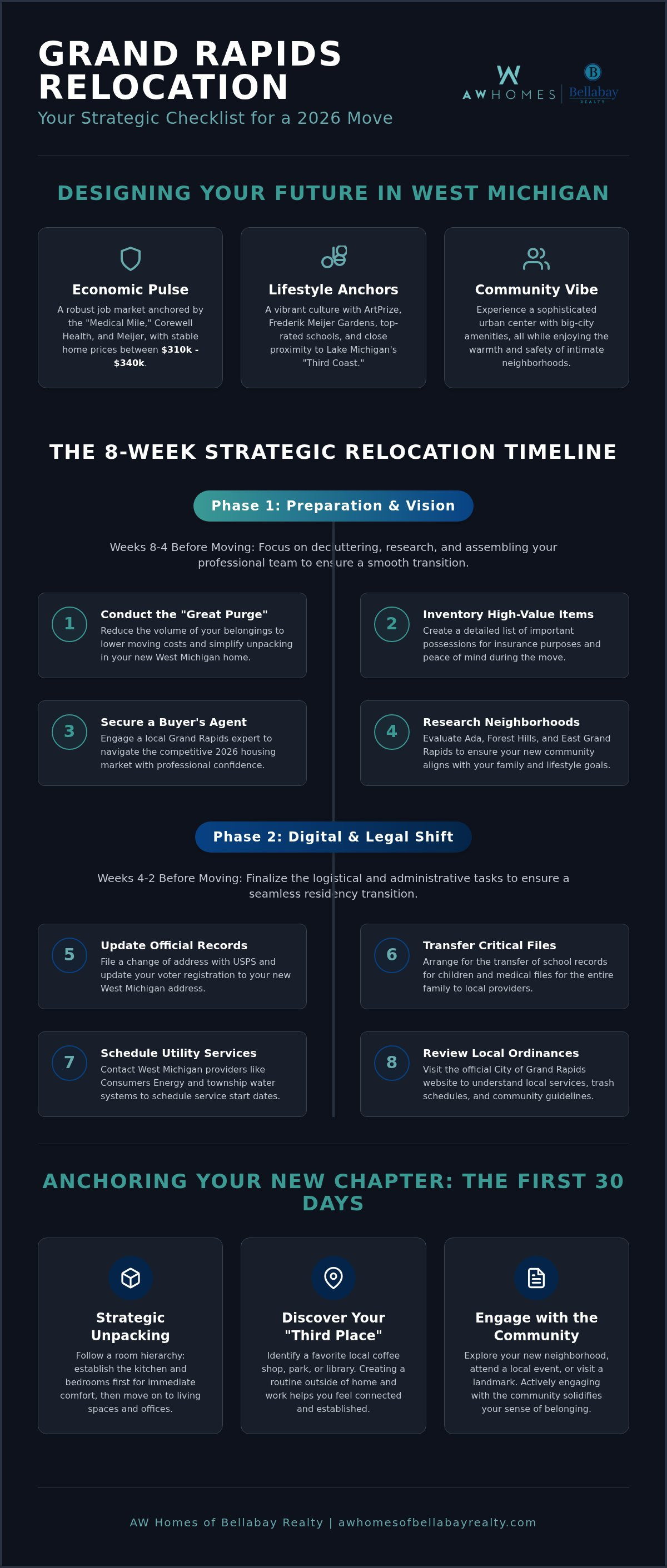
A successful move is built on three essential pillars: foresight, organization, and timing. When you approach a life transition with a structured plan, the inherent stress of moving transforms into a manageable, strategic evolution. Your Grand Rapids relocation checklist should begin exactly eight weeks before your move date. This timeline ensures that no detail is left to chance, providing the emotional security you need to focus on your family's next chapter in West Michigan.
Weeks 8 to 4: Preparation and Purging
The first phase of your move is defined by decluttering, inventorying, and researching. Begin by conducting a "Great Purge" of your current residence. Reducing the volume of your belongings doesn't just lower moving costs; it simplifies your transition into a new space. During this time, create a detailed inventory of high-value items for insurance purposes. If you haven't yet secured your new residence, it's critical to find a buyers agent Grand Rapids who understands the competitive 2026 market. Having a local authority on your side ensures you can navigate the nuances of neighborhoods like Ada or Forest Hills with professional confidence.
Weeks 4 to 2: The Digital and Legal Shift
As your move date approaches, the focus shifts to the logistical and digital requirements of residency. This is the time to update your USPS records and voter registration to reflect your new West Michigan address. Visit the official City of Grand Rapids website to review local ordinances and resident services. It's also vital to transfer school records and medical files to local providers. For those moving with children, verify the 2026 school registration deadlines for districts like East Grand Rapids or Forest Hills immediately. Cross-reference these tasks with your Grand Rapids relocation guide to ensure your timeline remains synchronized with local requirements.
The Final Countdown: Week 1 and Move Day
The final seven days are reserved for the "Essentials Kit" and final walkthroughs. Pack a separate box containing chargers, basic tools, medications, and enough toiletries for the first 48 hours. On move day, manage a "go-bag" for your most important documents, including your closing papers and keys. This methodical approach ensures that even in the middle of a multi-state transition, you remain in control. For personalized support that manages these details on your behalf, consider the concierge-style relocation assistance provided by our team, allowing you to arrive in Grand Rapids ready to enjoy your new home.
Neighborhood Nuances: Ada, Forest Hills, and East Grand Rapids
Selecting the right neighborhood is the most critical decision in your transition. It is the anchor for your family's daily life, your professional commute, and your long-term financial security. Your Grand Rapids relocation checklist must account for the distinct personalities of these West Michigan enclaves, as each offers a different rhythm of life. Whether you seek the walkable luxury of a historic village or the quiet acreage of a rural estate, understanding these nuances ensures your move is a positive evolution of your lifestyle.
Property taxes are a vital consideration for any strategic buyer. In Kent County, effective property tax rates typically range from 1.14% to 1.19%. It's important to remember that Michigan taxes are based on "taxable value," which is generally 50% of the market value at the time of purchase. While the City of Grand Rapids reduced its millage rate by 1.2% for the 2027 fiscal year starting in July 2026, suburban townships often offer different structures. Navigating these financial details requires a partner who prioritizes your long-term well-being over a quick closing.
Forest Hills and Ada: The Executive Choice
Ada and Forest Hills represent the pinnacle of rural elegance and executive living. These areas are characterized by rolling hills, private estates, and a deep connection to the outdoors. A unique aspect of this region is that school district boundaries often cross township lines; you might live in Ada Township but be part of the Forest Hills Public Schools system. This intersection creates a community defined by academic excellence, recreational trails, and the charming boutiques of Ada Village. For those already established in the area and looking to transition, our guide on how to sell my home Forest Hills MI provides the strategic focus needed for a high-stakes sale in the 2026 market.
East Grand Rapids and Cascade: Tradition and Growth
The West Michigan Utility and Service Directory
Establishing your roots in West Michigan requires a methodical approach to infrastructure. A functional home provides the emotional security needed to settle into your new life with confidence and clarity. This section of your Grand Rapids relocation checklist focuses on the practical systems that provide power, warmth, and connectivity to your residence. Managing these details early ensures that your family's transition is marked by comfort rather than logistical friction.
In the Grand Rapids area, Consumers Energy is the primary provider for electricity. As of the summer of 2026, residential peak rates are $0.245/kWh on weekdays from 2 p.m. to 7 p.m., while off-peak rates are $0.197/kWh. The average monthly electric bill in the region is approximately $234. Natural gas is typically managed by DTE Energy, though some rural pockets may utilize propane. Transitioning these accounts requires precision to avoid service gaps during your move-in week.
Water and sewer management depends on your specific municipality. For those moving within the city limits, 2026 rates saw a 6.38% increase for water services and a 3.09% decrease for sewer. If your move takes you to Ada, Cascade, or Forest Hills, you may be on a township system or utilize private well and septic services. Connectivity is equally vital; high-speed fiber options from AT&T and Xfinity are widely available, though local providers also offer competitive high-speed packages in suburban areas. Trash and recycling services are frequently privatized in West Michigan, with providers like Granger and Arrow Waste offering various curbside options.
Essential Contact Information
To ensure a seamless property transition, both buyers and sellers must coordinate utility transfers effectively. Sellers should schedule a "Final Reading" for the day of closing, while buyers must contact providers to "Start Service" on that same date. This synchronization prevents billing errors and ensures the lights are on when you arrive. Use the following contact points for your initial setup:
- Consumers Energy (Electric): 800-477-5050
- DTE Energy (Gas): 800-477-4747
Michigan homes require specific seasonal preparation, including furnace inspections and gutter clearing, to maintain efficiency and safety during the winter months.
Registering for Local Services
Becoming a local involves more than just a change of address; it's about integrating into the community's civic life. Visit the Secretary of State (SOS) to update your Michigan Driver’s License and vehicle registration within 30 days of your move. This visit is also an opportune time to update your voter registration and identify your local precinct for the next election cycle. Finally, securing a Grand Rapids Public Library card offers access to a wealth of community resources, digital media, and cultural programs. For a transition that prioritizes your peace of mind, our team provides concierge-level relocation assistance to manage these logistical details on your behalf.
Settling Into Your New Chapter: The First 30 Days
The first thirty days in a new residence represent a period of emotional recalibration. It is the time when a house transforms into a sanctuary. The final phase of your Grand Rapids relocation checklist shifts from logistical management to community integration. To minimize disruption to your family life, prioritize an "Unpacking Hierarchy." Establish the kitchen first to maintain the rhythm of shared meals, secure the bedrooms to ensure restorative rest, and then organize the communal living areas. This methodical approach provides a sense of order, comfort, and immediate stability.
Beyond the boxes, you must anchor your professional and personal safety nets. This involves establishing a local medical network, identifying a trusted mechanic, and selecting a primary financial institution. It is also the appropriate time for a reflective home closing process in Michigan review. Confirming that all post-closing documents are organized and that your homestead exemption is correctly filed ensures your long-term well-being is protected. This organized conclusion to your move allows you to step into your new life with clarity, security, and confidence.
Finding Your Community Roots
Integration is a proactive and rewarding journey. Join your specific neighborhood association or local social media groups to stay connected with regional events and neighborhood news. Spend your Saturday mornings at the Fulton Street Farmers Market or the Downtown Market; these locations serve as the cultural and culinary hearts of the city. Finding your "Third Place," whether it is a quiet park in Ada, a boutique coffee shop in East Grand Rapids, or a specialized gym in Forest Hills, is essential for feeling like a local. Attending a newcomer mixer or a local community center event can further accelerate your sense of belonging and localized reliability.
Maintaining Your Investment
Your home is a significant milestone that requires intentional stewardship and expert care. Schedule an initial HVAC tune-up to ensure your system is prepared for the specific demands of the Michigan climate. Identifying a reliable local handyman or a professional landscaping service early prevents minor maintenance tasks from becoming major stressors. Finalizing your transition with the support of a concierge-style relocation expert provides the emotional security that every detail has been managed. This strategic focus allows you to conclude your move with the peace of mind that only comes from expert navigation and purposeful planning. You are no longer just moving; you are arriving.
Embracing Your New Chapter in West Michigan
A successful move is more than a logistical triumph; it is a profound personal evolution. By following a structured 8-week timeline and understanding the distinct nuances of neighborhoods like Ada and East Grand Rapids, you replace uncertainty with intentionality. Your Grand Rapids relocation checklist serves as the foundation for this transition, ensuring that every detail is handled with professional precision. This strategic approach protects your time, your family's peace, and your professional focus.
Establishing your roots in a new community requires a partner who views your move as a significant life milestone. As a deeply rooted West Michigan neighborhood authority, Angela Worth acts as a strategic advisor for move-up buyers and downsizers alike. We provide the expert guidance, localized reliability, and personalized insight necessary to anchor your family in total emotional security. Start your stress-free move with Angela Worth’s concierge relocation services. We look forward to welcoming you home to a community where your future can truly flourish.
Frequently Asked Questions
How far in advance should I book movers for a Grand Rapids relocation?
You should secure your moving company at least eight weeks before your scheduled move date. High-quality movers in West Michigan often book several months in advance, especially during the peak spring and summer seasons. Including this step early in your Grand Rapids relocation checklist ensures you have your preferred dates and prevents the stress of last-minute logistical hurdles.
What are the best school districts in the Greater Grand Rapids area?
Forest Hills Public Schools and East Grand Rapids Public Schools are consistently recognized for their academic excellence and community support. These districts offer robust extracurricular programs, specialized learning paths, and high graduation rates. For families moving in 2026, it's vital to check specific registration deadlines and residency requirements for these top-tier districts well before the academic year begins.
How do I transfer my utilities when moving to Ada or Forest Hills?
You must contact Consumers Energy for electricity and DTE Energy for natural gas to schedule a service transfer for your closing date. While these major providers cover most of West Michigan, water and sewer services are typically managed at the township level in Ada and Forest Hills. Coordinating these transfers at least two weeks before your move ensures your home is functional and comfortable the moment you arrive.
Do I need a local Grand Rapids real estate agent if I already have a lender?
Yes, a local agent provides the neighborhood-specific insights and strategic negotiation skills that a lender cannot offer. A regional specialist understands the nuances of competitive bidding in 2026 and can guide you toward properties with long-term value. This partnership ensures your property transition is managed with professional authority, emotional security, and a focus on your family's unique lifestyle needs.
What are the average property taxes in Kent County, Michigan?
Effective property tax rates in Kent County generally range from 1.14% to 1.19% of a property's market value. Michigan uses a "taxable value" system where the assessed value is capped at the rate of inflation or 5% annually, whichever is lower, until the property is sold. This structure provides predictable long-term costs for homeowners, though you should always verify the specific millage rate for your chosen township or city.
What is the "Medical Mile" and how does it affect the local housing market?
The Medical Mile is a world-class healthcare and research corridor located in downtown Grand Rapids that serves as a major economic engine for the region. Its presence attracts high-level professionals, creates stable employment opportunities, and drives consistent demand for housing in nearby executive suburbs. This economic anchor contributes to the overall resilience and steady appreciation of the West Michigan real estate market.
How do I update my vehicle registration and license after moving to Michigan?
You are required to update your driver's license and vehicle registration at a Secretary of State (SOS) office within 30 days of establishing residency. You should bring proof of Michigan no-fault insurance, your current title, and identification documents to complete the process. Scheduling an appointment online in advance can significantly reduce your wait time and help you settle into your new life with greater ease.
Are there specific winter prep tasks I should know about when moving to West Michigan?
Preparing for a Michigan winter involves scheduling an HVAC tune-up, clearing your gutters, and insulating any exposed exterior pipes. You should also ensure your snow removal equipment is serviced or that you have a contract with a local plowing company before the first snowfall. These proactive steps protect your property investment and ensure your family remains warm and secure throughout the colder months.


