

What if the city with the lower sticker price actually leaves you with less wealth after five years? Choosing between Michigan's two largest hubs is rarely about the initial mortgage payment alone. It's about property tax trajectories, long-term equity growth, and the daily cost of your family's lifestyle. We understand that evaluating the cost of living Grand Rapids vs Detroit feels heavy when your financial security is on the line. You deserve a transition that feels intentional, secure, and expertly planned.
Moving is a significant milestone that marks the beginning of a new chapter. It's natural to feel concerned about overpaying in a volatile market or losing sleep over complex tax millage rates. This strategic 2026 comparison clarifies the economic landscape so you can move with absolute confidence. You'll discover the hidden tax differences between Kent and Wayne counties, the true value of school districts in areas like Forest Hills, and the lifestyle trade-offs between West and East Michigan. We've mapped out the data to help you select a community that honors your life stage and protects your legacy.
Key Takeaways
- Compare the economic foundations of both regions, contrasting Detroit’s industrial resurgence with the specialized medical and tech sectors driving Grand Rapids.
- Analyze the comprehensive cost of living Grand Rapids vs Detroit, focusing on how West Michigan’s stable inventory protects your long-term home equity.
- Identify the financial impact of regional tax millage rates and insurance premiums, including why Detroit residents often face significantly higher daily expenses.
- Quantify the lifestyle benefits of West Michigan, from the immediate access to Lake Michigan to the peace of mind provided by superior safety ratings.
- Master a strategic approach to your relocation by using a lifestyle audit to match your next home with your current life stage.
Grand Rapids vs. Detroit: Comparing the 2026 Economic Landscapes
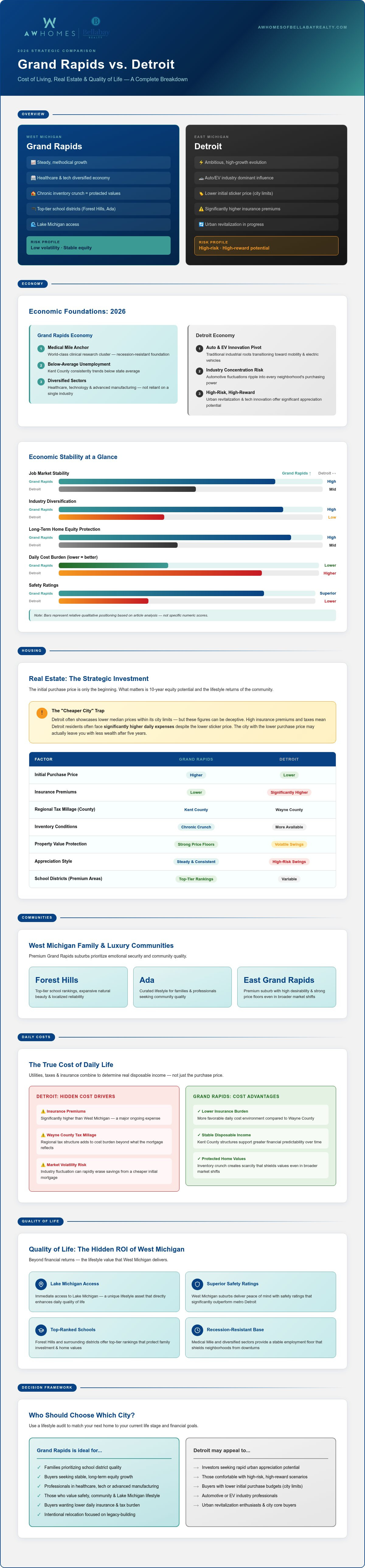
Understanding the cost of living Grand Rapids vs Detroit requires looking past basic price tags on eggs or gasoline. In 2026, these two cities represent distinct economic philosophies. Detroit remains a rebounding industrial giant, pivoting toward mobility and electric vehicle innovation. Conversely, Grand Rapids, Michigan, has matured into a diversified hub for healthcare, technology, and advanced manufacturing. While general indices might suggest Detroit offers a lower entry point, raw data often misleads relocation clients. It fails to account for how local tax structures and job market stability impact your actual disposable income over time.
A strategic relocation isn't just about what you spend; it's about what you keep. Job market stability plays a silent but critical role in your long-term cost of living. In a volatile market, a sudden job loss or industry downturn can quickly erase the savings gained from a cheaper mortgage. We view your move as a significant personal milestone, not just a financial transaction. Therefore, evaluating the underlying health of the local economy is the first step toward achieving true emotional and financial security in your new home.
The Economic Pulse of West Michigan
West Michigan’s economy is defined by its steady, methodical growth. The region’s strength is anchored by the Medical Mile, a world-class cluster of clinical research and healthcare facilities that provides a recession-resistant foundation. Kent County consistently maintains unemployment rates that trend below the state average, offering a level of security that protects your home investment from market volatility. This stability, coupled with a robust manufacturing sector, ensures that your property value isn't tied to a single industry’s performance. It's a landscape built on personalization, professional opportunity, and long-term equity.
The Southeast Michigan Economic Outlook
Detroit’s economic narrative in 2026 is one of ambitious evolution. The city has moved beyond its traditional roots to embrace tech innovation and urban revitalization. Investing in Detroit’s urban core offers a high-risk, high-reward scenario that appeals to those seeking rapid growth. However, the automotive industry still exerts significant influence over local purchasing power. When the industry fluctuates, the ripple effects are felt in every neighborhood. When calculating the cost of living Grand Rapids vs Detroit, one must weigh the stability of West Michigan against the high-growth potential of the East. Choosing Detroit involves balancing the potential for significant appreciation against the inherent volatility of a city in the midst of a massive transition.
Housing and Real Estate: Analyzing the Strategic Investment
Housing represents the most significant pillar of your financial legacy. When analyzing the cost of living Grand Rapids vs Detroit, the initial purchase price is only the beginning of the conversation. Detroit often showcases lower median prices within its city limits, but these figures can be deceptive for those seeking long-term stability. High-demand suburbs in both regions command a premium; however, the drivers of that value differ significantly between the East and West sides of the state. A strategic investor looks past the sticker price to evaluate the 10-year equity potential and the lifestyle returns of the community.
The latest Bureau of Labor Statistics Michigan economic data illustrates how regional wage growth supports these distinct housing markets. In West Michigan, a chronic inventory crunch has created a protective barrier for home values. This scarcity ensures that even during broader market shifts, properties in well-established neighborhoods retain their desirability and price floors. It's a market built on steady appreciation rather than the volatile swings often seen in larger metropolitan areas.
West Michigan Luxury and Family Communities
For families and professionals, areas like Forest Hills, Ada, and East Grand Rapids offer a curated lifestyle. These communities are defined by top-tier school rankings, expansive natural beauty, and localized reliability. Buyers are increasingly choosing these suburbs because they prioritize emotional security and community quality. To understand the deeper mechanics of this specific market, explore our guide on Grand Rapids Real Estate: Strategic Trends & 2026 Market Outlook. The premium paid for these locations is an investment in safety, education, and social capital that pays dividends for decades.
Detroit’s Suburban vs. Urban Real Estate
The Detroit real estate landscape is a study in contrasts. While the urban core offers historic homes at enticing price points, the renovation costs required to meet 2026 standards are often substantial; this creates a complex financial picture for the unwary buyer. Conversely, elite suburbs like Birmingham and Royal Oak command prices that frequently exceed the most expensive West Michigan enclaves. Investors must weigh the high rental yields found in Detroit’s revitalized neighborhoods against the predictable, low-stress growth found in Grand Rapids.
From a concierge perspective, we evaluate your move through three essential lenses:
- The historical resilience of the local school district.
- The planned infrastructure developments in the surrounding township.
- The current ratio of owner-occupied homes versus short-term rentals.
The Cost of Daily Life: Utilities, Taxes, and Essentials
Living in Michigan means balancing the state's natural beauty with its unique fiscal environment. When you evaluate the cost of living Grand Rapids vs Detroit, it's the recurring daily expenses that define your long-term comfort. While state income and sales taxes remain uniform, local variables like property millage rates and car insurance premiums create significant financial divergence. Choosing a community is about more than a zip code; it's about optimizing your monthly cash flow to support your family's evolution. We believe that financial clarity leads to emotional security.
One of the most striking differences lies in the car insurance factor. Detroit residents frequently pay 50% more for coverage than those in Grand Rapids. This isn't just a minor inconvenience; it's a structural cost that impacts your ability to invest elsewhere. According to U.S. Bureau of Labor Statistics Michigan economic data, these regional cost variations influence how residents allocate their earnings across housing, transport, and utilities. We focus on these nuances to ensure your transition is grounded in financial reality. Stability, security, and predictability are the hallmarks of a well-planned move.
Property Taxes: Kent vs. Wayne County
Property taxes are often the most misunderstood element of a home purchase. Wayne County typically carries higher millage rates compared to Kent County. This means that for the same total monthly payment, you can often secure a more substantial home in the Grand Rapids area. We look at taxes through the lens of return on investment. In communities like Forest Hills or Ada, your tax dollars fund top-tier school districts, maintain pristine public spaces, and enhance your long-term equity. It's a methodical way to ensure your money works as hard as you do.
Transportation and Commuting Costs
Your time is your most valuable asset. Grand Rapids is often celebrated as a 20-minute city, where most major amenities and employment hubs are reachable within a short drive. In contrast, Detroit’s sprawl necessitates longer commutes and higher fuel consumption. Urban driving in the East also brings a hidden cost of vehicle wear and tear. A shorter commute in West Michigan offers more than just fuel savings; it provides the peace of mind that comes with more time spent with family and less time navigating congestion. The lifestyle cost of a night out also varies, with Grand Rapids offering a curated dining scene that remains accessible and high-end without the inflated urban premiums found in larger metros.
Quality of Life and Community: The Hidden ROI of West Michigan
The true value of a home extends far beyond its square footage or the interest rate on a mortgage. When comparing the cost of living Grand Rapids vs Detroit, many families overlook the "hidden ROI" found in daily peace of mind and neighborhood connection. West Michigan offers a unique synergy of urban sophistication and natural serenity. With Lake Michigan’s coastline just a short drive away, the lifestyle here encourages a balance that is difficult to replicate in more densely packed metropolitan areas. We view your relocation as a journey toward personal evolution, where the community you choose acts as the foundation for your next chapter.
Safety ratings and crime indices are more than just statistics; they are the quiet architects of your well-being. Grand Rapids consistently provides a sense of security that allows residents to focus on growth rather than protection. This environment is particularly conducive to those in high-stakes professional transitions who require a calm home base. For a deeper dive into the logistics of this move, consult our Grand Rapids Relocation Guide: Your Strategic Roadmap to West Michigan in 2026. Natural beauty, academic excellence, and community safety form the cornerstone of the West Michigan experience.
Education and Schools: A Long-Term Wealth Driver
School districts in West Michigan, specifically Forest Hills and East Grand Rapids, serve as powerful long-term wealth drivers. High-performing schools don't just educate; they stabilize property values and ensure consistent demand for your investment. While Detroit’s elite suburbs like Grosse Pointe or Bloomfield Hills offer comparable academic excellence, the entry point for housing in those areas often reflects a much higher cost of living Grand Rapids vs Detroit comparison. We help you navigate these choices by aligning school quality with your specific life stage and financial goals. This methodical approach ensures that your children’s education and your home’s equity grow in tandem.
Recreation and Personal Evolution
The pace of life you choose should reflect your current priorities. Grand Rapids, often called "Beer City USA," boasts a vibrant arts scene and a community-centric culture that feels both high-end and accessible. Detroit offers the high-energy thrill of professional sports and world-class museums, which appeals to those seeking a faster tempo. However, for those looking to trade urban congestion for scenic beauty and a shorter commute, West Michigan provides a supportive environment for professional and personal development. It’s about selecting a community that mirrors your values and supports your long-term well-being. If you're ready to find a community that matches your vision for the future, our Buyer Agency Services provide the expert guidance needed for a stress-free transition.
Planning Your Transition: Strategic Next Steps for Your Move
Transitioning to a new city is a profound personal milestone. It involves more than just shifting your belongings; it's about recalibrating your lifestyle and securing your financial future. When navigating the cost of living Grand Rapids vs Detroit, the final step isn't just knowing the numbers. It's about executing a move that feels seamless and supportive. We believe that a successful relocation is built on three pillars: expert local insight, methodical financial planning, and emotional security. This strategic approach ensures your next chapter begins with total confidence.
Before you pack a single box, conduct a comprehensive lifestyle audit. Ask yourself how much you value a 20-minute commute, proximity to Lake Michigan, or the stability of a specific school district. This audit ensures your move aligns with your current life stage rather than just your budget. Managing a cross-state sale and purchase simultaneously can feel overwhelming. However, with the right advisor, this high-stakes transition becomes a structured, manageable process. To navigate the complexities of the 2026 market, it's essential to Find a Buyers Agent in Grand Rapids: A Strategic Guide to Your 2026 Home Purchase. Partnering with a specialist allows you to focus on your family while we handle the logistical precision.
The Angela Worth Concierge Approach
We position ourselves as your strategic advisor, not just your real estate agent. Our concierge approach is designed to mitigate the inherent stress of relocation through intentionality and expert navigation. We use a deep-dive comparative market analysis to find hidden value in West Michigan neighborhoods that generalist competitors often overlook. As transition experts, we understand the logistical nuances of moving between Wayne and Kent counties. We focus on your long-term well-being, ensuring that no detail is left to chance during your personal evolution.
Your Relocation Checklist
A successful move requires a clear, action-oriented roadmap. This progression creates a narrative of success that mirrors the actual process of a major transaction. Follow these steps to ensure your transition to West Michigan is both efficient and stress-free:
- Step 1: Secure a pre-approval with a lender who understands the nuances of the West Michigan market and 2026 property tax structures.
- Step 2: Schedule a neighborhood immersion tour in Grand Rapids, Ada, and Forest Hills to experience the local culture and community rhythm firsthand.
- Step 3: Partner with a listing agent who specializes in executive transitions to manage your current property sale with professional authority.
This methodical checklist moves the conversation away from chance and toward expert planning. By focusing on these strategic milestones, you can resolve the cost of living Grand Rapids vs Detroit debate with total clarity. We provide the localized reliability you need for a high-end, accessible moving experience. If you're ready to begin your journey, our Relocation Assistance services are designed to provide the emotional security you deserve.
Secure Your Financial and Emotional Future in West Michigan
Choosing your next home is a significant personal milestone that defines your family’s trajectory. While the initial data on the cost of living Grand Rapids vs Detroit might favor the east side's entry-level prices, the long-term value often rests in the west. West Michigan provides a unique combination of stable property taxes, lower insurance premiums, and superior school district quality in areas like Forest Hills and Ada. These factors, paired with the proximity to Lake Michigan, create a lifestyle ROI that transcends simple financial transactions.
We understand that high-stakes transitions require a strategic focus. Our team provides specialized relocation expertise, deep localized knowledge, and a calm, methodical approach to ensure your move is grounded in security. We prioritize your legacy, your comfort, and your peace of mind. You don't have to navigate these complex market dynamics alone. Start your intentional move to Grand Rapids with a strategic consultation today. We are here to guide you toward a community that truly honors your next chapter. Your evolution deserves the precision of a dedicated partner.
Frequently Asked Questions
Is it cheaper to live in Grand Rapids or Detroit?
Detroit city limits often show a lower sticker price for housing, but the total cost of living Grand Rapids vs Detroit tells a different story. When you look at the total monthly outflow, Grand Rapids often proves more economical. Detroit residents face significantly higher car insurance premiums and city income taxes. We focus on helping you find a home where your daily expenses align with your long-term wealth goals in West Michigan.
How do property taxes compare between Grand Rapids and Detroit in 2026?
Property taxes in Wayne County are frequently higher due to elevated millage rates compared to Kent County. In 2026, homeowners in Grand Rapids, Ada, and Forest Hills benefit from more competitive tax structures that maximize their purchasing power. These savings allow you to invest more into the quality of your home rather than administrative costs. We provide a methodical breakdown of these rates to ensure your monthly mortgage payment remains predictable and secure.
Why is car insurance so much higher in Detroit than in Grand Rapids?
Detroit’s car insurance rates are among the highest in the nation due to unique risk factors and historical litigation patterns. Residents in the Detroit metro area often pay 50% more for the same coverage than those in the Greater Grand Rapids area. Moving to West Michigan offers immediate relief for your household budget. This reduction in recurring costs is a significant factor when calculating the true cost of living Grand Rapids vs Detroit for your family.
Which city has better schools for families moving to Michigan?
Both regions offer elite options, but West Michigan provides superior accessibility to top-tier education. Districts like Forest Hills and East Grand Rapids are consistently ranked among the best in the state for academic excellence and college readiness. While Detroit’s Grosse Pointe or Birmingham are comparable, the lifestyle in Grand Rapids offers a more cohesive community feel. We specialize in matching families with neighborhoods where school quality acts as a permanent anchor for home value.
What is the median home price in Grand Rapids vs Detroit suburbs?
Suburban pricing varies significantly by neighborhood. In high-demand West Michigan areas like Ada or Cascade, median prices reflect the premium for safety and school quality. Detroit’s elite suburbs often command higher prices than the most expensive Grand Rapids enclaves. However, the move-up market in Grand Rapids offers more consistent inventory and stable appreciation. We help you navigate these price points with a strategic advisor's perspective to ensure you don't overpay in a volatile market.
Is Grand Rapids a safer city to live in than Detroit?
Statistical data and crime indices generally favor Grand Rapids as the safer metropolitan area. This sense of security is a core pillar of the West Michigan lifestyle, providing the emotional reassurance families need during a major life transition. Whether you are choosing a home in Caledonia or East Grand Rapids, the lower crime rates contribute to a more relaxed and predictable environment. We view safety as a non-negotiable component of your long-term well-being and investment stability.
How does the cost of groceries and utilities compare in West Michigan?
The cost for essentials like groceries and utilities is relatively consistent across the state, though micro-climates can influence seasonal heating costs. West Michigan’s proximity to local agriculture often provides better access to fresh, affordable produce in communities like Ada and Forest Hills. Utility rates in Grand Rapids are competitive with Detroit, though the shorter commute times in West Michigan lead to significant secondary savings on fuel and vehicle maintenance. These small daily differences add up over a decade.
Which city offers better long-term real estate investment ROI?
Grand Rapids offers superior long-term ROI through stable equity growth and consistent demand. While Detroit’s urban core offers high-risk speculative opportunities, West Michigan properties hold their value during economic shifts. The inventory crunch in Kent County ensures that your home remains a liquid and appreciating asset. We focus on finding properties in high-demand school districts that serve as a secure foundation for your financial legacy and personal evolution.


