

In a market where homes sell in just six days and inventory sits at a mere 1.1 months, the traditional path to property ownership has become a high-stakes sprint that often leaves investors behind. You've likely felt the pressure of rising contractor costs in Kent County and the frustration of competing against multiple offers on every listing. It's a complex landscape where local rental certification requirements and tight margins can make even seasoned professionals feel uneasy about their next move. We understand that real estate is more than a transaction; it's a significant life transition that requires expert navigation and a steady hand.
This guide will show you how to master the BRRRR method Grand Rapids real estate investors are using to recycle capital, generate passive income, and build long-term wealth. We'll explore how to navigate the 2026 market dynamics, leverage new ADU zoning changes, and identify stable equity opportunities in neighborhoods like Ada and Caledonia. By following a methodical, strategic, and localized approach, you can move away from the stress of competition and toward the security of a high-equity rental portfolio. Let's begin this journey toward your financial evolution with clarity, confidence, and expert insight.
Key Takeaways
- Discover why the 2026 West Michigan market remains a strategic "sweet spot" for building equity, generating income, and securing your financial future.
- Master the BRRRR method Grand Rapids real estate professionals use to find off-market deals, assess architectural value, and execute surgical renovations.
- Navigate the complexities of local rental certifications and leverage regional credit unions to secure the most favorable refinancing terms for your property transitions.
- Identify the specific neighborhood clusters, including Creston, Wyoming, and Kentwood, where the numbers currently align for high-demand rental success.
- Learn how a concierge-style advisor provides the methodical planning, expert insight, and local authority needed to scale your portfolio with confidence.
Understanding the BRRRR Method in the Grand Rapids Market
The BRRRR method Grand Rapids real estate investors utilize is a calculated cycle of wealth creation. It stands for Buy, Rehab, Rent, Refinance, and Repeat. Unlike a traditional flip where you sell for a one-time gain, this strategy focuses on property retention, equity growth, and consistent cash flow. In 2026, West Michigan has emerged as a premier location for this approach due to its resilient housing market and steady population growth. Success here isn't about luck; it's about expert navigation, methodical planning, and local authority.
Investors often look at two key metrics: the 1% Rule and the 70% Rule. While national averages provide a baseline, our local market requires a more nuanced touch. With median home prices around $300,000, achieving 1% of the purchase price in monthly rent takes specialized property sourcing. Similarly, the 70% rule, which suggests your total investment shouldn't exceed 70% of the After Repair Value (ARV), must account for current Kent County renovation costs. Adapting these real estate investing principles to our specific neighborhood dynamics is what separates a successful portfolio from a stressful transaction.
The Core Philosophy: Velocity of Capital
The true power of this strategy lies in the velocity of your capital. By refinancing and pulling out your initial investment, you effectively recycle your down payment to fund the next acquisition. This process provides more than just financial gain. It offers emotional security, professional growth, and a clear path toward long-term wealth. You aren't just an accidental landlord; you're a strategic consultant of your own future. This transition from buying a single house to building a multi-property legacy is a significant personal milestone that we're here to facilitate.
Why Grand Rapids? Market Stability and Growth
Grand Rapids continues to outperform national averages because of its diverse economic pillars. The Medical Mile, manufacturing hubs, and a vibrant tech sector create a consistent demand for high-quality rental housing. While other markets see volatile swings, West Michigan offers a sense of localized reliability. As detailed in our Grand Rapids Real Estate: Strategic Trends & 2026 Market Outlook, the city's 3% to 4% annual price growth provides a stable foundation for the Refinance stage. This environment allows you to build equity with confidence, knowing your investment is anchored in a community that values progress and stability.
The 'Buy' and 'Rehab' Phases: Finding Distressed Value in West Michigan
Sourcing properties in 2026 requires more than just refreshing the MLS. With inventory hovering at 1.1 months, the most lucrative deals often happen behind the scenes through off-market networking and deep-rooted community ties. Success in the BRRRR method Grand Rapids real estate market depends on your ability to identify value where others see only work. This is a surgical process of selection that favors the patient investor over the impulsive buyer. You're looking for properties with "good bones," such as the sturdy 1920s bungalows in Creston or the resilient mid-century ranches in Wyoming. These architectural styles often feature original hardwoods and solid foundations that provide a predictable, high-quality canvas for your vision.
Sourcing Your First (or Next) BRRRR Property
A dedicated Buyers Agent in Grand Rapids acts as your strategic scout, identifying investor-grade inventory before it faces a bidding war. This specialized sourcing is vital because Michigan housing market data shows a steady upward trajectory in home prices, making it easy to overpay without expert guidance. We focus on identifying distressed properties in emerging neighborhoods where the potential for appreciation is highest. Winning a deal in this environment isn't about the highest price; it's about the cleanest terms and the most certain path to closing.
Strategic Rehab: Renovating for Local Rental Demand
Renovating in West Michigan requires a specific focus on longevity and local weather patterns. You must prioritize energy efficiency to protect your investment from the region's unforgiving winters. Upgrading attic insulation, sealing windows, and installing high-efficiency furnaces are essential steps that reduce tenant turnover and lower long-term maintenance costs. Forced equity is the financial delta between your total acquisition and renovation costs and the final appraised After Repair Value. Beyond the mechanicals, we recommend focusing on the following "forced equity" updates:
- Modernizing kitchens with durable, high-end finishes that appeal to young professionals.
- Upgrading bathrooms with waterproof flooring and contemporary fixtures.
- Enhancing curb appeal with fresh siding or professional landscaping to stand out in the rental market.
Navigating the local contractor landscape in Kent County can be challenging due to ongoing labor shortages. A methodical approach to scheduling and a trusted network of tradespeople are your best defenses against rising costs. If you're looking to refine your acquisition strategy, our real estate investment consulting can help you map out a rehab budget that aligns perfectly with current appraisal trends.
Maximizing ROI: Renting and Refinancing with Local Expertise
Completing a renovation is a significant personal milestone. It marks the transition from construction to cash flow. In the BRRRR method Grand Rapids real estate cycle, the 'Rent' phase is your proof of concept. With median rents in the city ranging from $1,435 to $1,623 in August 2026, finding the right tenant is about matching quality housing with reliable neighbors. This stage ensures your property isn't just an asset; it's a home that provides emotional and financial security. It's a methodical process of screening, placement, and management.
Refinancing is where the velocity of capital truly accelerates. Most lenders require a six-month seasoning period before allowing a cash-out refinance. During this time, you'll want to maintain a clean paper trail of all rehab expenses and lease agreements. In the current market, expect investment property mortgage rates to start around 7.309% to 7.809%. Aiming for a conservative 70% to 75% Loan-to-Value (LTV) ratio protects your equity while providing the liquidity needed for your next acquisition. This balance of debt and equity is the hallmark of a strategic advisor's approach.
Grand Rapids Rental Compliance and Certification
The City of Grand Rapids requires a meticulous rental inspection process. Every unit must be certified to ensure safety, habitability, and longevity. This involves checking mechanical systems, egress windows, and smoke detectors. While the city has strict ordinances, surrounding areas like Ada or Caledonia often operate under different township rules. Understanding these nuances early prevents costly delays in your timeline. We track these shifting fee schedules and assessment trends to ensure your property remains compliant, safe, and profitable.
The Refinance Strategy: Local vs. National Lenders
Local credit unions and portfolio lenders in West Michigan often offer more flexibility than national banks. They understand the neighborhood dynamics of East Grand Rapids or Forest Hills and value long-term relationships over simple credit scores. To win their confidence, prepare a comprehensive 'Investor Binder' containing your purchase documents, itemized rehab receipts, and the signed lease. If an appraisal comes in lower than expected, having this data ready allows for a professional rebuttal based on local market specifics rather than generic algorithms. This methodical approach reduces the inherent stress of high-stakes financing and positions you as a high-level partner in the local economy.
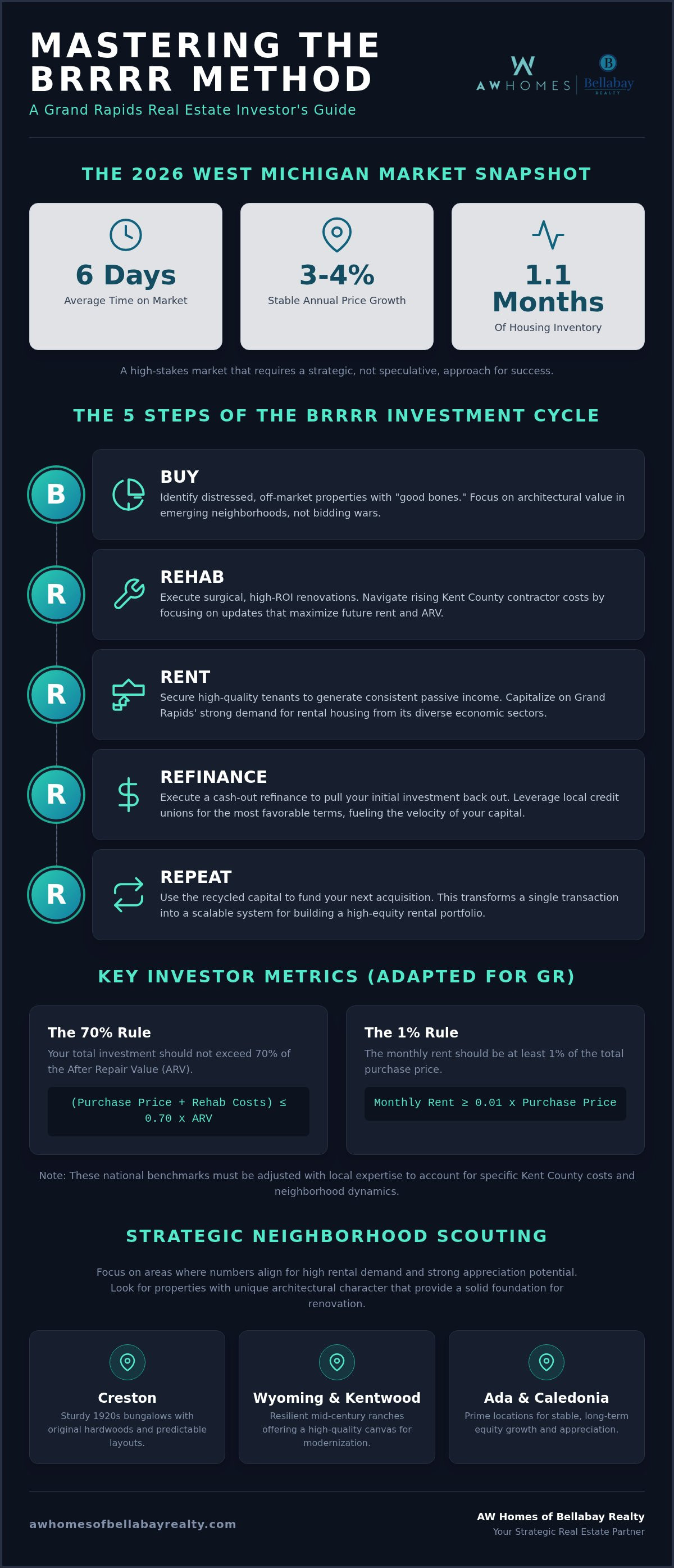
Strategic Neighborhood Scouting: Where the BRRRR Numbers Align in 2026
Success in the BRRRR method Grand Rapids real estate market is a game of geographic precision. You can't simply look at a map; you must understand the rhythm of each street, the quality of the schools, and the proximity to employment hubs. Creston and Belknap Lookout currently offer a sophisticated balance between entry-level pricing and high rental demand, specifically from professionals working on the Medical Mile. If you prefer a more predictable "bread and butter" approach, Wyoming and Kentwood provide consistent opportunities where the numbers often align without the volatility of more speculative areas. These neighborhoods represent the core of a stable rental portfolio, providing reliability, cash flow, and long-term value.
For those focused on significant equity plays and luxury rentals, Forest Hills and Ada present higher entry points but offer immense long-term potential. These areas are characterized by spacious lots, premium amenities, and a sense of exclusivity that attracts high-quality long-term tenants. Meanwhile, East Grand Rapids remains the gold standard for buy-and-hold strategies. In this community, historic charm and prestige ensure consistent appreciation that often outpaces the broader market. Choosing the right neighborhood is the first step in ensuring your investment reflects your long-term vision for wealth and stability. It's about finding the perfect intersection of market data and lifestyle appeal.
Emerging vs. Established Neighborhoods
Evaluating risk versus reward requires a deep understanding of community infrastructure. Forest Hills and Caledonia act as a natural hedge against market shifts, protecting your investment through their reputation for academic excellence and high quality of life. You can explore these amenities and local school data in detail through our Ada MI Neighborhood Guide. While the Southeast side of Grand Rapids shows promise, established suburbs offer a level of emotional security that many investors prioritize during major life transitions. This balance of growth and stability is vital for a stress-free investing experience.
The 'Path of Progress' in West Michigan
The 'Path of Progress' is the geographic direction of municipal and commercial expansion. Identifying this movement involves analyzing local zoning maps, infrastructure changes, and upcoming commercial developments. We look for signals like new transit lines, grocery store expansions, or corporate headquarters relocations that indicate a shift in property values. This methodical research allows you to predict the next hotspot before it becomes common knowledge. By positioning your portfolio in the way of growth, you turn speculative chance into expert navigation. If you're ready to identify your next acquisition target, our real estate investment consulting provides the data-driven insights you need to move forward with confidence.
Scaling Your Portfolio: How a Strategic Real Estate Partner Simplifies the BRRRR Journey
Scaling a portfolio is a marathon of intentionality. Once you've successfully navigated the first four pillars, the final step, Repeat, becomes the engine of your financial evolution. In the BRRRR method Grand Rapids real estate cycle, repeating is not just about doing it again; it's about doing it with more precision, more speed, and more certainty. This is where a strategic advisor moves beyond simple brokerage to provide high-level investment consulting. We help you analyze the macro trends of Kent County while keeping a micro-focus on the specific street-level data that ensures your next acquisition is as stable as your first. This progression creates a narrative of growth that mirrors the actual process of a major life transition.
A common pitfall for growing investors in West Michigan is the temptation to over-leverage in a competitive environment. Our methodical approach prioritizes your long-term well-being over a quick closing. We analyze debt-to-equity ratios, cash-flow cushions, and local tax assessment trends to ensure your expansion doesn't compromise your emotional security. You deserve a partner who values your legacy as much as your ROI. By leveraging local market insights, we help you avoid the mistakes that often stall a burgeoning portfolio, providing the clarity, confidence, and expert insight needed for sustainable success.
The AW Homes Strategic Advantage
Our role at AW Homes of Bellabay Realty extends far beyond the transaction. We provide a concierge-style approach to property sourcing, giving you access to off-market inventory through our deep West Michigan roots. By leveraging our regional dominance in areas like East Grand Rapids, Ada, and Forest Hills, we find opportunities that never reach the public eye. This high-level navigation ensures that no detail is left to chance, providing you with the trust, warmth, and localized reliability you need to scale with confidence. We view our services not merely as financial transactions but as significant personal milestones in your journey toward wealth.
Next Steps: Your Consultative Journey Begins
Your path to building a high-equity rental portfolio begins with a single, focused conversation. We start by defining your "Buy Box," which is a specific set of criteria covering location, property type, and projected ROI. This clarity allows us to move with speed and certainty when the right deal emerges in the 2026 market. We invite you to start your Grand Rapids investment journey with a strategic consultation today. Together, we will turn your vision of long-term wealth into a methodical, step-by-step reality, ensuring your financial and emotional security every step of the way.
Your Future in West Michigan Real Estate
Mastering the BRRRR method Grand Rapids real estate investors rely on is a journey of personal evolution and financial clarity. You've seen how success is built through surgical acquisition, methodical renovation, and strategic neighborhood selection. By focusing on high-demand areas like East Grand Rapids and Forest Hills, you move beyond the stress of high-stakes transactions into a space of long-term security. This process is about more than just property; it's about building a legacy that supports your life transitions with confidence and grace. You have the tools to turn market volatility into a structured path for wealth creation.
We provide the concierge-style service and localized authority needed to navigate the complexities of the 2026 market. Our approach prioritizes your emotional security, wealth growth, and professional success. You don't have to navigate these high-stakes decisions alone. We're here to act as your high-level consultant, ensuring that every detail is managed with precision and care. Schedule your strategic real estate investment consultation with AW Homes today. The path to a multi-property portfolio is within your reach, and we're honored to help you take that next meaningful step toward your future.
Frequently Asked Questions
Is the BRRRR method still profitable in Grand Rapids with 2026 interest rates?
Yes, the BRRRR method Grand Rapids real estate investors utilize remains profitable, though it requires more surgical precision than in previous years. With investment property mortgage rates starting around 7.309% in August 2026, success depends on finding distressed value and leveraging the city's new, streamlined zoning for Accessory Dwelling Units. The recent Michigan law limiting institutional investors has also created a more balanced environment for individual specialists to secure deals.
What is the typical seasoning period for a BRRRR refinance in Michigan?
Most conventional and local portfolio lenders in West Michigan require a six-month seasoning period before you can proceed with a cash-out refinance based on the new appraised value. This timeframe allows the property's market value to stabilize after renovations are complete. While some specialized lenders might offer shorter windows, a six-month hold is the standard for ensuring the emotional and financial security that traditional banks require for long-term financing.
How much cash do I actually need to start a BRRRR deal in Grand Rapids?
You typically need enough capital to cover a 20% to 25% down payment plus your initial renovation reserves. Given the current median sale price in Grand Rapids is approximately $300,000, you should plan for an initial acquisition cost of $60,000 to $75,000. Additionally, since local construction costs often range from $100 to $300 per square foot, having a liquid cash reserve for the "Rehab" phase is essential for a seamless transition.
Do I need a special license to rent out property in the City of Grand Rapids?
You must obtain a rental certificate from the City of Grand Rapids before you can legally place a tenant in your property. This involves a methodical inspection process where city officials verify that the home meets all current safety, habitability, and building codes. We recommend verifying the 2026 rental certification fee schedules early in your planning process to avoid any unexpected delays during the "Rent" phase of your investment.
What are the best neighborhoods in Grand Rapids for the BRRRR method right now?
Creston, Belknap Lookout, Wyoming, and Kentwood currently offer the most strategic balance of entry-level pricing and high rental demand. These neighborhoods are anchored by stable employment hubs and offer the consistent "bread and butter" inventory that makes the BRRRR method Grand Rapids real estate cycle predictable. Focusing on these regional markers allows you to build equity with confidence while tapping into a deep pool of reliable, long-term tenants.
Can I use the BRRRR method for multi-family homes in West Michigan?
Multi-family homes are highly effective for this strategy because they often provide superior cash flow and higher appraisal stability. Duplexes and triplexes in areas like the West Side or Heritage Hill are particularly popular for investors looking to scale their portfolios quickly. While the competition for these properties is intense, the ability to "house hack" or rent multiple units makes them a cornerstone of many successful wealth-building journeys.
How do I find a reliable contractor for my Grand Rapids rehab project?
Finding a trustworthy contractor in Kent County requires leveraging local professional networks and checking verified regional references. Because a full whole-home remodel can range from $70 per square foot for cosmetic updates to over $475 for luxury renovations, you should always secure multiple itemized bids. We recommend working with a strategic advisor who has deep roots in the local community to access a vetted list of reliable tradespeople.
What is the 70% rule in real estate and does it apply to the Grand Rapids market?
The 70% rule suggests your total investment shouldn't exceed 70% of the After Repair Value, but it must be adapted for our current low-inventory market. With only 1.1 months of housing supply and homes selling for 101.6% of list price, many local investors now target a 75% or 80% threshold. This methodical adjustment allows you to remain competitive in high-growth neighborhoods like Ada or Forest Hills while still protecting your equity cushion.


