

What if that thirty-page inspection report isn't a list of reasons to walk away, but your most powerful tool for securing long-term value? It's natural to feel a surge of analysis paralysis when faced with technical findings about foundation health, roof longevity, or electrical safety. You want to ensure your future home is safe, sound, and a wise financial commitment. Successfully negotiating repairs after home inspection is the most delicate phase of your real estate journey. It requires a blend of market insight, technical knowledge, and strategic patience to reach the finish line.
We understand that you're not just buying a property; you're choosing the backdrop for your next life transition. This guide simplifies the complex by helping you distinguish between cosmetic flaws and structural necessities. You will learn how to request meaningful concessions, understand the financial nuances of a repair credit, and maintain your momentum toward a successful closing. By following this methodical approach, you can protect your investment while securing your West Michigan home with complete emotional security.
Key Takeaways
- Transform the overwhelming inspection report into a clear, strategic roadmap that guides your investment decisions with confidence.
- Distinguish between critical safety issues, structural integrity concerns, and simple cosmetic updates to prioritize what truly matters for your future.
- Master the art of negotiating repairs after home inspection by choosing between the immediate security of a fix or the long-term flexibility of a closing credit.
- Utilize a data-driven approach by gathering professional quotes to ground your requests in technical reality rather than emotional reaction.
- Secure your dream home through a methodical negotiation process that emphasizes transparency, professional authority, and a seamless path to closing.
Understanding the Home Inspection Report: Moving from Anxiety to Action
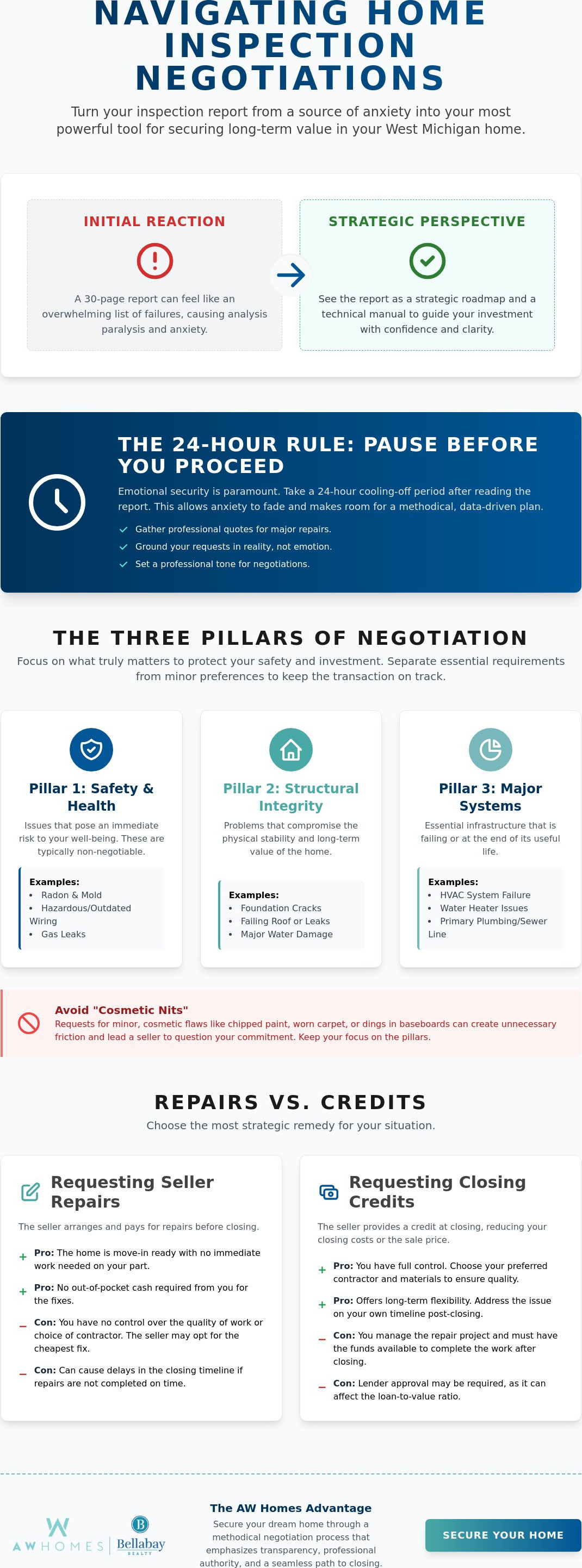
Receiving a thirty-page home inspection report can feel like a sudden weight on your shoulders. It is easy to view the document as a list of reasons why your dream home is failing, but a strategic shift in perspective is necessary. Instead of a list of failures, see this report as a comprehensive roadmap for your future property. It is a technical manual that provides the clarity you need to make an informed investment. Whether you are looking at a historic home in Heritage Hill or a custom new construction in Ada, every property has a laundry list of findings. No house is perfect; even a brand-new build will have minor settling or installation nuances that a professional will catch.
Understanding the Home Inspection process allows you to separate technical observations from genuine deal-breakers. In Michigan real estate, we distinguish between simple maintenance items and material defects. A material defect is a specific issue that has a significant impact on the value of the property or poses an unreasonable risk to people. Maintenance items, such as a worn faucet or a loose door handle, are part of the normal evolution of homeownership. Your Grand Rapids buyer's agent acts as your primary consultant during this phase, helping you triage the report to focus on what truly matters for your long-term well-being.
The Inspector's Narrative vs. Your Financial Reality
Inspectors use precise, often alarming language to protect themselves and ensure you are fully aware of every detail. Phrases like "immediate attention required" or "end of useful life" can sound terrifying, but they often describe routine aging. You don't need to negotiate all fifty items in a fifty-page report. Instead, identify the red flags that require expert consultation, such as structural movement or outdated electrical systems. This focused approach ensures that negotiating repairs after home inspection remains a productive conversation rather than an adversarial one.
The 24-Hour Rule: Processing the Data Before Responding
Emotional security is paramount during a high-stakes transaction. We recommend a twenty-four-hour cooling-off period after you first read the report. This time allows the initial anxiety to fade, making room for a methodical plan. During this window, we often coordinate with specialized contractors, such as HVAC experts or roofers, to get concrete data on repair costs. Using this time to gather facts ensures your response is grounded in reality. It sets a professional tone that shows the seller you are moving forward with intentionality, personalization, and expert insight.
Prioritizing Repair Requests: The Three Pillars of Negotiation
Successful negotiation is not a battle to win; it is a strategic alignment of safety, value, and momentum. When you are negotiating repairs after home inspection, the goal is to protect your future while keeping the transaction on track. We categorize requests into three distinct pillars to maintain clarity and focus. These pillars help you separate essential requirements from minor lifestyle preferences. By following this methodical structure, you ensure your investment is sound without alienating the seller over trivial details.
- Pillar 1: Safety and Health. Issues that pose an immediate risk to your well-being, such as radon, mold, or hazardous wiring.
- Pillar 2: Structural Integrity. Problems that compromise the physical stability of the home, including foundation cracks or failing roofs.
- Pillar 3: Major Mechanical Systems. The essential infrastructure that makes a home livable, such as the HVAC system, water heater, and primary plumbing lines.
Focusing on these pillars preserves your professional authority. Conversely, focusing on "cosmetic nits" like chipped paint, worn carpet, or minor dings in baseboards can derail even a million-dollar transaction. These requests create unnecessary friction and can lead a seller to question your commitment to the deal. Keep your eyes on the significant items that impact your long-term security and financial health.
Safety Issues: The Non-Negotiables in West Michigan
In our regional climate, certain environmental factors are non-negotiable. Radon testing is a common and recommended add-on in West Michigan, typically costing between $125 and $200. If levels are elevated, demanding a mitigation system is a standard safety request. Electrical hazards are equally critical. Outdated Federal Pacific panels or ungrounded wiring are local deal breakers that often make a home uninsurable. Additionally, moisture issues in Grand Rapids basements must be addressed to prevent mold growth. These items are about more than just money; they are about your peace of mind and emotional security.
Structural and Systemic 'Big Ticket' Items
Structural integrity is the bedrock of your investment. In Michigan, the average foundation repair costs approximately $9,250, though major structural work can exceed $30,000. If an inspector identifies significant movement, bringing in a structural engineer is the methodical next step. Roofs also represent high-stakes negotiations. With asphalt roof replacements for a 2,000 sq ft home ranging from $11,000 to $18,000 in 2026, a roof with less than three years of useful life is a primary concern. However, remember the "Functional System" rule. If an older furnace or water heater is currently operational, sellers are often hesitant to replace it. Navigating these nuances requires a steady hand, which is why our buyer agency services focus on strategic advocacy rather than high-pressure tactics.
Repairs vs. Credits: Choosing the Most Strategic Remedy
Once you have prioritized your findings, the next step in negotiating repairs after home inspection is deciding how you want those issues resolved. You generally have three primary options: physical repairs performed by the seller, a closing cost credit, or a reduction in the sales price. Each path has distinct financial and logistical implications for your future. While having the seller fix a leaking pipe before you move in sounds convenient, it often carries hidden risks that can impact your long-term emotional security.
Seller-performed repairs are frequently motivated by cost-saving rather than longevity. A seller might choose the lowest bidder for an asphalt roof replacement, which in 2026 averages $11,000 to $18,000 in West Michigan. A budget fix might skip the ice and water shield required by Michigan building codes, leading to ice dams and moisture issues during our harsh winters. Conversely, a closing cost credit provides immediate liquidity. It lowers the amount of cash you need at the closing table, allowing you to hire your own trusted specialists after you take possession. A sales price reduction lowers your long-term debt, but the impact is often minor. With 30-year fixed rates currently around 6.375% to 6.56%, a $5,000 price drop only saves you roughly $30 per month.
Why Seller Credits Often Lead to Emotional Security
Choosing a credit allows you to oversee the quality of every repair. You can ensure that your home receives the intentionality and expert insight it deserves by selecting your own licensed contractors. This path also avoids common closing delays. If a contractor's schedule slips, a physical repair could push your closing date back by weeks. A credit keeps the process seamless and unhurried. It ensures that when you receive the keys, you have the funds to address items with a focus on your family's long-term well-being.
When Physical Repairs are Mandatory
There are instances where the decision is made for you by your lender. Michigan mortgage underwriters often flag specific items that must be addressed before funding can be approved. Appraiser-required repairs for FHA or VA loans, such as peeling lead-based paint or missing handrails, are non-negotiable "safety and soundness" standards. In these cases, the seller must complete the work before the transaction can proceed. You must ensure all work is performed by licensed Michigan contractors and that the property meets the necessary certificate of occupancy standards before the final walkthrough.
The Negotiation Roadmap: Steps to a Win-Win Agreement
Moving from the analysis of a report to the actual conversation requires precision, data, and composure. Successfully negotiating repairs after home inspection is a four-step journey that ensures your interests are protected while respecting the seller's position. This methodical progression prevents emotional reactions from clouding your financial judgment.
- Step 1: Grounding in Data. Don't rely on estimates or guesses. Gathering professional quotes from local specialists provides a technical foundation for your requests. Approaching the process of negotiating repairs after home inspection with concrete numbers, such as the knowledge that the average handyman project in Grand Rapids ranges from $377 to $562, removes the guesswork from the conversation.
- Step 2: Strategic Drafting. Your inspection response should be clear and intentional. Group your requests by the three pillars discussed earlier. This shows the seller you're focused on essential safety and structural needs rather than minor cosmetic preferences.
- Step 3: The Give and Take. Negotiation is a professional dialogue. Be prepared to prioritize your "must-haves" while remaining flexible on minor items. This balance maintains the deal's momentum and fosters a sense of mutual respect.
- Step 4: Verification. Once an agreement is reached, it must be formalized in a signed addendum. Always verify the work during your final walkthrough to ensure every item meets the agreed-upon standards before you close.
Negotiating in a Low-Inventory Market (Forest Hills & Ada)
In high-demand areas like Forest Hills and Ada, inventory remains tight in 2026. Sellers often feel they hold the advantage, sometimes even listing properties "as-is." However, the "as-is" label is often a myth. Even in a competitive market, a seller is typically required to disclose material defects once they're known. If your inspection reveals a $14,000 foundation issue, the seller knows that any future buyer will likely find the same problem. You can leverage market trends in Grand Rapids to show that your requests are reasonable and aligned with current property values. Our strategic buyer agency services help you navigate these delicate power dynamics with professional authority.
The 'Walk-Away' Point: Protecting Your Long-Term Well-Being
Emotional security sometimes means knowing when a house is no longer the right fit. If an inspection reveals a "money pit"—a property with cascading structural, mechanical, and safety failures—it may be time to use your contingency. A well-drafted contract allows you to exit gracefully and recover your earnest money if a win-win agreement can't be reached. There's immense peace of mind in knowing when to say "no." It ensures that your personal evolution continues in a home that supports your future rather than draining your resources.
The AW Homes Advantage: Concierge-Style Negotiation
The transition into a new home represents a significant personal milestone. It's an evolution of your lifestyle, a financial commitment, and a vision for your future. At AW Homes, we view our role as more than just facilitators of a transaction; we are your strategic consultants and transition experts. Angela Worth's methodical approach to negotiating repairs after home inspection is designed to mitigate the inherent stress of high-stakes decisions. We replace uncertainty with professional authority, providing a steady hand that ensures your long-term well-being is never compromised for a quick closing.
Our concierge-style service begins with a deep dive into the technicalities of your inspection report. We don't just hand you a list of findings. We provide a curated analysis that aligns with your specific life stage and goals. To ground our negotiations in technical reality, we leverage an extensive network of trusted West Michigan contractors. Whether you need a rapid estimate for a foundation repair or a specialized HVAC assessment, our partners provide the data necessary to justify your requests. This evidence-based strategy moves the conversation away from chance and toward expert navigation, ensuring every "ask" is grounded in technical truth.
Expert Navigation Through the Closing Process
Success in real estate requires an organized persona and a commitment to detail. We manage the complexities of the Michigan home closing process so you can focus on your upcoming move. A critical component of this journey is the final walkthrough. This is the moment where we verify that every negotiated repair has been completed to the professional standards we demanded. Having a dedicated buyer's agent in Grand Rapids ensures that no detail is left to chance. We act as your advocate, your advisor, and your anchor through the final signatures.
Your Next Chapter Starts with a Solid Foundation
Your journey with AW Homes doesn't end when the papers are signed. We believe in building a solid foundation for your new life in West Michigan. Our commitment to your emotional security means we remain a resource long after the keys are in your hand. Whether you need guidance on the 2026 property tax reform or recommendations for local service providers, our localized reliability is always available. We invite you to experience a real estate partnership defined by intentionality, personalization, and expert insight. Contact us today for a strategic consultation on your next home purchase and let us help you secure your next chapter with confidence.
Secure Your Future with Strategic Intentionality
Mastering the process of negotiating repairs after home inspection is about more than just fixing a roof or replacing a furnace. It's a strategic alignment of your financial goals, your technical safety, and your long-term emotional security. By focusing on the three pillars of safety, structure, and mechanics, you transform a complex technical report into a clear path forward. Whether you choose the immediate liquidity of a credit or the necessity of a physical repair, every decision should support the evolution of your lifestyle in West Michigan.
Our concierge-style guidance ensures that no detail is left to chance during your transition. We combine regional expertise, technical data, and empathetic advocacy to prioritize your peace of mind. You deserve a partner who views your purchase not just as a transaction, but as a significant personal milestone. Focus on safety. Protect value. Secure momentum. Secure your next chapter with a strategic buyer's agent and move forward with the confidence that your new home rests on a solid foundation. Your dream home is within reach.
Frequently Asked Questions
What repairs are mandatory after a home inspection in Michigan?
Technically, Michigan law does not mandate that a seller must perform specific repairs for a private sale to proceed. However, mandatory repairs often arise from lender requirements. If you are using FHA or VA financing, the appraiser may require fixes for safety and soundness issues, such as peeling lead-based paint or missing handrails, before the loan can be funded. Additionally, some West Michigan municipalities require a Certificate of Occupancy, which may necessitate specific repairs to meet local building codes.
Can a seller back out if I ask for repairs after the inspection?
A seller cannot typically terminate the contract just because you made a repair request. Your request is an invitation to negotiate. If the seller refuses your request, the ball returns to your court. You then decide whether to move forward as-is, continue negotiating, or exercise your contingency to walk away. The seller only gains the right to move on to another buyer if you both fail to reach a written agreement within the timeline specified in your contract.
Is it better to ask for a price reduction or a repair credit?
A repair credit is often the more strategic choice for buyers seeking immediate emotional security. Credits reduce your out-of-pocket closing costs, leaving you with more cash to hire your own trusted contractors. While a sales price reduction lowers your mortgage balance, the impact on your monthly payment is often negligible. With 2026 interest rates around 6.5%, a $5,000 price drop only saves about $31 per month, whereas a $5,000 credit provides significant upfront liquidity.
What if the seller refuses to fix major structural issues?
When a seller refuses to address material defects like foundation failure or a collapsing roof, you must prioritize your long-term financial health. If an agreement cannot be reached, your inspection contingency allows you to exit the contract gracefully. This protection ensures you can recover your earnest money and continue your personal evolution in a home that doesn't pose a significant financial risk. We help you identify these "money pits" early to protect your investment.
How long do I have to negotiate repairs after the inspection is complete?
Your negotiation window is strictly defined by the inspection contingency period in your signed purchase agreement. In the West Michigan market, this period is typically 7 to 10 calendar days. This timeframe includes the time to conduct the inspection, review the report, and submit your formal response. Because this window is brief, we move with strategic focus to gather contractor quotes and draft your response with intentionality before the deadline expires.
Does an 'as-is' home sale mean I can't negotiate for repairs?
An 'as-is' clause is not a barrier to negotiating repairs after home inspection. It simply signals the seller's current intent. If your inspection reveals a major safety hazard or structural defect that was previously unknown, the seller may still be willing to negotiate to keep the deal alive. Most sellers understand that once a defect is documented, they must disclose it to all future buyers, which often makes them more amenable to finding a win-win solution with you.
Should I be present during the home inspection in Grand Rapids?
We strongly recommend attending the final hour of the inspection. This allows you to walk through the property with the inspector and see any technical findings firsthand. Hearing the inspector's perspective in person provides a more balanced view than reading a written report alone. This direct interaction helps mitigate the stress of the process by providing a clear, unhurried understanding of the home's condition before we move into the negotiation phase.
What are the most common inspection deal-breakers in West Michigan?
In our regional climate, deal-breakers often center on moisture and environmental safety. Elevated radon levels, which are common in Kent County, frequently require the installation of a mitigation system. Other significant concerns include failing septic systems in more rural areas like Caledonia or significant basement moisture and mold issues. These items impact both the safety of your family and the structural integrity of the home, making them primary focuses during our strategic negotiation process.


