

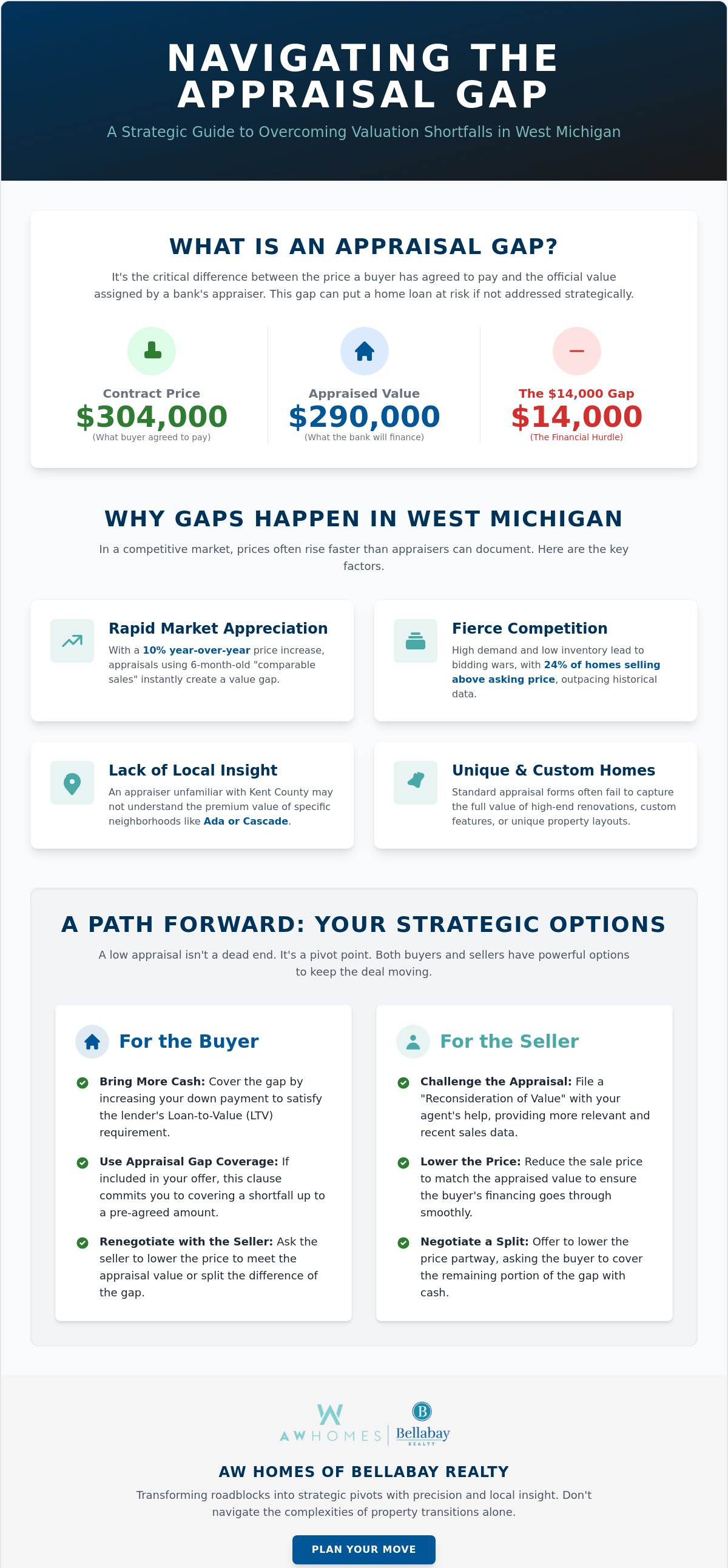
You've spent weeks preparing your home, found the perfect buyer, and signed a contract for $304,000, only to have the appraisal report come back at $290,000. It's a moment that feels like the floor is dropping out from under your transition. It's completely natural to feel frustrated when a valuation doesn't reflect the true heartbeat of your neighborhood or the competitive energy of the current West Michigan market. You might worry that the deal will crumble or feel stressed about finding extra cash to bridge the gap.
We understand that a low appraisal feels like a roadblock, but in reality, it's simply a strategic pivot point. This guide explains exactly what happens if home appraisal is low and provides the expert solutions needed to keep your transaction on track. You'll discover how to successfully renegotiate the price, leverage appraisal gap coverage, and challenge inaccurate reports with localized data. Our goal is to provide a clear, methodical path forward that prioritizes your financial security, your emotional peace, and your long-term goals.
Key Takeaways
- Understand the bank’s perspective on collateral to transform a valuation gap from a sudden roadblock into a manageable strategic pivot.
- Discover what happens if home appraisal is low and how to use cash bridges, loan restructuring, or price negotiations to protect your closing.
- Identify unique West Michigan market factors, such as the time-lag effect and the influence of out-of-area appraisers, that often lead to valuation discrepancies.
- Learn how to formally challenge inaccurate reports through a Reconsideration of Value to ensure your home’s price reflects its true neighborhood worth.
- Gain the emotional security that comes from working with a strategic advisor who navigates the complexities of property transitions with precision and local insight.
Understanding the Appraisal Gap in Today’s Market
The appraisal gap represents the mathematical distance between what a buyer is willing to pay and what a lender is willing to finance. It's the difference between the contract price and the bank's appraised value. In our local market, particularly in high-demand areas like Ada and Cascade, we often see offer prices that outpace the historical data appraisers rely on. As of June 2026, the median home sale price in Grand Rapids reached approximately $304,000, a 10% increase year-over-year. This rapid appreciation means the comparable sales from six months ago don't always reflect today's reality. Understanding what happens if home appraisal is low starts with recognizing that this gap is a common byproduct of a healthy, growing region. View this discrepancy as a strategic hurdle rather than a transaction-ending crisis.
Why the Bank Cares About the Appraised Value
Banks view your potential home primarily as collateral. They use the real estate appraisal process to ensure the property's value justifies the loan amount. This calculation centers on the Loan-to-Value (LTV) ratio, which is a critical metric for determining interest rates and mortgage insurance requirements. If an appraisal comes in low, the LTV ratio shifts, often requiring the buyer to increase their down payment to keep the loan within the bank's risk threshold. It's a distinction between market price, which reflects emotional value, and appraised value, which reflects financial security. A low appraisal doesn't mean you're overpaying; it means the bank's formula requires a different structure for the debt to protect their investment.
The Emotional Impact on Your Property Transition
Waiting for an appraisal report often brings a unique brand of anxiety. Sellers worry about their equity; buyers worry about their future home; both parties feel the weight of the unknown. We recognize that this is a significant personal milestone, not just a financial exchange. Maintaining objectivity is essential during this phase to prevent stress from clouding your long-term goals. Professional guidance acts as a buffer, preserving the momentum of your life transition even when the data doesn't immediately align with expectations. Knowing what happens if home appraisal is low allows you to move from a place of fear to a place of strategic planning. This process is about expert navigation, personal evolution, and localized reliability.
Common Reasons for Low Appraisals in West Michigan
In the vibrant corridors of Grand Rapids and Ada, market energy often moves faster than the paperwork. A valuation shortfall typically arises from three distinct factors: historical data lag, regional unfamiliarity, and the unique nature of custom estates. When you ask what happens if home appraisal is low, you're often seeing the result of an appraiser looking in the rearview mirror while the market is accelerating. While the average sale price in West Michigan rose 6.5% in early 2026, appraisal reports may still rely on sales from the previous autumn, creating a natural friction between past facts and present value.
The "Out-of-Area" appraiser is another common hurdle. A professional traveling from outside Kent County may lack the nuanced understanding of why a specific cul-de-sac in Cascade commands a premium or how proximity to the Thornapple River influences desirability. These subtle details often escape standard valuation formulas. If your property features high-end custom improvements or recent structural renovations, standard grids might fail to capture their full lifestyle impact. For those navigating these hurdles, exploring strategies for sellers can provide a necessary framework for response.
The Challenge of Rapidly Appreciating Neighborhoods
Neighborhoods like Forest Hills and East Grand Rapids are defined by high demand and low inventory. This scarcity frequently triggers bidding wars, with 24% of Grand Rapids homes selling above the asking price in mid-2026. Appraisers are often hesitant to use "pending sales" as benchmarks, preferring closed transactions that may be months old. This creates a "lagging" effect where the appraisal math simply cannot keep pace with the competitive reality of local buyer behavior. If you are preparing to list in these areas, our residential listing services ensure your home's unique value is documented with precision from day one.
Appraiser Subjectivity and Data Limitations
Not all appraisals are created equal. A "drive-by" valuation lacks the depth of a full interior inspection, where the quality of finishes and structural integrity are truly visible. Data errors in public records, such as incorrect square footage or bedroom counts, can also skew the final number. The choice of "comps" remains the most subjective element of the report. If an appraiser selects a home from a different school district or one lacking similar architectural character, the result will inevitably fall short of market truth. We view these discrepancies as opportunities for expert correction, strategic advocacy, and data-driven defense.
Strategic Options for Buyers to Bridge the Gap
A low appraisal report is not an endpoint; it is an invitation to refine your financial strategy. When you discover what happens if home appraisal is low, you realize that several methodical pivots exist to keep your life transition on track. A low appraisal invites three primary paths: financial adjustment, strategic negotiation, or a graceful exit. The most direct path is the "Cash Bridge," where you cover the difference out of pocket. This demonstrates strength to the seller and ensures the loan remains within the bank's required limits. Alternatively, a "Meet in the Middle" strategy often succeeds in our West Michigan market. With a sale-to-list price ratio of 98.2% in early 2026, sellers are often willing to adjust their expectations slightly to ensure a seamless closing.
If the appraisal contains factual inaccuracies regarding square footage or neighborhood boundaries, you have the right to challenge a low appraisal. This formal reconsideration of value requires specific, data-backed evidence to convince the lender to adjust their findings. While this process takes time, it preserves your emotional security by ensuring the bank’s math aligns with the true market reality of your new home.
Leveraging the Appraisal Contingency
The appraisal contingency is your ultimate safety net. It protects your earnest money deposit if the property fails to meet the valuation required by your lender. This clause typically dictates a specific timeline for notification, requiring swift action once the report is received. In highly competitive areas like Ada or East Grand Rapids, some buyers choose to waive this contingency. However, doing so requires a sophisticated risk assessment. We view this clause as a vital tool for maintaining balance and order throughout the high-stakes transaction process.
Restructuring the Mortgage Strategy
Creative financing offers a sophisticated way to bridge the gap without depleting your savings. You might shift from a 20% down payment to a 10% or 15% structure. This reallocation of funds provides the necessary cash to cover the appraisal shortfall while only adding a small monthly cost for private mortgage insurance (PMI). These financial pivots are most effective when guided by a find a buyers agent Grand Rapids professional who understands the nuances of local lending. This methodical approach transforms a potential crisis into a manageable milestone in your personal evolution.
How Sellers Can Overcome a Low Appraisal
For a seller, receiving a valuation that falls short of the contract price feels like a sudden anchor on your forward progress. It's a moment that requires a composed response rather than a reactive price cut. While many generalist resources suggest matching the appraisal immediately, we view this as only one of several strategic pivots. In a market where West Michigan home prices rose 6.5% in early 2026, a low appraisal often reflects a data lag rather than a lack of property value. Understanding what happens if home appraisal is low allows you to protect your equity through methodical advocacy and expert negotiation.
One of the most significant risks for a seller is the "Back on Market" scenario. If you choose to terminate the current deal because of a valuation gap, you may find that the next buyer’s appraiser relies on the same "stale" comparable sales. This can lead to a repetitive cycle of low valuations that delays your life transition. Instead of returning to the market, we prioritize identifying "missed features" in the original report. High-end finishes, professional landscaping, or recent structural upgrades like a new HVAC system are often undervalued by standard appraisal formulas. We provide the strategic insight, localized data, and professional advocacy required to defend your home's true worth.
Challenging the Appraisal with Better Data
The Reconsideration of Value (ROV) process is your formal right to challenge a report that contains factual errors or relies on poor data. This isn't a simple complaint; it's a structured "Rebuttal Package" that presents a more accurate picture of the neighborhood. We focus on three essential elements to strengthen your case:
- Factual Corrections: Identifying errors in square footage, room counts, or lot size that mandate an adjustment.
- Superior Comparables: Presenting closed sales that more closely mirror your home’s condition and location than those chosen by the appraiser.
- Contextual Staging: Using professional photography and staging records to prove your property’s superior condition compared to "distressed" or unrenovated comps.
Negotiating a Collaborative Solution
Negotiation is about finding a bridge that preserves the transaction while respecting your financial goals. Sometimes, a "closing cost credit" is a more palatable solution for a seller than a direct price reduction. This preserves the high sale price on public records while helping the buyer manage their out-of-pocket costs. The success of these discussions often depends on the buyer’s motivation and the strength of their initial offer. Our sell my home Forest Hills MI strategy includes preparing for these scenarios long before the appraiser arrives. If you are facing a valuation hurdle, we invite you to request a strategic listing consultation to explore your options for a successful closing.
Navigating Property Transitions with Strategic Counsel
A real estate advisor serves as the essential buffer between the cold data of an appraisal report and the warm reality of your home transaction. When you discover what happens if home appraisal is low, you realize that success depends on more than just raw numbers. It requires strategic insight, personalized advocacy, and professional poise. Localized expertise in markets like Grand Rapids and Ada is not merely a benefit; it is a necessity for defending your property's value against generic appraisal math. Angela Worth’s concierge approach is intentionally designed to mitigate stress and provide absolute clarity during the home closing process in Michigan. This methodical guidance ensures that your transition remains a positive evolution rather than a source of financial friction. We view every transaction as a significant personal milestone that deserves a high-level consultant rather than a simple salesperson.
The Value of a Neighborhood Authority
Working with a neighborhood authority who knows every street in Caledonia or East Grand Rapids provides a distinct advantage during an appraisal rebuttal. We don't simply wait for a report to arrive; we actively prepare for the valuation by being present during the inspection to highlight hidden value. We identify the custom millwork, the energy-efficient upgrades, and the unique lifestyle benefits that a standard data pull might overlook. This proactive stance keeps your life transition on track by ensuring the appraiser views the property through a local, expert lens. Our presence provides a layer of emotional security, ensuring that no detail is left to chance and every asset is documented with precision. This level of intentionality is what distinguishes a high-end service from a generalist approach.
Securing Your Next Chapter
We view our role as a steady partner in your personal evolution. Methodical planning, expert navigation, and emotional security are the anchors of our service. While a low valuation can feel like a crisis, it is often just a brief footnote in a successful home story when you have the right counsel by your side. We focus on the long-term goal of a seamless transition, moving beyond the immediate hurdle to secure your next chapter. Your journey deserves a composed, attentive, and highly competent partner who prioritizes your well-being over a quick closing. We invite you to Schedule a strategic consultation with AW Homes of Bellabay Realty to begin your next property transition with confidence and peace of mind.
Moving Forward with Confidence and Clarity
A valuation gap is a manageable hurdle, not a dead end for your transaction. By recognizing what happens if home appraisal is low, you can employ strategic pivots like loan restructuring, price renegotiation, or data-driven rebuttals to preserve your closing. These methodical solutions ensure that your financial interests remain protected while your life transition stays on schedule. Your journey is a significant personal milestone, and it deserves a steady partner who understands the high stakes of the local market.
Angela Worth offers over 15 years of West Michigan market expertise, providing the specialized focus required for the high-end neighborhoods of Forest Hills, Ada, and East Grand Rapids. Her concierge-style service ensures that your property transition remains a positive, stress-free evolution where no detail is left to chance. Contact Angela Worth for a Strategic Home Valuation to gain the professional authority and localized reliability your next chapter deserves. Your path forward is clear, secure, and supported by a partner who views your long-term well-being as the ultimate priority.
Frequently Asked Questions
Can a buyer pay more than the appraised value?
Yes, buyers frequently choose to bridge the gap with personal funds to keep a transaction moving forward. This decision is a strategic choice often made to secure a home in high-demand areas like Ada or Cascade. It requires a clear understanding of your financial liquidity, your long-term equity goals, and the current market momentum. Paying above the appraised value is a personal investment in your future lifestyle that moves beyond the bank's conservative lending limits.
Does a low appraisal mean the house is overpriced?
A low appraisal reflects historical data rather than the present energy of the market. While the bank's math relies on closed sales from previous months, the true market value is often driven by current demand, neighborhood scarcity, and unique property improvements. It is important to distinguish between a property's collateral value for a mortgage and its actual worth to a motivated buyer in a competitive regional environment.
How long does a home appraisal take in West Michigan?
The standard timeline typically spans seven to fourteen days from the initial order to the final report delivery. While the physical inspection of the property usually takes less than an hour, the appraiser’s comprehensive data analysis requires more time. This methodical process includes verifying public records, selecting the most accurate comparable sales, and ensuring the final report meets all professional and regulatory standards.
Who pays for the appraisal if the deal falls through?
The buyer is responsible for the appraisal fee as it is a service performed on behalf of their lender during the loan application process. Even if a transaction does not reach the closing table, the appraiser must be compensated for their professional time and expertise. This cost is a standard part of the financial due diligence required for any mortgage-backed property transition in Michigan.
Can I get a second appraisal if the first one is low?
Obtaining a second appraisal through the same lender is rare and usually requires proof of significant factual errors in the original report. Lenders are bound by strict regulations designed to maintain valuation independence and prevent "appraisal shopping." If a report is fundamentally flawed, a formal reconsideration of value is often a more methodical and effective path forward than attempting to order a new inspection.
What is an appraisal rebuttal and how does it work?
An appraisal rebuttal is a formal, data-driven challenge to an initial valuation that appears inaccurate. It involves presenting a structured package of superior comparable sales, factual corrections regarding the property, and documented evidence of recent high-end upgrades. This process allows your real estate advisor to advocate for your home’s true worth by bridging the gap between bank algorithms and the reality of the local neighborhood.
Will a low appraisal affect my property taxes in Kent County?
A mortgage appraisal does not directly influence your property tax assessment in Kent County or any other West Michigan municipality. The local assessor uses a different methodology and timeline to determine taxable value for the community. While both processes involve property valuation, they serve distinct purposes and operate within separate regulatory frameworks to ensure civic and financial order.
How often do appraisals come in low in the Grand Rapids market?
Valuation gaps occur more frequently in rapidly appreciating markets where buyer demand outpaces historical sales data. With approximately 24% of Grand Rapids homes selling above the asking price in mid-2026, the discrepancy between contract price and appraisal is a recurring strategic hurdle. Understanding what happens if home appraisal is low helps you navigate these common regional shifts with professional composure and expert insight.


