

Your Michigan seller's disclosure statement is the most powerful legal shield you possess in a real estate transaction. Many homeowners in East Grand Rapids or Ada feel a sense of dread when documenting the unique quirks of a historic or well-loved property. You likely worry that disclosing a minor defect might derail a high-stakes sale or invite a future lawsuit. It's a valid concern in a shifting market where the West Michigan median home price has climbed to $400,000 as of June 2026. I understand the emotional weight of this transition and the necessity of absolute certainty.
By mastering this document, you transform potential liability into a foundation of trust that ensures a seamless path to the closing table. This guide provides the expert navigation you need to handle the requirements of the Seller Disclosure Act with poise. We'll explore the nuances of "known" conditions, examine the 2026 legislative landscape regarding property taxes, and outline a methodical approach to transparency that secures your next chapter.
Key Takeaways
- Understand your legal obligations under the Michigan Seller Disclosure Act to safeguard your transition and prevent future disputes.
- Master the Michigan seller's disclosure statement by methodically documenting your home's major systems, from HVAC performance to occupancy status.
- Adopt a strategic mindset of transparency where over-disclosing known conditions serves as your ultimate protection in a competitive market.
- Navigate regional nuances specific to West Michigan, including radon considerations in Kent County and private utility requirements in Ada and Caledonia.
- Experience a stress-free path to the closing table with a concierge-style review that prioritizes your long-term well-being and financial security.
What is the Michigan Seller's Disclosure Statement?
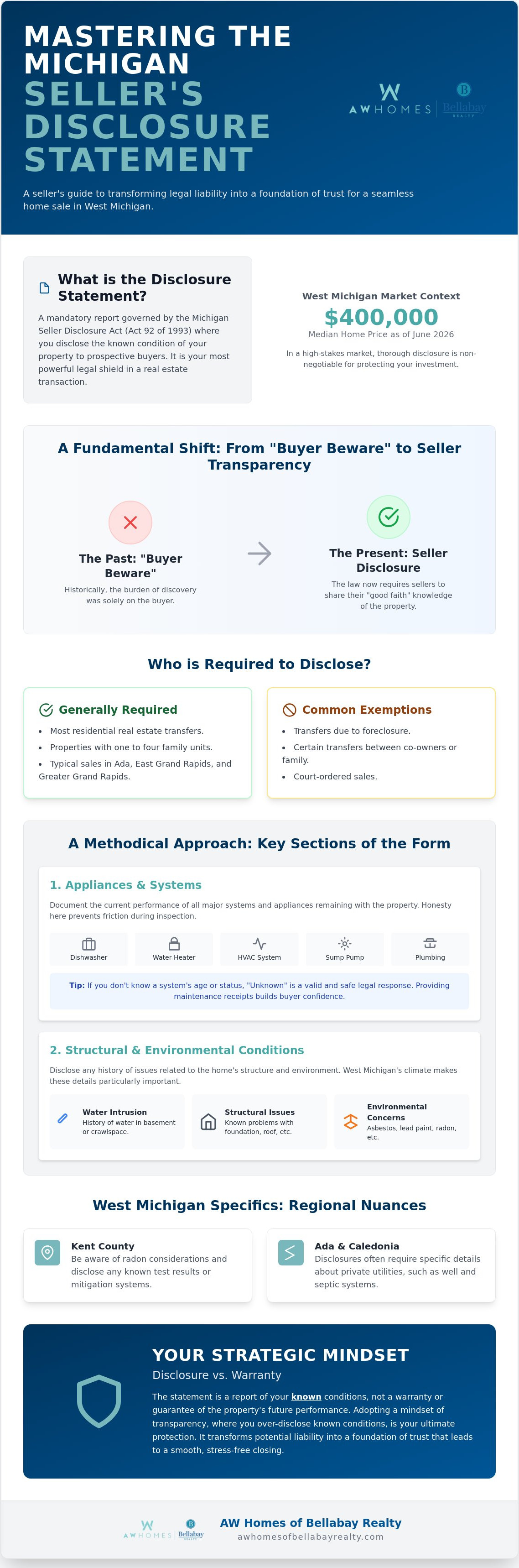
The Michigan seller's disclosure statement is more than a legal formality. It is a structured narrative of your home's history and a vital component of a successful real estate transaction. This document is a mandatory report where you disclose the known condition of your property to prospective buyers. Governed by the Michigan Seller Disclosure Act, specifically Act 92 of 1993 (MCL 565.951 through 565.966), it ensures that every residential sale begins with a shared understanding of the asset. For sellers in the Greater Grand Rapids area, this form acts as a declaration of facts, a record of stewardship, and a safeguard for your future. It provides the transparency needed to move from a listing to a successful closing without unnecessary friction.
The Core Purpose: Transparency and Protection
This legal requirement fundamentally changes the relationship between buyer and seller by shifting the burden of discovery. Historically, the principle of "buyer beware" placed the onus on the purchaser. Now, the law requires you to share your "good faith" knowledge of the property. By providing a clear Seller's Disclosure Statement, you mitigate the risk of post-closing litigation. Disputes often arise from surprises discovered after the keys have changed hands. A thorough disclosure eliminates those surprises, providing emotional security for both parties. It sets a definitive baseline for the property's condition before the professional inspection phase begins. This clarity helps maintain the momentum of your sale, protecting your timeline and your peace of mind.
Who is Required to Disclose?
Residential real estate transfers involving one to four family units generally require this documentation. Whether you are listing a modern estate in Ada or a historic home in East Grand Rapids, the law applies to your transaction. There are specific exemptions to consider, such as foreclosures, certain transfers between co-owners or family members, and court-ordered sales. However, for the vast majority of West Michigan homeowners, this is a non-negotiable step in the listing process. Good Faith is the honest belief in the accuracy of the information provided based on your current knowledge of the property. While you aren't expected to be a home inspector, you are required to be truthful about what you have observed during your residency.
In a competitive market, transparency is a strategic advantage. It signals to buyers that you are a responsible owner who has cared for the property with intentionality. This trust often leads to smoother negotiations and a more efficient path to the closing table. Mastering the Michigan seller's disclosure statement allows you to present your home with confidence, ensuring that no detail is left to chance as you prepare for your next life chapter.
Section-by-Section: How to Complete the Form
Completing the Michigan seller's disclosure statement requires a methodical approach that prioritizes precision over speed. The process begins with basic property identification, including your address, legal description, and occupancy status. Most homeowners in the Greater Grand Rapids area will identify their property as a "Principal Residence" for tax purposes. This initial section establishes the framework for your disclosures. It is your first opportunity to demonstrate the intentionality you've maintained as a steward of your home. By being clear from the first line, you set a professional tone that carries through the entire transaction.
Appliances and Systems: Being Thorough
The form asks you to evaluate every major system and appliance that will remain with the property. This list is extensive, covering everything from the dishwasher and range to the sump pump and water heater. Check the systems. Review the records. Report the facts. When assessing your HVAC, plumbing, and electrical systems, focus on their current performance rather than guessing at their remaining lifespan. For specialized features like a fireplace, having a recent inspection from a professional like Home Safe Hearth & Chimney can provide the definitive proof of maintenance that buyers value. If you haven't personally serviced a system or don't know its age, the "Unknown" status is a valid legal response. However, providing receipts for recent maintenance often provides the emotional security buyers need to move forward with confidence. Avoid the temptation to gloss over a temperamental appliance; honesty here prevents friction during the inspection phase.
Structural and Environmental Disclosures
West Michigan's climate presents specific challenges for homeowners, particularly regarding moisture and temperature fluctuations. Whether you are selling a modern estate in Forest Hills or a classic home in East Grand Rapids, you must disclose any history of water intrusion in the basement. The Michigan Seller Disclosure Act mandates that you report known structural defects, including the condition of the roof and any history of ice damming. For homes built before 1978, you must also navigate the federal Lead-Based Paint Disclosure. Environmental concerns like asbestos or radon levels are also addressed in this section. Being proactive about these disclosures ensures that your sale remains on track and your financial interests are protected from future claims.
Once you've addressed every section, the document must be finalized with signatures and dates from all titled owners. The buyer will then sign to acknowledge they've received and reviewed the information. This creates a clear, documented timeline that serves as a foundation of trust. If the prospect of documenting every detail of your property feels daunting, utilizing professional residential listing services can provide the unhurried, expert guidance necessary to ensure your disclosure is both legally compliant and strategically sound. This methodical planning is the key to a stress-free transition to your next life chapter.
Disclosure vs. Warranty: A Strategic Mindset
A successful sale in West Michigan relies on a clear understanding of what a disclosure actually represents. It is a snapshot. It is a record. It is a communication tool. Crucially, your Michigan seller's disclosure statement is not a warranty. While a warranty acts as a guarantee of future performance, a disclosure is simply a report of the property's condition at the specific moment of the listing. By embracing this distinction, you can approach the document with a strategic mindset that prioritizes long-term emotional security over a quick, potentially risky closing. Transparency is not a hurdle; it is your most effective tool for building buyer confidence.
The 'Known Condition' Standard
Homeowners often feel pressured to uncover every hidden flaw before listing, but the law doesn't require you to become a private investigator. You aren't required to hire an expert to find latent defects before you sign the form. Instead, you should focus on what you have personally observed during your years in the home. Actual knowledge is the legal threshold for Michigan sellers. This standard ensures that you are only responsible for sharing what you truly know, allowing you to provide an honest account without the stress of being a technical expert. If you don't know the answer to a specific question about a system's internal mechanics, "unknown" is a perfectly acceptable and legally sound response.
Mitigating Risk and Post-Sale Stress
The fear of scaring off buyers often leads to hesitation, but transparency is actually your strongest marketing tool. In high-stakes markets like Ada and Forest Hills, buyers appreciate a seller who is forthright about a property's history. According to the Michigan Seller Disclosure Act, being thorough protects you from "failure to disclose" lawsuits that can arise months or even years after the sale. If a new issue occurs while you are under contract, update the document immediately. This proactive communication maintains trust. It prevents disputes. It ensures a smooth transition.
While your disclosure provides the baseline, the professional home inspection serves as the validation. When your disclosures match the inspector's findings, it reinforces the buyer's confidence in you and the home. This alignment is essential for maintaining a stress-free path to the closing table. By choosing to over-disclose minor quirks or past repairs, you remove the leverage a buyer might use to renegotiate later. You aren't just filling out a form; you are strategically insulating your financial future and ensuring your peace of mind as you move toward your next chapter.
West Michigan Specifics: Regional Disclosure Nuances
The unique geography of West Michigan dictates specific requirements for your Michigan seller's disclosure statement. A modern estate in the heart of East Grand Rapids faces different environmental and legal considerations than a sprawling acreage in Caledonia. Understanding these regional nuances is essential for providing an accurate account of your home's condition. It's not just about filling out a form; it's about localized expertise. By addressing these specifics early, you eliminate the uncertainty that can stall a transaction during the due diligence period. This clarity protects your equity and your peace of mind.
Environmental Factors in Greater Grand Rapids
Kent County is recognized for varied radon levels, making this a frequent point of discussion during property transitions. If your home has an existing mitigation system, you must report its presence and operational status. Beyond air quality, properties situated near the Grand River or its tributaries must address proximity to flood zones or protected wetlands. This level of transparency is a core component of the Michigan home closing process. Being proactive about environmental factors ensures that buyers feel secure in their investment from the very first showing. It demonstrates a level of stewardship that resonates with discerning buyers.
Rural and Suburban Infrastructure
Infrastructure needs vary significantly across our region. In communities like Ada and Caledonia, private wells and septic systems are common. You must disclose the age, maintenance history, and any known issues with these private utilities. In semi-rural areas, shared road maintenance agreements or shared driveways are also critical points for your Michigan seller's disclosure statement. These details reflect the current Grand Rapids real estate trends, where buyers increasingly value documented property history in a market where the average days on market reached 27 in June 2026.
If you're selling in Forest Hills or East Grand Rapids, homeowners' association (HOA) bylaws and fees are mandatory disclosures. Be precise about monthly costs and any pending assessments. Additionally, address any potential boundary disputes or encroachments, such as shared fences or retaining walls. This methodical attention to detail prevents surprises that could disrupt your closing timeline. If you're unsure how to frame these regional specifics, our residential listing services provide the strategic oversight needed to manage every nuance of your disclosure. This unhurried approach ensures that your transition remains focused on your future milestones rather than past liabilities.
The Angela Worth Edge: Methodical Planning for Your Sale
At AW Homes of Bellabay Realty, we view the Michigan seller's disclosure statement as a cornerstone of your property’s narrative. Our concierge-style approach involves a meticulous, line-by-line review of your documentation to ensure every detail is captured with absolute precision. We don't just facilitate a transaction; we manage a significant life transition. By framing your property’s history with transparency and professional insight, we maintain buyer confidence from the initial showing to the final signature. This methodical planning is a vital component of our strategic 2026 seller’s guide for Forest Hills, where we align legal compliance with high-level market positioning. A detail reviewed. A risk mitigated. A legacy protected.
Why Professional Guidance Matters
Navigating the legal complexities of the Seller Disclosure Act requires a strategic advisor who understands the distinct nuances of Ada, Cascade, and East Grand Rapids. Your disclosure should never exist in a vacuum. It must align perfectly with your professional home photography and staging to present a cohesive, trustworthy image of your residence. We work closely with you to identify potential latent defects early, providing the expert navigation needed to address them before they become obstacles in a negotiation. This partnership ensures that your emotional security remains intact throughout the entire process. We prioritize your long-term well-being, moving the conversation away from chance and toward expert planning. Our role is to act as your steady, knowledgeable consultant in a high-stakes environment.
Your Next Chapter Starts with Clarity
A stress-free closing is the direct result of an organized and methodical process. As a neighborhood authority, we manage the fine print of your sale so you can focus on the personal milestones of your move. We believe that clarity is the foundation of trust. When every system is documented and every quirk is explained, the path to the closing table becomes a curated journey rather than a series of hurdles. This transparency often leads to a higher degree of buyer commitment, which is essential in a market where West Michigan homes averaged 27 days on market in mid-2026. We invite you to a private consultation to prepare your West Michigan home for the market with the expert navigation you deserve. Your next chapter is a significant evolution in your life story. We are here to ensure it begins with absolute confidence, localized reliability, and a seamless transition to what comes next.
Securing Your Legacy and a Seamless Transition
Your property's history is a testament to your stewardship. Approaching the Michigan seller's disclosure statement with transparency and intentionality turns a legal requirement into a strategic advantage. You now understand how to navigate regional nuances like radon levels in Kent County and the specific needs of private utilities in Ada and Forest Hills. This methodical approach ensures your financial interests remain protected long after the final signatures are dry. By prioritizing clarity over convenience, you insulate yourself from future disputes and build lasting trust with your buyer.
A successful sale. A stress-free closing. A confident next chapter. My concierge real estate service provides the expert navigation required to manage these high-stakes details with composure and grace. I am committed to your emotional security, providing a personalized approach that respects the significance of your property transition. No detail is left to chance when you have a strategic partner by your side.
Schedule your strategic home-selling consultation with Angela Worth today to prepare your West Michigan home for a successful market debut. Your next milestone deserves the security of professional guidance and the peace of mind that comes from expert planning.
Frequently Asked Questions
Is a seller's disclosure statement required in Michigan for every home sale?
Yes, the Michigan Seller Disclosure Act mandates this document for nearly all residential transfers involving one to four units. The disclosure serves as a declaration of facts, a record of stewardship, and a safeguard for your future. For the majority of homeowners in Greater Grand Rapids, providing this statement is a non-negotiable legal requirement. It ensures transparency before a purchase agreement is signed, protecting your equity and your peace of mind.
What happens if I forget to disclose a known defect in Michigan?
Forgetting to disclose a known defect can lead to significant legal liability and post-closing disputes. If a buyer discovers an undisclosed issue that you were aware of, they may pursue a lawsuit for fraud or "failure to disclose." This can result in costly financial settlements or court-ordered repairs. While real estate concerns are civil matters, those facing more severe legal challenges in the state can visit Law Office of Kevin Bessant & Associates for aggressive defense. Maintaining absolute honesty on your Michigan seller's disclosure statement is the most effective way to ensure a stress-free transition to your next chapter.
Do I need to fix every issue I list on the disclosure statement?
No, you aren't legally required to repair every item listed on the disclosure. The purpose of the document is transparency, not a checklist for mandatory repairs. Once a defect is disclosed, it becomes a point of negotiation between you and the buyer. Some buyers may accept the condition as-is, while others might request a credit or a repair before the closing date. We help you navigate these negotiations with a strategic focus.
Who pays for the inspections mentioned in the disclosure statement?
Typically, the buyer pays for the professional home inspection to validate the property's condition for their own records. While you may choose to hire an expert for a pre-listing inspection to identify latent defects early, it's not a legal requirement. The disclosure statement relies on your personal knowledge as the owner. Clear documentation and receipts for past maintenance can often reduce the buyer's perceived risk during this phase of the transaction.
Can a buyer back out of a contract based on the seller's disclosure?
Yes, a buyer has a specific legal window to terminate the contract if the disclosure statement is provided after they've signed the purchase agreement. If new issues arise or are disclosed late in the process, it may trigger a right to rescind the offer. Providing a thorough Michigan seller's disclosure statement at the very beginning of the listing process is a methodical way to prevent these types of last-minute cancellations and maintain momentum.
How far back do I need to go when disclosing past repairs?
You should disclose any past repairs that relate to the current structural or mechanical integrity of the home. While the form focuses on "known" current conditions, documenting major past issues like basement waterproofing or roof replacements builds trust. Transparency regarding significant repairs demonstrates your intentionality as a homeowner. It is always safer to over-disclose past events than to leave a buyer wondering about the history of a major system.
Does the Michigan seller's disclosure apply to 'as-is' sales?
Yes, selling a property "as-is" does not exempt you from the legal duty to disclose known defects. Even if you don't intend to make any repairs, you must still provide an honest account of the property's condition. An "as-is" clause simply means you won't fix the issues, but the buyer still has the right to know what those issues are. This transparency is essential for ensuring a legally compliant and smooth closing process.
Is the disclosure statement the same as a home inspection report?
No, these are two distinct documents with different purposes. Your disclosure is a record of your personal knowledge and observations as the owner. A home inspection report is a technical evaluation performed by a licensed professional who examines the property's systems in detail. Both documents work together to create a baseline of trust. When your disclosures align with the inspector's findings, it reinforces the buyer's confidence, secures your path to the closing table, and ensures a seamless transition.


