

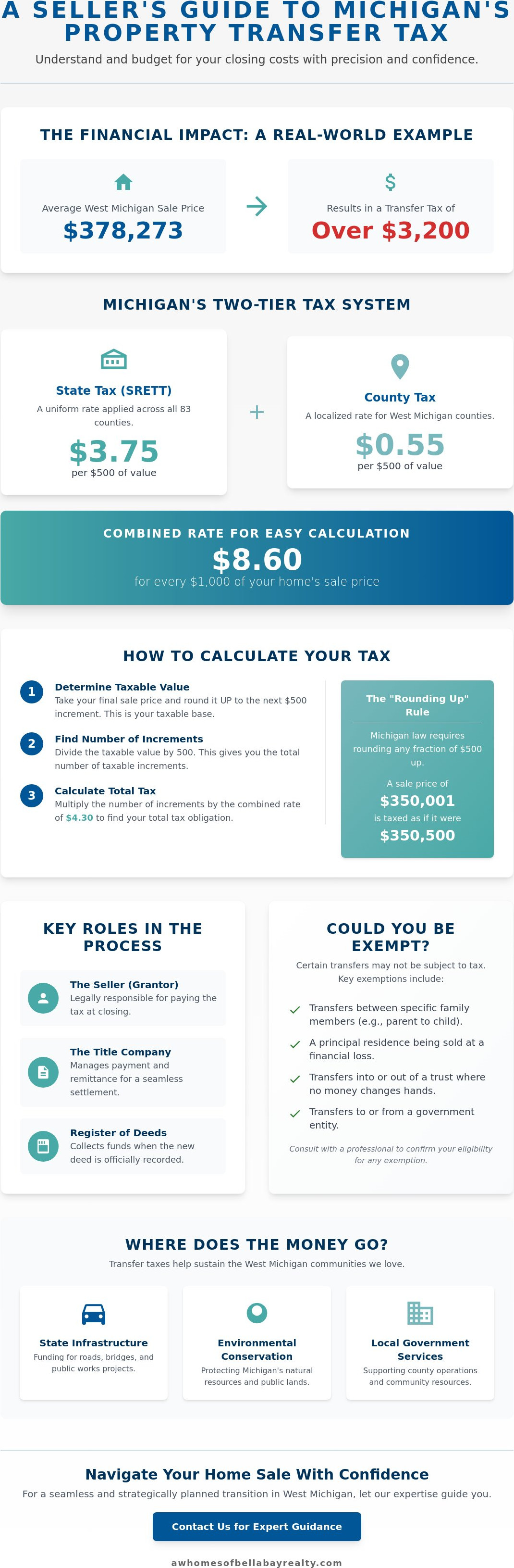
Did you know that on an average West Michigan sale of $378,273, the Michigan property transfer tax can represent a line item of over $3,200 at the closing table? For many sellers, this cost feels like an unexpected hurdle during an already emotional life transition. You deserve a process defined by clarity, expertise, and peace of mind. It is natural to feel a bit of apprehension when faced with complex math involving $500 increments and the fear of missing out on legal exemptions that could protect your equity.
We believe that moving to your next chapter should be a seamless experience where every detail is handled with professional precision. This guide will help you master the complexities of Michigan transfer taxes by providing a clear, strategic breakdown of current 2026 rates and their impact on your closing costs. We will walk through the specific state and county obligations, identify the legal exemptions you might qualify for, and review the potential impact of House Bills 5872-80 currently in the legislature. By the end of this article, you will have a precise budget for your transition and the confidence that your home sale is being managed with the highest level of regional authority.
Key Takeaways
- Understand the two-tier structure of state and county rates to calculate exactly how much equity will be allocated at the closing table.
- Master the Michigan property transfer tax math to ensure your financial planning is precise, predictable, and fully transparent.
- Identify specific legal exemptions, such as those for family transfers or principal residences sold at a loss, to protect your hard-earned equity.
- Learn how the title company manages the remittance process during settlement to provide a seamless and secure transition of ownership.
- Transition from uncertainty to confidence by viewing tax obligations as a managed milestone within a methodically planned home sale strategy.
What is the Michigan Property Transfer Tax?
Selling a home in West Michigan is more than a financial exchange; it's a significant life milestone that marks the beginning of a new chapter. To ensure this transition is handled with the precision it deserves, you must understand the underlying mechanics of the Michigan property transfer tax. At its core, this tax is a transactional fee levied by state and local governments for the privilege of transferring the title of real property from one person to another. If you're researching the broader context of what is a real estate transfer tax?, you'll find it's essentially an excise tax on the legal instrument used to convey ownership. In Michigan, the legal responsibility for this payment falls upon the seller or grantor. This cost is settled at the closing table, ensuring that the public record remains accurate, secure, and legally binding. The Register of Deeds in your specific county collects these funds at the time the new deed is recorded, serving as the final step in your property's professional transition.
The Purpose of Transfer Taxes in Michigan
The funds collected through the Michigan property transfer tax aren't merely administrative fees. They serve a vital role in our community by supporting state-level infrastructure, environmental conservation, and local government services. The tax is calculated based on the "total consideration" of the home, which is the full purchase price agreed upon by both parties. It's vital to report this figure with absolute accuracy on the deed. Precise reporting prevents legal complications, ensures professional transparency, and maintains the integrity of West Michigan property values. By contributing these funds, sellers help sustain the very neighborhoods that make our region a desirable place for the next generation of homeowners.
State vs. County: Two Different Assessments
Michigan utilizes a two-tier system that appears as separate line items on your final settlement statement. The State Real Estate Transfer Tax (SRETT) is a uniform rate applied across all 83 counties, providing a consistent baseline for every seller in the state. Parallel to this is the County Real Estate Transfer Tax, a localized assessment that supports the specific county where the property is located. While the state rate remains fixed, the county portion is managed at a local level, reflecting the unique needs of our regional municipalities. These two assessments work in tandem to validate your property’s transition, fund essential public resources, and secure your legal standing as the transaction concludes. Understanding this dual structure is the first step in creating a methodical, stress-free plan for your upcoming closing.
Calculating the Cost: State and County Tax Rates Explained
Precision is the hallmark of a successful transition. When calculating the Michigan property transfer tax, you'll encounter two distinct rates that work together to fund regional and state initiatives. The state portion, established by Michigan's State Real Estate Transfer Tax Act, is fixed at $3.75 for every $500 of the property's value. Complementing this is the county rate, which adds $0.55 for every $500 increment. Together, these assessments create a combined cost of $4.30 per $500, or $8.60 for every $1,000 of your home's sale price. This structure provides a framework that is steady, logical, and supportive.
Don't let the increments catch you off guard. Michigan law utilizes a "rounding up" rule. If your sale price exceeds a $500 increment by even one dollar, the tax is calculated based on the next full $500 level. For example, a home sold for $350,001 is taxed as if it were sold for $350,500. This ensures the process remains predictable, transparent, and manageable. It's these small details that define our residential listing services, where we prioritize your financial clarity from day one.
West Michigan Regional Rate Variations
While the state rate is universal across all 83 counties, the localized portion remains a point of focus for sellers in our region. In Kent County, covering Grand Rapids and Forest Hills, the $0.55 rate is the standard applied to your settlement. Sellers in Ottawa County, including Hudsonville and Jenison, follow the same calculation. While Michigan law allows counties with populations over 2 million to implement higher caps, our West Michigan communities maintain these standard, predictable rates. This regional stability allows for accurate budgeting and a more composed selling experience.
A Practical Calculation Example
Let's look at the numbers for a home in Ada, MI, selling for $400,000. To find the state portion, we divide the price by 500 and multiply by $3.75, resulting in $3,000. We repeat the process for the county portion using $0.55, which totals $440. In this scenario, the total Michigan property transfer tax is $3,440. For a $500,000 home, the combined total tax would be exactly $4,300. Having these figures in hand transforms a complex closing cost into a predictable strategic milestone. It ensures your transition is defined by clarity, strategy, and success.
Legal Exemptions: When You Might Not Owe Transfer Tax
Understanding the nuances of the Michigan property transfer tax is not just about math; it is about recognizing the specific legal protections afforded to you during significant life events. While most sales trigger an assessment, the Michigan legislature has carved out several scenarios where this burden is lifted. These exemptions exist to provide emotional security, financial relief, and professional clarity for families in transition. By identifying these opportunities early in your planning process, you move away from a reactive stance and toward a position of strategic advantage. This methodical approach ensures that no detail is left to chance as you prepare for your next chapter.
The Loss-of-Value Exemption (MCL 207.526(u))
One of the most vital provisions for West Michigan sellers is the loss-of-value exemption, formally known as MCL 207.526(u). This rule acts as a critical safeguard for homeowners who are selling their principal residence at a time when the State Equalized Value (SEV) has not increased since the date of purchase. To claim this exemption, you must demonstrate that the property was your primary residence and provide documentation comparing the current SEV to the value on your original purchase date. You can find the necessary forms and detailed guidelines via the Michigan Department of Treasury Property Transfer Resources. It is essential to remember that this exemption must be stated clearly on the face of the deed. If this detail is overlooked, the Register of Deeds will collect the tax at recording, which can lead to a frustrating and costly delay in your financial recovery.
Intra-Family and Divorce Transfers
Family transitions often involve the transfer of property as a gift or through the settling of an estate. Deeds between spouses, or from parents to children, are typically exempt from the Michigan property transfer tax when the consideration is less than $100 or based on "love and affection." Similarly, transfers mandated by a court order, such as those occurring within a divorce settlement, are generally protected from these fees. These situations are deeply personal milestones that require a composed, attentive, and highly competent partner. Navigating the use of quitclaim deeds in these scenarios without expert insight can lead to unintended tax consequences, so methodical planning remains your best defense for your long-term well-being.
Finally, estate planning tools such as trusts and wills offer another layer of protection. Moving a property into a revocable living trust is viewed as a change in the form of ownership rather than a taxable transfer. Transfers to government entities or charitable organizations also fall under these protected categories. Each of these paths ensures that your transition is handled with the intentionality and care it deserves, allowing you to focus on the future rather than the complexities of the past. By working with a regional specialist, you can ensure your transition is defined by structure, clarity, and peace of mind.
Transfer Taxes within the Michigan Home Closing Process
The final stages of your real estate journey should be defined by professional precision and emotional ease. While the Michigan property transfer tax is a legal obligation, it shouldn't be a source of uncertainty on your closing day. This fee is typically deducted directly from your proceeds at the settlement table. You won't need to manage a separate payment or worry about administrative deadlines. Instead, the title company serves as a vital partner, calculating the exact figures and remitting the funds to the Register of Deeds on your behalf. This methodical approach is a core component of the home closing process in Michigan. By accounting for these costs early, you ensure your transition is handled with the care and structure you deserve.
Budgeting for Closing Costs as a Seller
Transfer taxes often represent the second-largest expense for sellers, following only the professional commissions. When we analyze the current West Michigan market, we see that rising home values have made these assessments more significant. A concierge-style agent provides a detailed "Net Sheet" long before the moving trucks arrive. This document offers a clear, strategic breakdown of your final take-home equity. Factoring in these costs during the initial pricing phase allows you to move forward with a composed mindset. This level of planning transforms a financial transaction into a well-managed milestone, providing the security you need to focus on your next chapter.
The Documentation Trail
The integrity of your property's history relies on an accurate and transparent public record. During the closing process, you may be required to sign a Real Estate Transfer Tax Valuation Affidavit. This document is used to verify the "Total Consideration" of the sale, ensuring the Michigan property transfer tax is paid correctly. Accuracy matters. Transparency matters. Your financial security matters. Providing honest data on the public deed protects you from future legal complications and confirms that your property's evolution is recorded with absolute integrity. Our residential listing services are designed to manage these nuances, ensuring every detail of your sale is handled with professional authority and regional expertise.
Strategic Planning for Your West Michigan Property Transition
A home sale is far more than a sequence of financial calculations or a legal transfer of title. It represents a significant personal milestone, a transition of lifestyle, and a step toward your future evolution. While mastering the Michigan property transfer tax is a necessary step in this journey, we believe the process should never feel like a burden. Our approach moves beyond the raw math to focus on the human element of the transaction. By providing a steady, knowledgeable presence, we ensure that every detail is managed with an unhurried precision that respects the emotional weight of your move.
Methodical planning is the cornerstone of our philosophy. Whether you are a move-up buyer looking for more space in Grand Rapids or a downsizer seeking a simpler lifestyle, your transition deserves a bespoke strategy. We eliminate closing-day stress by addressing every variable, from tax obligations to market timing, long before you reach the settlement table. This proactive stance provides the emotional security you need to navigate high-stakes decisions with absolute confidence. It's about creating a narrative of success where no detail is left to chance.
Personalized Guidance for Your Next Chapter
Our concierge-style service is designed to handle the technical complexities of your sale so you can focus on the excitement of your next move. We tailor our approach to your specific situational needs, ensuring that every financial variable is transparent and predictable. For those selling in specific neighborhoods, our listing guide provides a comprehensive roadmap that includes localized insights and strategic pricing. We are committed to a process that is calm, supportive, and entirely unhurried, allowing you the space to transition at your own pace. This intentionality ensures that your move is a positive development in your life story.
Your West Michigan Real Estate Partner
Deep regional focus acts as a safeguard against the unexpected. Local expertise in areas like Ada, Forest Hills, and Caledonia ensures that no detail, such as specific Michigan property transfer tax filings or regional documentation requirements, is left to chance. As your strategic advisor, we bridge the gap between technical industry terminology and your personal goals. We view our role not merely as agents, but as partners in your long-term well-being and regional success. This neighborhood authority allows us to navigate the nuances of the West Michigan market with a level of insight that generalist competitors simply cannot match.
Your property transition should be a positive development, marked by clarity and professional excellence. If you are ready to move forward with a partner who prioritizes your peace of mind and financial security, we invite you to experience a seamless property transition with AW Homes of Bellabay Realty. Together, we will ensure your next chapter begins with the security, warmth, and expertise you deserve.
Securing Your Financial Future in West Michigan
A successful home sale is the result of intentionality, personalization, and expert insight. By understanding the nuances of the Michigan property transfer tax, you've replaced uncertainty with a clear, strategic roadmap for your closing day. You now have the tools to calculate your obligations, identify valuable legal exemptions, and protect your hard-earned equity. These technical details are the building blocks of a seamless life transition, ensuring that no surprise costs disrupt your move to a new chapter.
Expertise matters when navigating the complexities of the West Michigan market. As a neighborhood authority in Ada, Forest Hills, and Grand Rapids, we provide the steady guidance needed for a stress-free experience. We act as your strategic advisor, transition expert, and dedicated partner, prioritizing your long-term well-being over a quick transaction. Our concierge-style approach ensures that every detail is handled with professional precision and empathetic care.
Your journey of personal evolution deserves a process defined by clarity, strategy, and peace of mind. Plan your seamless West Michigan home sale with Angela Worth to ensure your transition is as rewarding as the destination itself. We look forward to helping you move forward with confidence and security.
Frequently Asked Questions
Who pays the property transfer tax in Michigan, the buyer or the seller?
In Michigan, the seller or grantor is legally responsible for paying the property transfer tax. This cost is typically deducted from the sale proceeds during the final settlement. While buyers and sellers can technically negotiate this responsibility, the traditional standard in West Michigan remains with the seller. This ensures a clean title transfer and a professional transition for both parties involved in the milestone.
Is the Michigan property transfer tax the same in every county?
The state portion of the Michigan property transfer tax is uniform across all 83 counties, but the total amount can vary based on local population thresholds. Every seller pays $3.75 per $500 of value to the state. Most counties, including Kent and Ottawa, charge $0.55 per $500. However, counties with populations over 2 million have the legal authority to implement higher rates; this doesn't currently apply to our regional market.
Can I avoid paying the Michigan Real Estate Transfer Tax if I sell my home for a loss?
You may be eligible for an exemption if you sell your principal residence for less than its original purchase price. This is known as the "u" exemption under MCL 207.526. To qualify, the State Equalized Value (SEV) must be less than or equal to the SEV at the time of purchase. It's a critical protection that provides financial relief during difficult life transitions.
How is the transfer tax calculated if I am gifting a home to a family member?
Transfers of property between family members are often exempt from the Michigan property transfer tax if the consideration is less than $100. Deeds given for "love and affection" rather than a monetary exchange generally bypass these fees. This allows families to manage estate planning and personal evolution with emotional security. It's vital to state the specific exemption on the deed to ensure the process remains seamless.
Do I have to pay the transfer tax at the time of the offer or at closing?
The transfer tax is paid at the time of closing when the deed is recorded with the Register of Deeds. It's not a cost you need to worry about during the initial offer or inspection phases. The title company manages the calculation and remittance of these funds from your final proceeds. This methodical timing ensures that your financial obligations are settled only when the transaction is successfully finalized.
What is the "Rounding Up" rule for Michigan transfer taxes?
Michigan law requires that the transfer tax be calculated based on the next $500 increment if the sale price exceeds a round number. For instance, a home sold for $250,001 is taxed as a $250,500 sale. This rounding up rule ensures a consistent and predictable standard for every transaction in the state. Understanding this small detail helps you maintain absolute precision in your closing cost budget.
Are there any exemptions for first-time home buyers in Michigan regarding transfer tax?
There are no specific Michigan transfer tax exemptions tailored exclusively for first-time home buyers because the tax is a seller's obligation. While buyers may benefit from other programs or credits, the transfer tax remains a line item for the party relinquishing ownership. We focus on providing clarity for sellers to ensure they understand their role in this regional real estate process.
What happens if the transfer tax is not stated on the face of the deed?
If an exemption is not clearly stated on the face of the deed, the Register of Deeds will require full payment of the tax at the time of recording. This can lead to unexpected delays and administrative hurdles during your transition. Ensuring that the correct legal language is present is a vital step in our methodical planning process. It protects your equity and confirms your professional standing.


