

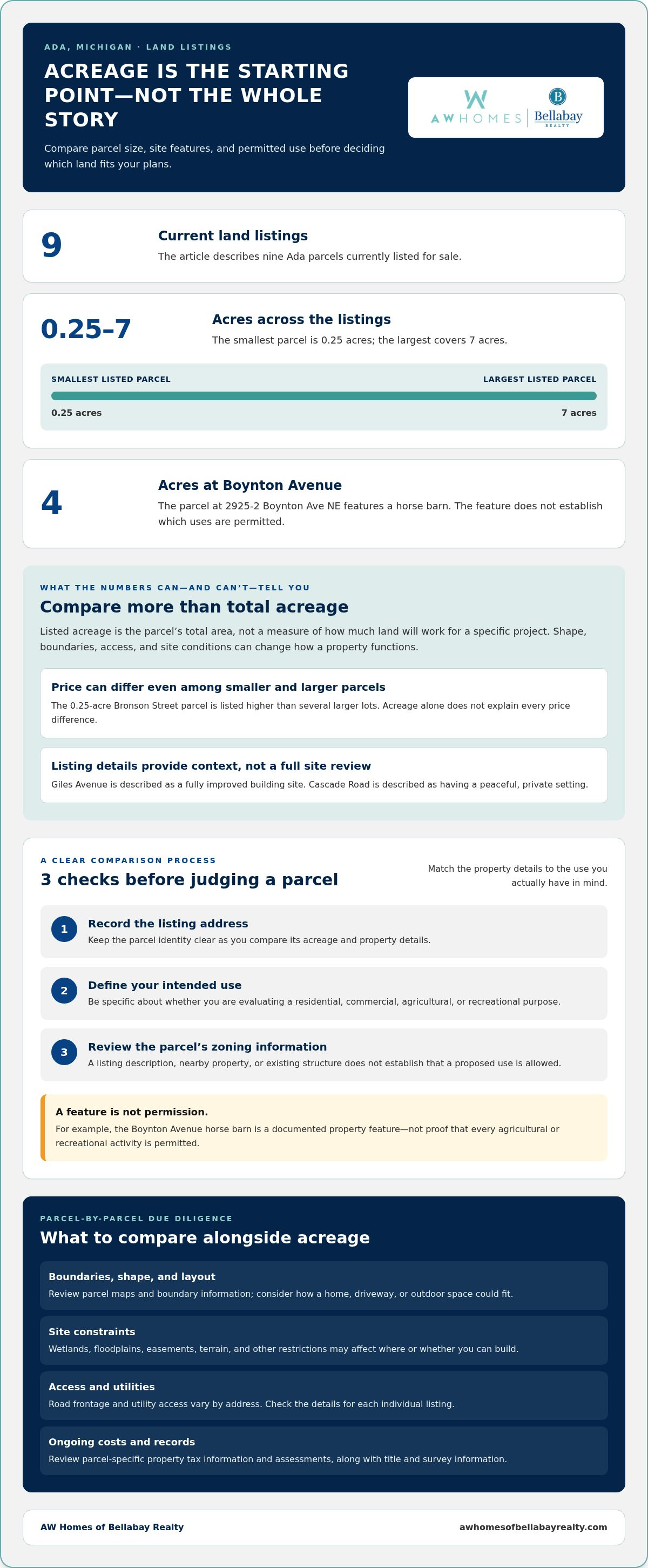
Ada’s land listings cover a wide range of lot sizes. Current land for sale in Ada, Michigan, includes nine listings from 0.25 to 7 acres. That means the options range from smaller parcels to properties spanning several acres.
Lot size is a useful starting point, but it doesn’t tell the whole story when you’re comparing land for sale in Ada, Michigan. The right fit depends on how much land you want and what kind of property you hope to find in Ada.
This guide outlines the available listings and compares their acreage, making it easier to see how the options differ. You’ll also get context on the property types represented, so you can approach your search with a clearer sense of what may suit your plans.
Key Takeaways
- Compare individual parcels by acreage and property features, including a fully improved building site and a lot described as having a peaceful, private setting.
- Use lot size as a starting point, then consider how each parcel’s setting and features align with your intended plans.
- Learn why a listing’s appearance or features alone don’t establish whether residential, commercial, agricultural, or recreational uses are permitted.
- See how zoning and permitted-use considerations fit into evaluating a property before moving forward with a purchase.
Land listings for sale in Ada, Michigan
Nine Ada parcels currently show a broad range of asking prices and acreage. The smallest listing is 0.25 acres; the largest covers 7 acres. Here are the addresses, lot sizes, and listed prices:
Prices vary beyond acreage alone. For example, the 0.25-acre Bronson Street parcel is listed higher than several larger lots. Giles Avenue is described as a fully improved building site, while Cascade Road offers a peaceful, private setting. Those details help explain why comparing land listings requires more than sorting by size.
Wetlands, floodplains, easements, and other restrictions can affect where or whether you can build. Before planning construction, review parcel records, maps, and site conditions for the specific Ada property.
Property taxes and special assessments vary by parcel. For an Ada Township lot, review the property’s tax information and any listed assessments to understand its ongoing costs.
Utility access and road frontage also vary by address. Review each listing’s property details for road access and available utility connections. Don’t assume one parcel has the same services as another.
For due diligence, compare listing details, review title and survey information, and assess zoning, site constraints, utilities, and assessments. Then match your findings to your intended use before making an offer on land for sale in Ada, Michigan.
Lot sizes
Acreage is a useful first comparison, but it isn’t a complete measure of usable land. Two parcels with similar listed areas can differ in shape, access, and site conditions. For example, when comparing the Leonard Street and Sterling Oaks Court properties, look beyond the acreage figures. A parcel’s layout can affect where a home, driveway, and outdoor spaces might fit.
Start by matching the parcel’s scale to your intended use. A smaller lot may suit a compact building plan, while a larger property may offer more layout options. Size alone doesn’t establish whether a particular plan will work. Review the parcel boundaries and site information, then compare the usable area with your priorities.
- For a home site: Consider the parcel’s shape and how a building could fit within its boundaries.
- For privacy: Look at surrounding properties and the placement of open areas.
- For investment: Compare acreage alongside location, access, and potential use.
- For a larger property: Evaluate how the land’s layout supports your plans, not just its total area.
On Ada land, listed acreage describes the parcel’s total area, not how much may be practical for a particular project. Boundaries, terrain, access points, and site constraints can affect how the property functions. These details matter whether you’re considering a home site or evaluating an investment.
Use a consistent comparison process. First, note each listing’s acreage. Next, review its map and boundary information. Then consider how the property’s configuration fits your intended use. For instance, if you’re considering the Bridle Court listing, compare its layout with the needs of your planned home rather than choosing by acreage alone.
Real Estate Investment Consulting can help you consider lot size alongside location and intended use. The strongest comparison isn’t simply smaller versus larger. It’s about which parcel’s scale and configuration best align with your plans.
Which Ada, Michigan land listings are residential, commercial, agricultural, or recreational?
A listing’s features can suggest possible uses, but they don’t establish its zoning category. In Ada, the 4-acre parcel at 2925-2 Boynton Ave NE features a horse barn. That detail points to an equestrian feature, not proof that every agricultural or recreational use is permitted. Use the listing as a starting point, then compare the parcel’s zoning and intended activity.
For a residential search, focus on whether the property suits a home site. The acreage alone doesn’t tell you what may be built. Consider the parcel’s layout, access, and site conditions alongside its permitted uses. A listing described as a building site, such as 4585 Giles Ave NE, gives useful context, but the description doesn’t replace zoning review.
Commercial, agricultural, and recreational uses are distinct categories. A horse barn may be relevant to an agricultural or recreational plan, while a buyer seeking commercial use needs to assess that specific purpose. Don’t infer permitted use from a structure, the surrounding area, or listing language. Compare the proposed activity with the property’s applicable zoning information.
- Residential: Identify the home-site plan and assess the parcel’s layout.
- Commercial: Define the intended business activity before evaluating suitability.
- Agricultural: Note features such as the Boynton Avenue horse barn.
- Recreational: Describe the intended use, then compare it with parcel restrictions.
For any Ada parcel, take three steps: record the listing address, identify your intended use, and review the zoning information that applies to that property. This makes comparisons more precise than relying on acreage or appealing features. For example, someone considering 2925-2 Boynton Ave NE can distinguish the documented barn from the separate question of which activities are allowed.
That distinction matters across the Ada market. A residential, agricultural, or recreational buyer may view the same property differently. Clear criteria for use help narrow the search and guide your next review of each parcel.
What zoning rules and permitted uses apply to vacant land in Ada Township?
Ada Township zoning determines which land uses may be allowed on a parcel. The property’s zoning district and the Township zoning ordinance are key starting points. A listing description, existing barn, or nearby home doesn’t establish that your intended use is permitted. For example, a horse barn at 2925-2 Boynton Ave NE doesn’t alone determine whether a proposed activity is allowed.
Use this sequence to assess a parcel before making plans:
- Identify the parcel: Use its Ada Township address and parcel information.
- Find its zoning district: Match the property to the Township zoning map.
- Review permitted uses: Check the ordinance for the district’s use categories and any conditions.
- Compare your plan: Describe the intended activity clearly, including buildings or business use.
A residential plan, commercial activity, agricultural use, or recreational purpose may be treated differently under zoning. The district’s permitted-use provisions guide that comparison. If the ordinance specifies conditions or a separate review process, account for those steps before relying on a proposed use. Don’t assume a large lot or existing structure changes the district’s rules.
Permitted use is only one part of feasibility. Boundaries, access, easements, and physical site conditions can affect how a project fits. For instance, a home plan may require a different layout than a recreational use. Review parcel details alongside zoning provisions rather than treating acreage as proof of development potential.
Keep a simple record for each Ada property: address, zoning district, intended use, and applicable ordinance provisions. That makes it easier to compare lots consistently and identify questions tied to a specific plan. If your goal is a land investment, discuss your investment plans through Real Estate Investment Consulting as you evaluate the property’s fit.
AW Homes of Bellabay Realty: Residential Listing Services
AW Homes of Bellabay Realty can help you move from comparing Ada parcels to planning your next real estate step. Buyer Agency Services provide guidance through the purchase process, while Real Estate Investment Consulting can help you assess a property in relation to your investment goals. Relocation Assistance supports your move to West Michigan.
If you own residential property and are preparing to sell, Residential Listing Services can support your transition. The right next step depends on whether you’re buying, selling, relocating, or considering an investment. Share your priorities and the property details with AW Homes of Bellabay Realty to focus on the path that fits your plans.
Contact AW Homes of Bellabay Realty or visit awhomesofbellabayrealty.com to discuss your next step.
Make Your Next Move With a Clear Plan
Choosing land for sale in Ada, Michigan, can be a step toward a bigger plan, whether you’re imagining a future home, a change of pace, or a long-term investment. Define what matters most before deciding. A clear picture of your goals can focus your conversations, sharpen your priorities, and make the next decision feel more manageable.
As you consider your options, think beyond the purchase. How do you want the property to fit into your life over time? What would make the next chapter feel right? These questions can help turn your search into a thoughtful choice aligned with your plans.
When you’re ready to talk through your real estate plans, contact AW Homes of Bellabay Realty. Take the next step at your own pace, with a clear sense of what you want to build toward.
Frequently Asked Questions
What vacant land is currently for sale in Ada, Michigan?
The current Ada inventory includes nine vacant-land listings, from a quarter-acre parcel to a seven-acre property. Addresses include Vergennes St SE, Leonard St NE, Bronson St SE, Ada Dr SE, Bridle Ct SE, Cascade Rd SE, Giles Ave NE, Boynton Ave NE, and Sterling Oaks Ct SE. Compare the full listing details to identify sites that fit your intended use.
What are the asking prices, lot sizes, and price per acre for land in Ada, MI?
To compare price per acre, divide a parcel’s asking price by its acreage. Treat the result as a screening measure, not a complete valuation. Site improvements, access, setting, and permitted uses can make parcels with similar acreage differ substantially.
Where are available land parcels located in Ada Township?
Listings are identified by street addresses across Ada, including Vergennes, Leonard, Bronson, Ada Drive, Bridle Court, Cascade, Giles, Boynton, and Sterling Oaks. Use each address to locate the specific parcel and compare its immediate surroundings. Street names alone don’t establish boundaries or access, so review the individual parcel map alongside the listing details as you narrow your search.
How do Ada land prices compare with nearby Grand Rapids and other Kent County communities?
Ada’s listed asking prices can’t be compared fairly with those in a neighboring community by total price alone. Match parcels by acreage, location, site improvements, access, and intended use. For example, a fully improved building site and a wooded or otherwise undeveloped parcel may not be comparable, even if both are listed in Kent County. Compare similar property types and parcel characteristics to understand relative value.
Are there wetlands, floodplains, easements, or other building restrictions on Ada land parcels?
Wetlands, floodplains, easements, and other restrictions can affect where or whether you can build. Review parcel records, maps, and site conditions for the specific property.


