
What if the most attractive number on a West Michigan listing is actually a financial trap waiting to spring the moment you close? It's a common anxiety for those looking to settle in Grand Rapids, Ada, or Forest Hills. Understanding how property taxes affect home value Michigan is essential because the tax bill you see today is rarely the one you'll pay tomorrow. This gap between current assessments and future obligations can disrupt your budget, complicate your mortgage planning, and turn a dream transition into a source of unexpected stress.
We believe that a home is more than a transaction; it's a significant personal milestone that requires expert navigation, intentionality, and strategic focus. You deserve a predictable financial roadmap that replaces confusion over SEV and uncapping with absolute confidence. This guide will help you master the 2026 inflation multiplier of 2.7 percent and the recent legislative shifts to value property accurately. By the end, you'll know how to use tax data to negotiate with authority, budget with precision, and protect your real estate investment.
Key Takeaways
- Identify the three pillars of Proposal A to understand how your taxable value is capped and protected over time.
- Navigate the "uncapping" effect to accurately predict your future tax bill and understand how property taxes affect home value Michigan following a transfer.
- Evaluate the impact of regional millage rates in Grand Rapids, Ada, and Caledonia on your long-term buying power and monthly budget.
- Use expert tax projections to negotiate a fair sale price and ensure your 2026 real estate investment remains financially secure.
Understanding Michigan Proposal A: The Foundation of Property Value
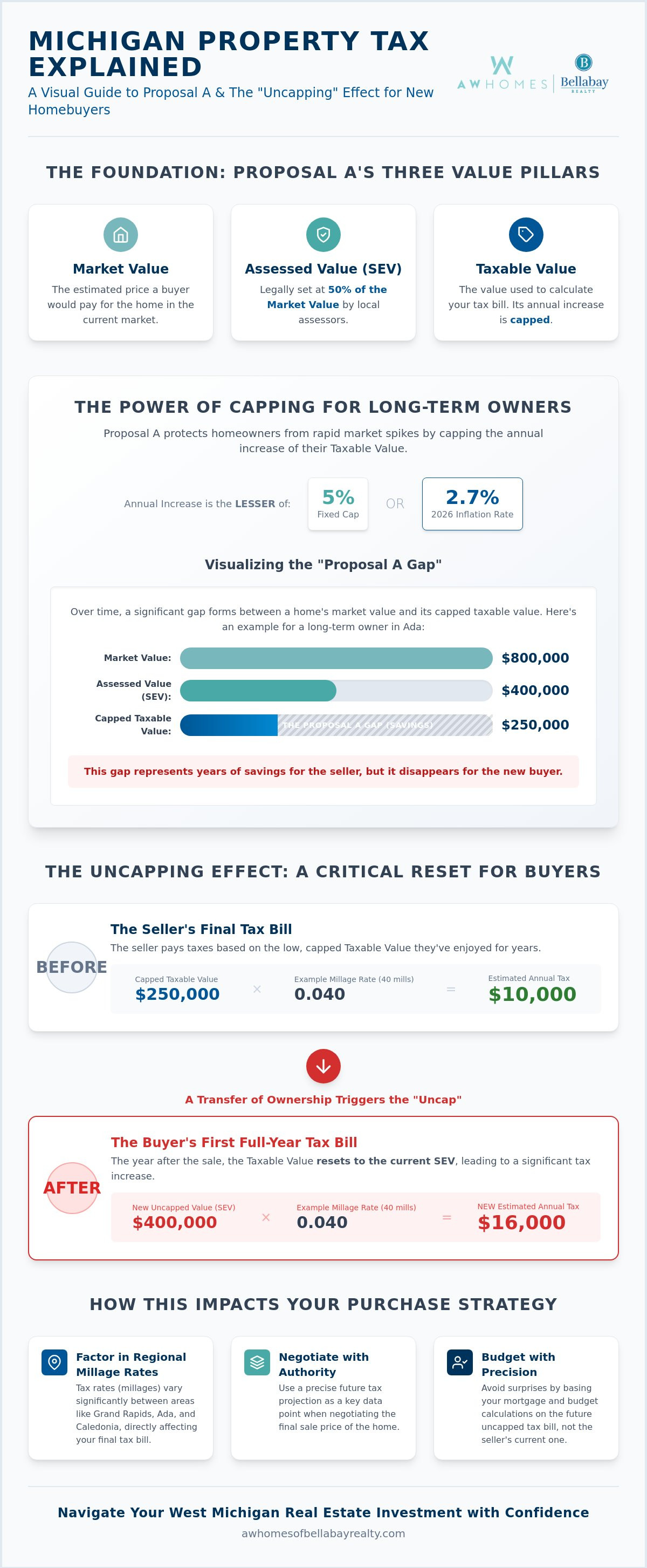
Michigan's property tax system is unique, governed by a landmark piece of legislation known as Understanding Michigan Proposal A. Passed in 1994, this law shifted the focus of school funding and changed how property values are calculated for tax purposes. Before this, taxes could skyrocket alongside market appreciation, leaving homeowners vulnerable to sudden financial shifts. Today, Proposal A serves as a stabilizer, ensuring that your home's value remains a source of security rather than a source of stress. It creates a methodical framework built on three distinct pillars:
- Market Value: The estimated price a buyer would pay for your home in the current market.
- Assessed Value (SEV): Legally mandated to be 50% of the market value.
- Taxable Value: The actual number used to calculate your annual tax bill.
For long-term residents in high-demand areas like Ada or Forest Hills, the gap between what a home is worth and what it's taxed on can become quite large. This is because Proposal A "caps" the annual increase of the Taxable Value, protecting you from the rapid market spikes common in West Michigan. Understanding how property taxes affect home value Michigan helps you see that your tax bill is a lagging indicator of your home's actual worth.
Market Value vs. Assessed Value (SEV)
Local assessors determine your home's value by analyzing neighborhood sales, property features, and local market trends. Your State Equalized Value (SEV) represents half of this determined worth. It's common to see your SEV rise even if you haven't added a new deck or finished the basement; it simply reflects the rising tide of the local real estate market. This is a primary way how property taxes affect home value Michigan, as a high SEV signals strong market desirability even if your current tax bill remains capped.
The Mechanics of the Taxable Value Cap
The beauty of the Michigan system lies in its predictability. Each year, your Taxable Value can only increase by 5% or the rate of inflation, whichever is lower. For the 2026 tax year, the inflation rate multiplier is set at 1.027, meaning most homeowners will see a modest 2.7% cap on their taxable value increases. The Consumer Price Index (CPI) serves as the official measure of inflation used by the state to calculate these annual adjustments. Over a decade of ownership, this cumulative capping creates a significant financial cushion. In a thriving community like Ada, a home might have a Market Value of $800,000, an SEV of $400,000, but a Taxable Value of only $250,000. This disparity is the "Proposal A gap," a benefit that provides long-term emotional and financial security to established neighbors.
The Uncapping Effect: What Happens the Year After a Sale?
The most critical moment in your property’s financial life occurs the year after you receive the keys. While the previous owner may have enjoyed years of protected, capped taxable values, the act of selling the home triggers a reset button. This process, known as "uncapping," is a central way Michigan's Proposal A regulates the market. It ensures that the taxable value aligns with the current market state, effectively ending the protections the previous owner built up over time. Understanding this shift is vital for any buyer because it directly influences how property taxes affect home value Michigan in the long term.
The timing of this change often catches buyers by surprise. If you close on a home in Ada or Grand Rapids in 2026, your tax bill for the remainder of that year will likely mirror what the seller was paying. However, on January 1 of the following year, the local assessor will uncap the property. This means your first full year of ownership often comes with a significantly higher tax obligation than the one listed on the initial marketing materials. Uncapping is predictable, calculable, and manageable when you have the right data.
Transfer of Ownership and the Reset Button
Under Michigan law, a transfer of ownership is the catalyst for uncapping. This usually happens through a standard deed transfer during a sale, but it can also include certain long-term leases or changes in partnership interests. There are specific exceptions designed to preserve family legacies; transfers between certain family members or into specific types of trusts may not trigger a reset. During the Michigan home closing process, you'll be required to file a Property Transfer Affidavit. This document notifies the local assessor that a transfer has occurred, setting the stage for the following year's tax adjustment. Handling this step with precision ensures there are no legal hurdles in your homeownership journey.
Calculating the Post-Purchase Jump
To avoid "sticker shock," you must look past the seller's current bill. The previous owner's tax history is irrelevant to your future costs. Instead, use a simple, methodical formula to estimate your new obligation: take your purchase price, divide it by two to find the new SEV, and multiply that by the local millage rate. For a $500,000 home, your taxable value will likely reset to $250,000. Managing the emotional transition of a higher escrow payment is much easier when the numbers are part of your initial budget. If you're feeling uncertain about these projections, our real estate investment consulting can provide the clarity you need to move forward with confidence. We focus on expert navigation to ensure your financial transition is as seamless as your physical move.
How Property Taxes Impact Buying Power and Sale Price
A home’s price tag is only one part of the financial equation. For many, the monthly mortgage payment is the true measure of affordability, and property taxes play a decisive role in that calculation. Understanding how property taxes affect home value Michigan allows both buyers and sellers to approach the market with a clear, strategic focus. When taxes are high, they consume a larger portion of a buyer’s monthly budget, directly influencing how much a lender is willing to provide. This relationship creates a ripple effect throughout the local market, affecting initial offers, final closing numbers, and long-term equity.
While high millage rates might initially seem like a deterrent, they often act as a signal of a high-value community. In areas like Ada or Forest Hills, these taxes fund top-tier schools, pristine parks, and reliable public services. These amenities drive demand, which in turn sustains property values over time. A strategic buyer views these taxes not as a burden, but as a deliberate investment in their lifestyle and long-term security. Conversely, a seller must understand that their home’s value is viewed through the lens of these ongoing costs, requiring a methodical approach to pricing and market positioning.
The Buyer’s Perspective: Monthly Payment vs. Purchase Price
Lenders evaluate your Debt-to-Income (DTI) ratio to determine your maximum loan amount. Because property taxes are included in this ratio, a home in a high-tax district might actually be less affordable than a more expensive home in a lower-tax area. For example, two homes priced at $600,000 can have vastly different monthly carry costs based on local millage rates. By mastering these numbers early, you can secure the emotional security that comes from a predictable financial roadmap. This level of planning ensures your move is a positive evolution in your life story, free from the stress of a stretched budget.
Seller Strategy: Positioning Your Home Value
When listing your home in Forest Hills, it's essential to address tax concerns proactively. A high-level consultant will highlight the Principal Residence Exemption (PRE) as a significant benefit, as it can reduce a property tax bill by nearly 30 percent in many communities. We focus on showcasing the tangible benefits those tax dollars provide, such as neighborhood safety, educational excellence, and community stability. By positioning the cost of taxes as a contribution to a premier lifestyle, we offset buyer hesitation. Strategic focus, local insight, and financial clarity are the hallmarks of a successful sale that attracts buyers who appreciate the intentionality of your specific community.
West Michigan Millage Rates: A Regional Comparison
To navigate the local market with confidence, one must understand the language of millage rates. A mill represents $1 of tax for every $1,000 of a property’s taxable value. In West Michigan, these rates are the primary mechanism for funding the essential services that define our community’s character. Because each township and city sets its own rates, Grand Rapids real estate trends vary significantly depending on which side of a municipal border a home sits. This regional variation is a fundamental factor in how property taxes affect home value Michigan, as the tax burden directly influences a buyer’s long-term carrying costs and overall interest in a specific neighborhood.
Local millage rates are not static; they evolve through voter-approved bonds and improvements for schools, libraries, and public safety. For instance, while the city of Grand Rapids approved a 1.2% reduction in millage rates for the 2027 fiscal year, other nearby municipalities may see increases to fund specific infrastructure projects. This landscape requires a methodical, step-by-step analysis to ensure your investment aligns with your long-term financial goals. We view this data not as a series of obstacles, but as a strategic map for your next life stage.
The Forest Hills and Ada Advantage
In high-demand areas like Forest Hills and Ada, millage rates often reflect a deep commitment to educational excellence. High-performing school districts typically correlate with higher millage rates, yet these communities continue to see robust home value appreciation. The ROI of paying slightly higher taxes is found in the premium neighborhood amenities and the sustained demand from move-up buyers. Navigating the tax landscape of Ada Township requires an understanding that your tax dollars are an intentional investment in community stability and neighborhood authority. This curated journey toward homeownership prioritizes your emotional security by ensuring you understand the value behind every dollar spent.
Principal Residence Exemption (PRE) in West Michigan
The Principal Residence Exemption (PRE) is a vital tool for homeowners seeking localized reliability and financial balance. Often referred to as the "homestead" exemption, it removes the 18-mill local school operating tax from your primary residence. For 2026, the deadline to file a PRE Affidavit is June 1 for the summer tax levy and November 1 for the winter levy. This exemption can reduce a property tax bill by nearly 30% in many Kent County communities, making it a critical component of your budget. If you are exploring real estate investment properties in Grand Rapids 2026, remember that non-homestead properties do not qualify for this 18-mill reduction, which significantly alters the cash-flow analysis. If you are ready to navigate these complexities with a neighborhood authority, our buyer agency services provide the methodical analysis needed for a confident purchase.
Strategic Navigation: The Angela Worth Concierge Approach
Navigating a high-stakes real estate transition requires more than just a search for listings. It demands a sophisticated blend of professional authority, localized reliability, and empathetic reassurance. At AW Homes of Bellabay Realty, we view every transaction as a significant personal milestone rather than a mere financial exchange. We replace the uncertainty of tax uncapping with a steady, logical, and supportive framework. Understanding how property taxes affect home value Michigan is a core pillar of our market analysis, ensuring that no detail is left to chance during your move. Clarity. Strategy. Security.
Our concierge-style approach moves beyond simple salesmanship to position our team as your high-level consultants. We provide every client with methodical tax projections that look forward into the first full year of ownership, effectively mitigating the stress of the unknown. This intentionality allows you to budget with precision, negotiate with authority, and avoid the common pitfalls of West Michigan real estate transitions. Our methodical analysis reveals how property taxes affect home value Michigan, providing you with a predictable financial roadmap for your next investment. Precision. Insight. Results.
Expert Insights for Move-Up Buyers
Move-up buyers in communities like Ada and Forest Hills often navigate complex situational needs that require specialized expertise. Whether you're transitioning to a larger family home or seeking a property in a specific school district, we tailor our strategies to your current life stage. We look beyond the immediate transaction to ensure your long-term financial security in your new community. Angela Worth’s commitment to seamless, stress-free processes means we handle the technical nuances of millage rates and taxable value resets. This allows you to focus on your personal evolution while we manage the logistical complexities of your move. Support. Knowledge. Excellence.
Your Next Chapter Starts Here
A neighborhood authority is essential for navigating the specific tax landscapes of Kent County municipalities. We prioritize your long-term well-being over a quick closing, acting as a composed and attentive partner throughout your curated journey. By choosing a partner who understands the methodical nature of Michigan property law, you ensure that your next move is a positive development in your life story. We provide the expertise, the insight, and the steady hand needed to secure your 2026 real estate investment. Trust. Warmth. Reliability.
Schedule a strategic consultation with Angela Worth to begin your next chapter with absolute clarity and professional guidance.
Secure Your Financial Future in West Michigan
Mastering the nuances of Proposal A and the 2.7 percent inflation multiplier is the first step toward a successful property transition. By understanding the predictable nature of tax uncapping and the value of regional millage rates, you transform a complex financial hurdle into a strategic advantage. It's essential to recognize how property taxes affect home value Michigan, as this knowledge allows you to negotiate with authority and move forward with absolute emotional security. Your home isn't just a transaction; it's the foundation of your next chapter.
Whether you're listing a home in Forest Hills or navigating the unique tax landscape of Ada, you deserve a partner who prioritizes your long-term well-being. Angela Worth’s concierge-style approach provides the expert guidance on West Michigan market trends and deep expertise in East Grand Rapids needed for a stress-free experience. We focus on providing a curated journey that replaces uncertainty with methodical planning, expert insight, and localized reliability.
Begin your seamless home transition with a strategic consultation and step into your next chapter with absolute confidence. We look forward to helping you evolve your life story in a community you love.
Frequently Asked Questions
How much will my property taxes increase when I buy a house in Michigan?
Your property taxes will reset to match 50% of the home's current market value in the year following your purchase. This "uncapping" process replaces the previous owner's protected, capped value with a new assessment based on the current market state. It's a critical factor in how property taxes affect home value Michigan, as it often leads to a significant jump from the seller's historical tax bill.
What is the difference between SEV and Taxable Value?
State Equalized Value (SEV) represents exactly 50% of your property's true market value as determined by the local assessor. Taxable Value is the specific figure used to calculate your actual bill, which is protected by a cap of 5% or the rate of inflation. While the SEV tracks the rising market in West Michigan, your Taxable Value remains stable until a transfer of ownership occurs.
Can I appeal my property tax assessment in Grand Rapids?
Homeowners in Grand Rapids can appeal their property assessment every March during the local Board of Review meetings. This is your opportunity to provide evidence that your home's assessed value is higher than 50% of its actual market value. We recommend a methodical approach, using recent neighborhood sales data to support your case and ensure your investment remains financially balanced and secure.
How do I calculate my estimated 2026 property taxes for a new home?
To estimate your 2026 taxes, divide your purchase price by two and multiply that number by the local millage rate. For example, a $500,000 home results in a $250,000 taxable value; if the millage rate is 34 mills, your annual tax would be approximately $8,500. This calculation provides a predictable financial roadmap, helping you avoid the "sticker shock" that often follows a move into a new community.
What is the Michigan Principal Residence Exemption (PRE)?
The Michigan Principal Residence Exemption (PRE) is a program that exempts your primary home from the 18-mill tax levied by local school districts for operating purposes. This exemption can reduce your total property tax bill by nearly 30% in many West Michigan areas. To qualify, you must own and occupy the home as your main residence and file the required affidavit with your local assessor by the state deadlines.
Does a home renovation trigger a property tax uncapping?
A standard home renovation doesn't trigger a full "uncapping," but the value of new construction or additions will be added to your taxable value. While your existing structure remains protected by the annual cap, the assessor will add the "new" value of a finished basement or a kitchen expansion to your bill. This ensures your taxes reflect the physical evolution of your property without resetting the entire assessment.
How often are property taxes assessed in Kent County?
Property taxes in Kent County are assessed annually, with new assessment notices typically arriving in February. These notices outline your new SEV and Taxable Value for the upcoming year based on market activity and the 2026 inflation multiplier of 2.7%. This yearly cycle allows for a methodical review of your property's standing, ensuring your financial planning remains aligned with current local market trends.
Are property taxes in Forest Hills higher than in East Grand Rapids?
Millage rates in East Grand Rapids are historically among the highest in Kent County, often exceeding the rates found in the Forest Hills school district. While both areas offer premium amenities and top-tier schools, the specific city taxes in East Grand Rapids usually result in a higher overall tax burden. Understanding these regional differences is essential when evaluating how property taxes affect home value Michigan during your neighborhood search.


