

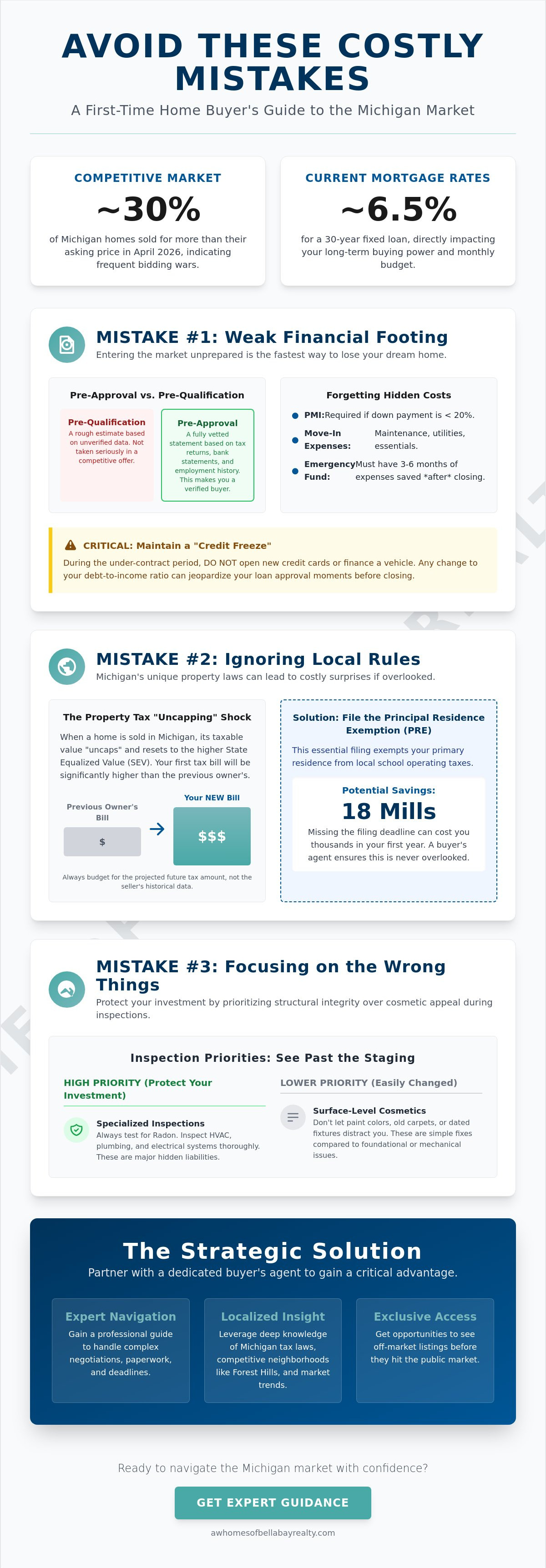
In April 2026, nearly 30% of Michigan homes sold for more than their asking price. This statistic highlights a market that is competitive, fast-paced, and often overwhelming, making it easy to fall into common first time home buyer mistakes to avoid MI. You likely worry about overpaying in a bidding war, feel confused by local property tax assessments, or lose sleep over the possibility of hidden structural repairs. It's natural to feel protective of your financial future during such a significant life transition.
By following a strategic approach, you can move forward with a sense of calm and professional authority. We've designed this 2026 checklist to provide the expert insight, localized knowledge, and strategic planning you need for a successful closing. We will explore how to secure a home in top-tier districts like Forest Hills, navigate current mortgage rates hovering around 6.5%, and build a foundation of long-term financial security.
Key Takeaways
- Distinguish between pre-qualification and a fully vetted mortgage pre-approval to anchor your financial foundation, strengthen your position, and ensure a seamless process.
- Navigate the unique complexities of the local market by accounting for Michigan property tax uncapping and the essential Principal Residence Exemption filing.
- Protect your investment from hidden liabilities by prioritizing specialized inspections for radon and mechanical systems over surface-level cosmetic appeal.
- Sidestep common first time home buyer mistakes to avoid MI by utilizing localized data to make swift, strategic offers in competitive neighborhoods like Forest Hills.
- Partner with a dedicated buyer's agent to gain expert navigation, personalized insight, and access to exclusive off-market listings.
Financial Foundations: Avoiding the 'Before You Browse' Blunders
Establishing your financial foundation is the first significant milestone in your journey toward homeownership. It's a process that requires clarity, precision, and a steady hand. Many eager buyers begin their search by browsing listings online, yet the most critical work happens before you ever step foot in an open house. Skipping these preliminary steps often leads to one of the most common first time home buyer mistakes to avoid MI: entering a negotiation without the necessary leverage to win.
The Pre-Approval vs. Pre-Qualification Trap
A pre-qualification is a surface-level estimate based on unverified information. In the competitive West Michigan market, where nearly 30% of homes sell above the list price, a simple estimate isn't enough to secure a property. You need a fully vetted mortgage pre-approval. This process involves a deep dive into your tax returns, bank statements, and employment history. It transforms you from an interested shopper into a verified buyer. Financial readiness is a synthesis of three essential elements: resilient credit, liquid capital, and strategic commitment.
Current June 2026 mortgage rates for a 30-year fixed loan range between 6.49% and 6.68%. These figures directly dictate your long-term buying power. A robust pre-approval allows you to lock in a rate and understand exactly how much home you can afford in neighborhoods like Forest Hills or East Grand Rapids. As you evaluate different loan products, be vigilant against predatory lending practices that can compromise your financial security. A strategic advisor will help you navigate these terms to ensure your investment remains a source of stability.
Hidden Costs: More Than Just a Mortgage
The monthly mortgage payment is only one piece of the financial puzzle. If your down payment is less than 20%, you must account for Private Mortgage Insurance (PMI). This is an added monthly cost that protects the lender but impacts your personal budget. Beyond the loan, first-time buyers often overlook the immediate "move-in" expenses that arise the moment you receive the keys. These include:
- Initial Maintenance: Mechanical tune-ups, gutter cleaning, or lock replacements.
- Lifestyle Essentials: Window treatments, area rugs, and basic landscaping tools.
- Emergency Reserves: A dedicated fund for unexpected repairs like a leaking water heater or a failed sump pump.
One of the most frequent first time home buyer mistakes to avoid MI is draining your entire savings for the down payment. It is vital to preserve an emergency fund that covers at least three to six months of expenses. Finally, maintain a "credit freeze" on your lifestyle during the under-contract period. Opening a new credit card for furniture or financing a new vehicle can alter your debt-to-income ratio, potentially causing your lender to revoke your loan approval just days before closing. Stay methodical, stay patient, and keep your financial profile stable until the keys are in your hand.
The Michigan Nuance: Local Pitfalls You Can't Ignore
Every real estate market operates under its own set of rules, but Michigan's landscape is particularly distinct. Understanding these regional intricacies is what separates a successful investment from a costly oversight. While the broader home buying process provides a general roadmap, local nuances in tax law and seasonal shifts require a more specialized perspective. Navigating this terrain effectively requires precision, timing, and local expertise to avoid the common first time home buyer mistakes to avoid MI.
Property Taxes and the PRE Benefit
The most significant "hidden" cost in a Michigan home purchase is the phenomenon known as tax uncapping. Under Michigan law, the taxable value of a property is capped for as long as a person owns it. When the property is sold, that cap is removed, and the taxable value "uncaps" to match the current State Equalized Value (SEV). This often results in a first-year tax bill that is significantly higher than what the previous owner paid. You must evaluate properties based on projected future taxes rather than historical data.
To mitigate these costs, you must file for the Michigan Principal Residence Exemption (PRE). This exemption can remove up to 18 mills of school operating taxes from your annual bill, provided the home is your primary residence. Missing the filing deadline is a frequent error that can cost you thousands of dollars in your first year of ownership. A strategic advisor will always recommend requesting a tax estimate based on the new SEV to ensure your long-term financial security remains intact.
Navigating the West Michigan Inventory
The 2026 market in areas like Caledonia, Cascade, and Ada operates with a different rhythm than the national average. With housing supply currently sitting between 1.09 and 2 months, competition is high and inventory is lean. This environment demands a proactive strategy rather than a reactive one. Understanding neighborhood-specific trends is essential for identifying properties that offer both immediate lifestyle benefits and long-term appreciation. For a deeper look at these localized dynamics, explore our analysis of the Grand Rapids Real Estate: Strategic Trends & 2026 Market Outlook.
Climate also plays a practical role in your monthly budgeting. Michigan’s seasonal extremes mean that utility costs can fluctuate wildly between a humid July and a frigid January. When viewing homes, pay close attention to the age of the furnace, the quality of the insulation, and the condition of the windows. These mechanical details are the silent drivers of your monthly overhead. If you're feeling overwhelmed by these local variables, our expert buyer agency services provide the steady guidance needed to navigate these transitions with confidence.
Property Inspection Mistakes: Seeing Past the Staging
Walking into a beautifully staged home in West Michigan is an evocative experience. The soft lighting, curated furniture, and fresh scents are designed to create an emotional connection, yet these elements often mask the true condition of the property. One of the most critical first time home buyer mistakes to avoid MI is allowing aesthetic appeal to overshadow structural integrity. A successful inspection requires three essential pillars: technical expertise, environmental awareness, and objective observation.
While the Michigan State Housing Development Authority (MSHDA) provides resources to help you reach the closing table, your long-term security depends on what you discover during the due diligence period. Research indicates that buyers in competitive markets sometimes feel pressured to skip inspections to make their offers more attractive. This is a high-risk gamble. An inspection is your primary tool for uncovering costly issues that aren't apparent during a twenty-minute showing. You should always attend the inspection in person; it's your opportunity to ask clarifying questions and understand the methodical maintenance your new home will require.
The Michigan Inspection Checklist
Michigan's unique geography and climate demand specialized testing that a general inspection might not emphasize. In Kent County, radon testing is a non-negotiable requirement for any home with a basement. Radon is a colorless, odorless gas that can seep through foundations, and identifying its presence early allows you to negotiate mitigation systems before you move in. You must also evaluate the grading and drainage around the perimeter of the house. Proper soil sloping is vital for preventing basement flooding during our intense spring thaws.
The mechanical systems also require a regional lens. Before the arrival of a Michigan winter, the age and efficiency of the furnace must be verified. A unit nearing the end of its lifespan is a significant looming expense that impacts your monthly cash flow. If you're looking at properties in more rural areas surrounding Grand Rapids, don't overlook specialized well and septic inspections. These systems are expensive to replace and essential for the daily functionality of your home.
Aesthetics vs. Infrastructure
It's easy to get distracted by "HGTV-style" finishes like quartz countertops or trendy backsplash tile. However, a strategic home purchase prioritizes the integrity of the "bones," the reliability of the mechanics, and the safety of the environment over any surface-level appeal. You must train your eyes to look past the decor to evaluate the actual condition of the roof, the siding, and the foundation. A fresh coat of paint can hide water stains, but it can't fix the underlying leak. Identifying the difference between a simple DIY cosmetic fix and a professional-grade structural repair is key to maintaining your financial security. Even if you're purchasing a "new" construction home, a third-party inspection is essential to ensure that the building standards match the promises made during the sale.
Process and Emotional Pitfalls: Strategy Over Sentiment
Buying a home is more than a financial transaction; it's a significant personal evolution. It represents a transition into a new chapter of your life story. However, an emotional attachment to a property before you've reviewed the data is a vulnerability. One of the most common first time home buyer mistakes to avoid MI is falling in love with a house before conducting a Comparative Market Analysis (CMA). This analysis provides an objective baseline for value. It removes the guesswork. It protects your investment. It anchors your future.
When you attend an open house in Ada or Cascade, maintain a composed and professional demeanor. It's natural to feel excited, but revealing too much personal information to the listing agent can weaken your negotiating position. Remember that the listing agent represents the seller's interests. Keep your budget, timeline, and motivations private. This methodical approach ensures you remain the lead architect of your transaction. Strategy, timing, and composure are your best tools in a high-stakes market.
The Danger of Emotional Overbidding
In a market where housing supply remains tight, bidding wars are frequent. In 2026, Michigan home prices are forecasted to appreciate by 2% to 4%. This steady growth means you must be strategic with your offers to ensure long-term financial security. Many buyers face "appraisal gaps," where the agreed-upon price exceeds the bank's valuation. Navigating these gaps requires a clear plan for your liquid capital and a willingness to walk away if the numbers don't align with your goals. Rely on data-driven market trends to stay grounded. For a deeper understanding of the final steps, review our Michigan Home Closing Process: A Strategic Guide.
Researching the Lifestyle, Not Just the Walls
A home is an anchor for your daily life. You aren't just buying four walls; you're choosing a community. Evaluate the "commute-to-community" ratio for Grand Rapids and its surrounding suburbs to ensure it fits your daily rhythm. Forest Hills and Ada remain top-tier choices because they offer long-term stability, excellent school districts, and community-focused lifestyles. Research local zoning laws to ensure that future neighborhood developments align with your vision for the property. Hesitating too long in high-demand areas like East Grand Rapids can result in missed opportunities. Success in this market requires three things: preparation, decisiveness, and expert navigation.
To ensure your next transition is handled with precision and care, consider partnering with us for Buyer Agency Services.
The Strategic Solution: Why a Buyer's Agent is Essential
Navigating the complexities of the 2026 market without dedicated representation is perhaps the most significant of all first time home buyer mistakes to avoid MI. While online tools and open houses provide a window into the market, they don't offer the specialized navigation required for a high-stakes transaction. Many buyers mistakenly assume the listing agent at an open house is a neutral party. In reality, that agent has a fiduciary duty to the seller. They are contracted to secure the highest price and best terms for their client, not yours. You deserve an advocate whose sole focus is your long-term well-being.
A professional buyer's agent acts as a strategic buffer during intense contract negotiations. They translate complex industry terminology into actionable insights, ensuring no detail is left to chance. This relationship moves beyond simple salesmanship; it is a partnership grounded in professional authority, empathetic reassurance, and strategic focus. By securing your own representation, you gain a consultant who prioritizes your financial security over a quick closing.
Your Strategic Advisor in West Michigan
The West Michigan landscape requires a deep, localized understanding of neighborhood dynamics. An expert advisor provides access to "pocket listings" and off-market opportunities that never reach public search portals. In competitive areas like Grand Rapids, Ada, and Caledonia, this inside track is often the difference between securing a home and missing out entirely. We understand the nuances of local school districts, upcoming infrastructure projects, and the subtle shifts in regional property values. To learn more about selecting the right partner for your journey, explore our guide on how to Find a Buyers Agent in Grand Rapids: A Strategic Guide.
The AW Homes Concierge Advantage
At AW Homes, we view real estate as a catalyst for personal evolution. Angela Worth and her team provide a concierge-style approach that recognizes your home purchase as a significant life milestone. We don't just facilitate transactions; we manage transitions. Our methodical process is designed to mitigate stress by providing a clear, step-by-step roadmap from the initial consultation to the final closing. We handle the logistics, we manage the timelines, and we protect your interests. This organized approach ensures that your move into a new community is seamless, supportive, and successful. We invite you to Connect with AW Homes for a strategic home buying consultation and take the first step toward your next chapter with confidence. We plan, we navigate, and we secure your future.
Securing Your Future in West Michigan
Your journey toward homeownership is a significant personal evolution that requires a blend of data-driven strategy and emotional security. By prioritizing a fully vetted pre-approval, accounting for Michigan's unique tax uncapping laws, and looking past staging to the structural integrity of a property, you position yourself for long-term success. These proactive steps are essential to sidestep the common first time home buyer mistakes to avoid MI that can jeopardize your financial foundation and peace of mind.
At AW Homes, we provide concierge-style real estate expertise tailored to your specific life stage. We offer a specialized focus on the nuances of Grand Rapids and Forest Hills, providing empathetic guidance during these major life transitions. We invite you to Schedule Your Strategic 2026 Home Buying Consultation to ensure your next move is handled with precision and care. Your vision for the future is within reach, and we're here to help you navigate every step of the journey with confidence.
Frequently Asked Questions
Is it a mistake to buy a home in Michigan without 20% down in 2026?
Buying a home with less than 20% down is a strategic entry point for many first-time buyers and is not a mistake. As of June 2026, MSHDA programs offer up to $10,000 in down payment assistance for those who meet income and credit requirements. While you will likely pay Private Mortgage Insurance, entering the market sooner allows you to begin building equity in a climate of steady appreciation.
How do Michigan property taxes change after I buy my first home?
Your property taxes will likely reset to a higher rate due to the "tax uncapping" process that occurs after a sale. In Michigan, the taxable value is capped for the current owner, but it resets to match the State Equalized Value when the property transfers. You must file the Principal Residence Exemption to ensure you aren't paying unnecessary school operating taxes on your primary home.
Should I skip the home inspection to make my offer more competitive in Grand Rapids?
Skipping a home inspection is a high-risk gamble that can lead to unforeseen financial burdens. A professional inspection is essential for identifying regional issues like radon gas, foundation cracks, or aging furnaces before a Michigan winter. Maintaining this contingency provides the emotional security, professional leverage, and technical clarity needed for a successful investment.
What is the most common mistake first-time buyers make in the Forest Hills area?
The most frequent error in Forest Hills is hesitating too long in a market where inventory often sits between 1.09 and 2 months of supply. High demand for top-tier school districts means properties move quickly, often within two to four weeks. Success in this neighborhood requires three essential elements: a vetted pre-approval, clear priorities, and a decisive offer strategy.
How much should I set aside for closing costs in West Michigan?
You should generally budget between 2% and 5% of the home's purchase price to cover closing costs. In Michigan, the average closing cost is approximately $4,138, which includes title insurance, state transfer taxes, and loan origination fees. Establishing this budget early ensures your transition remains stress-free and your financial foundation stays secure through the final signature.
What happens if the home appraisal comes in lower than my offer price?
A low appraisal creates an "appraisal gap" that requires a strategic resolution before the lender will finalize your loan. You can choose to cover the difference in cash, negotiate a price reduction with the seller, or use your appraisal contingency to walk away. Navigating these gaps effectively is a critical part of managing first time home buyer mistakes to avoid MI.
Can I buy a home in Michigan if I have student loan debt?
You can purchase a home with student loan debt as long as your debt-to-income ratio remains within your lender's specific guidelines. Lenders focus on your monthly payment obligations rather than the total balance of your loans. Many state programs are designed to support buyers with diverse financial backgrounds, ensuring that education debt doesn't prevent your personal evolution into homeownership.
How do I know if a neighborhood in Ada or Cascade is a good investment?
Identifying a strong investment in Ada or Cascade involves evaluating school district performance, historical resale values, and proximity to regional employment hubs. These areas are characterized by long-term stability and high-end community infrastructure. A localized expert can provide the methodical analysis and neighborhood-specific data required to confirm that your chosen property aligns with your long-term goals.


