
For a first-time home buyer in Grand Rapids, MI, the amount needed upfront depends in part on the mortgage program and any assistance available.
It’s understandable to focus on the down payment: it can affect which homes and financing options feel within reach.
This guide explains how local prices translate into down-payment examples, which assistance programs to explore, and what their key conditions involve. It also points to HUD home-buying resources and helps you consider your options and next steps.
Key Takeaways
- Compare local home prices with the down payment your mortgage option requires to frame a realistic purchase budget.
- Explore Michigan and Grand Rapids assistance programs, paying close attention to eligibility rules and how support is structured.
- Learn how HUD-related home-buying resources and FHA financing can inform your next steps.
- Understand how buyer agency services can help you assess homes and move through the purchase process with a clearer plan.
Grand Rapids home prices and down payments
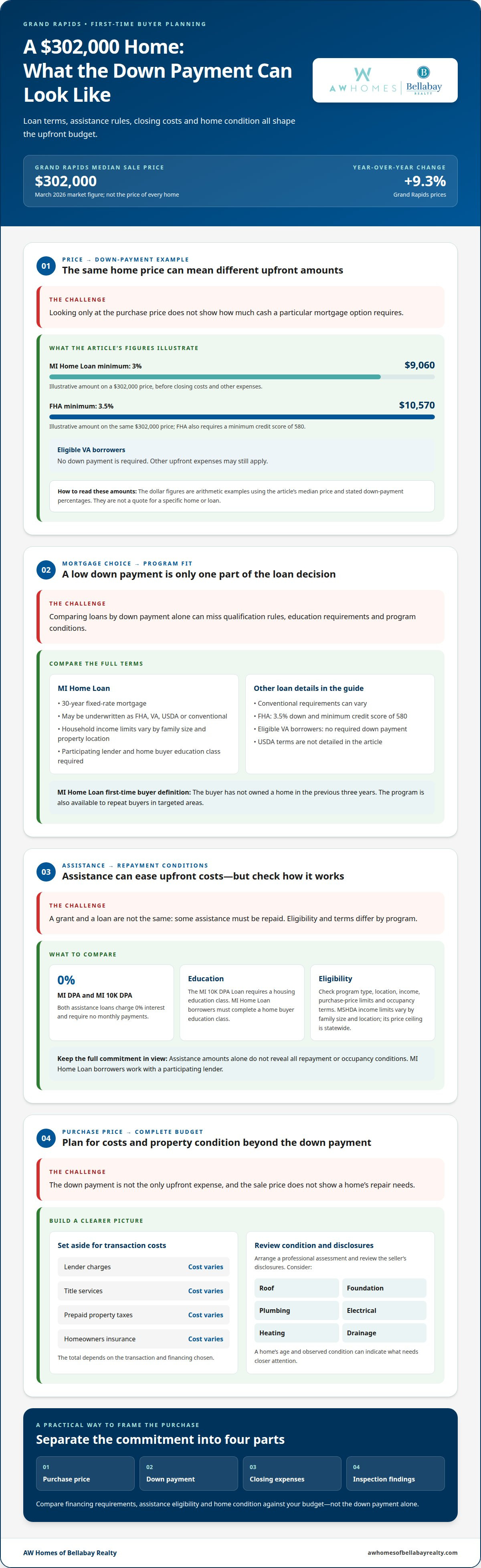
Grand Rapids’ median sale price was $302,000 in March 2026. Grand Rapids prices rose 9.3% year over year. These figures frame the market, not an individual home’s price.
Michigan’s MI Home Loan requires at least 3% down. Eligible VA borrowers aren’t required to make a down payment. Your mortgage option therefore affects the cash needed upfront, alongside the home’s price.
The MI Home Loan is a 30-year fixed-rate mortgage. It can be underwritten as an FHA, VA, USDA, or conventional loan. Household income limits vary by family size and property location. Borrowers work directly with a participating lender and must complete a home buyer education class. These terms help determine whether a particular purchase fits the program.
Budget for more than the down payment. Closing costs and upfront expenses may include lender charges, title services, prepaid property taxes, and homeowners insurance. Set these costs apart in your purchase budget, since the total depends on the transaction and financing you choose.
For inspections, arrange a professional assessment of the home’s condition and review the seller’s disclosures. Consider the roof, foundation, plumbing, electrical systems, heating, and drainage. The property’s age and observed condition can indicate what needs closer attention.
- Compare financing: Review down-payment requirements alongside loan type and purchase price.
- Check program fit: MI Home Loan limits and income requirements affect eligibility.
- Budget fully: Account for closing expenses beyond the down payment.
- Assess the property: Use inspection findings and disclosures to understand condition and potential repair needs.
For a first-time buyer in Grand Rapids, MI, separating the purchase price, down payment, closing expenses, and inspection findings gives you a clearer view of the commitment. Comparing these factors helps you weigh the home’s condition and financing terms against your budget.
First-time buyer grants
Assistance can reduce the cash needed upfront, but programs differ in eligibility and repayment terms. Compare state and local options in Grand Rapids before choosing a financing path.
First-Time Buyer Grant Options
Down payment assistance can help eligible buyers cover purchase costs through grants or loans. The distinction matters: some assistance must be repaid, even on favorable terms. Michigan’s MI Home Loan is available statewide to first-time buyers and repeat buyers in targeted areas. For this program, first-time means not owning a home in the previous three years. These options can make the upfront budget more manageable, but their different rules determine which may fit.
MSHDA Income and Purchase Price Limits
MSHDA’s MI Home Loan has household income limits that vary by family size and property location. These limits affect whether a household and home qualify, so buyers in Kent County should consider both household income and property price. The income threshold depends on family size and location, while the price ceiling is statewide. Borrowers work with a participating lender and must complete a home buyer education class.
Down Payment Assistance and Repayment
Both MI DPA and MI 10K DPA assistance loans charge 0% interest and require no monthly payments. The state’s MI 10K DPA Loan also requires a housing education class. Compare program type, location, and occupancy terms: assistance amounts alone don’t show the full commitment.
HUD home-buying resources
Grand Rapids buyers can use FHA, VA, USDA, or conventional financing. MI Home Loan can be paired with these loan types. MSHDA borrowers work with participating lenders and complete buyer education.
Finding an Approved MSHDA Lender
A participating lender handles MI Home Loan applications and financing. MSHDA borrowers work directly with a participating lender, rather than through the housing agency for mortgage underwriting. Start by identifying participating lenders, then discuss the property, household income, and mortgage type. These details help determine how the program fits your purchase. Compare loan terms as well as eligibility, not just down payment requirements.
Home Buyer Education Courses
A home buyer education course covers purchase preparation and is required for MI Home Loan borrowers. Include the class in your financing plan. Grand Rapids Housing Commission participants must complete homeownership classes before purchasing. Course completion is also required for participants in its Housing Choice Voucher Homeownership Program. Keep this education requirement separate from lender approval: both are program considerations.
Loan options differ in down-payment and credit requirements. FHA financing requires 3.5% down and a minimum credit score of 580. Conventional loan requirements can vary, so compare the down payment and credit criteria with your finances. Eligible VA borrowers aren’t required to make a down payment. MI Home Loan may be underwritten as FHA, VA, USDA, or conventional financing; USDA terms aren’t detailed here. Compare the loan’s qualifying criteria with your finances and the home you’re considering.
HUD-related resources also connect buyers with local housing assistance. The Grand Rapids Housing Commission’s voucher homeownership program is for first-time buyers under HUD and Fair Housing guidelines. Applicants must have no ownership interest in another home. Housing Choice Voucher recipients must have received GRHC rental assistance for at least one year and remain in good standing. The program requires an approved lender who agrees to finance the purchase.
GRHC’s program also requires qualifying income and employment history. The home must be a single-family residence, pass a HUD Housing Quality Standards inspection, and receive an independent professional inspection. Participants must use it as their only residence and recertify annually to continue assistance.
How much down payment assistance can Grand Rapids first-time buyers receive, and what are the repayment terms?
Assistance varies by program, location, and eligibility. Compare the amount with repayment terms and occupancy conditions, not just the headline figure.
Buyers use it with an MI Home Loan mortgage through a participating lender. The MI 10K DPA Loan Program serves MI Home Loan buyers in 236 ZIP codes. These are loans, not grants, so understand their terms when planning your purchase funds.
Both MI DPA and MI 10K DPA charge 0% interest and require no monthly payments. That means borrowers don’t make regular monthly payments on these assistance loans. The terms differ from an outright grant, so don’t assume the assistance is automatically forgiven. The program name, eligible property location, and related mortgage determine which option may apply.
Recipients must remain in the home for five years. Consider this occupancy condition if a job change, household shift, or relocation could affect your future plans. Compare the local requirement with state assistance before deciding what support suits your circumstances.
MI Home Loan borrowers must complete a home buyer education class. The MI 10K DPA Loan also requires a housing education class. Include the class requirement in your timeline, alongside lender review and purchase preparation. For buyers weighing programs, the key distinctions are assistance amount, participating location, monthly payment requirements, and occupancy terms. Together, they show how support affects both cash due at purchase and commitments afterward.
As you compare eligible homes and assistance conditions, plan your Grand Rapids home search with a clear view of your purchase priorities.
AW Homes of Bellabay Realty: Residential Listing Services
AW Homes of Bellabay Realty offers Buyer Agency Services for buyers planning a purchase in Grand Rapids, Ada, Caledonia, or East Grand Rapids. After comparing financing, assistance, and property needs, buyer representation can help you focus your search and evaluate homes against your priorities.
If you’re moving to the area, Relocation Assistance can support your transition. Buyers considering an investment property can explore Real Estate Investment Consulting. If your plans include selling a home, Residential Listing Services can help with that part of the move. Each service supports a different real estate decision, from finding a home to planning a sale or investment.
Share your goals with AW Homes of Bellabay Realty to discuss the next step in your home search.
Make your next move with a clear plan
Choosing a home also means choosing how you want daily life to feel. For a first-time home buyer in Grand Rapids, MI, the next step is to turn your priorities into a focused search. Consider neighborhoods that suit your routine, the features you value, and how long you expect to stay.
AW Homes of Bellabay Realty can guide you through the real estate decisions involved in that transition. Buyer Agency Services can help with your home search, while Relocation Assistance supports a move to Grand Rapids, Ada, Caledonia, or East Grand Rapids. If your plans include selling a property, Residential Listing Services can help with that part of your next chapter.
Bring your questions, priorities, and preferred pace to the conversation. Contact AW Homes of Bellabay Realty to discuss your next step. A thoughtful plan can make the move ahead feel more intentional, and your search can begin with confidence.
Frequently Asked Questions
What are the current home prices and property taxes in Grand Rapids, MI?
Grand Rapids’ median sale price was $302,000 in March 2026. Property taxes vary by parcel, so the specific home’s tax bill provides a more useful budgeting figure than a citywide estimate. Before making an offer, review that property’s tax information and include it in ongoing ownership costs. This helps a first time home buyer in Grand Rapids, MI understand expenses beyond the purchase price.
How do I apply for first-time home buyer assistance in Grand Rapids, step by step?
Start by identifying the assistance program that fits your plans, then review its requirements. For a first-time home buyer in Grand Rapids, MI, the MI Home Loan process involves working directly with a participating lender. Compare your household income and property location with program limits, then complete the required home buyer education class. Also account for the local fund’s eligibility and occupancy conditions.
Are there local home buyer programs or grants through the City of Grand Rapids or Kent County?
Grand Rapids offers a Homebuyer Assistance Fund, and Michigan has statewide MI Home Loan options. The Grand Rapids Housing Commission also offers a homeownership program for eligible Housing Choice Voucher recipients. Applicants need GRHC rental assistance for at least one year and must be in good standing. First-time home buyers in Grand Rapids, MI, can compare the programs’ distinct eligibility rules and support.


