

A local lender may add credibility to a home offer, even when a national lender offers a similar rate. In the local vs national mortgage lenders comparison, neither type consistently has the lowest rates. Offers vary by credit score, loan type, and market conditions. A local lender may know the area’s closing practices, while a national lender may offer a wider range of loan programs.
It makes sense to focus on the rate, but the full cost, communication, and confidence your financing inspires matter too. A low quote is useful only if its fees and terms fit your plans and the lender can keep your purchase moving.
This guide compares rates and service, explains which lender may suit different priorities, and explores how local reputation can shape sellers’ and agents’ views of an offer. You’ll have a clearer way to weigh your options before choosing how to finance your next move.
Key Takeaways
- Compare Loan Estimates for the same type of loan, looking beyond the interest rate to fees and terms; the Consumer Financial Protection Bureau recommends this like-for-like approach.
- Weigh digital tools and loan selection against the value of local market knowledge and more personal communication.
- Choose based on your priorities, including the loan programs you need, how you prefer to communicate, and the support you want through closing.
- A reachable lender and credible approval can strengthen seller confidence, so consider how your financing may come across with an offer.
Are interest rates the same between national and local lenders?
Local and national lenders often quote rates within a similar range, but no single rate applies to every buyer. Your credit score, loan type, and market conditions influence the offer. A national lender may have the scale to manage rate fluctuations, while a local lender may respond to conditions in its specific housing market. Either type could offer the lower rate for a particular borrower.
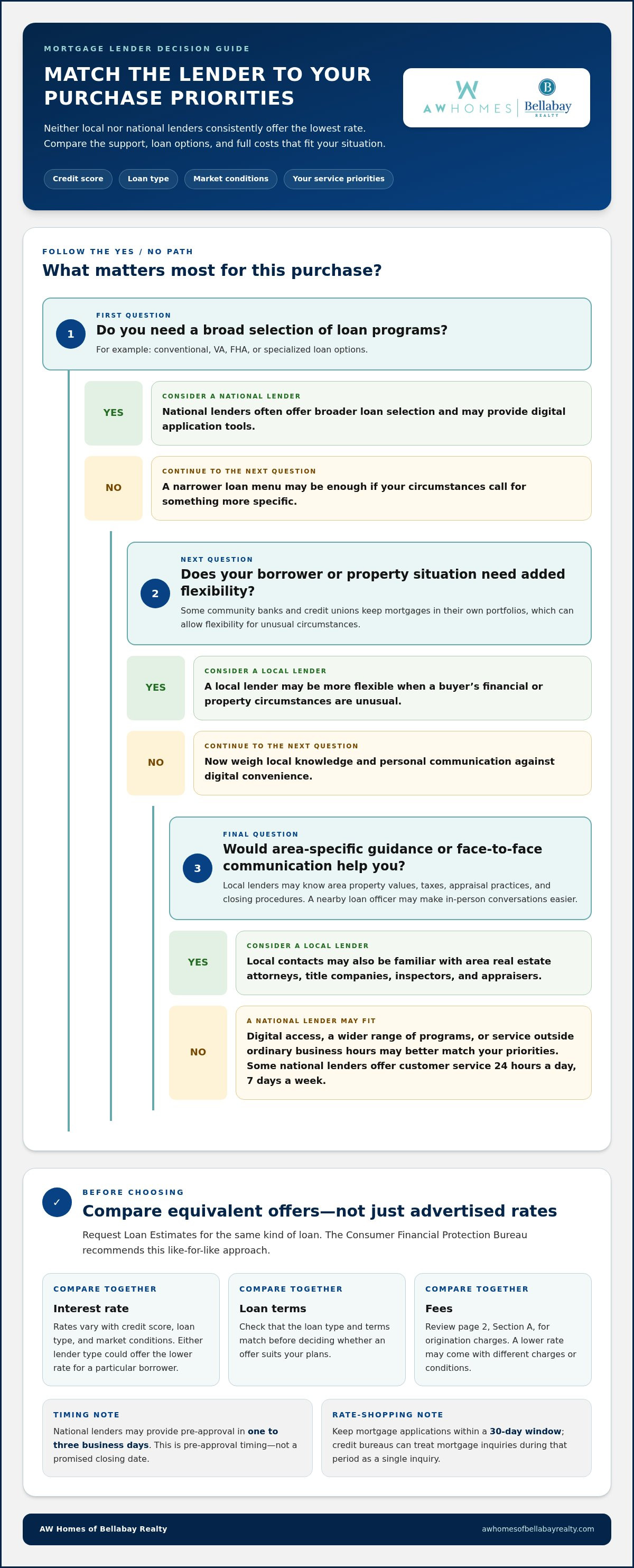
Loan choices and digital access also differ. National lenders typically offer a broad selection, including conventional, VA, and FHA loans, plus specialized options. Many local lenders provide online applications and pre-approvals, but their loan menus may be narrower. Some community banks and credit unions keep mortgages in their own portfolios, which can give them flexibility with unusual borrower or property circumstances.
Qualification requirements vary by lender. Local lenders may be more flexible when a buyer has a unique financial situation, while national lenders can offer more program choices. Compare actual terms rather than assuming a familiar loan name means identical requirements. The Consumer Financial Protection Bureau recommends requesting Loan Estimates for the same kind of loan to compare equivalent offers.
| Option | Loan selection | Digital access | Potential advantage |
|---|---|---|---|
| Local lender | May have fewer programs | Many offer online applications and pre-approval | Possible flexibility for unusual circumstances |
| National lender | Often includes conventional, VA, FHA, and specialized loans | Online applications and pre-approval may be available | Broader selection and scale |
Speed depends on the lender’s process and how complete your application is. National lenders may use in-house underwriters and processing teams, which can support faster turnaround. Borrowers choosing a national lender could receive pre-approval in one to three business days. That timing applies to pre-approval, not a promised closing date. Ask each loan officer how decisions and updates are handled.
For a clear comparison, request matching Loan Estimates and review the interest rate, loan terms, and fees together. Choose a lender whose program fits your circumstances and whose process supports your purchase timeline, not simply the one advertising the lowest rate.
National lenders’ potential rates and service trade-offs
National lenders process thousands of loans, and their scale can support broad loan products and competitive pricing. Digital applications can simplify document submission and let buyers follow approval steps online. Some national lenders also provide customer service 24 hours a day, 7 days a week. That access can help borrowers who need assistance outside ordinary business hours.
Convenience has trade-offs. High application volumes can affect response times, and an online process may provide less personalized support or local market insight. Local lenders, by contrast, may know area property values, taxes, and closing practices. A nearby loan officer can also make face-to-face conversations easier when questions arise. Service style matters as much as the application platform.
Compare Loan Estimates for the same kind of loan, as the Consumer Financial Protection Bureau recommends. Review the interest rate, loan terms, and fees together; on page 2, Section A, examine origination charges. Consider the full cost, not just the rate shown in an advertisement. You can also compare customer reviews for patterns in responsiveness, reliability, and closing performance.
How can borrowers compare mortgage loan estimates from different lenders? Request estimates for the same loan type and compare rates, terms, and fees side by side. A consistent comparison shows whether a lower rate comes with different charges or conditions.
What risks should borrowers consider when choosing a mortgage lender? Consider slow communication, limited personal support, and the possibility that servicing may transfer after closing. Reviews can help you assess how lenders handle updates and deadlines, while direct conversations clarify who your primary contact will be.
For rate shopping, keep applications within a 30-day window; mortgage inquiries made during that period can be treated by credit bureaus as a single inquiry. Then choose the lender whose costs, communication, and loan products match your priorities. Buyers who value area-specific guidance can also explore local buyer guidance as they plan their purchase.
Choosing a lender based on borrower priorities
Start by considering the support your home loan requires. A local lender may know area property values, taxes, and settlement procedures. That context can help when a property has features that affect appraisal or financing. Local and regional lenders may also understand appraisal methods used in their markets. When comparing local vs national mortgage lenders, consider how much that area knowledge matters to your purchase.
Personal communication can matter just as much. With a local lender, buyers may be able to meet a loan officer face to face, discuss an application, and resolve questions in person. Local contacts may include real estate attorneys, title companies, inspectors, and appraisers. Familiarity with these professionals can help coordinate details around a specific property.
A national lender may suit buyers who prioritize digital access or a wider selection of loan programs. A mortgage broker may shop a borrower’s profile across multiple lenders, while a national bank offers its own programs. The right fit depends on your situation, desired loan type, and comfort with an online process. Choosing between local vs national mortgage lenders comes down to which approach fits those priorities.
Compare two or three lenders, such as a local credit union, a mortgage broker, and a national bank. Ask each who your primary point of contact will be and how often you’ll receive updates. For first-time buyers, fully underwritten pre-approval can provide a more complete assessment than a pre-qualification letter alone.
- Prioritize local guidance: Consider a community lender if local taxes, property values, or settlement practices are central to your purchase.
- Prioritize digital tools: A national lender may fit if you prefer online applications and a broad menu of loan products.
- Prioritize choice: A mortgage broker may be useful when you want your profile considered across multiple lending options.
Choose based on the actual support and approval process, not the lender’s size. The best fit is the one whose knowledge, communication, and program options align with your purchase.
Local lender credibility with sellers and real estate agents
A local lender’s credibility can influence how sellers assess an offer. Reachability matters: a listing agent who can connect with the lender and confirm the buyer’s approval may feel more confident about the financing. Familiarity with local real estate conditions and closing timelines can also help explain how the transaction is expected to proceed. This doesn’t make a national lender’s approval less valid, but local relationships may offer a practical advantage in some markets.
Local lenders may already have working relationships with area real estate agents, appraisers, and underwriters. Those connections can help keep communication moving when an appraisal, document, or closing detail needs attention. Some sellers or agents, by contrast, may be cautious about national banks or online lenders because of past experiences or reputation. The key question is whether the lender is responsive and the approval supports the offer, not simply whether its name is local.
How can I find and verify reputable mortgage lenders in my area? Compare public reviews with recommendations from friends, family, and real estate professionals. Consider banks, credit unions, and mortgage brokers serving your area, then look for reviews describing clear communication, reliability, and closings completed on time.
- Before making an offer: Have a credible approval ready and know how the lender will respond to the listing agent.
- For a competitive offer: Consider whether the lender understands local timelines and can explain the financing clearly.
- For a slower market: In markets averaging more than 30 days on market, seller preference for a strong local lender may matter less.
Seller confidence is one part of an offer, alongside its terms and fit for the property. If you’re planning a purchase, connect financing choices with your wider property goals. Plan your next real estate move with local market context in mind.
AW Homes of Bellabay Realty: Residential Listing Services
AW Homes of Bellabay Realty helps homeowners prepare to sell through Residential Listing Services and supports buyers through Buyer Agency Services. If you’re weighing lenders while planning a move, local real estate guidance can help you consider how financing fits your purchase or sale timeline. Relocation Assistance supports moves to Grand Rapids, Ada, Caledonia, and East Grand Rapids, and Real Estate Investment Consulting helps clients assess residential investment decisions.
These services complement your financing choice, but they don’t replace a mortgage lender’s role in setting rates, evaluating applications, or approving loans. As you compare local vs national mortgage lenders, consider the property, your next step, and the local market together. This perspective can help you make a more informed real estate decision.
Contact AW Homes of Bellabay Realty to discuss your real estate plans, or visit awhomesofbellabayrealty.com.
Shape your next move with a clear plan
Choosing between local and national mortgage lenders is one part of a larger home decision. Consider how your financing fits the property you want, the timing of your move, and the guidance that would help you feel prepared. With those priorities in view, you can approach the next step with purpose rather than letting the lender comparison define the whole process.
For support with the real estate decisions around your financing, AW Homes of Bellabay Realty offers Residential Listing Services for sellers, Buyer Agency Services for buyers, and Relocation Assistance for people moving to the area. These services can help you plan your property transition alongside your mortgage process.
Contact AW Homes of Bellabay Realty to talk through your real estate plans. A thoughtful next step can make your move feel more manageable.
Frequently Asked Questions
Why Use a Local/Regional Mortgage Lender?
A local or regional mortgage lender can be useful if you want area-specific context and direct communication during a purchase. Comparing local vs national mortgage lenders can show whether that local knowledge fits your needs. In Grand Rapids, Ada, Caledonia, or East Grand Rapids, a lender familiar with local property patterns may help clarify questions about a particular home. The strongest reason to choose is fit, especially when property details need extra coordination.
Home Financing Options: Should You Use a Local or National Lender?
Choose based on the loan program you need, how you prefer to manage paperwork, and the support that suits your situation. For buyers comparing local vs national mortgage lenders, a national lender may fit a broad online process, while a local bank or credit union may suit someone who values in-person discussion. Compare equivalent offers, then choose the process that aligns with your purchase priorities.
How do local mortgage lenders compare with national lenders on interest rates and APR?
Neither type guarantees lower interest rates or APR. Both vary by borrower profile, loan structure, and market conditions. APR helps compare borrowing costs by reflecting the rate alongside certain loan charges, while the interest rate is the borrowing rate itself. Review the APR and interest rate on comparable Loan Estimates, using the same loan type and terms, so you compare actual offers rather than unlike scenarios.
What fees do local and national mortgage lenders charge?
Fees vary by lender and loan, so compare itemized Loan Estimates instead of assuming local lenders cost less or national lenders charge more. Review lender origination charges separately from other transaction costs, and note which charges are fixed, estimated, or tied to services. If offers have different fees, check whether their loan terms and points also differ before judging the overall cost.
How do local and national lenders compare on loan options and eligibility requirements?
Loan options and eligibility depend on each lender’s programs and underwriting approach. National lenders often offer conventional, FHA, and VA options, while some local institutions may have fewer products or portfolio lending for unusual circumstances. USDA loans are another program to consider. If your income or property doesn’t fit a standard profile, compare actual program rules and qualification criteria rather than relying on the lender’s local or national label.
Which type of mortgage lender offers faster preapproval and closing?
Neither lender category is automatically faster at both stages. Preapproval timing depends on application completeness and the lender’s review process; closing also involves underwriting, appraisal, title, and other transaction steps. Ask each lender for its average closing time on similar files during the previous 90 days, and clarify what could delay your own file. Compare responsiveness alongside the quoted timeline.


