

What if the final step to securing your West Michigan legacy has nothing to do with a moving truck and everything to do with a single, strategic form? For many new homeowners, the transition into a new life stage is often shadowed by the "pop-up" tax and the complex paperwork that follows a closing. You've likely felt the pressure of strict deadlines and the confusing overlap between "Homestead" and "Principal Residence Exemption" labels when filing for homestead exemption Grand Rapids. It's a high-stakes moment where expert navigation, localized knowledge, and methodical planning make all the difference.
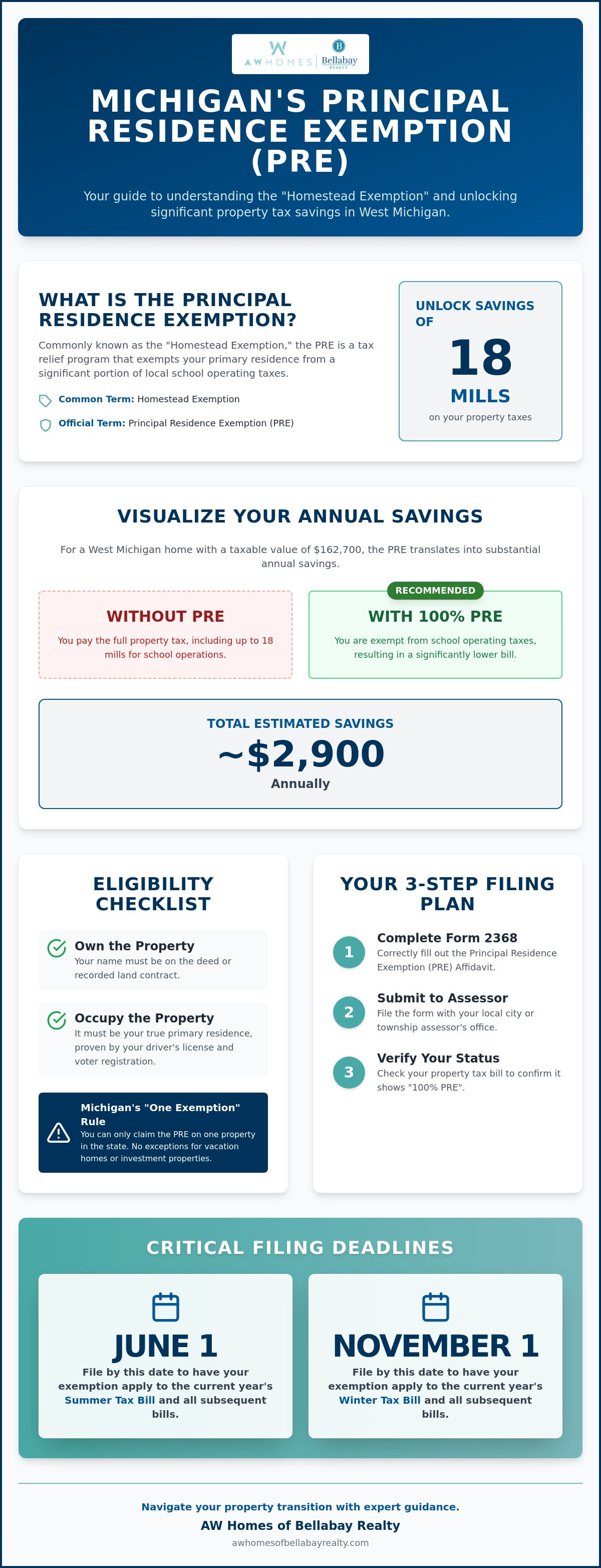
Strategic focus. Emotional security. Financial clarity. We understand that your home is more than a financial transaction; it's a personal milestone and a long-term investment. By mastering this process, you can unlock significant savings of up to 18 mills on your annual bill. This guide offers a clear, calming roadmap to ensure your 2026 filing is seamless. You'll learn how to manage the 2.7% inflation multiplier, meet the critical June 1 and November 1 deadlines, and officially confirm your primary residence status for total peace of mind.
Key Takeaways
- Clarify the terminology between "Homestead" and the official Principal Residence Exemption to unlock savings of up to 18 mills.
- Master the administrative process of filing for homestead exemption Grand Rapids by correctly submitting Form 2368 to your local assessor.
- Secure your financial legacy by meeting the strict June 1 and November 1 deadlines for summer and winter tax adjustments.
- Verify your property's 100% status to ensure your West Michigan investment is officially recognized and protected.
- Simplify your transition with expert guidance on post-closing logistics, local tax navigation, and strategic home readiness.
What is the Michigan Principal Residence Exemption (PRE)?
The Michigan Principal Residence Exemption (PRE) is frequently discussed under its traditional title, the "Homestead Exemption." While neighbors and local residents often use the older term, mastering the formal terminology is a vital part of your personal financial evolution. Understanding What is a Homestead Exemption? provides the necessary foundation for this specific local benefit. A PRE is a targeted tax relief mechanism that removes up to 18 mills of local school operating taxes from your property’s taxable value. For those currently filing for homestead exemption Grand Rapids, this distinction represents a major shift in annual affordability. It's a move toward strategic focus, professional authority, and localized reliability.
The criteria for eligibility are direct but require precision. You must own the property and occupy it as your primary residence. Michigan maintains a strict "One Exemption" rule to ensure this benefit is reserved for true primary dwellings. This means you can't claim the exemption on a vacation cottage in Northern Michigan or a commercial investment property while also claiming it on your Grand Rapids home. It's a singular commitment to the place you truly call home. This process is about securing your legacy through methodical planning and expert navigation.
Distinguishing Between Owning and Occupying
Legal ownership is usually straightforward, typically verified through a deed or a recorded land contract. Occupancy, however, requires more intentionality and proof of physical presence. When you are preparing your paperwork for filing for homestead exemption Grand Rapids, the local assessor confirms your status by reviewing your driver's license address and your voter registration records. These documents must match the property address to prove it's your primary social and legal anchor. If you live in a multi-unit property, such as a traditional Grand Rapids duplex or a home with a secondary suite, your exemption is calculated based on the percentage of the square footage you personally inhabit. Ownership. Occupancy. Opportunity.
Why This Matters for Your West Michigan Investment
Viewing tax optimization as a high-level consulting strategy transforms your home from a simple transaction into a long-term milestone. Lowering your annual millage rate directly impacts your monthly carrying costs, which enhances your overall wealth-building potential. This creates an atmosphere of trust and financial stability that protects your investment during different life stages, making it an ideal time to explore Retirement Income Planning. It's a methodical step toward real estate security. By reducing fixed costs, you gain the emotional security needed to enjoy your neighborhood without the stress of overpayment. Clarity. Protection. Savings.
Calculating Your Savings: The Financial Impact in Kent County
Precision matters when managing your West Michigan investment. While the concept of school operating taxes was introduced previously, the actual dollar impact on your bank account is where strategic focus pays off. For a property with a taxable value of $162,700, which reflects half of the 2026 median home value of $325,400, this exemption removes nearly $3,000 from your annual tax liability. It's a significant financial milestone that underscores why correctly filing for homestead exemption Grand Rapids is a vital component of the home closing process in Michigan. Financial clarity. Methodical planning. Expert navigation.
Your property tax statement will clearly display your status as either 0% or 100% PRE. A 100% status indicates you're fully exempt from the school operating portion of the levy. This status is reflected across both your summer and winter tax bills. Since the school operating tax is a primary component of the summer bill, the timing of your filing is essential for immediate cash flow relief. For more details on local regulations, you can consult the Kent County filing guide. Strategic planning. Localized reliability. Professional authority.
Kent County Millage Breakdown
Millage rates vary across the region, creating a diverse tax landscape. A millage rate is the amount of tax per $1,000 of a property's taxable value. In the City of Grand Rapids, the millage rate for homestead properties sits at approximately 43.00 mills. However, if you're looking at Ada or Forest Hills, rates might range from 33 to 47 mills depending on your specific school district. The PRE interacts with these local assessments by neutralizing the 18-mill school operating levy, ensuring your tax dollars stay in your pocket rather than the school district's general operating fund.
The Long-Term ROI of Timely Filing
The cumulative effect of this exemption is substantial. Over a five-year period, a typical Grand Rapids homeowner might save over $14,000 based on current millage averages. Over a decade, that figure doubles, providing a significant boost to your long-term real estate wealth. Move-up buyers often overlook this step in the rush of a Grand Rapids relocation, leading to costly oversights on their first winter tax bill. Checking your status immediately after moving is a vital habit. If you're feeling overwhelmed by the logistics of your transition, our team at AW Homes of Bellabay Realty can help you navigate these specialized client needs with ease. Expert navigation. Personalized insight. Proven results.
Step-by-Step Guide to Filing Your Affidavit in Greater Grand Rapids
Securing your West Michigan lifestyle requires more than just a signature at the closing table. It demands a methodical approach to post-closing logistics. The primary instrument for this transition is Form 2368, officially known as the Principal Residence Exemption (PRE) Affidavit. This document is the key to unlocking your tax benefits and officially anchoring your residency. When you begin the process of filing for homestead exemption Grand Rapids, you must have your property’s parcel number, your social security number, and the exact date you occupied the home ready for entry. Precision. Intentionality. Security.
Proving your occupancy is a vital step that moves beyond simple ownership. Local assessors look for concrete evidence that the property is your primary social and legal hub. You'll need a Michigan driver’s license or state ID card that matches the property address. Voter registration records and utility bills are also frequently used to substantiate your claim. Once your documentation is gathered, you can submit the affidavit via mail or in person at your specific municipal office. Some areas now offer digital submission portals, though requirements vary by township. Always request a date-stamped copy or a digital confirmation to ensure your status is updated in the system before the next tax cycle begins.
Filing in the City of Grand Rapids
For those living within the city limits, the City Assessor’s Office at City Hall serves as your primary resource. You can navigate this process with ease by utilizing the 311 customer service line to verify your current exemption percentage. Urban neighborhoods often have unique parcel configurations, so double-checking your legal description on the affidavit is a strategic move. Methodical planning. Localized authority. Seamless execution.
Filing in East Grand Rapids, Ada, and Caledonia
Each municipality in the Greater Grand Rapids area maintains its own administrative rhythm. If your new chapter begins in East Grand Rapids, you will file your paperwork with the Finance Department located on Lakeside Drive. In Ada Township, you'll coordinate directly with the Township Assessor’s Office to confirm your eligibility. Caledonia residents should pay close attention to township-specific submission windows, as these can differ slightly from city protocols. This regional focus ensures that your filing for homestead exemption Grand Rapids is handled with the specialized care your specific neighborhood requires. Professional introduces. Specialized expertise. Neighborhood authority.
Critical Deadlines and Avoiding Common Filing Errors
Timing is the silent architect of financial success in West Michigan real estate. While the process of filing for homestead exemption Grand Rapids is straightforward, the window for action is narrow. To secure your savings for the 2026 tax year, you must prioritize two pivotal dates. June 1st serves as the primary deadline for the summer tax levy. Missing the June 1st deadline usually means paying full millage on the summer bill. If you transition into your home later in the season, November 1st provides a second opportunity to receive relief on your winter tax statement. Precision. Timing. Security.
Managing your personal evolution also involves closing old chapters correctly. When you sell a previous Michigan residence, you are legally required to file Form 2602 to rescind your old exemption. Failing to do so can lead to costly penalties and interest down the road. However, if your previous home remains on the market while you occupy your new one, you may qualify for a Conditional Rescission. This allows you to maintain the exemption on the former property for up to three years, provided it is not leased or used for business. It's a methodical way to protect your equity during a high-stakes transition.
Common Pitfalls That Delay Your Exemption
Even the most organized homeowners can encounter administrative hurdles. A common oversight occurs when a property is transferred into a trust or after a legal name change; these events often require a fresh affidavit to maintain your status. Additionally, ensure your parcel ID is copied exactly from your deed, as a single digit error can stall the entire approval process. Finally, your Michigan driver’s license must reflect your new address. Local assessors view this as the ultimate proof of occupancy. Methodical planning. Expert navigation. Total readiness.
What to Do If You Miss the Deadline
If a deadline slips past, your path to recovery lies with the July or December Boards of Review. These local bodies have the professional authority to correct "qualified errors" regarding your Principal Residence Exemption status. While they can offer retroactive relief in specific hardship cases, the process requires a formal petition and documented evidence of occupancy. Avoiding these stresses altogether is the hallmark of a well-managed move. If you need a partner to oversee these critical details, our Residential Listing Services ensure your transition is handled with expert care. Professionalism. Reliability. Peace of mind.
Navigating Your Property Transition with AW Homes of Bellabay Realty
A successful move is defined by more than just the exchange of keys; it's about the seamless integration into your new community and the protection of your financial legacy. At AW Homes of Bellabay Realty, we view our service as a high-level consultancy that extends far beyond the closing table. Our concierge approach is designed to provide emotional security by managing the logistical nuances that often cause post-closing stress. This includes providing expert navigation for essential tasks like filing for homestead exemption Grand Rapids, ensuring you don't miss the critical savings milestones discussed in our roadmap. We prioritize your long-term well-being through methodical planning, localized reliability, and intentional support.
Angela Worth provides a steady, knowledgeable presence for clients navigating the complexities of West Michigan's tax landscape. Whether you're moving into the vibrant streets of East Grand Rapids, the scenic landscapes of Ada, or the top-tier school districts of Forest Hills, our team offers specialized insights tailored to your specific neighborhood. We understand that every property transition is a significant personal milestone. By handling the administrative details of your move, we allow you to focus on the evolution of your lifestyle. Professional authority. Empathetic reassurance. Strategic focus.
Strategic Guidance for Every Life Stage
Our expertise is specifically tailored to meet the situational needs of different life stages, ensuring that no detail is left to chance. For those embarking on a relocation to West Michigan, we provide a welcoming vision of the future alongside practical relocation assistance. We act as your regional specialist, bridging the gap between your previous residence and your new investment. For downsizers, we offer a composed and attentive partnership to manage multiple property transitions simultaneously. Your emotional security is our ultimate anchor during the buying agent partnership, ensuring that your filing for homestead exemption Grand Rapids is handled with precision. Expertise. Intentionality. Peace of mind.
Your Next Chapter Starts Here
Your home is the foundation of your financial legacy and your personal story. We invite you to experience a curated journey where your needs are prioritized through every phase of the transaction. Beyond our core services, we provide access to a trusted network of local professionals, from tax specialists to home readiness experts, ensuring your West Michigan investment is fully protected. This is not a high-pressure sales environment; it's a partnership dedicated to your long-term success and localized stability. Schedule your strategic real estate consultation with Angela Worth today. Trust. Warmth. Results.
Securing Your West Michigan Financial Legacy
Transitioning into a new home is a significant personal milestone that requires both expert navigation and methodical planning. By mastering the Principal Residence Exemption, you protect your investment from unnecessary costs and ensure your long-term well-being. Success in this area depends on meeting the strict June 1st and November 1st deadlines, verifying your 100% status, and maintaining precise documentation that aligns with your physical occupancy. Completing the process of filing for homestead exemption Grand Rapids is the final strategic step in anchoring your life in our local community. Precision. Clarity. Security.
Led by Angela Worth, a dedicated West Michigan transition expert, our team provides a concierge-style service designed for seamless property transitions. We are deeply rooted in the Grand Rapids, Ada, and Forest Hills communities, offering the professional authority and empathetic reassurance you deserve. Whether you're moving up or downsizing, we ensure every detail of your journey is handled with strategic focus and personalized care. Begin your strategic home search or sale with AW Homes of Bellabay Realty to experience a higher standard of real estate partnership. Your next chapter in West Michigan deserves a foundation of total confidence and expert support.
Frequently Asked Questions
Is the homestead exemption the same as the Principal Residence Exemption (PRE)?
Yes, the Michigan Principal Residence Exemption is the formal name for what many residents still call the homestead exemption. While the technical terminology has evolved to be more precise, the core benefit remains the same for your West Michigan investment. It's a strategic tool used to reduce your property tax burden by exempting your primary home from local school operating taxes. Professional authority. Clear terminology. Financial protection.
When is the deadline to file for the PRE in Grand Rapids for the 2026 tax year?
You must meet two critical deadlines to secure your savings for the 2026 tax year. June 1st is the primary cutoff for the summer tax adjustment, while November 1st serves as the deadline for the winter tax bill. Filing for homestead exemption Grand Rapids before these dates ensures your property status is updated in time for the respective tax levies. Methodical planning. Strict deadlines. Financial clarity.
Can I claim the homestead exemption on my cottage or vacation home in Michigan?
No, you can only claim the Principal Residence Exemption on one property that you own and occupy as your primary residence. Secondary properties, such as vacation cottages or rental investments, aren't eligible for this specific tax relief. Michigan law is very strict regarding the "One Exemption" rule to ensure the benefit is reserved for your main social and legal anchor. Localized reliability. Expert navigation. Secure investment.
Do I need to file for the homestead exemption every year?
No, the PRE is a one-time filing that remains in effect as long as you own and occupy the home. You don't need to re-apply annually once your status is officially confirmed by the local assessor. However, if you move to a new property or change your legal ownership structure, you'll need to submit a new affidavit to maintain your benefits. Steady status. Simple process. Long-term security.
What happens to my homestead exemption if I move my home into a revocable trust?
Moving your home into a revocable trust often requires you to re-file your affidavit to ensure the exemption remains active. Because the legal owner has changed from an individual to a trust entity, the local assessor needs updated documentation to verify the primary residence status. This is a common administrative milestone that requires expert navigation to avoid an accidental increase in your taxable value. Methodical care. Professional oversight. Personal evolution.
How much money will I actually save by filing for the Principal Residence Exemption?
Does my title company file the PRE affidavit for me at closing?
While many title companies include the PRE affidavit in your closing packet, the ultimate responsibility for submission lies with the homeowner. You should verify whether the title company will mail the form on your behalf or if you need to deliver it to the City Assessor’s Office yourself. Confirming receipt is a vital step in your transition to ensure your investment is protected from the start. Attentive partnership. Seamless process. Total readiness.
What is a Conditional Rescission and how does it help if I haven’t sold my old house yet?
A Conditional Rescission allows you to keep the PRE on your previous home for up to three years while it's actively listed for sale. This is a strategic move for those managing multiple property transitions, as it prevents a tax spike on the unoccupied property. To qualify, the home must remain vacant and can't be leased or used for any commercial purpose during this period. Strategic focus. Financial relief. Methodical transition.


