

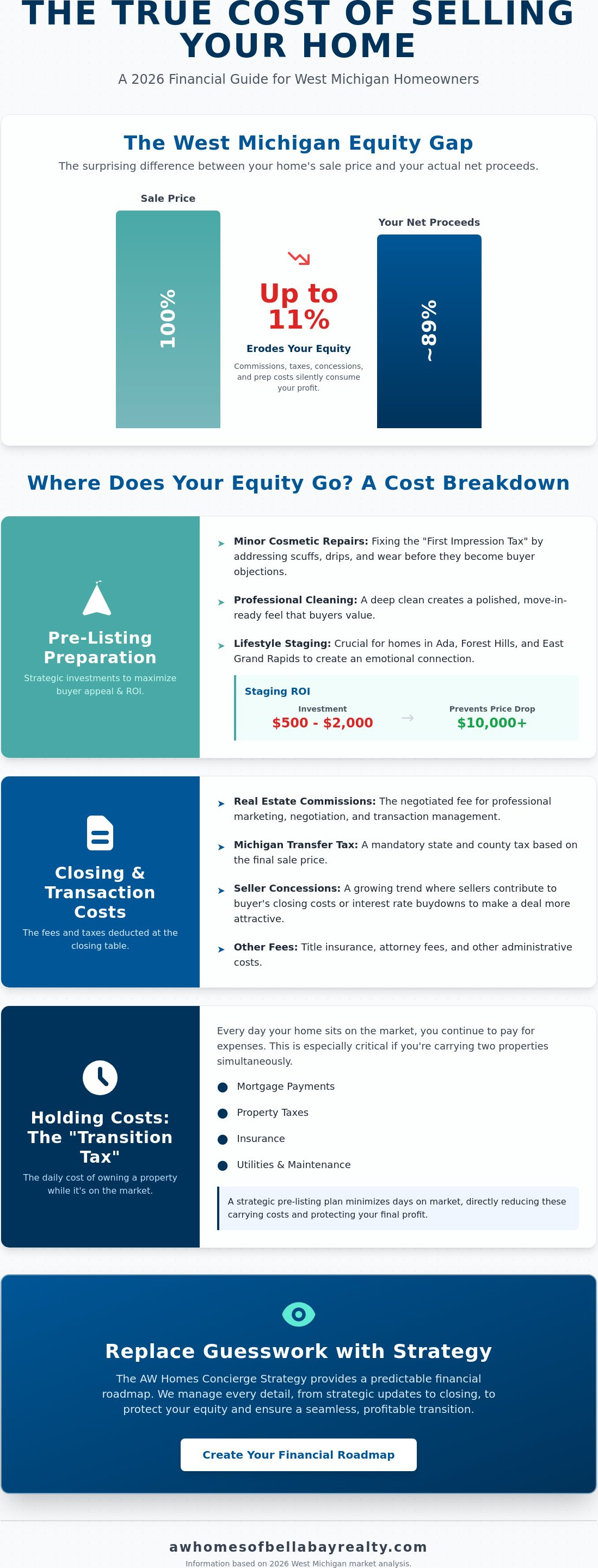
The true cost of selling your property isn't found in the listing price, but in the quiet erosion of equity that happens between the first showing and the final signature. While many Grand Rapids homeowners anticipate standard commissions, the hidden costs of selling a home in West Michigan can consume up to 11% of your final sale price. You deserve a transition defined by clarity, precision, and financial security. We believe a home sale is a significant personal milestone that requires expert navigation, intentional planning, and a deep understanding of local market shifts.
It's natural to feel a sense of unease about being blindsided at closing or overspending on renovations that don't offer a return. We've designed this 2026 guide to replace that anxiety with a predictable financial roadmap. You'll learn how to manage the current state transfer tax rates, navigate the complexities of seller concessions, and account for the carrying costs of holding two properties simultaneously. By the end of this article, you'll have the strategic insight needed to maximize your proceeds and move forward with total confidence.
Key Takeaways
- Learn why the gap between sale price and net proceeds often surprises sellers and how to calculate your true financial outcome with precision.
- Identify which strategic pre-sale updates offer the highest return on investment to ensure every dollar spent enhances your final equity.
- Uncover the specific Michigan state and county transfer taxes and other hidden costs of selling a home in West Michigan that impact your bottom line at the closing table.
- Quantify the daily transition tax of carrying two properties to create a predictable, stress-free financial roadmap for your next move.
- Explore how a methodical concierge strategy protects your equity, minimizes market fatigue, and ensures a seamless transition to your next chapter.
Beyond the Commission: Defining the West Michigan Equity Gap
Most sellers focus on the top-line sale price. It's the number that gets celebrated on social media and discussed at dinner tables. However, the true measure of a successful property transition is your net proceeds. This represents the actual liquid capital remaining after every fee, tax, and adjustment is settled. In the 2026 market, homeowners in Kent and Ottawa counties frequently find themselves underestimating these expenses by 3% to 5%. This discrepancy creates a significant financial hurdle at the exact moment you need liquidity most.
A foundational step in protecting your investment is understanding closing costs as a comprehensive set of obligations rather than a single, static line item. When these numbers aren't forecasted with precision, sellers often experience "closing table shock." This psychological stress can derail the excitement of a new chapter, leaving you feeling blindsided by the final tally. Our approach prioritizes your emotional and financial security by treating your sale as a high-level consultancy. We replace guesswork with strategic focus, ensuring your financial roadmap is clear, predictable, and supportive.
The Standard vs. Hidden Cost Spectrum
The expenses associated with a sale exist on a spectrum. On one end are the expected costs, such as real estate commissions, which are negotiated upfront. On the other end are the variable hidden costs of selling a home in West Michigan, including pre-sale repairs, professional staging, and buyer concessions. In 2026, Grand Rapids buyers are increasingly requesting concessions for interest rate buydowns, which can significantly impact your bottom line if not anticipated. The Equity Gap is the difference between your property's perceived market value and the actual liquid capital you receive at the end of the transaction.
Why Local Expertise Matters for Budgeting
Accurate cost forecasting requires more than a general calculator; it demands the insight of a neighborhood authority. Whether you are selling a luxury estate in Ada or a family home in Cascade, local market nuances dictate buyer expectations and repair standards. Your life stage also influences this analysis. A family moving up to a larger home has different liquidity needs than a couple downsizing for retirement. We utilize a methodical, unhurried process to identify these variables early. This intentional planning ensures that your transition is not just a transaction, but a well-managed milestone that funds your next personal evolution.
Pre-Listing Preparation: Strategic Investment vs. Sunk Cost
Listing your property before it is truly market-ready is a high-stakes gamble that often results in the "First Impression" tax. In the 2026 West Michigan market, buyers are discerning, tech-savvy, and emotionally driven. If a home lacks the polished aesthetic they expect, they don't just see a project; they see a reason to offer less. These initial days on the market are your most valuable. Wasting them on a subpar presentation is a hidden cost that can't be recovered through later price drops or refreshed marketing photos.
Strategic preparation involves a methodical three-pillar approach: professional cleaning, minor cosmetic repairs, and intentional staging. These aren't just expenses; they are investments designed to protect your equity. While you're budgeting for these physical updates, it's also the right time to account for mandatory legal expenses like Michigan's real estate transfer tax. Our concierge strategy manages this entire evolution, ensuring every repair offers a clear return on investment and every detail is accounted for before the first showing.
Staging for the West Michigan Lifestyle
Generic staging often feels cold and uninspired. For luxury listings in East Grand Rapids or Forest Hills, we utilize "lifestyle staging" to evoke a deep emotional connection. This approach highlights how a space functions for modern living, whether it's a sophisticated executive home office or a seamless indoor-outdoor transition. Research from early 2026 suggests professional staging can cost between $500 and $2,000, yet it frequently prevents a $10,000 price reduction later. You can find more room-by-room tactics in our guide on home staging tips for sellers.
Pre-Inspection and the Cost of "Surprise" Repairs
Nothing erodes a seller's leverage faster than a surprise inspection report. In West Michigan, common "deal killers" include radon mitigation needs, aging HVAC systems, or roof wear. A $500 pre-inspection allows you to address these issues on your own terms. It prevents a buyer from demanding $5,000 in credits at the eleventh hour when your moving truck is already scheduled. This proactive step ensures a smoother closing and reinforces the sense of trust between both parties. If you're ready to move forward with a predictable plan, you might consider exploring our concierge listing services to manage these logistics seamlessly.
Navigating Closing Costs and Michigan-Specific Taxes
The transition from a signed purchase agreement to a successful closing requires technical precision, local authority, and strategic foresight. While the sale price remains the headline figure, the line-by-line deductions on your settlement statement determine the actual resources available for your next chapter. These deductions often represent the most significant hidden costs of selling a home in West Michigan. Understanding these financial obligations early ensures your move is grounded in reality rather than estimates.
A Michigan Seller’s Settlement Statement serves as the final accounting of your transaction. It details every credit and debit, from mortgage payoffs to administrative fees. Navigating this document requires a steady hand and a clear understanding of regional customs. We prioritize your emotional security by providing a transparent preview of these costs long before you reach the closing table. This methodical approach eliminates surprises and allows you to focus on the personal evolution your move represents.
The Michigan Transfer Tax Breakdown
In Michigan, the privilege of transferring property ownership comes with a specific tax obligation that sellers customarily cover. This expense is governed by Michigan's Real Estate Transfer Tax Act. As of June 2026, the combined rate is $8.60 per $1,000 of the sale price. This is composed of a $7.50 state tax and a $1.10 county tax. For a $400,000 home in Kent County, this translates to a $3,440 expense. Some sellers may qualify for exemptions, particularly if the property is a primary residence sold for less than its state equalized value. Transfer taxes are typically the seller’s largest closing expense after commissions.
Title Insurance and Administrative Fees
Title insurance is a critical pillar of a secure transaction. In West Michigan, it is customary for the seller to pay for the "Owner’s Policy," which protects the buyer’s interest in the property. This ensures the title is clear of liens, encumbrances, or ownership disputes. On a $500,000 home, these policies and related settlement fees can range from $2,250 to $3,750. These costs anchor your identity as a responsible seller and provide the buyer with the confidence needed to proceed. For a more detailed legal walkthrough, you can consult our Michigan home closing process guide.
Property Tax Prorations
Michigan’s property tax system is famously complex. Taxes may be paid in advance or in arrears depending on the specific municipality within Grand Rapids or Ottawa County. Because summer and winter tax bills cover different fiscal periods, the proration calculation depends entirely on your specific closing date. You might receive a credit back for taxes already paid, or you may owe a debit for the days you occupied the home during the current billing cycle. This careful balancing act ensures that neither party pays more than their fair share of the neighborhood’s collective investment.
Holding Costs and the "Transition Tax"
The financial commitment to your property doesn't end when the "For Sale" sign is hammered into the lawn. It continues every single day until the deed is officially recorded and the keys are handed over. These ongoing expenses, often called holding costs, represent a significant portion of the hidden costs of selling a home in West Michigan. Mortgage payments, property insurance, and essential utilities continue to accrue, effectively acting as a "transition tax" on your equity. In the Grand Rapids metro area, where the median sale price remains strong in 2026, even a 30-day listing period can represent thousands of dollars in unrecovered carrying costs.
Strategic sellers must also account for potential capital gains tax. While the IRS typically allows an exclusion of up to $250,000 for individuals and $500,000 for married couples, long-term homeowners in high-appreciating pockets like Forest Hills may find themselves nearing these limits. We provide the methodical oversight needed to forecast these impacts accurately. This level of planning moves your transaction away from chance and toward expert navigation, ensuring your financial roadmap remains intact throughout the entire process.
The Financial Overlap of Buying and Selling
Managing the gap between your sale and your next purchase is one of the most stressful aspects of a life transition. You may face the dilemma of choosing between a bridge loan, a contingent offer, or a "Post-Closing Occupancy Agreement." This "rent-back" strategy is common in West Michigan, allowing you to remain in your home for a set period after closing to avoid a double move. However, this convenience comes with its own daily fee and security deposit. For a deeper look at managing these logistics, read our guide on selling and buying a house at the same time.
HOA and Utility Finalizations
If your property is located in a managed community in Ada or Caledonia, you'll likely encounter HOA transfer fees and status letter costs. These administrative requirements ensure the new owner starts with a clean slate, but the fees are almost always a seller obligation. Additionally, maintaining complex systems for executive estates requires intentionality. Irrigation schedules, smart home subscriptions, and security monitoring must remain active through the final walk-through and inspection. If you want to ensure no detail is left to chance during your move, contact us for a strategic listing consultation today.
The AW Homes Concierge Strategy: Protecting Your Net Equity
Successfully navigating a property sale requires a shift in perspective. Rather than viewing a real estate agent as a simple listing service, you should consider the role as that of a strategic advisor. This partnership is built on the pillars of professionalism, personalization, and planning. When a home is brought to market without a methodical plan, it often falls victim to market fatigue. This is a subtle but devastating expense. Homes that linger on the market in Grand Rapids often face aggressive low-ball offers and increased holding costs, which are among the most significant hidden costs of selling a home in West Michigan. Our concierge strategy is designed to create immediate momentum, ensuring your home is positioned as a premier opportunity from day one.
The ROI of this approach is measured in the equity we protect through intentionality. By managing every detail of the preparation process, we eliminate the friction that leads to price reductions. We believe that your home sale is not just a financial transaction; it's a significant personal milestone. This perspective drives us to provide a high-end, accessible experience that prioritizes your long-term well-being. We replace the chance of the open market with expert navigation and methodical execution.
Negotiation as a Cost-Saving Measure
Expert negotiation is your most effective tool for mitigating equity loss. This is particularly true during the inspection period, where unmanaged requests can quickly consume thousands of dollars in credits. We approach these hurdles with a steady, knowledgeable presence, differentiating between essential structural repairs and cosmetic preferences. In competitive areas like Forest Hills, managing buyer appraisal gaps is equally critical. By providing appraisers with a detailed portfolio of your home’s strategic updates and local comparables, we anchor the value of your property and protect your net proceeds from being eroded by conservative valuations.
Your Next Chapter Starts with a Strategic Plan
As you prepare for your 2026 move, your financial roadmap should be clear, predictable, and supportive. Moving beyond the transaction allows you to focus on the personal evolution your new home represents. We provide the emotional security and seamless processes necessary for a stress-free transition. To ensure no detail is left to chance, consider this final budgeting checklist for your West Michigan sale:
- Michigan State and County Transfer Taxes ($8.60 per $1,000)
- Owner’s Title Insurance Policy and escrow fees
- Professional staging and lifestyle photography
- Daily holding costs (mortgage, utilities, and HOA)
- Pre-inspection repairs and buyer concessions
- Prorated property taxes and final utility readings
Protecting your hard-earned equity starts with a conversation about your specific goals and life stage. For a personalized analysis of your property's value and a clear forecast of your net proceeds, Consult with Angela Worth for a custom Net Sheet and Strategy Session. Your next chapter deserves a foundation of financial clarity and expert guidance.
Securing Your Legacy Through Strategic Planning
A successful home sale is defined by the liquid capital you carry into your next chapter. By anticipating transfer taxes, staging investments, and holding costs, you transform a complex transaction into a well-managed milestone. Understanding the hidden costs of selling a home in West Michigan is not just about budgeting; it's about reclaiming control over your personal evolution. You deserve a process that prioritizes emotional security and financial precision at every turn.
Led by local expert Angela Worth, our team specializes in concierge-style service tailored to life's major transitions. Whether you are moving from a high-end estate in Ada or a family home in Forest Hills, our methodical approach ensures no detail is left to chance. We invite you to Request Your Personalized West Michigan Seller Net Sheet to gain total clarity on your financial roadmap. Your next chapter is waiting, and we are here to ensure you begin it with confidence and peace of mind.
Frequently Asked Questions
What is the average total cost to sell a home in West Michigan?
Sellers should generally budget approximately 11% of the final sale price to cover the total cost of the transaction. This figure encompasses real estate commissions, closing fees, and the hidden costs of selling a home in West Michigan, such as seller concessions and holding expenses. For a property sold at $300,000, these combined costs typically amount to roughly $33,000.
Who pays for title insurance in Kent County, the buyer or the seller?
In Kent County and throughout Michigan, the seller customarily pays for the owner's title insurance policy. This is a standard practice that ensures the buyer receives a clear title free of liens or encumbrances. While the buyer is responsible for their lender's policy, the owner's policy is a foundational seller expense that provides essential emotional and financial security for both parties.
How much is the Michigan real estate transfer tax in 2026?
The current combined real estate transfer tax rate is $8.60 per $1,000 of the sale price. This total is composed of a $7.50 state tax and a $1.10 county tax, both of which are traditionally paid by the seller at closing. For a $400,000 home, this tax represents a $3,440 deduction from your net proceeds. It is important to monitor pending 2026 legislation that may impact the state portion of this requirement.
Do I have to pay capital gains tax on my Grand Rapids home sale?
Most sellers in Grand Rapids are exempt from capital gains tax on the first $250,000 of profit for individuals or $500,000 for married couples. To qualify for this exclusion, the property must have served as your primary residence for at least two of the last five years. If your home in a high-growth area like Forest Hills has appreciated beyond these limits, we recommend a methodical review with a tax advisor.
What are common seller concessions in the current West Michigan market?
Common concessions currently include interest rate buydowns and credits toward a buyer’s closing costs. Approximately 25% to 35% of recent West Michigan transactions include these financial incentives to attract qualified buyers. Budgeting 1% to 2% of your sale price for concessions can be a strategic move to secure a firm offer and ensure a predictable transition.
How much should I budget for pre-listing home repairs in Ada or Forest Hills?
Sellers in premier communities like Ada or Forest Hills should typically budget between $1,500 and $5,000 for strategic pre-listing preparation. This range covers professional staging, which often costs between $500 and $2,000, as well as deep cleaning and minor cosmetic updates. A $500 pre-inspection is also a wise investment to identify "deal killer" repairs before your home goes live on the market.
Can I avoid some of these hidden costs by selling FSBO (For Sale By Owner)?
Selling your home without an agent may reduce listing commissions, but it does not eliminate the majority of closing expenses. FSBO sellers remain responsible for transfer taxes, title insurance, and often the buyer’s agent commission. Furthermore, the risk of "market fatigue" and poor negotiation often results in a lower net profit than a sale managed with professional authority and intentional marketing.
What happens to my escrow account balance after I sell my home?
Your mortgage lender will typically refund the remaining balance in your escrow account within 30 days of the loan being paid off. These funds, which were held for future property taxes and insurance, are not usually credited directly at the closing table. Instead, the lender will either issue a refund check or apply the balance to reduce your final mortgage payoff amount.


